
- What changed: ATS is now contextual AI that reads meaning, writing quality, impact, and consistency, so keyword stuffing is no longer a strategy.
- What matters next: Your resume is only page one, your “digital twin” (LinkedIn, portfolio, GitHub, search results) is being checked as proof and for red flags.
- How to win scans: Write bullets that show actions and measurable outcomes, because AI scores substance, not generic claims.
- Best format trend: Skills-based or hybrid resumes are rising, helping career changers and non-linear paths by leading with capabilities backed by evidence.
- Action plan: Audit your online footprint, align every platform, keep learning visible, and use AI as an editor to refine, not a ghostwriter.
Remember 2015? Your polished PDF resume, meticulously crafted with action verbs, felt like the golden ticket. By 2020, you learned to appease the keyword-hungry Applicant Tracking Systems (ATS). Now? That same resume is being ingested, parsed, and critically analyzed by Artificial Intelligence sophisticated enough to understand context, judge the quality of your writing, cross-reference your digital footprint across the web, and rank you against thousands before a human recruiter even glances at your name. Welcome to the rapidly accelerating future of resumes – a landscape where the document itself isn’t dead, but its role as a standalone artifact is fundamentally, irrevocably changed.
Here’s the stark reality check: the traditional resume, isolated from your broader professional narrative, is becoming insufficient. It’s necessary, yes, but no longer the sole arbiter of your qualifications. Your LinkedIn profile, your GitHub contributions, your online portfolio showcasing tangible results, the articles you publish on Medium, even your thoughtful engagement in relevant online communities – these are no longer optional extras. They are integral components of your comprehensive “career portfolio,” scrutinized by increasingly intelligent AI. The pertinent question isn’t whether resumes have a future, but whether your current approach to presenting yourself does.
This isn’t another hyperbolic piece predicting robot overlords stealing jobs. It’s a strategic briefing. It’s about dissecting the technological shifts happening right now, understanding the new benchmarks employers and their AI assistants expect, and equipping you with actionable strategies to position yourself not just to survive, but to thrive in this AI-driven hiring ecosystem. Let’s dive into the key trends reshaping how talent is discovered and evaluated.
Trend 1: The Rise of Contextual AI Screening (ATS 3.0 and Beyond)
The era of simply stuffing your resume with keywords from the job description to “beat the ATS” is definitively over. While keywords still matter for initial filtering, the game has evolved significantly. Modern AI recruitment platforms (think ATS 3.0, powered by Natural Language Processing and Machine Learning) don’t just perform crude keyword matching. They understand. They analyze context, infer skills, assess the quality of your accomplishments, and even detect subtle inconsistencies or attempts at exaggeration.
Consider the leap: Old ATS (circa 2020) might search for the exact phrase “project management.” If your resume said “managed complex projects from initiation to completion,” you might have been missed. Today’s AI? It recognizes semantic equivalence. It understands that “managed projects,” “led project teams,” “oversaw project lifecycles,” and “delivered key projects” all relate to the core competency of project management. It reads between the lines.
Beyond Keywords: What Advanced AI Recruiters Can Decipher
The capabilities of current AI screening tools extend far beyond basic pattern matching:
- ✅ Semantic Understanding & Skill Inference: AI comprehends synonyms, related concepts, and industry jargon. It can infer skills you possess based on the context of your described achievements, even if you don’t use the exact keyword.
- ✅ Quantification & Impact Assessment: AI is specifically trained to look for measurable results. Generic statements score significantly lower than specific, quantified achievements (“Grew organic social media engagement by 150%…”). AI prioritizes evidence of impact.
- ✅ Career Trajectory Analysis: Sophisticated systems can analyze your career progression for growth and stability.
- ✅ Writing Quality & Professionalism: AI evaluates clarity, conciseness, and professionalism. Errors or awkward phrasing can negatively impact your score.
- ✅ Inconsistency Detection: AI excels at spotting contradictions (e.g., claiming 10 years experience with a 5-year-old tech).
Implications for Your Resume Strategy: Authenticity Wins
The key takeaway is that transparency and substance now outperform clever tricks. You cannot simply “game” these smarter systems. Your focus must shift from optimizing for simplistic algorithms to clearly and compellingly articulating your actual value.
Outdated Approach (Generic, Keyword-Focused):
“Results-driven Marketing Professional with extensive experience in project management, digital marketing, SEO, SEM, content creation, and leading cross-functional teams. Responsible for managing multiple campaigns and delivering impactful results in dynamic environments.”
Modern Approach (Specific, Context-Rich, Impact-Oriented):
“Led the GTM strategy for three simultaneous SaaS product launches, coordinating efforts across Engineering, Sales, and Marketing teams. Shipped features to an initial user base of 50,000, exceeding adoption targets by 20%. My data-driven content approach directly contributed to a 25% reduction in time-to-market compared to previous launches.”
The second version resonates with advanced AI because it provides specific actions, measurable outcomes, and contextual details that the system can analyze for relevance and impact. It demonstrates skills rather than just listing them. Focus on crafting achievement-oriented bullet points using the STAR method (Situation, Task, Action, Result).
Trend 2: Your “Digital Twin” Is Your Living Resume
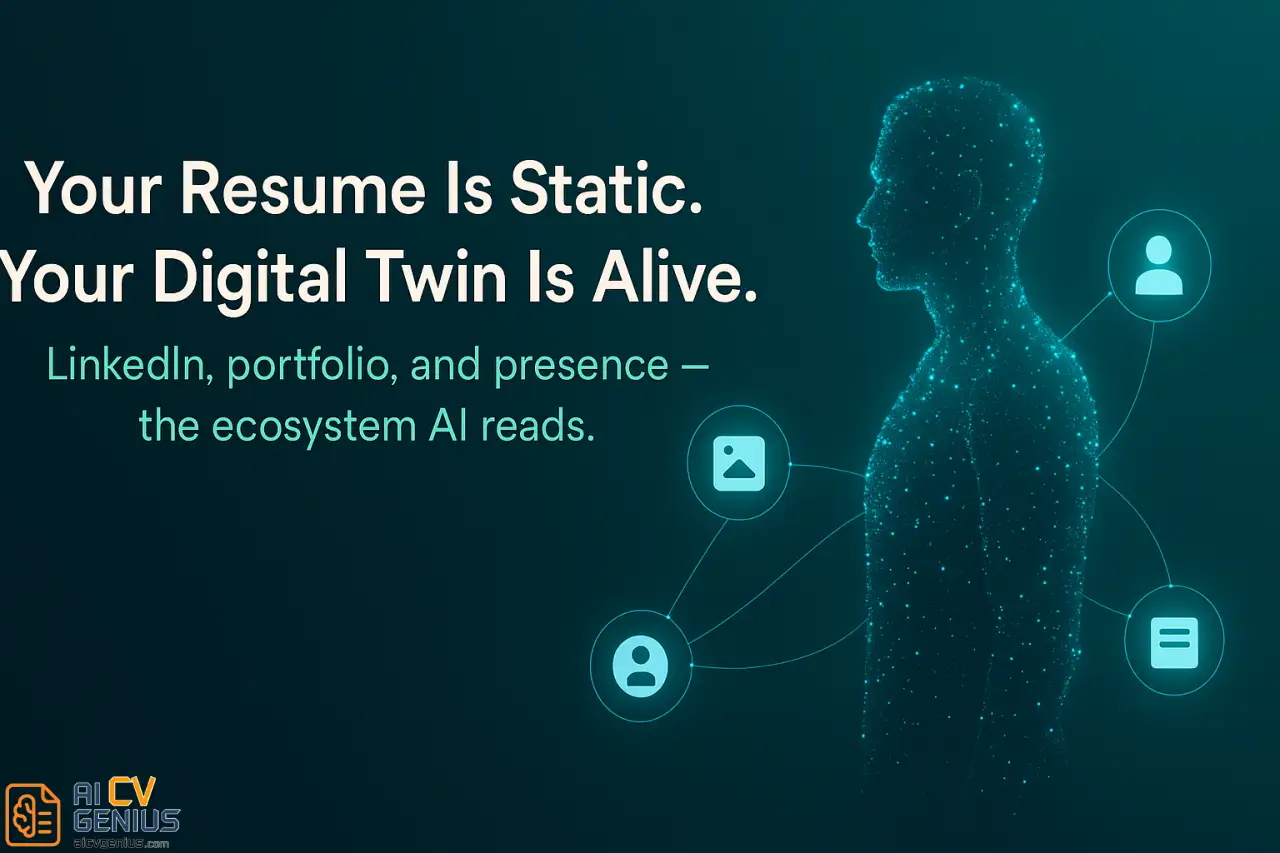
Your submitted resume is merely the static snapshot; your online professional presence is the dynamic, constantly evolving “digital twin” that recruiters and AI are scrutinizing. In 2026, assuming your application stops at the PDF upload is a critical mistake.
Consider the statistics: Upwards of 90% of recruiters incorporate online searches into their vetting process. They aren’t just verifying your resume; they are actively seeking corroborating evidence, assessing your industry engagement, and scanning for potential red flags. What appears on the first page of Google search results for your name is, effectively, page two of your resume.
Deconstructing Your Digital Twin: Key Components
Your digital twin isn’t monolithic; it’s an aggregation of various online touchpoints. Understanding their relative importance is key:
| Platform/Asset | What Recruiters & AI Look For | Strategic Importance |
|---|---|---|
| LinkedIn Profile | Completeness, keyword optimization, detailed experience with results, recommendations, skill endorsements, recent activity. | Critical: Often the first check. Needs to align with and expand upon your resume. |
| Professional Portfolio / GitHub | Tangible work samples, code quality, project complexity, contribution frequency (GitHub), clear case studies (Portfolio). | High: Essential for creative, technical, project-based roles. Provides concrete proof. |
| Personal Website / Blog | Professional branding, detailed project showcases, thought leadership articles, clear expertise. | Medium-High: Excellent for establishing authority. |
| Other Social Media (Twitter/X, etc.) | Professionalism, tone, industry engagement vs. controversial content. Checked more often for red flags. | Low-Medium: Primarily for reputation management. Ensure public profiles are clean or private. |
The crucial insight here is the interconnectedness. A hiring manager might find your resume intriguing, check your LinkedIn, click through to your portfolio, and Google your name. A consistent narrative across all platforms is essential.
Strategic Curation: Building a Compelling Digital Twin
Managing your digital twin isn’t about becoming a full-time content creator; it’s about strategic curation and consistency.
- 1️⃣ Conduct a Digital Audit: Google yourself in incognito mode. What are the top results? Identify areas needing cleanup or optimization.
- 2️⃣ Optimize Your LinkedIn Hub: Complete every section. Craft a keyword-rich headline/summary. Request recommendations. Add detailed project descriptions. Engage weekly.
- 3️⃣ Choose Your Showcase Platform(s): Pick 1-2 additional platforms vital to your field (e.g., GitHub for developers, Behance for designers). Focus on quality.
- 4️⃣ Ensure Consistency: Job titles, dates, achievements, and skills should align across your resume, LinkedIn, and portfolio.
- 5️⃣ Link Strategically: Your resume should link to LinkedIn/portfolio. LinkedIn should link back. Create clear pathways.
Trend 3: The Ascendance of Skills-Based Hiring & Resumes
The rigid, purely chronological resume format, while still common, is rapidly losing its dominance. Why? Because employers care less about the linear progression of your job titles and more about the portfolio of skills you possess and can demonstrably apply right now.
This shift profoundly benefits career changers, individuals with non-traditional backgrounds, and those with employment gaps. A skills-based or hybrid resume allows you to foreground your capabilities, backed by evidence.
The “Why” Behind the Skills-First Revolution
Factors driving this include accelerated skill obsolescence, the rise of project-based work, a focus on transferable abilities, and AI’s improved skill identification capabilities. The World Economic Forum predicts 44% of core skills will change in five years. Adaptability and relevant skills are key.
Structuring for Skills: Chronological vs. Hybrid/Functional
Contrast the approaches:
Traditional Chronological Snippet:
Marketing Coordinator, ABC Company (2021-2023)
• Managed company social media accounts.
• Created content calendars.
• Coordinated with design team.
Skills-Based / Hybrid Snippet:
KEY SKILLS & ACCOMPLISHMENTS
Content Strategy & SEO Execution
• Executed SEO-driven content calendar at ABC Company (2021-2023), increasing organic traffic 140%.
• Authored guides for freelance client (Tech Solutions Inc., 2022) generating 50+ MQLs in 3 months.Social Media Marketing & Community Engagement
• Grew LinkedIn followers for ABC Company by 200% via engaging content (2021-2023).
• Managed paid social campaigns ($5K/month budget), achieving 15% lower CPA than benchmarks.
The skills-based approach highlights core competencies with quantified evidence from multiple experiences. A hybrid format (skills summary + concise chronology) is often most effective.
Understanding these shifts is the first step. Actively adapting is next. This is about continuous strategy.
1. Elevate Your “Human Skills”
As AI handles routine tasks, uniquely human capabilities (strategic thinking, creativity, empathy, leadership) become premium differentiators. Explicitly showcase these skills on your resume with concrete examples, not just claims. Frame “soft” skills with results.
2. Leverage AI Strategically: Your Resume’s “Personal Trainer”
Use AI writing assistants (ChatGPT, Grammarly AI) as expert editors, not ghostwriters. Prompt them to refine bullet points, suggest stronger verbs, check keyword alignment, or critique sections. Iterate on suggestions, adding your specific knowledge. Never copy-paste AI output directly without significant editing.
3. Curate Your Digital Ecosystem Deliberately
Actively manage your online presence as an extension of your resume. Keep LinkedIn complete and active. Maintain a high-quality portfolio/GitHub relevant to your field. Ensure consistency across platforms and manage your online reputation by regularly Googling yourself.
4. Embrace Continuous Learning (and Showcase It)
Demonstrate a commitment to ongoing learning. Target 1-2 critical skills for your next career move via reputable online courses or certifications. Apply the skill immediately in a project. Add completed certifications/projects to LinkedIn and your resume promptly.
Final Thoughts: Adaptability is the Ultimate Skill
The future of resumes isn’t about the death of a document; it’s about the expansion of your professional narrative. Your resume is now part of a larger ecosystem including your online presence, all scrutinized by increasingly sophisticated AI.
Success hinges on adaptability. Focus on demonstrable skills, especially uniquely human ones. Leverage AI as an assistant, not a replacement for authenticity. Curate your digital footprint deliberately. Embrace continuous learning and showcase it.
A lazy application – generic resume, inconsistent online presence – will likely be filtered out. A strategic, authentic, multi-platform approach that highlights quantifiable impact? That’s what gets noticed by both AI and humans.
Start small, but start now. Update LinkedIn. Refine one bullet point. Add one portfolio piece. Consistent adaptation is key to building a compelling career narrative for tomorrow.
Ready to build an application package that meets the demands of the AI era? Explore our comprehensive career resources for cutting-edge templates, examples, and strategies designed for the modern job search.