
- Achievements on resume means impact, not duties: Duties describe what you were asked to do, achievements show what changed because you did it, and that difference is what gets interviews.
- Use one repeatable bullet formula: Action verb + Specific task or context + Measurable result, with before/after examples that turn lines like “Responsible for” into outcomes like higher revenue, fewer complaints, faster load times, or shorter onboarding.
- Make numbers your default proof system: Pull metrics from money, time, volume, and people outcomes (Satisfaction, retention, customers served), and use prompt questions to “find the numbers” even when your role is not obviously measurable.
- Integrate achievements across the whole resume, then tailor: Put 3 to 5 achievement bullets per role, apply the same impact logic to projects, education, and volunteering, reorder bullets to match the job description, and use keywords naturally to help both recruiters and ATS.
- Finish with polish and credibility guards: Keep bullets short and scannable, prove soft skills through outcomes, avoid common mistakes like vague phrases and no context, include awards as third-party validation, and follow ATS-safe formatting rules so your achievements stay readable.
Your job title is a label. It tells a recruiter what you were hired to do. Your achievements on resume, however, tell a much more interesting story: they show what you actually accomplished. This distinction is the secret to a resume that gets interviews. Recruiters do not hire duties; they hire impact.
Think of achievements as the evidence that proves your value. They are the tangible, often quantifiable, results of your work that show you did not just occupy a role – you owned it. You made something better, faster, cheaper, or more efficient. Whether you are in sales, software development, healthcare, or education, employers are desperately searching for evidence that your presence on their team will lead to measurable, positive results.
This guide will deconstruct the art of framing your accomplishments. We will move beyond passive lists of duties and transform your experience into a compelling narrative of impact, proving you are not just a candidate, but a solution.
The Core Concept: From Passive Duties to Active Achievements
The single most common resume mistake is listing job descriptions instead of results. A job description is passive; it is what the company asked of you. An achievement is active; it is what you delivered. Before you write a single bullet point, you must internalize this difference.
Step 1 – Understand the Difference: Duties vs. Achievements
A duty is “what you did.” An achievement is “what happened because of what you did.” Let’s look at the direct comparison. One side is passive and expected; the other is active and impressive.
| Responsibilities (Weak, Passive) | Achievements (Strong, Active) |
|---|---|
| Responsible for managing sales team. | Led a 6-member sales team to exceed quarterly goals by 18% through new performance coaching. |
| Handled customer complaints. | Reduced customer complaints by 25% in six months by redesigning the customer feedback process. |
| Worked on marketing campaigns. | Launched a targeted social media campaign that gained 10K followers and generated $50K in attributable revenue. |
| Wrote code for the new feature. | Developed a new caching module that decreased average page load time by 35%. |
Step 2 – Use the “Action + Impact” Formula
Every strong achievement bullet point should be a miniature story. The most effective storytelling structure for a resume is the “Action + Impact” formula, often enhanced with context.
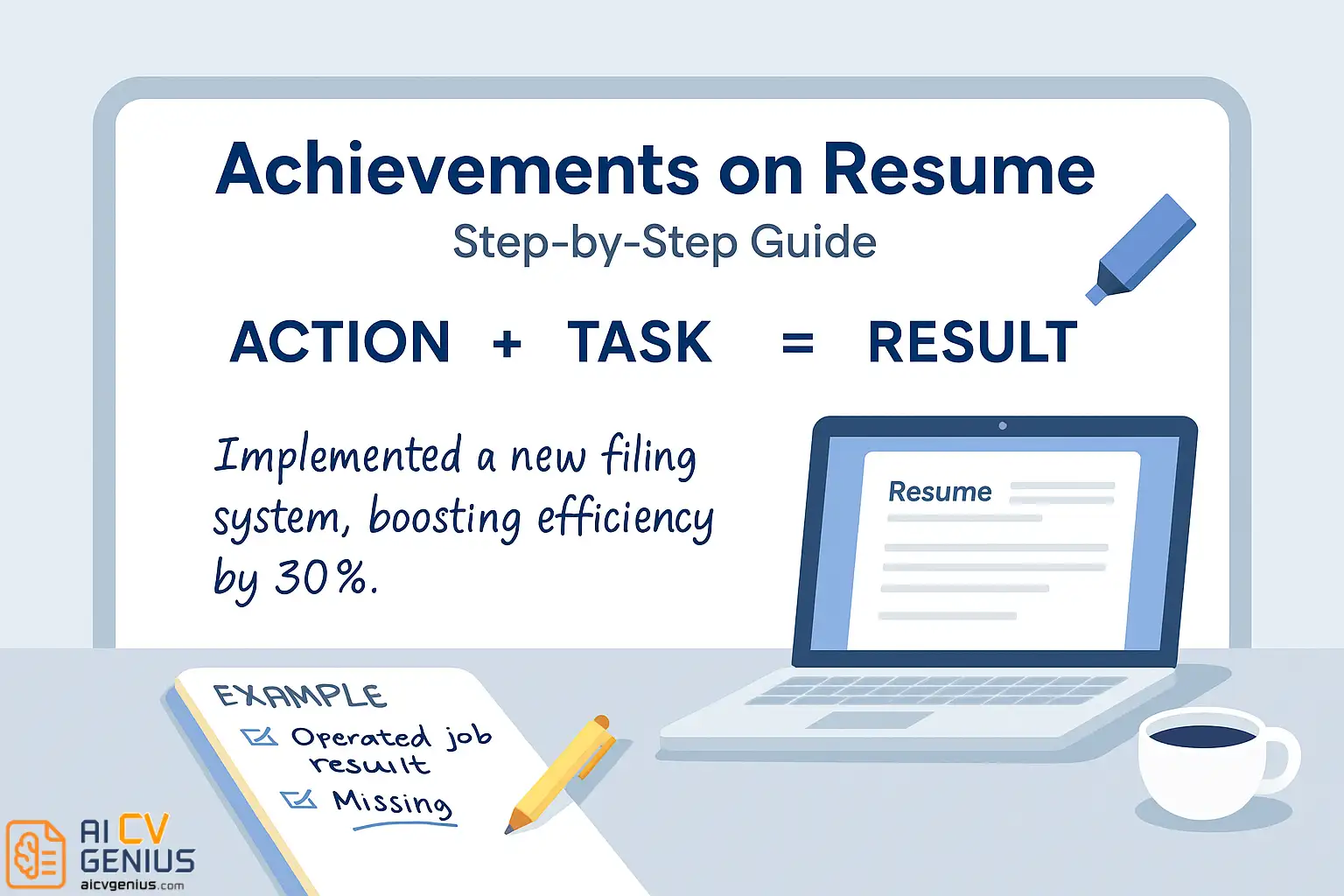
[Action Verb] + [Specific Task] + [Measurable Result]
- Weak: “Increased website traffic.” (How? By how much?)
- Strong: “Increased organic website traffic by 45% in Q4 by optimizing 50+ blog posts for long-tail SEO keywords.”
- Weak: “Streamlined onboarding.” (How? What was the result?)
- Strong: “Streamlined the new-hire onboarding process by implementing an automated email workflow, cutting average training time from 3 weeks to 10 days.”
- Weak: “Developed budget reports.” (So what?)
- Strong: “Developed new Excel budget reports with pivot tables that improved financial forecast accuracy by 12% and saved 10 hours of manual data entry per month.”
Step 3 – Choose Powerful Action Verbs
The first word of your bullet point is the most important. It sets the tone. Avoid weak, passive verbs like “helped,” “worked,” “assisted,” or “participated.” These words suggest you were a bystander, not the driver.
Choose verbs that show ownership, leadership, and impact. Group them by the function you want to prove:
- For Leadership: Led, Managed, Coordinated, Mentored, Directed, Oversaw, Supervised.
- For Improvement/Efficiency: Streamlined, Optimized, Reduced, Decreased, Consolidated, Refined, Re-engineered.
- For Growth/Creation: Built, Created, Designed, Developed, Implemented, Launched, Generated, Increased, Grew.
- For Problem-Solving: Resolved, Diagnosed, Analyzed, Troubleshot, Identified.
Step 4 – Quantify Whenever Possible (The Secret Weapon)
Numbers are the language of business. They cut through the clutter and provide objective proof of your value. A recruiter’s eye is naturally drawn to percentages, dollar signs, and numbers. Even if you think your role doesn’t have metrics, you can find them if you dig deeper.
Ask yourself these questions to find your numbers:
- Money: Did I save money? Generate revenue? Manage a budget? Reduce costs?
- Example: “Saved $15,000 annually by renegotiating three key vendor contracts.”
- Time: Did I save time? Reduce response time? Shorten a project timeline? Automate a manual task?
- Example: “Automated a weekly report, saving 8 hours of manual data entry per month.”
- Volume/Quantity: Did I increase output? Increase efficiency? Handle a large volume of X?
- Example: “Boosted team efficiency by 30% through the implementation of Asana for project tracking.”
- People/Satisfaction: Did I improve customer satisfaction scores? Improve employee retention? Train a number of people? Serve a number of customers?
- Example: “Served 200+ customers weekly while maintaining a 95% customer satisfaction rate.”
Integrating Achievements Into Your Resume
Step 5 – Tailor Achievements to the Role
Do not use a one-size-fits-all resume. Your achievements must be tailored to the specific job you are applying for. Print the job description and highlight the key responsibilities and required skills. Then, re-order and re-phrase your achievements to mirror that language.
Tip: If the job posting mentions “leadership and team building,” your first bullet point should be your strongest leadership achievement. If it mentions “process optimization,” your first bullet point should be your best efficiency metric.
This tailoring does two things: it proves to the human recruiter that you are a perfect fit, and it helps your resume pass the Applicant Tracking System (ATS) filters that are looking for those specific keywords.
Step 6 – Structure Your Resume Sections Around Achievements
Your achievements should be the core of every section, not just your work experience.
- Work Experience: This is the primary location. Replace all task-based bullets with results-based achievements. Aim for 3-5 achievement-driven bullet points per role.
- Projects: Do not just list the project name. Emphasize the outcome. (e.g., “Developed a full-stack e-commerce site that processed its first 100+ orders.”).
- Education: Did you lead a major group project? Receive an award? (e.g., “Selected by faculty to present capstone thesis, which received ‘Best in Show’ recognition.”).
- Volunteer Work: Show impact here, too. (e.g., “Organized a fundraising event that raised $5,000 for the local animal shelter, exceeding goals by 25%.”).
Consider adding a “Key Achievements” subsection at the very top of your “Professional Experience” section (or directly under your summary) to highlight your 3-4 most impressive, relevant accomplishments. This is a powerful strategy for senior-level roles.
Step 7 – Real-World Examples by Industry
How you frame an achievement depends on your industry’s values.
Marketing
- Instead of: “Ran email campaigns.”
- Use: “Increased email click-through rate from 4% to 9% by A/B testing personalized subject lines and CTA buttons.”
- Instead of: “Managed social media.”
- Use: “Launched an influencer campaign on TikTok that generated 1M impressions and drove a 15% increase in site traffic within one month.”
Sales
- Instead of: “Met sales goals.”
- Use: “Closed $500K in new business in Q2, surpassing a $400K target by 25%.”
- Instead of: “Top salesperson.”
- Use: “Ranked #1 of 50 sales representatives in the region for three consecutive quarters.”
IT / Tech
- Instead of: “Fixed bugs.”
- Use: “Reduced website load time by 40% (from 4.5s to 2.7s) by optimizing image assets and refactoring legacy JavaScript.”
- Instead of: “Handled IT tickets.”
- Use: “Implemented a new self-service knowledge base, cutting routine help-desk tickets by 60% and improving employee resolution time.”
Education
- Instead of: “Taught students.”
- Use: “Improved average student test scores in state assessments by 15% through the introduction of a gamified, project-based learning module.”
- Instead of: “Advised student club.”
- Use: “Mentored the student debate team, leading them to a 2nd place finish at the state finals for the first time in school history.”
️Administrative / HR
- Instead of: “Handled scheduling and hiring.”
- Use: “Streamlined the hiring workflow by adopting a new ATS, reducing the average time-to-fill from 45 days to 35 days.”
- Instead of: “Planned company event.”
- Use: “Organized the 2024 annual company summit for 500+ employees, finishing 10% under budget while achieving a 4.9/5 satisfaction rating from attendees.”
Optimization and Final Polish
Step 8 – Use Visual Clarity
How your achievements look matters as much as what they say. Keep your achievements in short, scannable bullet points. No one will read dense paragraphs. Each line should start with its strong action verb, end with a number or clear outcome, and use a consistent tense (past tense for past jobs, present tense for your current role).
Step 9 – Combine Soft Skills with Impact
Do not just list “Teamwork” or “Communication” in a skills section. Prove these soft skills through your achievements. This is far more convincing.
- Instead of: “Strong communication skills.”
- Use: “Presented complex data findings to non-technical stakeholders, influencing the adoption of a new marketing strategy.”
- Instead of: “Good team player.”
- Use: “Fostered collaboration between the sales and marketing departments by leading a new weekly alignment meeting, reducing cross-departmental conflict cases by 40%.”
- Instead of: “Leadership.”
- Use: “Promoted a positive and high-performing culture by mentoring three junior developers; two were promoted to mid-level roles within 18 months.”
Step 10 – Example Resume Snippet (Before & After)
Let’s see the transformation in action.
❌WEAK VERSION (Duty-Focused):
Project Manager – GreenTech Solutions (2021–Present)
- Responsible for project delivery.
- Managed team productivity.
- Handled new hire training.
✅STRONG VERSION (Achievement-Focused):
Project Manager – GreenTech Solutions (2021–Present)
- Delivered 12 major software projects 100% on time and an average of 5% under budget.
- Increased team productivity by 22% by implementing Agile methodologies and a new workflow in Asana.
- Trained and mentored 8 new project coordinators, improving onboarding satisfaction scores by 30% and reducing time-to-productivity.
Step 11 – Common Mistakes to Avoid
- ❌ Listing Job Duties: The #1 mistake. Recruiters know what a “Sales Manager” does. They want to know what you did.
- ❌ No Numbers: Writing “Increased sales” is meaningless. “Increased sales by 20%” is a fact.
- ❌ Vague Phrases: Banish “worked on,” “helped with,” and “was responsible for” from your vocabulary.
- ❌ Burying the Lead: Put your most impressive, relevant achievement as the first bullet point for your most recent job.
- ✅ The Fix: Always write with the “Action Verb + Task + Result” formula. Review every bullet and ask “So what?” If there is no clear answer, rewrite it.
Step 12 – Add Awards and Recognition
Formal recognition is a third-party validation of your achievements. Do not be shy about including it. This can be a separate subsection or integrated into your experience.
“Received ‘Employee of the Quarter’ award (out of 200+ employees) for consistent client satisfaction scores above 95%.”
“Won the 2023 ‘Innovation in Practice’ award for designing a new patient check-in system.”
Step 13 – Optimize for ATS
To pass Applicant Tracking Systems, your achievements must be parsable. Keep your achievement bullets in plain text – no icons, tables, or complex formatting within the bullet itself. Most importantly, ensure the keywords from the job ad (e.g., “stakeholder management,” “revenue growth,” “data visualization”) are naturally included in your achievement descriptions.
Step 14 – Example of a Strong Closing Section
Wrap up your experience section for your most recent job with a summary statement that ties your achievements together. This is less common but can be effective for senior roles.
“Consistently exceeded performance goals through a balance of data-driven decision-making, cross-functional team leadership, and creative problem-solving.”
Where to Learn More
Check our resume templates designed specifically for achievement-based layouts. A clean structure makes your numbers pop.
Or explore our cover letter examples to learn how to pair your resume’s results with a strong, compelling narrative.
You can also visit career resources for more in-depth writing guides and interview preparation tips.
Pros & Cons of Listing Achievements on Resume
| ✅ Strengths | ⚠️ Pitfalls |
|---|---|
| Shows measurable impact and a results-oriented mindset. | Can sound inflated or dishonest if not backed by credible data or context. |
| Highlights problem-solving, initiative, and leadership skills. | Overuse of numbers without context (the “how”) can feel robotic. |
| Makes you stand out instantly in both ATS and 6-second recruiter scans. | Requires careful formatting for readability; dense text can be skipped. |