

- Problem: Internship listings ask for “experience,” but many students define experience too narrowly and end up with an empty resume that gets ignored.
- Why The “Education + Skills List” Fails: It shows what you studied, not what you can build, ship, or solve in real scenarios.
- The Fix: Rebuild around three proof pillars – Projects written like jobs (actions, tools, outcomes), Skills with context (years + use cases), and Volunteer or any work reframed as transferable value.
- What Changed In Results: A proof-based resume creates real interview talking points, leading to faster callbacks and stronger screens than coursework-only resumes.
- Takeaway: If you think you have “no experience,” turn projects, GitHub, extracurriculars, and simple metrics into credible evidence recruiters can trust.
The Chicken-and-Egg Problem
Sarah was a college junior studying computer science. She had a 3.7 GPA, strong technical skills, and genuine interest in software development. But every internship posting she found asked for “prior experience” or “relevant work history.”
How do you get experience when everyone requires experience to get started?
Her first resume attempt was a single page with her name, education, and GPA. Everything else was blank. She applied to 23 internships over winter break and heard back from zero.
The problem wasn’t her qualifications. The problem was how she defined “experience.” This student resume internship case study shows exactly how we transformed her resume from empty to compelling – without inventing fake jobs or exaggerating her background.
The “Before” Resume: Education and Nothing Else
Sarah’s original resume had three sections: Contact Information, Education, and Skills. That’s it.
What It Looked Like
Education
- Bachelor of Science in Computer Science, State University
- Expected Graduation: May 2025
- GPA: 3.7/4.0
- Relevant Coursework: Data Structures, Algorithms, Database Systems, Web Development
Skills
- Python, Java, HTML/CSS, JavaScript
- Git, SQL, React
That was the entire resume. No work experience section. No projects. No extracurriculars. Just education and a list of technologies she’d touched in class.
Why This Failed
Recruiters saw nothing that proved Sarah could apply her knowledge. Knowing Python from a class is different from using Python to build something real. Listing “Git” as a skill doesn’t show she’s contributed to actual codebases.
The resume answered one question: “What classes did you take?” But it didn’t answer the question recruiters actually care about: “What can you do?”
The Fix: Building on Three Pillars
We rebuilt Sarah’s resume around three pillars: Projects, Skills (with context), and Volunteer Experience. These three sections gave recruiters proof of ability without requiring traditional work history.
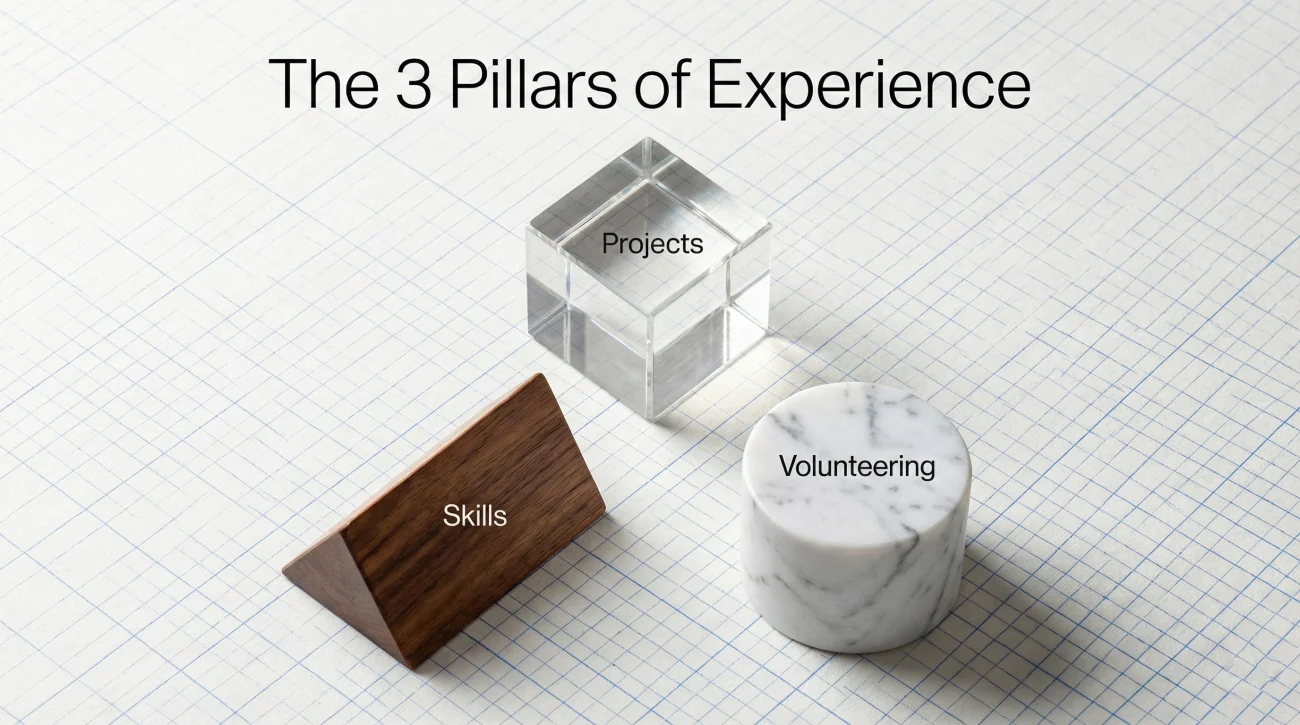
Pillar 1: Projects
Sarah had completed several class projects and one personal side project. None appeared on her original resume because she didn’t think they “counted” as real experience.
We added a Projects section and treated each one like a job, with bullet points describing what she built, what technologies she used, and what the outcome was.
Personal Finance Tracker (Personal Project)
- Built full-stack web app using React, Node.js, and MongoDB to track expenses and visualize spending patterns
- Implemented user authentication with JWT and created RESTful API with 8 endpoints
- Deployed to Heroku, currently used by 15 friends and family members
- GitHub: [link to repo]
University Course Registration System (Class Project)
- Collaborated with team of 4 to design and develop MySQL database managing 10,000+ student records
- Wrote 20+ SQL queries optimizing search performance, reducing average query time from 800ms to 120ms
- Created Python scripts for data validation and automated testing
Notice how these read like work experience. Each bullet starts with an action verb, includes specific technologies, and shows measurable outcomes (15 users, 10,000+ records, 800ms to 120ms).
Pillar 2: Skills With Context
Instead of just listing technologies, we added context showing how Sarah used each one.
Before: Python, Java, HTML/CSS, JavaScript
After:
- Languages: Python (3 years – data analysis, web scraping, automation), Java (2 years – OOP, data structures), JavaScript/React (1 year – full-stack projects)
- Tools & Platforms: Git/GitHub (version control for 5+ projects), MySQL/MongoDB (database design and queries), VS Code, Postman
- Concepts: RESTful APIs, responsive web design, agile development, unit testing
This shows depth. “Python (3 years)” with specific applications like “data analysis, web scraping, automation” is far more credible than just “Python.”
Pillar 3: Volunteer Experience
Sarah had volunteered with a local nonprofit helping seniors learn basic computer skills. She didn’t include it on her resume because it wasn’t “technical work.”
But teaching people how to use technology requires communication, patience, and problem-solving – all skills employers value. We reframed it:
Tech Literacy Volunteer, Senior Community Center (Sept 2023 – Present)
- Teach 20+ seniors basic computer skills including email, web browsing, and video calls
- Created step-by-step guides and visual tutorials to simplify complex technical concepts
- Troubleshoot hardware and software issues, demonstrating patience and clear communication
This shows soft skills that matter for internships: communication, teaching, and the ability to explain technical concepts to non-technical people.
For more guidance on building strong resumes at any career stage, see our comprehensive resume writing guide.
The “After” Resume: Full and Credible

The revised resume was still one page, but it was no longer empty. It had five sections: Contact Information, Education, Projects, Skills, and Experience.
Every section proved Sarah could do something, not just that she’d taken classes about something.
The Complete Structure
Contact Information – Name, email, phone, LinkedIn, GitHub
Education – Same as before, but moved below Projects to prioritize what she’d built
Projects – Three projects (personal finance tracker, course registration system, data visualization dashboard)
Skills – Organized by category with years of experience and context
Experience – Volunteer work framed to highlight relevant skills
The resume went from “I took some classes” to “I’ve built real things, solved real problems, and can demonstrate technical and soft skills.”
The Result: Internship Offer in 3 Weeks
Sarah sent the revised resume to 15 companies over three weeks. She got four responses requesting phone screens. Two led to technical interviews. One resulted in an offer.
Week 1: Applied to 8 internship positions at tech companies
Week 2: Two recruiter calls, both asked about her personal finance tracker project
Week 3: Technical interview at a fintech startup, received offer two days later
What Made the Difference in Interviews
During her successful interview, the hiring manager spent most of the time discussing Sarah’s projects – not her coursework. He asked about her decision-making process, how she debugged issues, and what she’d do differently if she rebuilt the finance tracker today.
These questions only worked because her resume gave him something concrete to discuss. You can’t have a meaningful technical conversation about “took a class in web development.” You can have one about “built a full-stack app with React and Node.js.”
The hiring manager later told Sarah: “Your projects showed you don’t just know the syntax – you know how to ship working code. That’s what we look for in interns.”
What You Can Do If You Have “No Experience”
Stop Saying You Have No Experience
If you’ve completed class projects, built something for yourself, contributed to open source, freelanced, volunteered, or held any job (even unrelated ones), you have experience. The key is framing it correctly.
Class projects are real projects. Side projects count. Volunteer work demonstrates skills. Even retail or food service jobs show reliability, communication, and customer service.
Treat Projects Like Jobs
Use the same format you’d use for work experience:
- Project name and brief description
- Technologies used
- Bullet points with action verbs and outcomes
- Link to GitHub or live demo if available
Make sure each bullet answers: What did you build? How did you build it? What was the result?
Link to Your GitHub
If you’re applying for technical roles, a GitHub profile with actual code is worth more than a dozen bullet points claiming you know programming languages.
Clean up your repos – add README files, remove half-finished tutorial projects, and pin your best 3-4 projects. Recruiters will look.
Include Relevant Extracurriculars
Leadership in student clubs, organizing events, tutoring, teaching, volunteer work – these all demonstrate skills employers care about. Don’t leave them off because they’re not “jobs.”
Quantify When Possible
Even without traditional work metrics, you can quantify projects:
- Number of users (even if it’s just friends)
- Lines of code or commits
- Performance improvements (load time, query speed)
- Team size for group projects
- Hours spent or weeks of development
Numbers make accomplishments tangible.
For additional resources on building your first professional resume, check out our guide to the best resume builders with student-friendly templates.
FAQ
You Don’t Need Work Experience – You Need Proof
Sarah’s story proves that the “no experience” problem is really a “no proof” problem. She had skills, she’d built things, and she’d solved problems. Her original resume just didn’t show any of it.
The transformation didn’t require inventing credentials or padding her background. It required recognizing that class projects, personal projects, and volunteer work all count as experience when framed correctly.
If you’re a student or recent graduate struggling with a blank resume, stop focusing on what you don’t have. Focus on what you do have:
- Projects you’ve built (class or personal)
- Skills you can demonstrate (with context and depth)
- Any work or volunteer experience (framed to show transferable skills)
These three pillars are enough to build a student resume that gets interviews. The key is treating each element seriously – not as filler, but as genuine proof of your abilities.
Employers don’t expect students to have five years of industry experience. They expect students to show curiosity, initiative, and the ability to learn and build. Your resume should prove you can do all three.
For more examples and templates tailored to different career stages, explore our comprehensive resume guide.