
- Student resumes are different because recruiters scan for potential, not a long work history: Education, relevant skills, projects, extracurriculars, and initiative matter most.
- The core sections stay consistent: Contact info, a targeted objective or summary, education near the top, projects that prove applied skills, experience of any kind, a categorized skills list, and leadership or extracurriculars.
- Template choice depends on your stage and goal: High school emphasizes academics and activities, college emphasizes coursework and projects, internship templates lead with a strong objective, and first-job templates highlight transferable skills in a clean single-column layout.
- The writing process is step-by-step: Pick an ATS-friendly template, add accurate contact details, tailor your objective, build education, showcase 2 to 3 projects with action bullets, add experience and skills aligned to the posting.
- Common mistakes are predictable and avoidable: Going over one page, unprofessional email, vague “Responsible for” bullets, typos, and sending an untailored resume, then missing the final checklist on headings, proofread, and ATS-safe format.
Applying for your first job or internship can feel daunting, especially when faced with a blank page and the realization you lack formal work experience. The good news? Recruiters evaluating student applications aren’t looking for a decade-long career history. They seek potential, relevant skills developed through coursework and activities, academic achievements, and demonstrable drive. This is precisely where student resume template prove invaluable. These tailored formats are designed specifically for individuals with limited or no traditional work experience, providing a structure to effectively showcase your education, key projects, extracurricular involvement, and crucial transferable skills.
This guide will clarify what distinguishes a student resume, detail the essential components to include, offer examples of effective templates, and provide step-by-step instructions for crafting a resume that secures your first job, internship, or volunteer role. We’ll also address common pitfalls, answer frequently asked questions, and share expert insights to ensure your resume captures attention, even without extensive professional experience.
Why Student Resumes Are Different
A student resume shifts the focus from professional history to potential and foundational capabilities. Recruiters understand you’re at the beginning of your career journey. Consequently, they scan for specific indicators: organizational ability, learned technical and soft skills, teamwork aptitude demonstrated through group projects or activities, and personal initiative shown within or outside academic settings. An effective student resume template structures your information to highlight these exact signals.
What Employers Look for in Student Resumes
- Education: Often your most significant asset. Your degree, institution, GPA (if strong), relevant coursework, and academic honors matter.
- Skills: A blend of technical proficiencies (software, research methodologies, languages) and essential soft skills (communication, collaboration, problem-solving, time management).
- Relevant Projects: Academic assignments, capstone projects, group work, or personal initiatives that demonstrate practical application of skills pertinent to the target role.
- Extracurricular Activities: Involvement in clubs, sports teams, student government, or other organizations can showcase leadership potential, teamwork, and commitment.
- Volunteer Work & Internships: Provides concrete evidence of responsibility, specific skills learned, and real-world application of knowledge.
Core Elements of a Student Resume
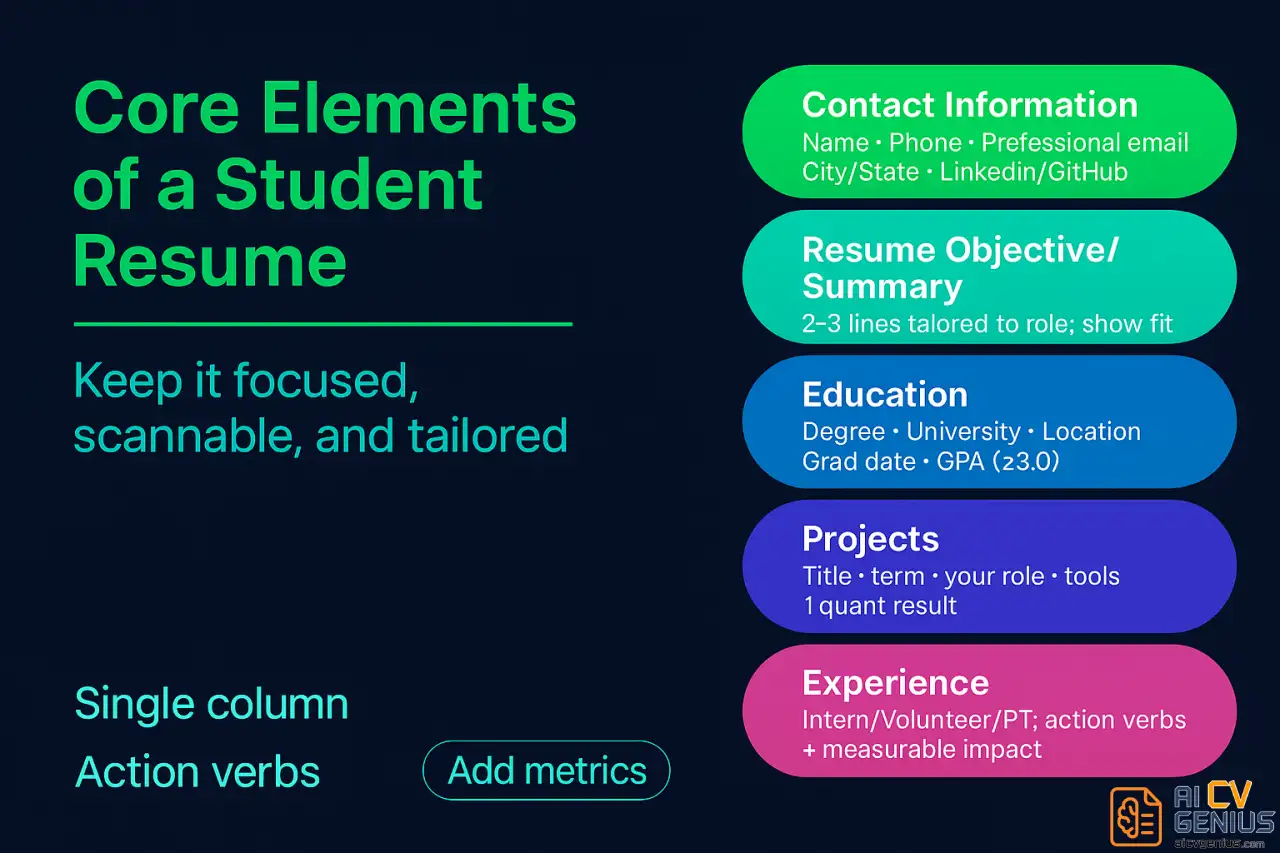
A strong student resume must strategically include the following sections:
Contact Information
Ensure accuracy: Full Name, Phone Number, Professional Email Address (e.g., firstname.lastname@email.com), and optionally, a link to your LinkedIn profile or relevant online portfolio (like GitHub for developers). City and State are usually sufficient; avoid full street addresses.
Resume Objective or Summary
A brief (2-3 sentence) statement customized for each application. An Objective clearly states your immediate career goal and enthusiasm for the specific role/company. A Summary (suitable if you have some internship/project experience) highlights key skills and relevant accomplishments. Example Objective: “Highly motivated and detail-oriented college student pursuing a B.S. in Marketing seeks a challenging summer internship at [Company Name] to apply strong analytical skills and passion for digital media campaigns.”
Education
Position this section prominently, usually near the top. Include: Full Degree Name (e.g., Bachelor of Science in Computer Science), University Name, Location, Expected Graduation Date. Optionally add: GPA (if 3.0 or higher), relevant coursework (list 3-5 key courses), academic honors (Dean’s List, scholarships), or thesis/capstone title if applicable.
Projects
This section is crucial for demonstrating applied skills. Include academic projects (class assignments, group work, capstone) and personal projects. For each, list the project title, timeframe (e.g., Fall 2024), a brief description of the goal and your contribution, and the skills/tools used. Quantify results if possible. Example: “Team Lead for Capstone Marketing Plan (Spring 2025): Led a 4-person team to develop a comprehensive digital marketing strategy for a local non-profit, utilizing SWOT analysis and social media analytics; presented final plan to stakeholders.”
Experience (Internships, Volunteer, Part-Time Work)
Even non-traditional experience matters. Include internships, volunteer roles, part-time jobs, tutoring, or campus positions. Focus on transferable skills: responsibility, time management, customer service, teamwork. Use bullet points starting with action verbs. Example (Part-Time Retail): “Provided customer assistance in a fast-paced environment, handling cash transactions accurately and resolving customer inquiries efficiently.”
Skills
Create clear categories for better readability:
* Technical Skills: Software (e.g., Microsoft Office Suite, Adobe Creative Suite, specific programming languages like Python/Java), research tools, laboratory techniques.
* Soft Skills: Communication (Written & Verbal), Teamwork/Collaboration, Problem-Solving, Leadership, Time Management, Adaptability, Critical Thinking.
* Languages: Specify proficiency level (e.g., Fluent in Spanish, Conversational French).
Extracurricular Activities / Leadership
List involvement in clubs, sports, student government, or community organizations. Mention any leadership roles held (e.g., President of Debate Club, Treasurer of Student Association). Briefly describe key responsibilities or achievements.
Examples of Student Resume Templates
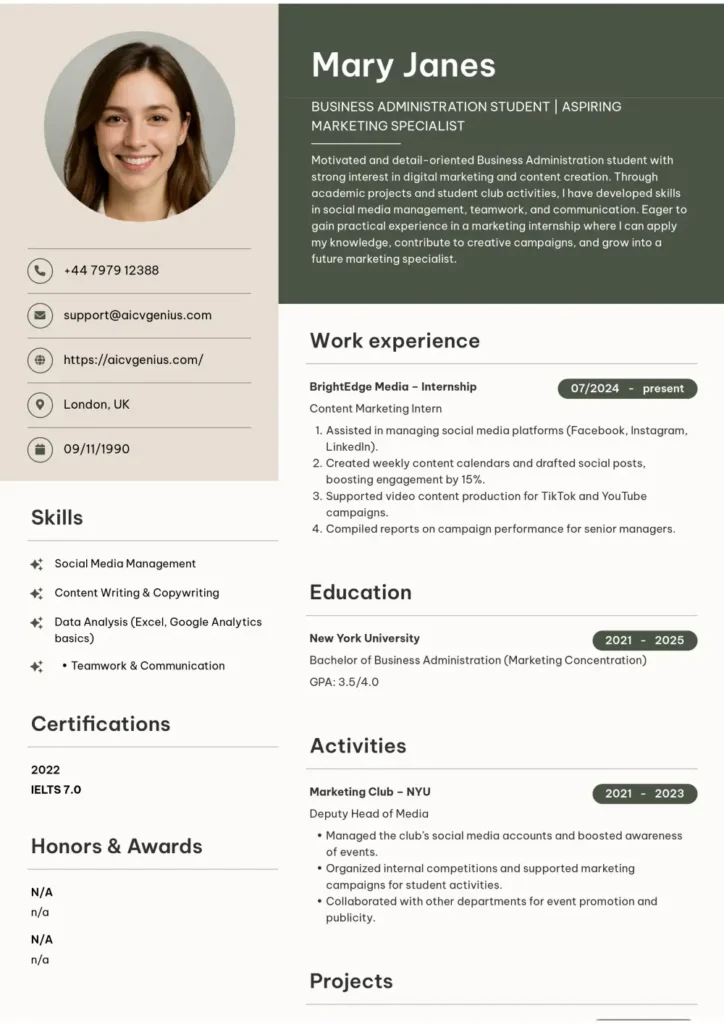
Different templates cater to specific student needs:
High School Resume Template
Emphasizes academic achievements (GPA, relevant courses), extracurricular activities (clubs, sports, band), volunteer experience, and part-time jobs (babysitting, retail). Skills section highlights basic software proficiency and soft skills like responsibility.
College Student / Undergraduate Resume Template
Prioritizes Education, including major, expected graduation date, relevant coursework, and significant projects. Internships (if any) are highlighted. Skills section becomes more specific (technical skills related to major).
Internship Resume Template
Highly targeted towards a specific internship posting. Features a strong Objective statement connecting skills to the internship requirements. Projects and coursework directly relevant to the internship are detailed prominently.
First Job (Entry-Level) Resume Template
Often uses a simple, professional, single-column format. Focuses on transferable skills gained from education, projects, and any work/volunteer experience. Emphasizes reliability, communication, and eagerness to learn.
Step-by-Step: How to Write a Student Resume
Step 1: Choose a Clean, ATS-Friendly Template
Select a simple, professional layout, preferably single-column, with clear section headings. Use built-in templates from Word/Google Docs or trusted online sources like simple layouts. Ensure it’s easy to read and parse by software.
Step 2: Add Accurate Contact Information
Place your Full Name, Phone Number, Professional Email, and LinkedIn URL (if you have one) clearly at the top.
Step 3: Write a Targeted Resume Objective
Craft 1-2 sentences specifically connecting your skills and academic background to the requirements of the job or internship you’re applying for. Example: “Enthusiastic and detail-oriented Computer Science student seeking a Software Engineering Internship at [Company Name] to apply proficiency in Java and collaborative problem-solving skills gained through university projects.”
Step 4: Detail Your Education Section
List your most recent degree first. Include Degree Name, Major, University, Location, Expected Graduation Date. Add GPA (if strong), relevant coursework, and honors. Example: “Relevant Coursework: Data Structures & Algorithms, Web Development, Database Management.”
Step 5: Showcase Relevant Projects
Describe 2-3 key projects. Use bullet points to detail your role, tasks performed, skills applied, and any measurable outcomes. Example: “Collaborated in a 3-person team using Python and Pandas to analyze public health data for a class project, identifying key trends in local vaccination rates and presenting findings via data visualizations.”
Step 6: Include Experience (Internships, Volunteer, Part-Time)
List any relevant roles. Use action verbs and focus on transferable skills. Example (Volunteer Tutor): “Tutored high school students in Algebra I, explaining complex concepts clearly and helping students improve average test scores by 15%.”
Step 7: List Targeted Skills
Create distinct categories (Technical, Soft, Languages). Prioritize skills mentioned in the job description. Be specific (e.g., “Microsoft Excel (Pivot Tables, VLOOKUP)” instead of just “MS Office”).
Common Mistakes Students Make (And How to Avoid Them)
- ❌ Exceeding One Page: Recruiters expect brevity from students. Stick rigorously to one page unless you have multiple significant internships or publications.
- ❌ Using Unprofessional Email Addresses: Addresses like “partylover@email.com” undermine credibility. Create a professional one (e.g., firstname.lastname@email.com).
- ❌ Vague or Passive Language: Avoid phrases like “Responsible for…” Instead, use strong action verbs: “Managed,” “Developed,” “Coordinated,” “Analyzed.”
- ❌ Typos and Grammatical Errors: These suggest carelessness. Proofread multiple times, use spell-check tools, and ask someone else to review it.
- ❌ Generic, Untailored Content: Sending the same resume everywhere. Customize your Objective, Skills, and highlighted Projects for each specific application based on the job description.
Simple vs. Creative Student Resumes: Which is Right?
While a creative resume might seem appealing for roles in graphic design, visual arts, or some marketing fields, most students should prioritize simple, professional templates. Creative formats often struggle with Applicant Tracking Systems (ATS) due to complex layouts, non-standard fonts, or graphics. A clean, well-structured, ATS-friendly simple template ensures your qualifications are accurately parsed and easily reviewed by recruiters. Focus on highlighting achievements through strong content rather than relying solely on visual flair.
Checklist for a Strong Student Resume
Before submitting, run through this final check:
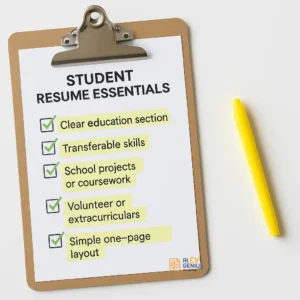
- ✅ One Page Maximum: Concise and focused.
- ✅ Clear, Standard Headings: Easy for recruiters and ATS to navigate (Education, Skills, Projects, Experience).
- ✅ Action Verbs & Quantifiable Results: Bullet points demonstrate impact where possible.
- ✅ Professional Contact Information: Accurate and appropriate email address.
- ✅ Relevant Content Only: Information is tailored to the target job/internship. No irrelevant personal details (age, marital status).
- ✅ ATS-Friendly Format: Preferably single-column, standard fonts, text-based PDF or DOCX.
- ✅ Proofread: Free of typos and grammatical errors.
FAQs About Student Resume Templates
No. As a student, your primary focus should be on showcasing your education, relevant coursework, academic or personal projects, internships (if any), volunteer work, extracurricular activities, and skills. Employers understand students are building experience.
Include your GPA if it is strong (typically 3.0 or higher on a 4.0 scale, or equivalent). If it’s lower, or if the employer doesn’t specifically request it, you can omit it and focus on other strengths like projects or skills.
Include a mix of relevant technical skills (software proficiency, programming languages, lab techniques) and soft skills (communication, teamwork, problem-solving, leadership, time management). Always tailor this section by reviewing the skills mentioned in the job description.
Absolutely. Many free templates available in Microsoft Word, Google Docs, or reputable online builders are perfectly suitable. Prioritize templates that are clean, professional, and explicitly ATS-friendly (usually single-column). The quality of your content is more critical than the template’s cost.
Strictly one page. Recruiters do not expect more extensive resumes from candidates at the student or entry-level stage. Conciseness is key.
Final Thoughts
A well-crafted student resume template isn’t about concealing a lack of professional experience – it’s about strategically highlighting your potential, academic achievements, acquired skills, and enthusiasm. Employers hiring students value eagerness to learn, adaptability, and foundational abilities demonstrated through coursework, projects, and activities. By selecting a clean, simple, and ATS-friendly template, and populating it with tailored content focused on relevant accomplishments, you can create a compelling resume that secures interviews, even without a traditional work history. Remember, every successful professional started somewhere; your student resume is the critical first step on your career path.