
- Why finance cover letters still matter: They prove communication, add context to metrics, and signal trust, precision, and motivation.
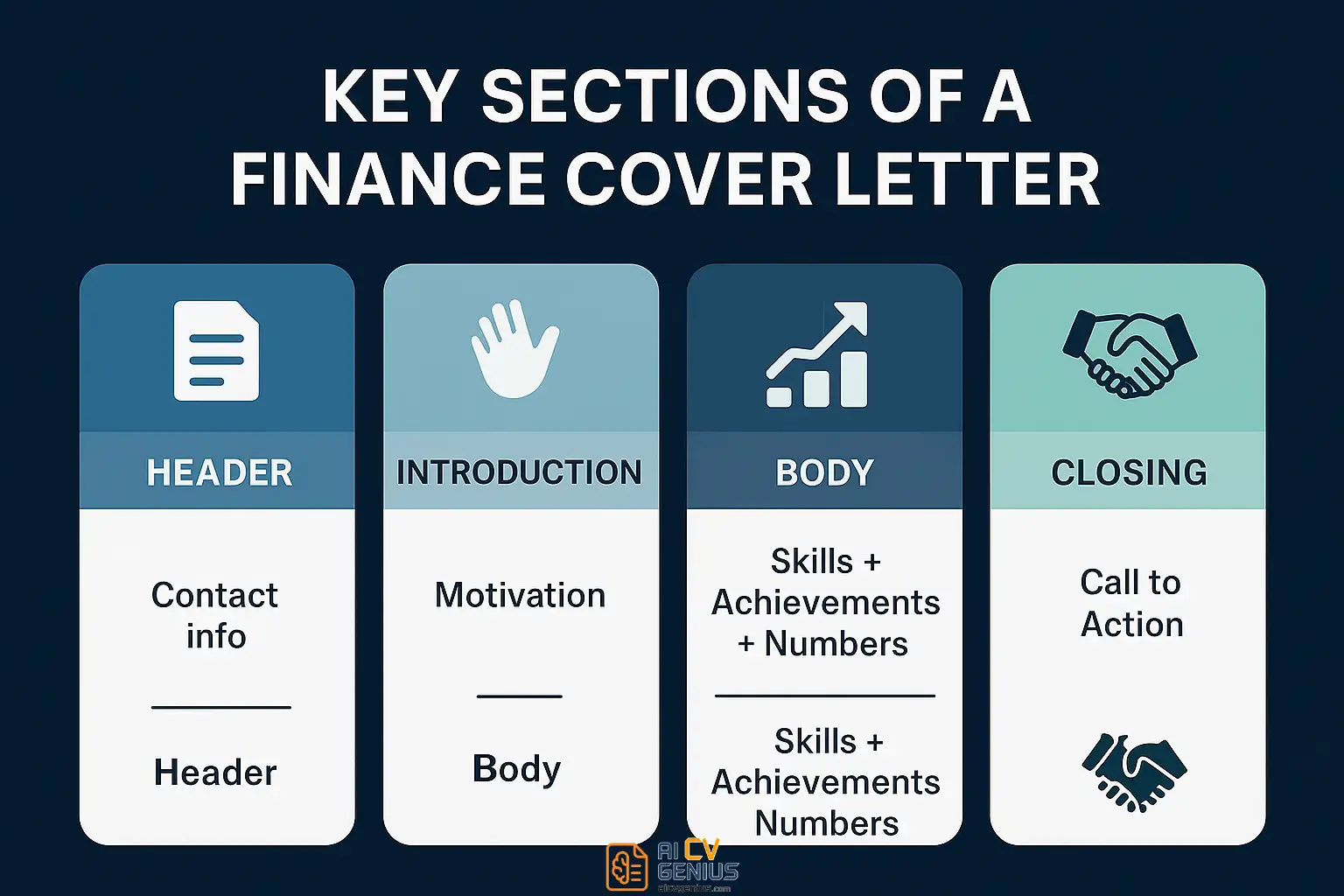
- Best structure to follow: Header, Personalized greeting, Sharp role-specific opening, 1 to 2 proof paragraphs, Confident close.
- What wins in finance: Quantify achievements, Show the “how” behind results, And connect your work to business outcomes.
- How to tailor by subfield: Adjust examples and keywords for FP&A, Corporate finance, Investment banking, Or accounting and audit.
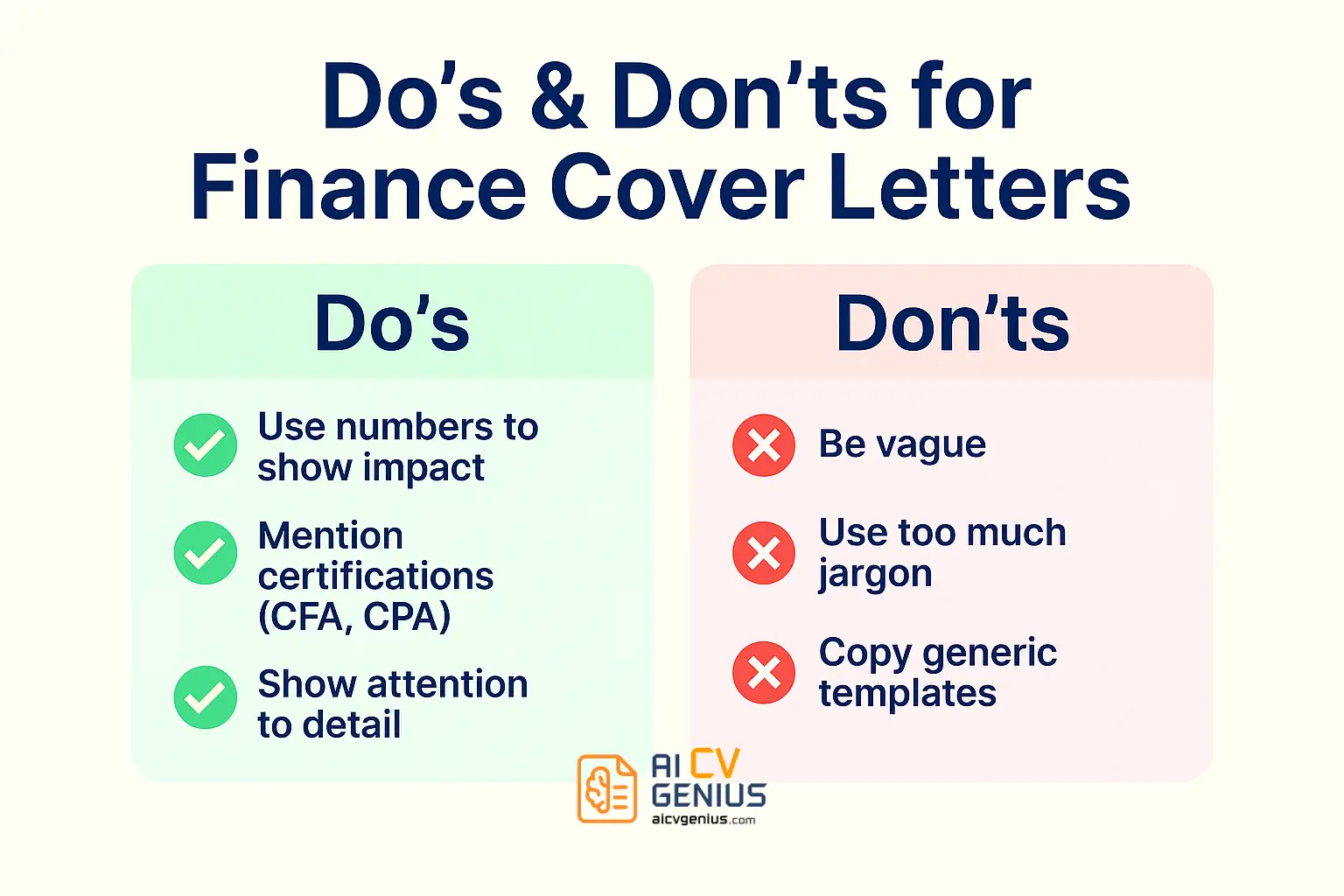
- What to avoid every time: Repeating the resume, Generic letters, Unquantified claims, Heavy jargon, And any typos or formatting flaws.
Introduction: More Than Numbers – Your Narrative Edge
Landing a coveted role in finance demands more than just impeccable quantitative skills; it requires proving you possess both analytical rigor and compelling communication prowess. Your resume meticulously lists the numbers – GPA, certifications, quantifiable achievements – but your finance cover letter example is the crucial space where you weave those numbers into a persuasive narrative. Think of it as the strategic commentary accompanying your financial report: it connects technical expertise, sophisticated problem-solving, and polished communication skills into a cohesive package that instills trust and credibility in employers.
Finance remains one of the most intensely competitive industries globally, whether your ambition lies in corporate finance, investment banking, public accounting, asset management, or the burgeoning fintech sector. Recruiters and hiring partners in this field operate under immense pressure and expect candidates to demonstrate unwavering professionalism, meticulous attention to detail, and a lucid understanding of how their specific skills translate directly into tangible business results. This is precisely why your cover letter carries weight equal to, if not sometimes exceeding, your resume – it constructs the story of your career trajectory thus far and compels the reader to invest their time in learning more about your potential contribution.
The Strategic Imperative: Why Finance Professionals Still Need a Cover Letter
In an era dominated by digital applications and sophisticated Applicant Tracking Systems (ATS), many job seekers, particularly in analytical fields like finance, question the necessity of a cover letter. Is it truly essential in today’s streamlined hiring processes? The unequivocal answer, especially within the high-stakes finance industry, remains a resounding yes. While technology facilitates initial screening, the final decisions are invariably made by humans seeking connection and context. A meticulously crafted cover letter provides that vital human element and offers several strategic advantages:
- Demonstrates Communication Acumen: Finance roles demand the ability to distill complex financial data into clear, actionable insights for diverse audiences – executives, clients, regulators. Your cover letter serves as immediate, tangible proof of this critical skill, showcasing your ability to write with precision, clarity, and persuasive impact, just as you would in a critical financial report or client presentation.
- Provides Context and Narrative to Achievements: A resume bullet point might state “increased portfolio ROI by 15%,” but the cover letter allows you to briefly elaborate on the how and why – the strategic thinking, analytical process, or innovative approach that led to that result. It transforms a static data point into a compelling mini-narrative of strategy and execution.
- Highlights Meticulous Attention to Detail: Finance operates on precision; errors in budgets, forecasts, or compliance documentation can have severe consequences. A flawless cover letter – free of typos, grammatical errors, and formatting inconsistencies – signals that you possess the requisite attention to detail demanded by the profession.
- Signals Genuine Motivation and Strategic Alignment: A generic resume can be sent anywhere. A tailored cover letter, referencing the specific firm, its values, recent deals, or market position, demonstrates genuine, targeted interest. It shows you’ve invested time in understanding their business and envision how your contribution aligns specifically with their strategic goals.
In the finance world, where trust, credibility, and sound judgment are the currency of success, your cover letter is your first opportunity to establish all three. It allows you to build rapport and frame your candidacy strategically before you even secure an interview, setting you apart from candidates who rely solely on credentials.
Structuring for Impact: The Essential Anatomy of a Finance Cover Letter
Finance professionals – recruiters, hiring managers, partners – are invariably time-constrained. Your cover letter must therefore be a model of efficiency: concise, impeccably professional, logically structured, and easily navigable. Adherence to a standard one-page format is strongly advised. Below is a proven structure applicable across various finance roles:
1. Header: Establishing Credibility Instantly
Include your full name, professional email address, primary phone number, and LinkedIn profile URL (ensure it is current and professional). Critically, if you hold prestigious designations like the CFA (Chartered Financial Analyst) or CPA (Certified Public Accountant), list them prominently alongside your name (e.g., “Jane Doe, CFA”). This immediately establishes a high level of credibility and qualification recognized industry-wide. Ensure consistent formatting with your resume header.
2. Greeting: Precision and Personalization Matter
Whenever possible, address the letter to a specific individual – the hiring manager, recruiting partner, or department head. Diligent research via the company website, LinkedIn, or even a polite inquiry to HR can yield the correct name and title. A personalized salutation (“Dear Ms. Carter,” or “Dear Mr. Singh,”) demonstrates meticulousness and respect, making a significantly stronger impact than the generic and outdated “To Whom It May Concern” or “Dear Sir/Madam.” In finance, precision starts with getting the name right.
3. Introduction: Hooking the Reader with Relevance
Your opening paragraph must be sharp and strategic. Clearly state the specific role you are applying for and immediately articulate why you are interested, connecting your motivation directly to something specific about the company – its market reputation, stated values, recent transactions, industry focus, or technological innovation.
Example:
“As a Financial Analyst with a deep passion for sustainable investing and three years of experience in ESG portfolio analysis, I was particularly impressed by [Firm Name]’s recent white paper on impact investing trends. I am writing to express my strong interest in the ESG Analyst position advertised on [Platform], where I believe my quantitative skills and commitment to responsible finance align perfectly with your firm’s pioneering work in this critical area.”
This approach immediately establishes relevance and demonstrates thoughtful research, compelling the reader to continue.
4. Body Paragraph(s): Substantiating Your Value Proposition with Evidence
This section forms the core of your argument, providing concrete, quantifiable evidence to support your candidacy. Avoid merely listing responsibilities; instead, focus on showcasing specific achievements and their impact. Finance professionals respond to data – use metrics ($ value, % improvement, time saved) to demonstrate the tangible value you delivered. Implicitly use the STAR method (Situation, Task, Action, Result) to structure your examples.
| Instead of (Duty) | Try (Achievement) |
|---|---|
| “Managed client portfolios.” | “Developed and implemented optimized portfolio allocation strategies for high-net-worth clients, resulting in an average client ROI increase of 12% over an 18-month period, exceeding firm benchmarks by 4%.” |
| “Involved in budgeting process.” | “Led the annual budget restructuring initiative for the operations division, identifying and implementing process efficiencies that reduced annual operating costs by over $500,000 (a 7% decrease) without impacting service levels.” |
| “Created financial reports.” | “Designed and automated weekly financial performance dashboards using advanced Excel macros and VBA, reducing report generation time by 10 hours per week across the finance team and improving data accuracy for executive decision-making.” |
Emphasize skills critical in finance: analytical reasoning, quantitative modeling, risk assessment, strategic planning, problem-solving, and client communication. Crucially, tailor these examples to directly address the requirements and keywords mentioned in the specific job description.
5. Closing Paragraph: A Confident and Professional Call to Action
Conclude your letter with professional assertiveness. Reiterate your enthusiasm for the specific role and firm, and clearly state your interest in moving forward. Avoid passive language.
Example:
“My proven ability to translate complex financial data into actionable strategic insights, coupled with my experience in [mention a key skill/area again, e.g., M&A due diligence], aligns strongly with the requirements of the Senior Financial Analyst role. I am eager to discuss how my analytical expertise can contribute to [Firm Name]’s continued success in [mention their industry/focus]. Thank you for your time and consideration; I welcome the opportunity for an interview.”
End with a standard professional closing (“Sincerely,” or “Respectfully,”) followed by your typed name.
Finance Cover Letter Example (Full Text)
Here is a complete example integrating these principles:
[Your Name], CPA
[Your Phone Number] | [Your Email Address] | [Your LinkedIn URL]
[City, State][Date]
Mr. David Chen
Hiring Manager
Innovate Financial Solutions
[Company Address]Dear Mr. Chen,
I am writing to express my strong interest in the Financial Analyst position at Innovate Financial Solutions, as advertised on LinkedIn. With a robust foundation in corporate finance developed over four years at BrightBank, coupled with a proven ability to deliver measurable results through rigorous analysis, I am eager to contribute my expertise in financial modeling, strategic forecasting, and cross-functional collaboration to your dynamic team.
During my tenure at BrightBank, I spearheaded the development of a sophisticated financial forecasting model that improved the accuracy of our quarterly projections by over 20%. This enhanced precision provided senior management with more reliable data for strategic decision-making, directly supporting the company’s achievement of 10% year-over-year revenue growth. Additionally, I initiated and led a collaborative project with the IT and Operations departments to streamline the monthly expense reporting process, successfully reducing reporting cycle times by three business days and freeing up valuable analyst time for higher-value activities.
My analytical rigor extends beyond spreadsheets. I have frequently presented complex financial insights and strategic recommendations to executive leadership and external clients, honing my ability to communicate intricate data in a clear, concise, and actionable manner that facilitates informed decisions. I am particularly drawn to Innovate Financial Solutions’ reputation for leveraging cutting-edge technology to deliver innovative financial solutions and its consistently client-focused strategic approach, which aligns perfectly with my professional values.
I am confident that my skills in advanced data analysis, strategic financial planning, and effective communication would enable me to make a significant and immediate contribution to your team. Thank you sincerely for considering my application. I have attached my resume for your detailed review and welcome the opportunity to discuss how my qualifications and proactive approach can support Innovate Financial Solutions’ continued success.
Sincerely,
Emily Carter, CPA
Tailoring Your Narrative: Customizing for Different Finance Roles
A generic cover letter is ineffective in finance. You must strategically tailor your focus, language, and examples based on the specific sub-field and role requirements:
Entry-Level Finance Roles (Analyst, Intern)
Focus: Emphasize academic achievements (strong GPA, relevant coursework like corporate finance, econometrics), internships (even brief ones), extracurricular activities demonstrating leadership or analytical skills (e.g., investment club), and technical proficiency (Excel mastery is key, Python/SQL a plus). Highlight certifications like Bloomberg Market Concepts (BMC) or progress towards CFA/CPA exams. Showcase enthusiasm, eagerness to learn, and strong work ethic.
Financial Analyst / FP&A (Financial Planning & Analysis)
Focus: Highlight quantitative and analytical prowess, mastery of Excel for complex modeling, budgeting, forecasting, variance analysis, and experience with FP&A software (e.g., Anaplan, Adaptive Insights). Emphasize your ability to translate data into actionable business insights that influenced strategic decisions. Quantify impact related to cost savings, revenue growth, forecast accuracy improvement, or process efficiency gains.
Corporate Finance
Focus: Showcase experience in capital budgeting, financial statement analysis, working capital management, M&A support (due diligence, valuation), and investor relations. Demonstrate understanding of corporate strategy and how finance supports overall business objectives. Highlight achievements related to optimizing capital structure, improving profitability, managing cash flow, or supporting successful transactions.
Investment Banking (Analyst, Associate)
Focus: Emphasize experience in financial modeling (DCF, LBO, comps), valuation techniques, deal execution (M&A, IPO, debt/equity financing), due diligence, pitch book creation, and client interaction. Highlight resilience, ability to perform under extreme pressure, meticulous attention to detail, long hours managed successfully, and strong quantitative aptitude. Mention specific transaction experience if possible (while maintaining confidentiality).
Accounting & Audit (Public or Corporate)
Focus: Demonstrate deep understanding of GAAP/IFRS, technical accounting principles, financial reporting, internal controls (SOX), audit procedures, and tax compliance. Highlight precision, accuracy, ethical judgment, and experience with accounting software (e.g., QuickBooks, SAP, Oracle). Mention specific audit findings that led to improvements or successful navigation of complex regulatory requirements. CPA certification or candidacy is crucial.
Key Strategies for Writing a Strong Finance Cover Letter
- Quantify Ruthlessly: Finance speaks in numbers. Back up every significant claim with specific, measurable results (%, $, #, time saved). Even estimations (“approximately,” “over”) are better than vague statements.
- Maintain Unwavering Professionalism: Use formal language, avoid slang or overly casual phrasing. Ensure the tone is confident but respectful. Avoid buzzwords (“synergy,” “disruptive”) unless used meaningfully in context.
- Demonstrate Meticulous Attention to Detail: Proofread multiple times for grammar, spelling, punctuation, and formatting consistency. Errors signal carelessness – fatal in finance. Ensure names, titles, and company details are accurate.
- Mirror Company Values and Language: Research the firm’s website, recent press releases, and executive interviews. Subtly incorporate their language regarding values, mission, or strategic priorities to demonstrate cultural alignment.
- Adhere Strictly to One Page: Brevity signals discipline and respect for the reader’s time. Focus on the most impactful information; clarity and directness are paramount in finance communication.
Critical Errors: Common Mistakes to Avoid
Steer clear of these frequent missteps that can undermine your credibility:
- ❌ Simply Repeating Resume Content: The cover letter must add value – context, narrative, and specific alignment – not just rephrase bullet points without elaboration.
- ❌ Vague or Unquantified Achievements: Statements like “Improved financial performance” or “Managed budgets” lack impact. Be specific and use data.
- ❌ Focusing Solely on Technical Skills: Finance roles also require soft skills like communication, collaboration, and leadership. Briefly illustrate these through examples.
- ❌ Sending a Generic, Untailored Letter: Failing to mention the specific firm or customize content signals low effort and lack of genuine interest.
- ❌ Overusing Complex Financial Jargon: While technical accuracy is important, clarity is paramount. Avoid overly dense language that could obscure your core message or alienate non-specialist readers (like HR).
- ❌ Typos, Grammatical Errors, or Formatting Flaws: In finance, precision is non-negotiable. Errors suggest a lack of attention to detail.
Strategic Considerations: Pros & Cons of Investing Time in a Finance Cover Letter
While strongly recommended, acknowledging the resource allocation involved is practical:
| Pros ✅ | Cons ❌ |
|---|---|
| Highlights critical analytical, quantitative, and problem-solving skills with narrative context. | Requires significant time investment for research and meticulous tailoring for each specific role and firm. |
| Provides crucial context and storytelling behind resume achievements, making them more memorable. | A poorly written, generic, or error-filled letter can actively harm your application more than having no letter at all. |
| Demonstrates essential professionalism, communication finesse, and attention to detail valued in finance. | Some high-volume application portals or recruiters might deprioritize reading cover letters during initial screens (though this is less common in finance). |
| Effectively differentiates you from candidates with similar technical qualifications by showcasing motivation and fit. | Can be challenging to strike the right balance between showcasing technical depth and maintaining concise, accessible language. |
Conclusion: In the competitive finance sector, the strategic advantages of a well-executed cover letter significantly outweigh the time investment, often serving as the critical differentiator.
FAQs: Finance Cover Letter Specifics
Final Thoughts: Your First Investment – Crafting Credibility
Writing an effective finance cover letter example is fundamentally an exercise in strategic communication and evidence-based persuasion – mirroring the core functions of the finance profession itself. It requires more than just listing numbers; it demands the ability to show how your analytical skills, sound judgment, and meticulous execution translate directly into tangible business impact and stakeholder value.
Ensure your cover letter synergizes perfectly with a resume optimized for modern Applicant Tracking Systems and recruiter expectations. Explore robust tools like our Resume Templates Finder for ATS-friendly designs, or delve into curated Cover Letters examples tailored for various finance specializations. For comprehensive guidance on navigating the entire application and interview process within the finance sector, our Career Resources section offers invaluable insights on interview preparation, compensation negotiation, and long-term career planning.
Ultimately, remember that finance operates on the bedrock of trust. Your cover letter represents your crucial first opportunity to demonstrate that you are not only proficient with numbers but also a reliable, clear-thinking, and strategically motivated professional poised to contribute significantly to the company’s financial health and future success.