
- Core idea: An NGO cover letter must prove mission fit and a real “why,” not just repeat your resume.
- What recruiters screen for: Specific research, impact framed for beneficiaries, long-term commitment, collaboration, and resourcefulness under constraints.
- Tone shift: Translate corporate wins into community impact language and avoid profit-first jargon that feels tone-deaf.
- 3-paragraph blueprint: Hook with concrete org details, prove fit with 1 to 2 aligned impact examples, close with a confident next-step ask.
- Fatal mistakes: Generic passion lines, “what’s in it for me” framing, and corporate buzzwords that signal you do not understand the sector.
Your resume meticulously outlines your professional history – the roles held, the skills acquired, the quantifiable achievements. It answers the crucial question: “What have you done?”. But for organizations driven by purpose rather than profit, an equally, if not more, critical question looms: “Why do you care?“. In the nonprofit sector, where mission alignment isn’t merely desirable but foundational, your cover letter shoulders the weight of answering this ‘why’. A truly effective ngo cover letter example transcends a simple list of qualifications; it must weave a compelling narrative that proves you not only possess the necessary competencies but also deeply understand, resonate with, and are genuinely committed to advancing their specific cause.
Here lies the uncomfortable reality that sidelines countless applications: the vast majority of cover letters submitted to NGOs tragically miss this mark. They often read like slightly modified corporate applications, prioritizing individual career progression, generic skill lists, and a superficial understanding of “making a difference.” This approach fundamentally misunderstands the NGO hiring calculus. These organizations aren’t just filling seats; they are seeking partners – individuals who will demonstrate resilience when funding is uncertain, exhibit unwavering dedication when the work becomes emotionally taxing, and champion the mission with authentic conviction.
This in-depth guide moves beyond generic advice. We will dissect the precise formula that distinguishes impactful NGO cover letters from the forgettable majority. We provide a robust example, ripe for adaptation, and critically analyze the three most common – and disqualifying – mistakes candidates make. Whether you’re transitioning from the corporate world, seeking your first role in the sector, or are a seasoned nonprofit professional aiming for advancement, mastering the art of the mission-driven cover letter is an indispensable skill. Let’s craft a letter that doesn’t just apply for a job, but applies for a purpose. We also provide a tailored ngo resume template to complement your letter.
The Mission Imperative: Why NGO Cover Letters Demand a Different Approach
A corporate cover letter functions primarily as a sales pitch highlighting your potential contribution to profitability, market share, or operational efficiency. An NGO cover letter, while still a persuasive document, operates on a different axis: it sells your commitment to a cause and your ability to generate social or environmental impact. While core competencies like project management, communication, and leadership remain vital, they are merely the entry fee. What truly distinguishes a compelling NGO application is the demonstrated, authentic connection between the candidate’s skills, values, and the organization’s specific mission.
Beyond Keywords: The Deeper Screening Criteria of NGO Recruiters
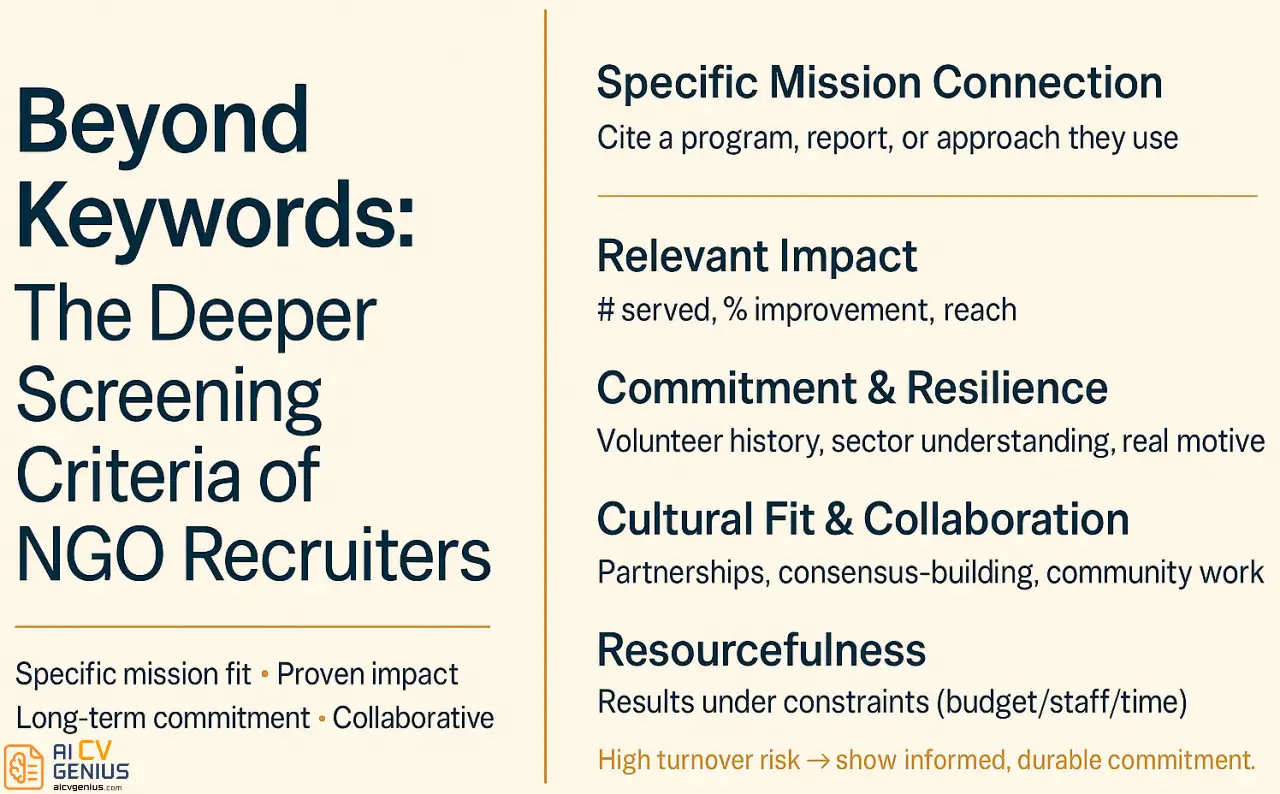
Drawing from numerous conversations with hiring managers across diverse nonprofit sub-sectors (humanitarian aid, environmental advocacy, arts & culture, community development) and analysis of sector hiring trends, several core evaluation points consistently surface beyond basic qualifications:
- ✅ Evidence of Specific Mission Connection & Research: This cannot be overstated. Generic platitudes (“I want to help people,” “I’m passionate about social justice”) are immediate red flags. Recruiters need concrete evidence that you understand their specific work. Have you referenced a particular program they run? Mentioned a recent impact report or news article about them? Connected their approach to a specific community need you’ve observed or experienced? Can you articulate why their method or focus area resonates more strongly than other similar organizations? Lack of specificity signals a lack of genuine interest.
- ✅ Demonstration of Relevant Impact (NGO Context): Listing responsibilities is insufficient. Recruiters need proof of tangible results framed in the language of social impact. Instead of “Managed projects,” articulate “Successfully managed the ‘Clean Water Initiative’ project, resulting in the installation of 15 bio-sand filters providing safe drinking water to approx. 800 villagers.” Quantify beneficiary reach, funds raised, volunteers mobilized, policy changes influenced, or specific program outcomes whenever possible. Even qualitative impact should be described vividly.
- ✅ Indicators of Long-Term Commitment & Resilience: High turnover is a significant challenge and expense for many NGOs. Recruiters scrutinize applications for signals of genuine, durable commitment. This can manifest as: consistent volunteer history (even outside the specific sub-sector), thoughtful explanations for career transitions towards mission-driven work, personal stories authentically connecting the applicant to the cause (used judiciously), or demonstrated understanding of the sector’s challenges (e.g., resource constraints, navigating complex stakeholder environments). They want to hire individuals who are joining for the mission, not just as a stepping stone.
- ✅ Cultural Fit & Collaborative Mindset: Nonprofits often foster highly collaborative, mission-focused cultures. Your cover letter’s tone and content should implicitly convey your ability to thrive in such an environment. Highlighting experiences involving teamwork, cross-sector partnerships, community engagement, and consensus-building is crucial. An overly aggressive, individualistic, or corporate-jargon-laden tone can be off-putting.
- ✅ Resourcefulness and Adaptability: Implicitly woven throughout, recruiters look for clues that you can achieve results creatively and efficiently, often with limited budgets or staff. Highlighting successful projects completed under constraint is a powerful indicator.
The high staff turnover rates often cited in the nonprofit sector (Nonprofit HR data suggests figures frequently exceeding 19%, significantly higher in certain roles) underscore why demonstrating genuine, informed commitment in your cover letter isn’t just a “nice-to-have” – it directly addresses a core operational concern for the hiring organization.
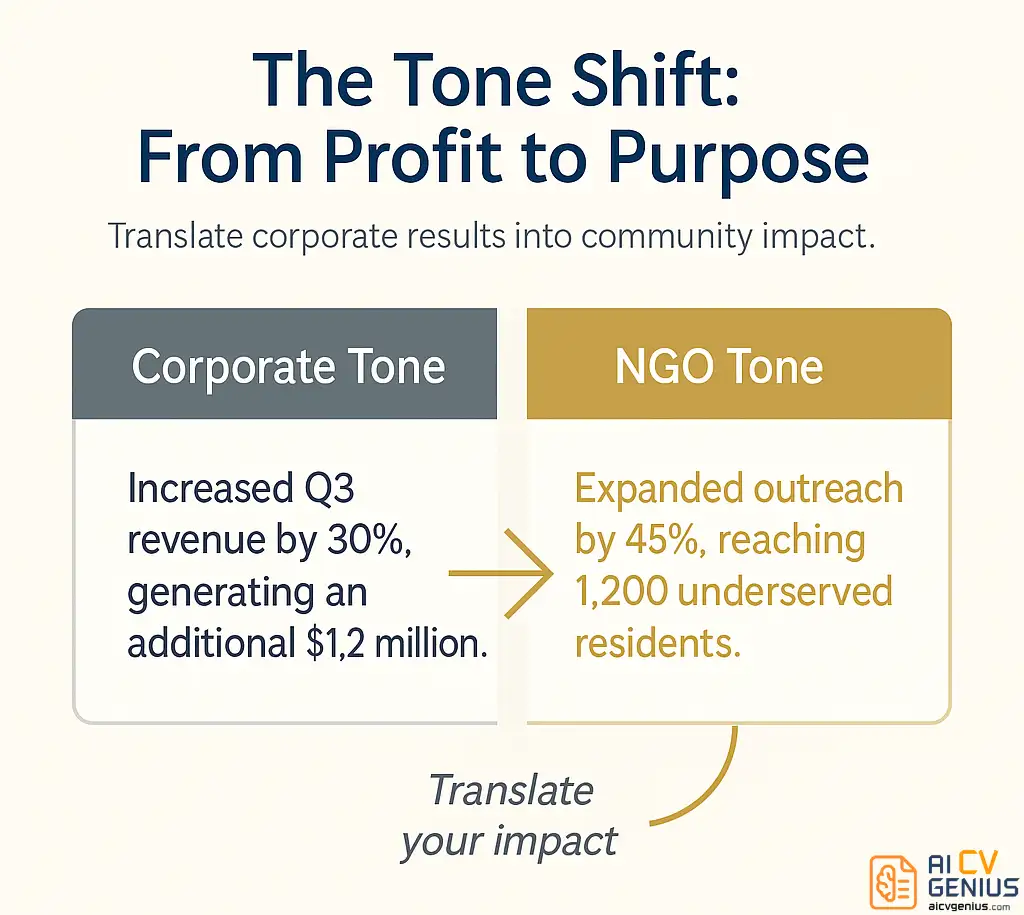
The Crucial Tone Shift: From Profit to Purpose
The language you employ is a powerful signal of your understanding of the sector. While professionalism is essential, the underlying tone needs adjustment.
Corporate Tone Example:
“Leveraging my expertise in market penetration and strategic account acquisition, I successfully increased Q3 revenue by 30% year-over-year, exceeding aggressive targets and capturing significant market share from key competitors through optimized sales funnels.”
Focus: Profit, competition, individual achievement, corporate metrics.
Effective NGO Tone Example (Translating Similar Skills):
“By cultivating strategic partnerships with three key community health clinics and implementing a targeted outreach campaign based on local needs assessments, I successfully expanded program participation by 45% within 12 months, ensuring critical preventative care reached an additional 1,200 previously underserved residents. This collaborative approach built sustainable referral pathways that continue to benefit the community.”
Focus: Collaboration, community benefit, beneficiary reach, sustainability, mission impact. The underlying skills (strategy, outreach, relationship building, results tracking) are similar, but the framing, language (“cultivating,” “collaborative,” “underserved,” “sustainable”), and ultimate metric (people served) are aligned with NGO values.
The Strategic Blueprint: Mastering the 3-Paragraph NGO Cover Letter
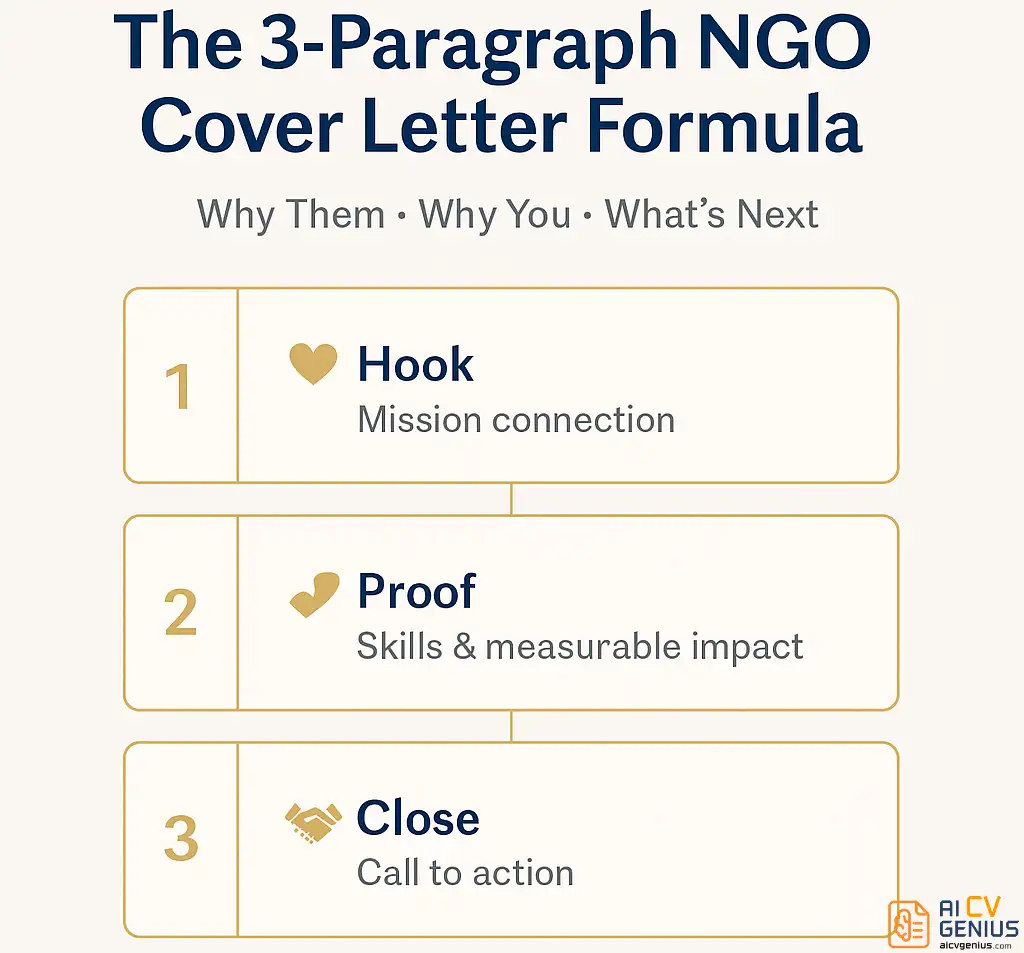
While allowing for personalization, adhering to a clear, concise structure ensures your letter delivers the essential information efficiently and persuasively. This proven three-paragraph framework guides the reader logically from your motivation to your qualifications to the desired next step.
Paragraph 1: The Hook – Establish Specific Mission Resonance (Why Them)
Your opening sentences are your most critical opportunity to differentiate yourself from the generic applicant pool. Do not waste them on stating the obvious (“I am applying for X position”). Instead, immediately demonstrate genuine interest and specific knowledge of this particular organization.
Effective Opening Strategies:
- Reference a Specific Program/Initiative: “Your organization’s innovative use of mobile literacy labs to reach remote communities, as detailed in your recent annual report, directly addresses a challenge I encountered while volunteering in rural Guatemala…” (Shows research and potential relevant experience).
- Connect to Recent News/Achievement: “I was deeply impressed to read about [NGO Name]’s recent success in advocating for [Specific Policy Change] and believe my background in policy analysis could contribute to furthering this vital work…” (Shows awareness and aligns skills).
- Share a Brief, Relevant Personal Connection (Use Judiciously): “Having personally benefited from a mentorship program during a challenging period in my youth, I have a profound appreciation for the impact of organizations like yours, particularly your focus on supporting first-generation college students…” (Establishes authentic motivation, if genuine).
- Mention a Referral or Connection: “My former colleague, [Name], who serves on your advisory board, suggested I reach out regarding the Program Director opening, believing my experience in scaling similar initiatives at [Previous Org] would be a strong asset…” (Leverages network and adds credibility).
- Highlight Alignment with Unique Approach/Values: “The emphasis [NGO Name] places on community-led development, rather than top-down solutions, strongly resonates with my own participatory research experience and belief in empowering local stakeholders…” (Shows understanding of their philosophy).
Goal: Within 3-4 concise sentences, convince the reader that your interest is specific, informed, and genuinely connected to their unique mission and work. Avoid generic praise; focus on concrete details.
Paragraph 2: The Proof – Connect Your Skills & Impact to Their Needs (Why You)
Having established your motivation, this paragraph provides the evidence that you possess the necessary skills and experience to excel in this specific role and contribute meaningfully to their specific goals. This is where you strategically highlight your most relevant accomplishments, translating them into the language of NGO impact.
Effective Strategies for Paragraph 2:
- Directly Address Key Job Requirements: Identify the top 2-3 responsibilities or qualifications listed in the job description. For each, provide a specific, quantifiable example from your past experience (paid or volunteer) demonstrating your proficiency. Implicitly use the STAR method (Situation, Task, Action, Result focused on impact).
- Quantify NGO-Relevant Outcomes: Focus on metrics that matter to nonprofits (see Tip 5). How many people did you serve? How much funding did you secure? By what percentage did you increase program reach or efficiency? How many volunteers did you manage?
- Showcase Understanding of NGO Context: Weave in examples that demonstrate resourcefulness (“achieved X despite a Y% budget cut”), collaboration (“partnered with Z organizations to deliver…”), or adaptability (“successfully pivoted program delivery online during the pandemic, maintaining X% engagement”).
- Bridge Skill Gaps (If Applicable): If transitioning sectors, explicitly connect your transferable skills. “While my experience at [Corporate Job] focused on client acquisition, the underlying skills in relationship building, needs assessment, and persuasive communication are directly applicable to cultivating major donor relationships for [NGO Name].”
- Keep it Focused: Don’t try to cover your entire resume. Select the 1-2 most powerful examples that directly map to the core requirements of this specific role.
Example Snippet (Strong):
The Program Coordinator role requires strong community engagement and volunteer management skills. At my previous position with the Downtown Food Pantry, I redesigned our volunteer onboarding process, which decreased first-month volunteer attrition by 40%. Concurrently, I launched a targeted outreach campaign in partnership with three local community centers, increasing participation in our nutritional workshops by over 200 families within six months. My experience managing diverse stakeholders and measuring program reach aligns directly with your goals for expanding the ‘Healthy Futures’ initiative.
This works by directly addressing stated needs, providing specific actions and quantified results, and explicitly linking the experience to the target initiative.
Paragraph 3: The Close – Confident Call to Action (What’s Next)
End your letter concisely and professionally, reiterating your enthusiasm and clearly stating the desired next step – a conversation.
Effective Closing Elements:
- Briefly Reiterate Enthusiasm & Core Value: A short reinforcement of your interest and key strength. “I am very enthusiastic about the possibility of bringing my expertise in community-led program design to [NGO Name]…”
- Propose the Next Step: Clearly state your desire to discuss further. “…and would welcome the opportunity to discuss how I can contribute to your team in more detail.”
- Provide Clear Logistics: Make it easy for them. “I am available for an interview at your earliest convenience and can be reached via email at [Your Email] or phone at [Your Phone Number].”
- Professional Closing: “Thank you for your time and consideration.” followed by “Sincerely,” or “Respectfully,” and your typed name.
Avoid Weak Closings: Steer clear of passive phrases like “I hope to hear from you” or overly demanding ones. Project polite confidence and make the next step clear and easy for the recruiter.
Illustrative Example: Complete NGO Cover Letter
This comprehensive ngo cover letter sample synthesizes the three-paragraph formula for a hypothetical Program Manager role focused on youth education.
[Your Name]
[Your Address]
[Your Phone Number] | [Your Email Address]
[Your LinkedIn Profile URL (Optional)][Date]
[Hiring Manager Name (if known), Title]
[NGO Name]
[NGO Address]Dear [Mr./Ms./Mx. Hiring Manager Last Name, or “Dear Hiring Team”],
Having closely followed [NGO Name]’s innovative work in closing the educational equity gap for first-generation students in [City/Region] – particularly the impressive outcomes of your ‘College Pathways’ mentorship program highlighted in your 2025 Impact Report – I am writing with genuine enthusiasm to apply for the Program Manager position. My own experience as a first-generation college graduate fuels my deep commitment to this cause, and [NGO Name]’s focus on holistic support, combining academic tutoring with socio-emotional learning, resonates strongly with my professional background in youth development.
In my current role as Senior Coordinator at Bright Futures Initiative, I manage a portfolio of after-school programs serving over 400 high school students across three partner schools. A key achievement involved redesigning our volunteer tutor recruitment and training protocol, which resulted in a 50% increase in active tutors and improved student-tutor match consistency by 60%, directly correlating with a 15-point average increase in participants’ standardized test scores over two years. Furthermore, recognizing a need for better family engagement, I launched a series of bilingual parent workshops on college application processes, attended by over 150 families and praised for demystifying complex procedures. This experience in program enhancement, volunteer management, stakeholder communication (including grant reporting to foundation partners like the [Funder Name] Foundation), and data-driven outcome tracking aligns directly with the requirements outlined for the Program Manager role at [NGO Name].
I am confident that my proven ability to scale impactful programs and build strong community relationships can significantly contribute to [NGO Name]’s mission. I am eager to learn more about this opportunity and discuss how my skills can support your team. I am available for an interview at your convenience and can be reached at [Your Phone Number] or [Your Email Address]. Thank you for your time and consideration.
Sincerely,
[Your Typed Name]
Deconstructing the Effectiveness
- ✅ Hyper-Specific Hook: References a specific program (‘College Pathways’), data source (Impact Report), and target population (first-gen students).
- ✅ Authentic Mission Connection: Shares a relevant personal background element briefly and professionally.
- ✅ Quantified Achievements: Includes multiple specific metrics (400 students, 50% tutor increase, 60% match consistency, 15-point score increase, 150 families).
- ✅ Addresses Key NGO Skills: Demonstrates program management, volunteer coordination, stakeholder communication, grant reporting awareness, data tracking, and community engagement (bilingual workshops).
- ✅ Direct Link to Role Requirements: Explicitly states alignment with the target position.
- ✅ Professional & Confident Tone: Avoids jargon while clearly articulating value.
- ✅ Clear Call to Action: Proposes discussion and provides easy contact details.
Fatal Flaws: The Top 3 Mistakes That Disqualify NGO Cover Letters
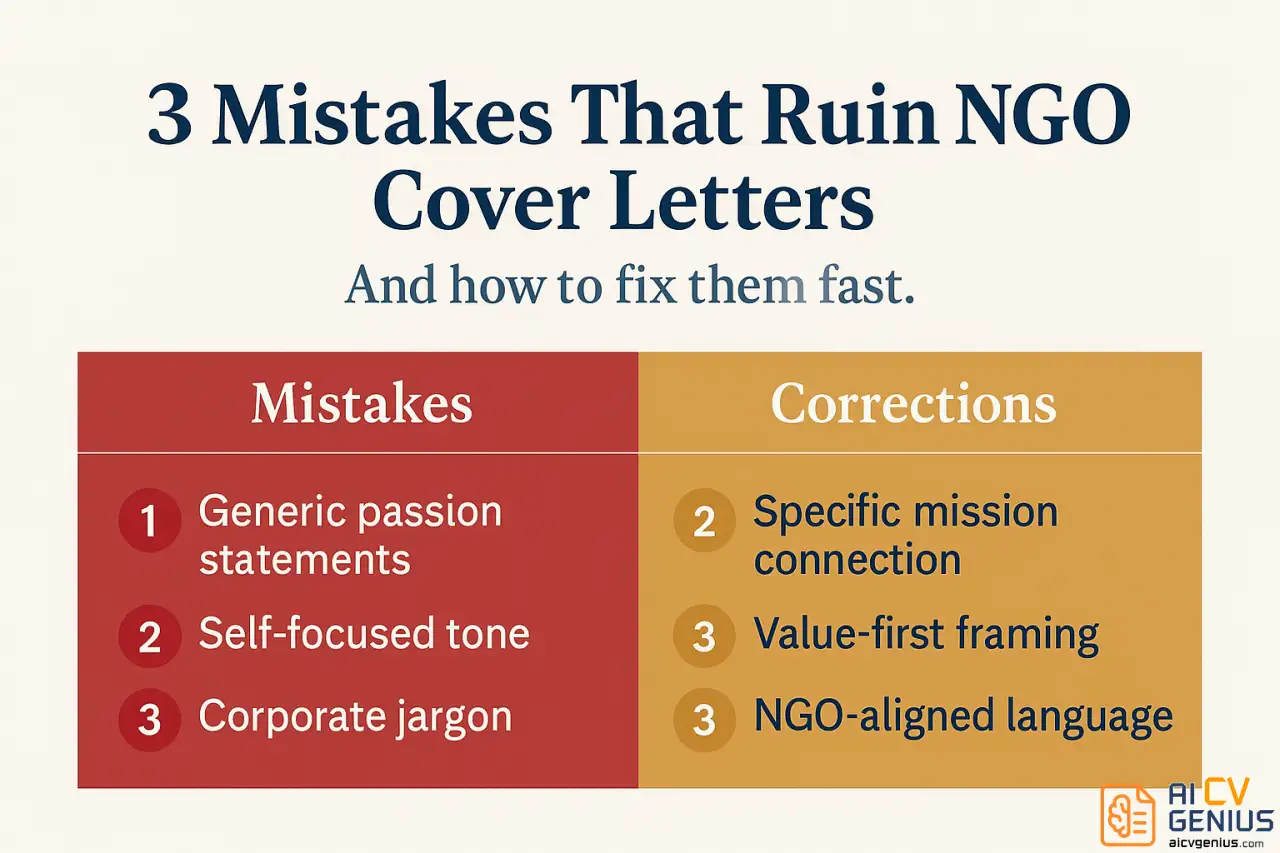
Beyond simply failing to impress, certain errors actively undermine your candidacy and often lead to immediate rejection. Awareness is the first step to avoidance.
Mistake 1: The Curse of Generic Passion (“Helping People” Syndrome)
As highlighted earlier, vague pronouncements of altruism are meaningless noise in the NGO application process. Statements like “I am passionate about making a positive impact,” “I have always wanted to help underserved communities,” or “I believe strongly in giving back” are ubiquitous and convey zero specific interest or understanding.
❓Why It’s Fatal: It demonstrates a fundamental lack of research and strategic thinking. It suggests the applicant hasn’t bothered to understand the specific mission, challenges, or approach of this particular organization. It implies they might be applying indiscriminately to any organization with “nonprofit” in its description. NGOs want candidates invested in their cause, not just the abstract concept of “doing good.”
The Strategic Fix: Always replace generic passion statements with specific, evidence-based connections. Research thoroughly. Find a concrete aspect of their work – a program, a recent success, a unique methodology, a specific community served – and articulate why that specific element resonates with your experience, values, or observations.
Example: Instead of “passionate about environmental issues,” try “Your organization’s focus on grassroots mangrove restoration projects aligns directly with my thesis research on coastal ecosystem resilience…” Specificity signals genuine interest and intellectual engagement.
Mistake 2: The “What’s In It For Me?” Focus
While personal and professional growth are valid career motivations, the cover letter is not the primary venue to emphasize them, especially in the NGO sector. Framing your application around what the organization can do for you signals misaligned priorities.
❌Common Red Flag Phrases:
- “This position offers an excellent opportunity for me to develop my skills in [Area].”
- “I am seeking a role where I can gain hands-on experience in the nonprofit sector.”
- “Your organization’s reputation would be a valuable addition to my resume.”
- “I believe this job will provide the challenge and growth I am looking for.”
❓Why It’s Fatal: NGOs operate with a primary focus on mission delivery. They are hiring individuals to contribute to that mission, not primarily to serve as a training ground or resume builder. An applicant perceived as overly focused on personal gain raises concerns about their long-term commitment and willingness to prioritize organizational needs, especially when resources are scarce.
The Strategic Fix: Invert the perspective. Frame your skills and aspirations exclusively in terms of the value you will deliver to the organization and its beneficiaries. Instead of “I want to gain grant writing experience,” position it as “My background in persuasive writing and detailed research equips me to quickly contribute to your grant writing efforts, helping secure the resources needed to expand [Specific Program].” Focus entirely on solving their problems and advancing their mission.
Mistake 3: The Language Barrier – Inappropriate Corporate Jargon
While professionalism is key, deploying overly aggressive, competitive, or profit-centric corporate terminology can create dissonance and signal a lack of cultural understanding within the typically more collaborative and mission-focused NGO environment.
Examples of Potentially Jarring Corporate Phrases:
- “Crushing goals,” “dominating the market,” “maximizing shareholder value”
- Overuse of terms like “synergize,” “leverage,” “bandwidth,” “circle back”
- Heavy emphasis on “ROI” without connecting it to social impact
- Describing beneficiaries as “customers” or “consumers” (unless appropriate for a specific social enterprise context)
❓Why It’s Fatal: It suggests the candidate hasn’t adapted their communication style and may not fully grasp the different values and operational realities of the nonprofit sector. It can come across as tone-deaf or overly focused on metrics that aren’t the primary drivers for the organization.
The Strategic Fix: Immerse yourself in the language of the sector and the specific organization. Read their website, annual reports, newsletters, and social media. Note the terminology they use to describe their work, impact, and stakeholders. Mirror that language appropriately. Focus on terms like “collaboration,” “community,” “impact,” “sustainability,” “beneficiaries,” “stakeholders,” “capacity building,” and “mission alignment.” Translate your corporate achievements into this lexicon (as shown in Tip 2).
Tailoring Your Message: Customizing for Specific NGO Roles
While the core 3-paragraph structure remains consistent, the specific content, emphasis, and highlighted skills must be meticulously tailored to the requirements and nuances of the particular role you are targeting.
Targeting Entry-Level NGO Positions (Program Assistant, Coordinator)
When professional nonprofit experience is limited, your cover letter must strategically leverage other assets:
- Amplify Volunteer & Internship Experience: Treat these roles with the same detail and impact focus as paid work. Quantify achievements if possible (e.g., “# hours contributed,” “# people assisted,” “event attendance achieved”).
- Highlight Relevant Coursework & Academic Projects: Mention specific university projects, research papers, or courses directly related to the NGO’s field or required skills (e.g., “My capstone project analyzed barriers to healthcare access in rural communities, providing me with a strong foundation for understanding the challenges your mobile clinics address.”).
- Showcase Transferable Skills from Any Experience: Frame skills gained in retail (customer service, problem-solving), food service (working under pressure, teamwork), or administrative roles (organization, communication) in terms relevant to NGO operations (e.g., “My experience handling complex customer inquiries in a fast-paced retail environment developed my ability to communicate empathetically and effectively with diverse individuals, a skill crucial for beneficiary support roles.”).
- Emphasize Passion with Specificity & Proactivity: Clearly articulate why you are drawn to this specific mission and mention any proactive steps taken (attending webinars, informational interviews, subscribing to their newsletter) to learn more. Demonstrate eagerness to learn and contribute.
Your goal is to showcase potential, relevant foundational skills, and undeniable commitment.
Targeting NGO Program/Project Manager Roles
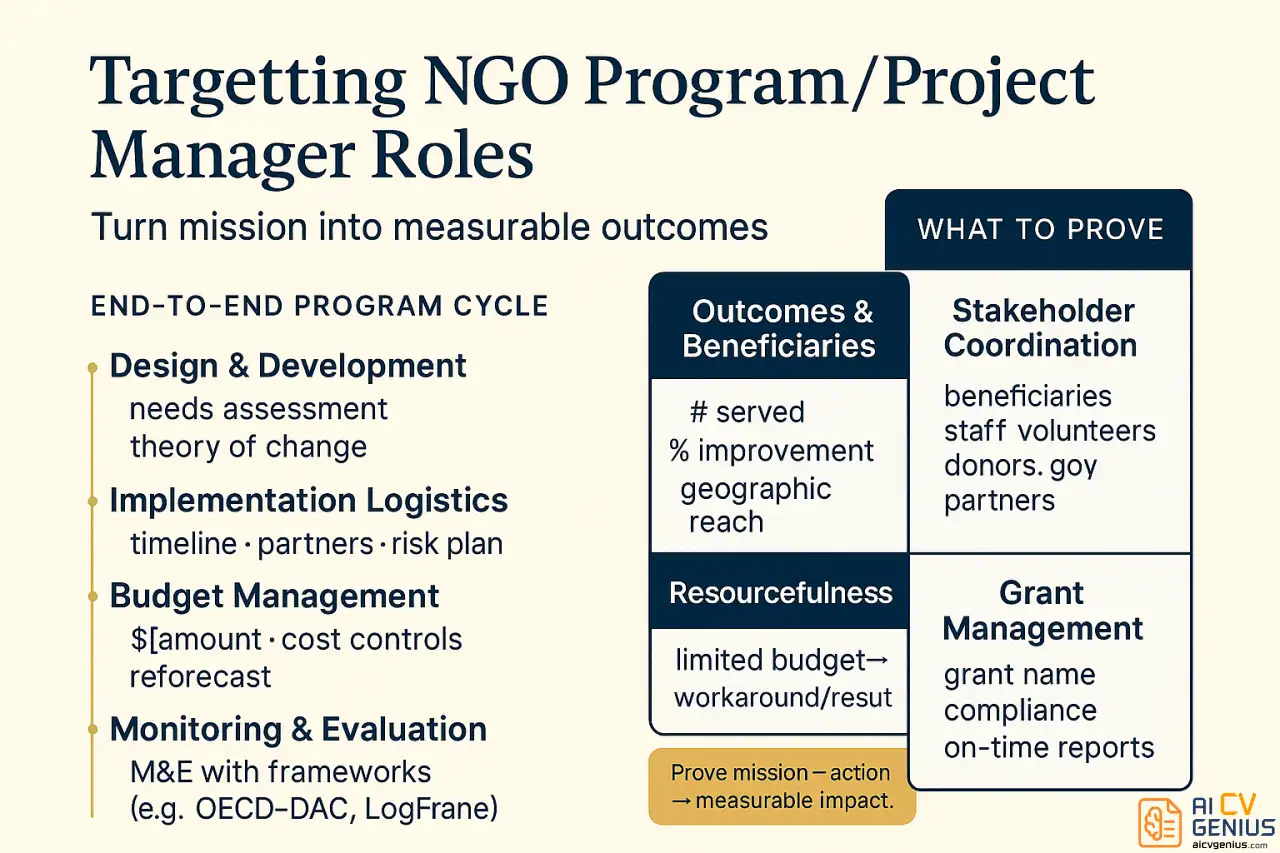
These roles demand a blend of strategic thinking, operational execution, and stakeholder management within a mission context.
- Focus on End-to-End Program Cycle: Provide examples covering program design/development, implementation logistics, budget management ($ amount), monitoring & evaluation (M&E – mention specific frameworks if used), and reporting.
- Quantify Program Outcomes & Beneficiary Impact: Use metrics demonstrating program success (e.g., # served, % outcome improvement, geographic reach expanded).
- Highlight Stakeholder Coordination: Detail experience working with diverse groups – beneficiaries, staff, volunteers, donors, government agencies, community partners. Emphasize collaboration and consensus-building.
- Demonstrate Resourcefulness: Give examples of successfully managing programs with limited budgets or navigating unexpected challenges.
- Showcase Grant Management/Reporting Experience: If applicable, mention experience managing activities funded by specific grants and fulfilling reporting requirements.
Prove you can translate mission into effective, measurable action.
Targeting Fundraising/Development Roles
These roles are critical for NGO sustainability. Your letter must demonstrate a proven ability to secure resources.
- Quantify Fundraising Results Aggressively: $ amount raised (specify individual gifts, grants, corporate sponsorships, events), % increase in donations, # new donors acquired, donor retention rates improved.
- Detail Grant Writing Success: Specify types of funders (foundation, government, corporate), $ amount requested vs. secured, examples of successful proposals.
- Showcase Donor Cultivation & Stewardship: Describe experience building relationships with individual donors, managing donor databases (mention specific CRMs like Salesforce NPSP), and implementing stewardship plans.
- Highlight Event Management Experience: Detail successful fundraising events planned and executed ($ raised, attendance, ROI).
- Emphasize Communication & Persuasion Skills: Frame your ability to articulate the organization’s mission compellingly to potential supporters.
Focus relentlessly on your ability to generate revenue and build sustainable funding streams.
Targeting NGO Roles as a Career Changer (Corporate to Nonprofit)
Your cover letter is paramount for explaining the transition and reframing your background.
- Address the “Why” Directly and Authentically: Clearly state your motivation for moving into the nonprofit sector. Connect it genuinely to the target NGO’s mission or a personal experience. Avoid clichés about “wanting more meaning.”
- Explicitly Translate Skills: Don’t assume the reader will connect the dots. Map your corporate competencies (project management, data analysis, marketing strategy, financial oversight) directly to the requirements of the NGO role using sector-appropriate language (see Tip 2).
- Leverage Any Nonprofit Exposure: Prominently feature volunteer work, pro bono consulting, board service, or even relevant personal projects to demonstrate understanding and commitment to the sector.
- Acknowledge the Learning Curve (If Appropriate): Show self-awareness. “While my background is in [Corporate Field], I am a quick learner, actively pursuing [Relevant Course/Certification], and deeply committed to applying my [Transferable Skill] to achieve [NGO’s Mission].”
- Focus on Value Proposition: Emphasize the unique perspective or skills you bring because of your different background (e.g., bringing analytical rigor from finance, applying marketing discipline to outreach).
Your cover letter must build the bridge between your past experience and their future needs.
Frequently Asked Questions: Mastering the NGO Cover Letter
Beyond Application: Your Cover Letter as a Mission Statement
The most effective ngo cover letter example transcends mere application formality. It functions as a personal mission statement, a narrative bridge connecting your unique skills and experiences to the specific purpose and needs of the organization you seek to join. It’s your prime opportunity to articulate the ‘why’ behind your ‘what,’ demonstrating not just competence, but conviction.
Mastering the 3-paragraph formula – Hook (Why Them), Proof (Why You), Close (What’s Next) – provides the essential structure. But true impact comes from the substance within: meticulous research yielding specific organizational insights, authentic (and often personal) connections to the cause, concrete examples of relevant achievements quantified in terms of social impact, and a tone that reflects genuine understanding of the collaborative, resource-conscious, mission-first ethos of the nonprofit sector.
Steer clear of the pitfalls that doom the majority of applications: generic platitudes about “helping people,” a self-serving focus on personal gain, and the discordant clang of corporate jargon. Instead, invest the time to tailor each letter, translating your background into the language of impact and demonstrating unequivocally that your interest is both informed and deeply held.
Remember the crucial role this document plays. NGO hiring managers aren’t just filling roles; they are selecting individuals entrusted with advancing often critical social or environmental missions, frequently under demanding conditions. Your cover letter is your primary chance, beyond the factual resume, to convince them you possess the requisite blend of skill, resilience, and unwavering commitment to be a valuable partner in that vital work. Make it count.
Craft it with honesty. Infuse it with specificity. Edit it for brevity and clarity. When executed strategically, the NGO cover letter remains a potent tool, far from obsolete, capable of elevating your application from the qualified pool to the truly compelling few.
Ready to craft application materials that truly resonate within the nonprofit sector? Explore our tailored cover letter templates and delve into our comprehensive library of career resources designed specifically for purpose-driven professionals.