
- Remote hiring is a trust test: Your remote job cover letter is your “handshake” and has to prove reliability, accountability, and clear communication before anyone can even evaluate your skills.
- Remote managers read for signals beyond competence: They want Professional Friendliness, which means Warmth (easy to collaborate with) plus Precision (organized, detail-oriented, dependable), and they reject letters that feel robotic or overly casual.
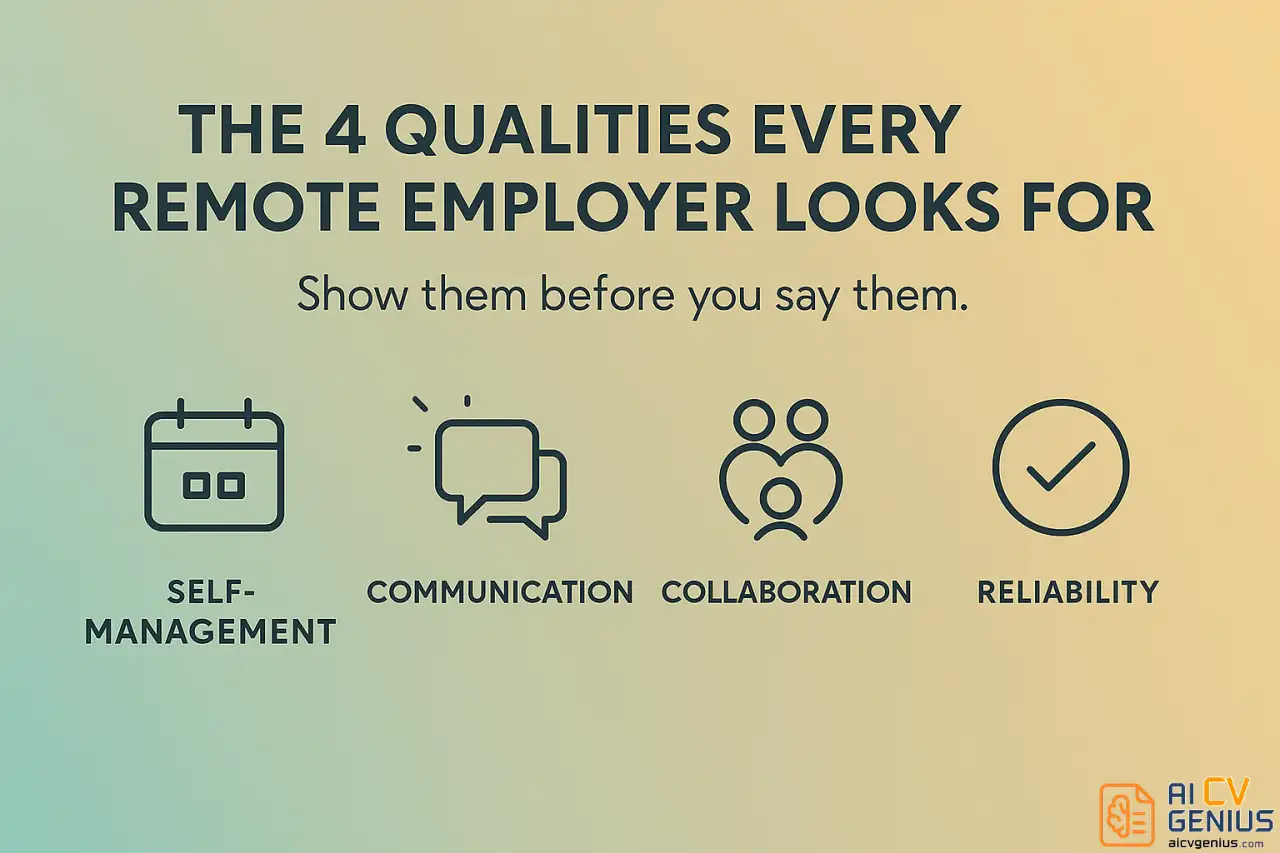
- Use the article’s 4-part blueprint: Opening Hook (name the remote role and show you understand remote work), Value Statement (your remote impact in one strong claim, ideally with a number), Proof of Reliability (a concrete remote example with tools and outcomes), Closing Line (confident, collaborative next step).
- Show remote readiness with evidence, not tool lists: Weave tools into actions and results (Asana, Slack, Notion, Loom, Jira, Confluence, Git), prove independence and proactive updates, and include measurable proof like on-time delivery rates, reduced meeting time, retention, or cross-time-zone execution.
- Finish like a polished remote professional: Keep paragraphs short for screen reading, use clean formatting and PDF, add one brief human line if it fits, think in the “Trust Equation” (Credibility, Reliability, Connection, Low self-focus), follow up after 5 to 7 business days, and use the FAQs to guide length (about 200 to 300 words) and what to do if you have no official remote history.
Introduction: Why Remote Cover Letters Matter More Than Ever
In a world where you might never meet your boss face-to-face, your remote job cover letter becomes your handshake, your first impression, and your credibility test – all in one message. It’s the digital embodiment of your professionalism and reliability.
Employers hiring remotely aren’t just looking for skills; they’re fundamentally assessing trust. Can you stay accountable without direct supervision? Can you communicate clearly and proactively across different time zones? Can you manage your time and tasks like a seasoned professional, even from your home office? Your cover letter must proactively address these underlying questions before they are even explicitly asked.
“When you apply remotely, your words are your presence – they have to prove reliability before results.”
This guide delves into crafting a cover letter that not only showcases your qualifications but also builds that essential trust, making you stand out in the rapidly growing remote job market.
Decoding the Remote Employer’s Mindset: Beyond Skills
Remote hiring managers operate under a different set of assumptions and priorities compared to their in-office counterparts. They can’t rely on traditional cues like body language, office demeanor, or casual hallway conversations to gauge your personality or work ethic. Instead, they scrutinize your written communication for signals of dependability, clarity, and ease of collaboration. Your cover letter, therefore, needs to strike a delicate balance, blending two crucial energies:
- Warmth: Conveying approachability, empathy, and a collaborative spirit. This assures them you’ll be a positive and communicative team member, even virtually.
- Precision: Demonstrating clarity, organization, and attention to detail. This signals that you are reliable, can follow instructions, and manage your work effectively without constant oversight.
A letter that sounds too stiff or formal might come across as robotic or difficult to connect with. Conversely, one that’s overly casual or informal can raise red flags about professionalism and self-discipline. The sweet spot? Professional friendliness – a tone that is confident, clear, and genuinely human, showing you can be both personable and productive from a distance.
The Remote Cover Letter Blueprint: A 4-Part Structure for Impact
A well-structured cover letter guides the reader smoothly and makes your key points memorable. This simple, four-part framework consistently delivers clarity and impact for remote roles:
| Section | Purpose | Content Guidance & Example |
|---|---|---|
| 1. Opening Hook | Immediately capture interest and state your purpose clearly. Show you understand the remote context. | Express enthusiasm for the specific remote role and mention where you saw it. Briefly connect your relevant remote work experience or mindset. Example: “I was genuinely excited to discover the remote Project Coordinator opening on [Platform]. Having successfully managed collaborations across global teams for the past three years, I thrive in environments that value clear communication and asynchronous efficiency.” |
| 2. Value Statement | Succinctly explain how you solve problems or deliver results in a remote setting. Focus on impact. | Provide a high-level overview of your core strength relevant to remote work, ideally with a quantifiable element. Example: “Over the last three years leading distributed marketing teams, my focus on structured workflows and proactive communication resulted in 98% of projects being delivered on schedule, despite complex time zone differences.” |
| 3. Proof of Reliability | Offer specific, concrete examples demonstrating your self-management, communication, and remote tool proficiency. | Detail a situation or project where you successfully navigated remote work challenges. Mention specific tools and outcomes. Example: “At [Previous Company], I managed client relationships across four international time zones, utilizing Asana for task tracking, Slack for daily updates, and Notion for documentation, ensuring seamless project progression without a single missed client deadline.” |
| 4. Closing Line | End with a confident, approachable call to action that invites further conversation. | Reiterate your interest and suggest the next step, framing it collaboratively. Example: “I am eager to discuss how my experience in fostering clarity and driving results within remote teams can contribute to your next product launch. Thank you for your consideration.” |
This structure ensures your letter is concise, value-driven, and directly addresses the unique demands of remote employment.
Example: Remote Marketing Coordinator Cover Letter (Annotated)
Below is a complete sample written for a mid-level remote marketing applicant. Notice the deliberate choices in tone – clear, confident, yet personal and collaborative:
Subject: Application for Remote Marketing Coordinator – [Your Name]
Hi [Hiring Manager’s Name],
[Opening Hook: Immediate connection and relevance]
As someone who’s not only managed but genuinely thrived in leading digital campaigns across remote teams spanning three time zones, I was excited to see your opening for a Marketing Coordinator. I understand firsthand the importance of keeping communication tight, deliverables consistent, and team morale high – especially when collaboration happens across thousands of miles.[Value Statement & Proof: Quantifiable results and remote tools]
In my previous role at [Previous Company], I spearheaded a cross-functional remote team that successfully increased user engagement by 37% within six months. This was achieved through meticulous planning in Asana, clear asynchronous updates via Loom videos, and fostering a collaborative environment in our dedicated Slack channels. I firmly believe that clarity, empathy, and proactive accountability are the foundational currencies of successful remote work – and I bring all three to every project I undertake.[Closing Line: Confident and collaborative call to action]
I am eager to discuss how my structured approach to remote campaign management and my commitment to team alignment can help streamline your next marketing initiative. Thank you for considering my application.Warm regards,
[Your Name] [Your LinkedIn Profile URL (Optional)] [Your Portfolio URL (Optional)]
This letter is effective because it’s:
- Concise: Respects the reader’s time (under 250 words).
- Specific: Mentions tools (Asana, Loom, Slack) and quantifiable results (37% increase).
- Confident: Uses strong action verbs (“spearheaded,” “achieved”).
- Human: Emphasizes values like clarity, empathy, and accountability.
- Proactive: Shows ownership and self-management, not dependency.
Highlighting Remote-Specific Skills: The How Matters More Than the What
The Difference-Maker: Proof of Independence
The fundamental principles of a good cover letter – clarity, relevance, enthusiasm – remain unchanged for remote roles. However, there’s an added layer of emphasis: demonstrating your ability to thrive autonomously. Remote employers cannot afford the time or resources for constant micromanagement. They prioritize candidates who exhibit strong self-discipline, proactive communication, and effective self-management. Your cover letter must implicitly or explicitly convey:
- ✅ You deliver results without needing constant supervision or hand-holding. Show initiative and ownership in your examples.
- ✅ You communicate proactively and clearly, especially in writing. Mention asynchronous updates or documentation practices.
- ✅ You are proficient with, or adaptable to, common asynchronous collaboration tools. Name-dropping tools isn’t enough; show how you used them effectively.
- ✅ You can manage your time effectively and produce consistent results, regardless of location or time zone differences. Highlight successful cross-time-zone collaborations or meeting deadlines independently.
Ultimately, all these points converge into a single, powerful message: “I have successfully navigated the challenges of remote work before, and I can be trusted to do so effectively for your team.” This assurance is often the deciding factor in remote hiring decisions.
Weaving Remote Skills Into Natural Language: Show, Don’t Just List
Avoid simply listing remote work tools like “Proficient in Slack, Zoom, Trello.” This tells the reader very little about your actual capabilities. Instead, integrate these tools into concise descriptions of your actions and achievements to demonstrate practical application and impact. Compare these examples:
Weak: “Familiar with Asana.”
Strong: “Utilized Asana to coordinate project tasks across a distributed team of five global contributors, maintaining daily visibility on progress and proactively addressing potential blockers despite overlapping time zones.”
Weak: “Used Slack for communication.”
Strong: “Implemented dedicated Slack channels for project updates and Q&A, reducing email clutter by 40% and ensuring all remote team members had access to real-time information.”
Weak: “Knows Notion.”
Strong: “Developed and maintained a centralized project knowledge base in Notion, providing the remote team with a single source of truth for documentation, meeting notes, and standard operating procedures.”
The stronger examples illustrate the difference between merely knowing a tool and strategically mastering its use to enhance remote collaboration, efficiency, and transparency. If you’re crafting your professional materials from scratch and need inspiration for phrasing or structure, exploring resources like AI Cover Letter Templates can be beneficial. These tools often provide pre-written examples designed for clarity, professional tone, and adaptability, which you can then customize to reflect your unique remote work experiences and skills.
Demonstrating the Remote-Ready Mindset: Signaling Discipline and Proactivity
Beyond specific skills and tools, remote employers look for indicators of a “remote-ready” mindset – evidence that you possess the intrinsic motivation, discipline, and organizational habits necessary to thrive without the structure of a physical office. Briefly mentioning how you structure your workday, manage focus, or communicate proactively can significantly strengthen your application. Consider incorporating subtle signals like these:
“I thrive in autonomous environments and am accustomed to structuring my workday using time-blocking techniques and prioritizing tasks based on project milestones. My routine includes dedicated periods for focused deep work and proactive asynchronous updates to ensure team alignment without relying on constant meetings.”
“My approach to remote collaboration emphasizes proactive communication. I typically start my day by reviewing project boards and providing brief status updates via Slack, ensuring my colleagues are aware of progress and any potential impediments early on.”
These small details do more than just describe your process; they humanize your application, paint a picture of a disciplined and reliable professional, and subtly reassure the hiring manager that you can manage yourself effectively from anywhere.
Finding the Right Tone: Balancing Confidence and Approachability
The most effective remote cover letters project confidence without sounding arrogant, and approachability without seeming overly casual. Aim for a tone that feels like a capable and friendly colleague, not a distant contractor or an overly eager applicant. Avoid language that suggests dependence or requires constant validation.
Here’s how to rephrase common statements to project a more collaborative and self-assured partnership mindset:
| Weak / Dependent Phrasing | Stronger / Growth-Oriented Rewrite | Why it Works Better |
|---|---|---|
| “I’m available for any task you need and eager to learn.” | “I am proactive in taking ownership of projects that align with team priorities and confident in my ability to learn new systems quickly.” | Shows initiative and confidence in learning, not just availability. |
| “I work well independently but need clear instructions.” | “I balance autonomy with proactive check-ins and clarifying questions to ensure progress remains transparent and aligned with objectives.” | Highlights proactive communication and alignment, not dependency on instructions. |
| “I’m looking for a stable remote job where I can contribute.” | “I am seeking a long-term remote partnership where my skills in [mention key skill] can consistently add measurable value to your team’s goals.” | Frames the relationship as a partnership focused on mutual value, not just stability for the applicant. |
This subtle shift in phrasing positions you as a proactive contributor ready to integrate into their remote workflow, rather than someone needing constant guidance.
Communication: The Undisputed Remote Superpower
In a remote setting, effective communication isn’t just a soft skill – it’s arguably the most critical performance indicator. Since managers can’t physically observe your work process, they rely heavily on the clarity, conciseness, and timeliness of your written and verbal updates. A well-structured, error-free, and thoughtfully phrased cover letter serves as immediate proof that you possess strong communication skills. Your letter implicitly demonstrates your ability to:
- Organize thoughts logically.
- Articulate value concisely.
- Pay attention to detail (grammar, spelling).
- Adopt a professional yet engaging tone.
Beyond the structure itself, explicitly highlighting your communication approach can further reinforce this strength:
“My communication style prioritizes clarity and context, whether I’m documenting project progress in Notion or providing quick updates via Slack. I believe that effective asynchronous communication is key to keeping distributed teams aligned and productive.”
Emphasizing both clarity (logical presentation) and empathy (understanding the recipient’s perspective, choosing the right communication channel) showcases the nuanced communication skills that define successful remote leadership and collaboration.
“In remote work, clarity isn’t optional – it’s your strongest signal of reliability.”
Adding Measurable Proof of Remote Success
Vague claims about remote work proficiency are easily dismissed. Concrete numbers and specific examples provide undeniable proof that you not only understand remote work but excel within its unique constraints. Weave quantifiable achievements into your narrative to demonstrate tangible impact:
- ✅ “Successfully coordinated a fully remote team of 12 international developers to deliver 5+ major feature releases per quarter, consistently meeting project deadlines with zero delays over 18 months.”
- ✅ “Implemented a system of daily asynchronous updates via Notion dashboards, reducing time spent in status meetings by 40% while improving project transparency across departments.”
- ✅ “Managed a portfolio of 15 key client accounts entirely remotely, maintaining a 100% client retention rate over a two-year period through proactive communication and virtual check-ins.”
- ✅ “Transitioned a traditionally co-located support team to a hybrid remote model, maintaining an average customer satisfaction score of 95% during the transition period.”
Even if exact numbers aren’t available, using specific examples of processes improved, tools implemented, or challenges overcome in a remote context adds significant weight to your application.
Adapting for Technical Roles: Example Remote Developer Letter
The same structural principles apply even for highly technical roles, but the emphasis shifts slightly towards demonstrating both coding proficiency and effective remote collaboration within development workflows:
Subject: Application for Senior Remote Full-Stack Developer – [Your Name]
Hi [Hiring Manager’s Name],
[Opening Hook: Blend technical skill with remote work understanding]
As a full-stack developer with over five years of experience building scalable applications in fully remote environments, I’ve learned that great code thrives on equally great communication. My daily rhythm balances focused, independent development time with structured asynchronous updates via Jira and Slack, ensuring teams stay aligned without succumbing to meeting overload.[Value Statement & Proof: Technical achievement in a remote context]
In my last role at [Previous Distributed Company], I architected and implemented a new microservices feature that successfully reduced average server response time by 28% – a project managed entirely remotely across team members in three continents using Git for version control and Confluence for documentation. I am confident I can bring that same blend of technical expertise, reliability, and clear communication to your engineering team.[Closing Line: Forward-looking and collaborative]
I am excited by the prospect of contributing my skills to your upcoming product sprint and would welcome the opportunity to discuss this further.Best,
[Your Name] [Link to GitHub Profile] [Link to Personal Portfolio/Website]
This example highlights technical impact (28% reduction), remote workflow tools (Jira, Slack, Git, Confluence), and the core remote values of communication and reliability.
The Complete Remote Cover Letter Example (Putting It All Together)
Here is a full, practical example of a remote cover letter. This sample is for a fictional candidate, Jane Doe, applying for a Remote Project Manager role. It is formatted using the specific HTML and inline-CSS style requested to ensure it renders perfectly in the Classic Editor, and it contains no subheadings (H3, H4, etc.) within the example block.
JANE DOE
Remote Project Manager
(555) 987-6543 | j.doe@email.com | linkedin.com/in/janedoePM
November 10, 2025
David Lee
Hiring Manager
TechFlow Solutions Inc.
Subject: Application for the Remote Project Manager position (ID: 789-RMT)
Dear Mr. Lee,
I was excited to see the opening for the Remote Project Manager position at TechFlow Solutions. As a certified PMP with over 7 years of experience managing distributed development teams, I have a proven track record of delivering complex SaaS projects on time, driven by a communication framework that prioritizes clarity and asynchronous efficiency.
In my most recent role at WebWeavers Ltd., I led a fully remote team of 10 engineers and designers across five time zones. By implementing a centralized “source of truth” in Notion and standardizing our sprint planning in Jira, I successfully reduced meeting overhead by 30% while increasing on-time project delivery from 80% to 95% within one year. I am adept at using tools like Slack, Asana, and Loom to maintain team alignment and provide transparent progress updates to C-level stakeholders.
My approach is built on proactive communication and meticulous organization – the two pillars I believe are essential for any remote team’s success. I am confident I can bring this same level of discipline and positive, results-driven leadership to your team.
I am eager to discuss how my experience can help TechFlow Solutions achieve its upcoming product goals. Thank you for your time and consideration.
Sincerely,
Jane Doe
Presentation Matters: Subtle Design Cues for Remote Readability
Since your cover letter will likely be read on a screen (desktop or mobile), optimize its visual presentation for digital readability. Small design choices signal thoughtfulness and respect for the reader’s experience:
- Short Paragraphs: Break up dense text into smaller, digestible chunks (3-5 sentences maximum per paragraph).
- Ample White Space: Use generous margins and spacing between paragraphs to create a clean, uncluttered look.
- Clear Headings (if applicable): While less common in cover letters than resumes, if you structure sections, ensure headings are clear and consistent.
- Professional Font: Stick to standard, readable sans-serif fonts like Inter, Lato, Calibri, or Arial.
- PDF Format: Always save and send as a PDF to preserve formatting perfectly. Avoid sending editable .docx files unless specifically requested.
A simple, clean, and well-spaced document is easier to scan quickly and subconsciously communicates organization and professionalism – key traits for remote roles.
Adding a Human Touch Without Losing Professionalism
Remote teams often place a high value on personality fit and cultural alignment, as building rapport virtually requires more intentional effort. While maintaining professionalism, injecting a brief, authentic touch of personality can help you build connection and stand out. Consider adding a single, concise line that offers a glimpse into who you are beyond your professional skills, particularly if it relates subtly to remote work strengths like focus or discipline:
“When I’m not deep in debugging code, I find that practicing mindfulness helps maintain the focus and patience required for complex problem-solving – a skill equally valuable in remote collaboration.”
“Outside of optimizing marketing funnels, I’m an avid long-distance runner, which has taught me a lot about setting goals, maintaining discipline, and pushing through challenges – qualities I bring to my remote work ethic.”
Keep it brief, relevant, and authentic. A touch of human warmth can make a recruiter smile, feel a connection, and remember your application more vividly later.
The Implicit “Trust Equation” Every Remote Employer Calculates
Ultimately, before extending an offer for a remote position, hiring managers subconsciously run a quick risk assessment based on the “Trust Equation.” They ask themselves:
- ✅ Credibility: Does this person possess the necessary skills and experience to do the job effectively? (Proven by your quantifiable achievements and technical mentions).
- ✅ Reliability: Can I trust this person to deliver consistent results, meet deadlines, and manage their time without constant supervision? (Proven by examples of self-management, proactive communication, and past remote success).
- ✅ Intimacy/Connection: Does this person seem like someone who will communicate openly, collaborate well virtually, and be easy to work with? (Proven by your professional yet warm tone, clarity, and empathy).
- ✅ Self-Orientation (Low): Is this person focused on team goals and company success, or primarily on their own convenience? (Proven by aligning your goals with theirs and focusing on contribution).
Your cover letter is your first, crucial input into this equation. By addressing each element – demonstrating skills, proving reliability, fostering connection, and focusing on contribution – you significantly increase their confidence in hiring you for a remote role. That’s why the tone and evidence in your letter often matter more than simply using a generic template.
Follow-Up Strategy: Patience and Professionalism
When to Follow Up After Applying
Remote hiring processes can sometimes move slower than in-office ones due to coordination across time zones or virtual interview scheduling. Exercise patience, but don’t hesitate to follow up professionally if you haven’t heard back within a reasonable timeframe. A good rule of thumb is to wait 5–7 business days after submitting your application (or after your last interview stage) before sending a brief follow-up email.
How to Phrase Your Follow-Up
Keep your follow-up email concise, polite, and value-focused. Avoid sounding demanding or impatient. Simply reiterate your interest and gently remind them of your application.
Subject: Following Up – Application for [Job Title] – [Your Name]
Dear [Hiring Manager Name],
I hope this email finds you well. I’m writing to gently follow up on my application for the [Job Title] position I submitted on [Date]. I remain very interested in the opportunity to contribute my skills in [mention 1-2 key skills] to your team, particularly given my experience in [mention relevant remote experience aspect]. Could you possibly provide an update on the hiring timeline? I’m happy to provide any further information needed. Thank you again for your time and consideration.
Best regards,
[Your Name]
This approach is professional, non-intrusive, and reinforces your continued interest without adding pressure.
Case Study: From Generic Applicant to Remote Team Lead
James, a talented UX designer with several years of experience, was struggling to land interviews for fully remote positions. He had applied to over a dozen roles using a standard cover letter template that focused solely on his design skills and portfolio projects. Frustrated, he sought feedback and realized his letters sounded generic and failed to address the specific demands of remote work.
He decided to rewrite his cover letter, consciously incorporating stories and examples that highlighted his remote leadership and collaboration skills. He mentioned:
- How he used Figma’s collaborative features and asynchronous video feedback (Loom) to manage design reviews across different time zones.
- How he proactively created detailed process documentation in Notion, which reduced onboarding time for new remote team members.
- A specific instance where he resolved a communication breakdown between remote developers and stakeholders through structured virtual meetings and clear action items.
He also adjusted his tone to be more confident and collaborative. Within three weeks of sending out his revised, remote-focused cover letters, James received three interview requests and ultimately landed a fully remote role leading a distributed design team of seven. The difference? Shifting the narrative from just “design skills” to “design leadership in a remote context,” backed by specific proof and a personality that shone through.
Key Takeaways for a Winning Remote Letter
To summarize, a compelling remote job cover letter effectively signals the qualities employers prioritize for distributed teams:
| Element | What It Demonstrates to the Employer |
|---|---|
| Clear, Concise Opening | Respect for their time; ability to get straight to the point. |
| Concrete, Quantifiable Results | Proven ability to deliver value and measure success, even remotely. |
| Collaborative & Proactive Tone | Indication of being easy to work with, communicative, and reliable. |
| Mention of Remote Tools/Workflows | Familiarity with the practicalities and best practices of distributed teams. |
| Balanced Personality (Professional + Human) | Signals good communication skills, emotional intelligence, and potential cultural fit. |
| Error-Free Writing & Clean Formatting | Attention to detail, professionalism, and clear thinking. |
If you’re looking to explore different tones, structures, or phrasing techniques adapted specifically for remote-first roles, browsing resources in sections like Career Resources can provide valuable inspiration. These often include sample letters, templates, and storytelling strategies designed to highlight independence and communication skills effectively.
Conclusion: The Remote Letter as a Reflection of Trust
Ultimately, writing an effective cover letter for a remote job is about earning confidence through words. It’s your primary opportunity to demonstrate that you possess not only the required skills but also the self-discipline, communication habits, and reliability essential for success outside a traditional office setting. Your cover letter should implicitly answer the fundamental question in every remote hiring manager’s mind: “Can I count on this person – even when I can’t physically see them?”
“The best remote workers don’t just meet deadlines – they actively remove distance through clarity and connection.”
When your letter achieves this, it transforms from a simple application document into a powerful signal of trust.
Final Thoughts: Connecting Across the Distance
Remote work isn’t merely about working from a different location; it demands a closer connection – to your values, your time management, and your communication habits. A strong cover letter doesn’t just list what you can do; it vividly demonstrates how you will make remote collaboration feel seamless and productive for the entire team. Because ultimately, successful remote professionals don’t chase flexibility – they consistently build and maintain credibility. That crucial process begins the moment they introduce themselves, crafting words that bridge the distance and foster connection from the very first interaction.
FAQs: Common Questions About Remote Cover Letters
Conciseness is key. Aim for 200–300 words, fitting comfortably on one page. This demonstrates respect for the reader’s time and your ability to communicate efficiently – both valued traits in remote settings.
Yes, if you have it, highlight it – but focus on the results achieved remotely, not just the fact that you worked from home. Showcase how your remote experience led to improved performance, successful collaboration, or specific achievements.
Focus on transferable skills and traits crucial for remote success: self-discipline, time management, proactive written communication, accountability, and experience with digital collaboration tools (even from academic projects or volunteer work). Employers often prioritize behavior and mindset over direct remote history, especially for roles requiring training.
Only mention your time zone if it’s directly relevant to the role’s requirements (e.g., needing overlap with specific team hours) or if you want to highlight your experience collaborating across zones (e.g., “I’ve successfully collaborated across EST and GMT teams.”). Otherwise, it’s usually unnecessary and can be discussed later. Location might be relevant if the role has geographical constraints despite being remote.
It can be, but it’s optional and depends heavily on the company culture and role. If you choose to send one (e.g., a brief Loom video linked in your signature), keep it short (under 60 seconds), professional, and ensure it genuinely adds value by showcasing your personality and communication style in a way text cannot. Only do it if it feels authentic and aligns with the company’s vibe (e.g., more common for startups or creative roles).