
- Core idea: An HR cover letter should feel human and people-centered, not like a compliance document.
- Story lesson: Lisa got rejected with a cold template, then got traction by adding a real company connection and measurable impact.
- What to avoid: Clichés, stiff jargon, and empty claims like “people person” or “excellent communication skills” without proof.
- Best structure: Open with a specific hook, share one short impact story with numbers, reinforce alignment, then close with warm confidence.
- Fast upgrade: Rewrite “responsible for” lines into outcomes and keep the letter tight so it reads clean in one pass.
Introduction: The Most Human Letter on the Desk
Human Resources isn’t merely about managing policies or processing payroll – it’s fundamentally about understanding, nurturing, and connecting people. Ironically, many HR professionals inadvertently forget this core truth when crafting their own job applications. A compelling hr cover letter example shouldn’t read like a compliance document; it should feel like the most genuinely human letter resting on the recruiter’s desk. Yet, countless applications default to robotic formality, missing the crucial opportunity to showcase the very empathy and insight the role demands.
This guide aims to rectify that disconnect. We’ll follow the real story of Lisa, an HR professional whose initial rejection transformed into recruitment success once she learned to infuse her cover letter with authentic voice and strategic storytelling. Let’s deconstruct the common pitfalls and rebuild an approach that balances professional structure with genuine human connection.
The Story of Lisa: When Qualifications Aren’t Enough
Lisa possessed three solid years of HR experience. Her responsibilities spanned the spectrum: managing comprehensive onboarding processes, designing employee engagement initiatives, and coordinating successful recruitment campaigns. When her dream company announced an opening for an HR Generalist role – a position perfectly aligned with her skills and aspirations – she applied with enthusiasm, using a polished, standard cover letter template she found online. The outcome? A polite but firm rejection email, beginning with the all-too-familiar phrase, “We appreciate your interest…”
Lisa’s mistake wasn’t a lack of qualifications; her resume clearly demonstrated competence. Her failing lay in the absence of a distinct, personal voice in her cover letter. It read like an internal policy manual – logically structured but utterly devoid of soul. It dutifully listed tasks (“screened resumes, organized training sessions, managed employee relations inquiries”) but failed entirely to articulate the impact of her work, her underlying HR philosophy, or any genuine connection to the specific company’s culture and values. It communicated process, but not purpose.
The HR Paradox: Why We Often Write the Wrong Way
As HR professionals, we spend our days evaluating applications, screening candidates, and advising managers on effective communication. We review hundreds, sometimes thousands, of cover letters. Ironically, this very immersion makes us susceptible to writing overly safe, formulaic letters ourselves. We internalize the patterns we see, often concluding: “Recruiters prefer clean, formal, objective, bulletproof letters.” The unintended consequence? We erase our own personality, sounding indistinguishable from the multitude of other applicants playing it safe.
An exceptional HR cover letter, however, demands a delicate balance: the warmth of human connection fused with the clarity of professional structure. It needs to feel authored by someone who genuinely understands people – their motivations, their challenges, their potential – not just someone adept at navigating policies and procedures. When you infuse your writing with empathy, strategic clarity, and authentic self-awareness, discerning hiring managers perceive you not merely as another name in a digital queue, but as a potential strategic partner in achieving their organizational mission.
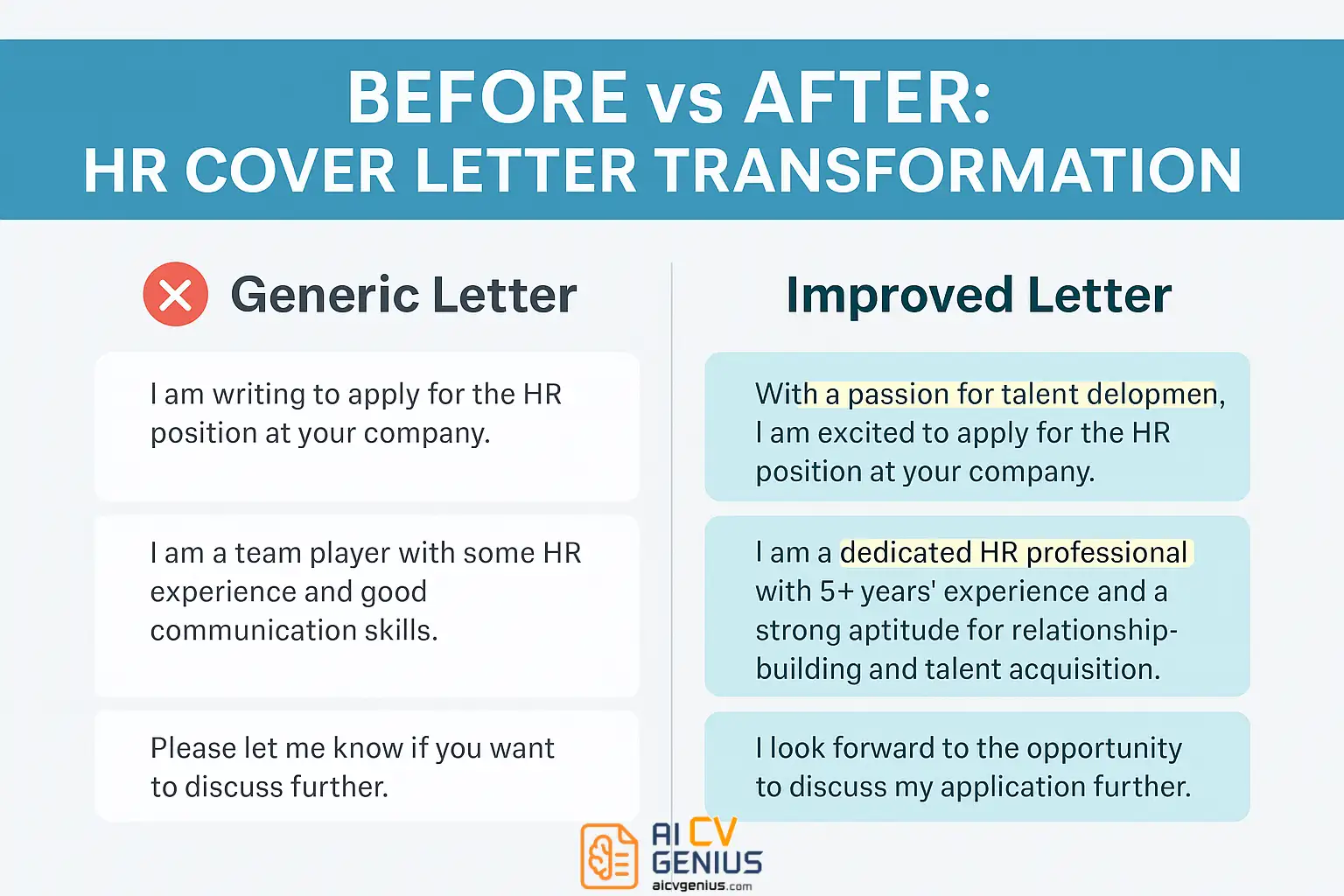
Before and After: A Real HR Cover Letter Makeover
Let’s examine the tangible difference strategic rewriting made for Lisa.
The “Before” Version: Competent but Cold
Dear Hiring Manager,
I am writing to apply for the HR Generalist position advertised on [Platform]. I possess over three years of progressive experience within the Human Resources field. My primary responsibilities have encompassed recruitment coordination, new employee onboarding facilitation, and addressing employee relations matters. I believe my demonstrated skills and qualifications align well with the requirements outlined for this role. Please find my detailed resume attached for your review.
Sincerely,
Lisa M.
This version is technically adequate: concise, polite, grammatically correct. However, it utterly lacks vitality. There’s no distinct voice, no indication of genuine motivation beyond securing employment, and absolutely no evidence that Lisa understands or connects with the specific company’s mission or culture. It reads like a job description paraphrased by generic AI circa 2010 – functional, but forgettable.
The “After” Version: Connection and Impact
Dear [Hiring Manager Name – if found, otherwise use title],
When I first learned about [Company Name]’s widely recognized “People First” initiative through [Source, e.g., a recent article, their careers page], I felt an immediate and profound connection. My own professional philosophy centers on making organizations fundamentally more human. Over the past three years in HR, I’ve focused on translating that philosophy into tangible results – from redesigning onboarding programs that actively transform new hires into engaged company advocates, to conceptualizing and executing engagement campaigns that demonstrably raised employee retention by 18% last year alone.
At BrightEdge Inc., I collaborated closely with department managers to overhaul our outdated performance feedback system. By strategically shifting from rigid annual reviews to more fluid, constructive quarterly conversations focused on development, we achieved a significant 25% improvement in employee satisfaction scores related to feedback within just six months. My consistent goal is to position HR not merely as a function of policies and compliance, but as a proactive driver of progress – benefiting both the individuals within the organization and the overarching business objectives.
I would be genuinely thrilled by the opportunity to bring this same blend of strategic thinking, data-driven approach, and empathetic execution to your esteemed team at [Company Name]. Thank you sincerely for considering my application and my potential contribution.
Sincerely,
Lisa M.
This revised version feels alive and authentic. It achieves several critical improvements: it quantifies success with specific metrics (18% retention increase, 25% satisfaction improvement), establishes an emotional connection (“make organizations more human”), demonstrates research and alignment by referencing the company’s specific “People First” initiative, and implicitly tells a story of transformation and positive outcomes rather than just listing static duties. This is how you elevate a generic application letter into a compelling, genuine introduction.
Deconstructing Success: Why the Second Letter Connects
Let’s meticulously dissect the strategic elements that make Lisa’s revised letter significantly more effective:
- ✅ Personalization Establishes Genuine Interest: Explicitly mentioning the company’s specific “People First” initiative instantly signals that Lisa has done her homework and isn’t sending a generic blast. This simple act respects the recruiter’s time and demonstrates targeted interest.
- ✅ Quantifiable Success Provides Concrete Proof: HR functions are increasingly data-driven. Citing specific metrics – 18% retention improvement, 25% satisfaction score increase – transforms vague claims into credible evidence of impact. Numbers anchor assertions in reality.
- ✅ Empathy Reveals Core Values: Phrases like “make organizations more human” articulate a guiding philosophy. This resonates deeply in HR, suggesting Lisa operates from a place of genuine care and understanding, not just procedural adherence.
- ✅ Storytelling Creates Engagement: Instead of passively listing duties (“managed feedback system”), she describes a specific transformation (“shifting from annual reviews to quarterly conversations”) and its positive outcome. This narrative structure is inherently more memorable and engaging.
- ✅ Conciseness Maintains Focus: Despite adding depth, the letter remains focused and respects the reader’s time (ideally fitting comfortably on one page, likely around 3-4 concise paragraphs). It balances structure with authentic warmth without rambling.
These elements collectively paint a picture of a thoughtful, results-oriented, and genuinely motivated HR professional – precisely the profile hiring managers seek.
The Underlying Psychology: Reading Between the Lines
Experienced HR professionals are masters at reading between the lines. They subconsciously evaluate authenticity, tone, emotional intelligence, and self-awareness in every paragraph they read. This inherent skill makes overly mechanical or jargon-laden language particularly detrimental to your application. Stiff, impersonal phrases like “Pursuant to the advertised opening,” “I am writing to express my formal interest,” or “I believe my qualifications render me a suitable candidate” fail to establish any genuine human connection.
Instead, consciously employ language that reflects your nuanced understanding of human dynamics and organizational culture. Consider incorporating phrases that reveal perspective and empathy:
- “I’ve consistently observed how authentic, timely recognition can fundamentally transform employee motivation and engagement.”
- “One of my most professionally rewarding experiences involved mentoring an intern I initially hired, watching them develop the confidence to eventually become a respected team leader.”
- “My approach involves striving to cultivate workplace environments where constructive feedback is perceived as an opportunity for growth, rather than a moment of judgment.”
- “Successfully navigating complex employee relations requires not just policy knowledge, but active listening and a commitment to finding equitable solutions.”
These types of statements subtly showcase insight derived from experience, not just adherence to process. They allow recruiters to envision you not just performing HR tasks, but actively contributing to a positive and productive workplace culture – which is ultimately the core objective.
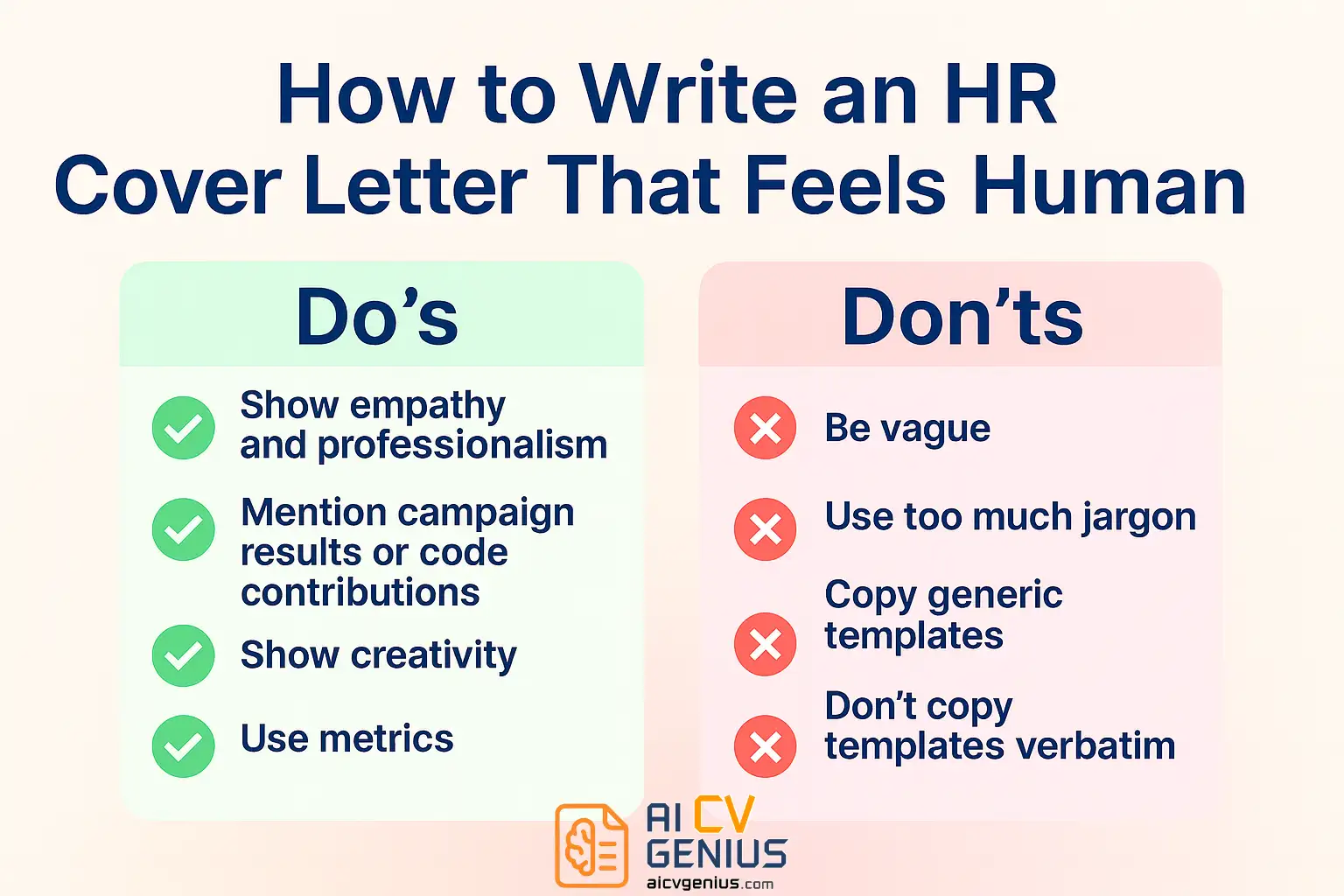
Red Flags: Common Phrases That Make HR Recruiters Cringe
Certain clichés and vague statements appear so frequently in cover letters that they instantly signal a lack of originality or genuine thought. Avoid these common pitfalls:
- ❌ “I possess excellent communication skills.” – This is perhaps the most overused and meaningless phrase. Demonstrate your communication skills through the clarity, tone, and precision of your writing itself, rather than stating it explicitly. Show, don’t just tell.
- ❌ “I am a people person.” – This sounds generic, slightly unprofessional, and offers no real insight. Instead, provide specific examples of successful collaboration, conflict resolution, or relationship-building.
- ❌ “I am passionate about Human Resources.” – Passion is demonstrated through action and specific interest, not just adjectives. Explain why you are passionate by connecting your work to tangible outcomes or specific company values.
- ❌ “Please find my resume attached for your review.” – This is redundant; they know the resume is attached. Use this valuable sentence space for something more impactful, like reinforcing your key value proposition or expressing targeted enthusiasm.
- ❌ “To Whom It May Concern.” – This greeting signals a lack of effort in identifying the appropriate contact person. Always strive to personalize the salutation.
- ❌ “Results-driven professional…” – While true, it’s become a buzzword. Show the results instead of labeling yourself with the term.
Subtle shifts in phrasing make a significant difference. Replace generic clichés with concrete experiences. Substitute vague claims with measurable proof. Focus on demonstrating your qualities through examples, rather than simply stating them as facts.
A Practical Framework: Writing an HR Cover Letter That Resonates
Here’s a refined, actionable formula based on Lisa’s successful transformation, applicable to most HR roles:
- Establish an Authentic Connection (Paragraph 1): Research the company thoroughly. Identify a specific initiative, value, recent achievement, or cultural aspect that genuinely resonates with your personal HR philosophy or past experiences. Start your letter by referencing this specific point to immediately demonstrate tailored interest and alignment.
- Showcase Transformation and Impact (Paragraph 2): Select one or two powerful examples from your experience where your actions led to a tangible, positive change. Focus on initiatives related to culture improvement, employee engagement, process efficiency, or successful recruitment/retention. Use the implicit STAR method (Situation, Task, Action, Result) to structure these mini-stories. Crucially, quantify the outcome whenever possible (e.g., increased retention rates, reduced time-to-hire, improved satisfaction scores).
- Reinforce Alignment and Enthusiasm (Paragraph 3): Briefly reiterate why you are specifically interested in this company and this role. Connect your key skills or experiences directly back to the requirements mentioned in the job description or the company’s stated goals. Express genuine enthusiasm for the opportunity to contribute.
- Close with Professional Warmth and Call to Action (Paragraph 4): Thank the reader sincerely for their time and consideration. Express curiosity and openness to discussing your fit further, rather than making demands. End with a standard professional closing.
If you’re currently building your letter, exploring diverse examples can provide valuable inspiration. You can find curated samples in our comprehensive Cover Letters section. Additionally, ensure visual consistency by using our Resume Templates Finder to select a resume design that complements the professional yet human tone of your cover letter. HR recruiters value coherence and attention to detail – your application materials should reflect this synergy visually and textually.
Weighing the Effort: Pros & Cons of a Personalized HR Cover Letter
Investing time in personalization yields significant advantages but requires a strategic approach.
| Pros ✅ | Cons ❌ |
|---|---|
| Builds an immediate emotional connection and rapport with recruiters, setting you apart from generic applicants. | Requires dedicated time and thorough research for each specific company and role, making mass applications difficult. |
| Provides a powerful platform to showcase essential soft skills like communication, empathy, and cultural awareness in action. | Risk of sounding overly informal or unprofessional if the tone isn’t carefully balanced with professional structure. |
| Demonstrates genuine interest, authenticity, and a nuanced understanding of the target company’s culture and values. | More challenging to standardize components for multiple applications, requiring fresh thought for each submission. |
| Significantly increases your chances of standing out from automated, template-driven applications, especially for competitive roles. | Demands strong writing skills, self-awareness, and the ability to articulate value concisely and persuasively. |
While personalization demands more effort upfront, the potential payoff – securing an interview for a role you genuinely desire – makes it a worthwhile investment, particularly for strategic HR positions.
Mini Workshop: Transforming Robotic Phrases into Human Insights
Let’s practice refining common, lifeless HR phrases into statements that convey genuine insight and impact.
- Example 1: Engagement
Robotic Original: “I am responsible for managing employee engagement activities and initiatives.”
Human & Impactful Revision: “I designed and implemented quarterly employee engagement initiatives (including pulse surveys and cross-departmental focus groups) that directly contributed to a 15% increase in positive feedback regarding workplace culture and a measurable 10% reduction in voluntary turnover.”
- Example 2: Detail-Orientation
Robotic Original: “I am a highly detail-oriented and organized HR professional.”
Human & Impactful Revision: “Colleagues consistently rely on my meticulous approach to compliance and documentation, ensuring accuracy that proactively prevents potential payroll discrepancies and policy misunderstandings before they impact employees.” (Focuses on the benefit of being detail-oriented).
- Example 3: Teamwork
Robotic Original: “I possess strong teamwork skills and work well in collaborative environments.”
Human & Impactful Revision: “I focus on building trust quickly across diverse teams by prioritizing active listening and seeking collaborative solutions, which was key in successfully mediating three complex inter-departmental conflicts last year.” (Provides a specific context and outcome).
Each revision shifts the focus from a passive statement of qualification to an active demonstration of value and insight. This subtle transformation makes your contributions feel real, tangible, and significantly more compelling.
Concluding with Grace: How to End Your HR Cover Letter
Avoid the ubiquitous and slightly passive closing line: “I look forward to hearing from you soon.” Instead, end your letter with a statement that reflects intention, reinforces your understanding of the role, and subtly echoes the company’s culture.
Consider these more impactful alternatives:
- “I am genuinely excited by the prospect of bringing my people-centric, data-informed approach to an HR team that clearly values both strategic growth and employee well-being.”
- “Thank you for considering my application and exploring my potential contribution. I hope to have the opportunity to discuss how my experience in fostering positive workplace cultures can benefit [Company Name].”
- “If given the opportunity, I am confident I can contribute to ensuring every new employee joining [Company Name] feels as genuinely welcomed and aligned with the mission as I felt upon reading about your values.”
- “I welcome the chance to discuss further how my proactive approach to HR challenges and commitment to continuous improvement align with your team’s objectives.”
HR is fundamentally about shaping and reinforcing organizational culture. Your closing line offers a final, subtle contribution to demonstrating your fit within that culture, leaving a lasting impression of thoughtfulness and professionalism.
FAQs: HR Cover Letter Queries
Final Thoughts: The Human Element Wins
Your HR cover letter serves as the preliminary test of your core competency: connecting effectively with people. It’s the critical juncture where professional efficiency meets genuine empathy, and where structured communication intersects with compelling storytelling. When you successfully demonstrate that you understand what motivates individuals, what fosters collaboration, and what makes teams truly thrive, you are, in essence, already performing the fundamental duties of the role you seek.
If you wish to explore further examples tailored to various HR specializations or career levels, delve into our extensive Career Resources section. Additionally, the Cover Letters Tips hub offers deeper insights into mastering tone, narrative structure, and maintaining emotional balance throughout your job application materials.
Remember the core principle: HR ultimately doesn’t hire skill sets in isolation; it hires individuals who demonstrate a profound understanding of people. Let your thoughtfully crafted cover letter serve as undeniable proof that you are one of them.