
- A cover letter with no experience is not an apology: It is a confident argument for potential, and it explains the “why” behind your resume.
- Recruiters hiring entry-level look for four traits, not years: Coachability, initiative, alignment with the mission, and reliability, so your letter should prove these with evidence.
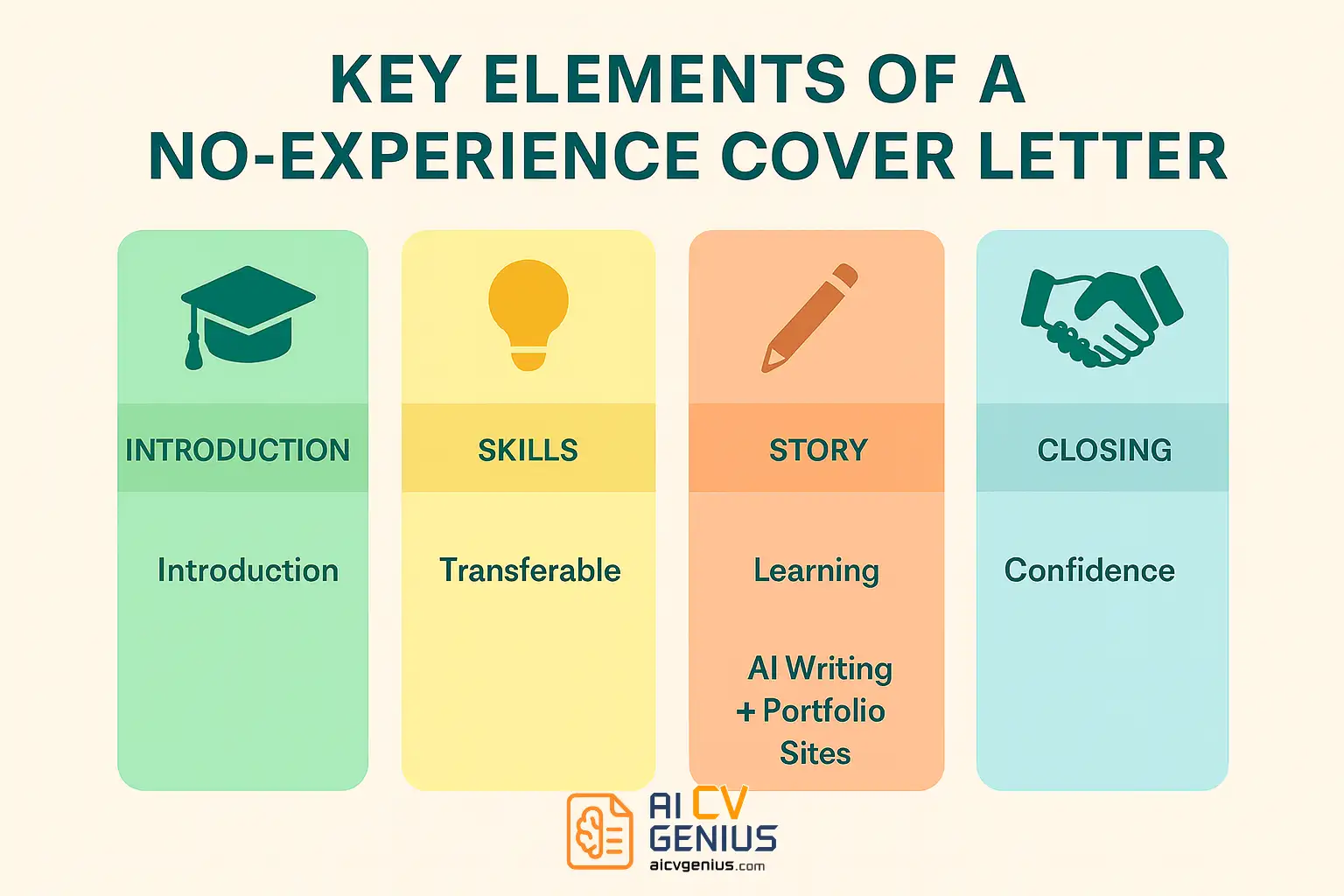
- Use a clean structure that reads like business communication: Matching header, specific greeting, a strong hook that names the role and shows research, then 2 to 3 body paragraphs that translate school, retail, volunteering, or projects into job-ready skills.
- Write like proof, not vibes: Tell 1 to 2 short STAR stories, use action verbs, end with outcomes, and close with a confident call to action.
- Avoid the red flags that get deleted fast: Starting with an apology, sounding robotic, generic copy paste, typos, and over-length, then treat “no experience” as an advantage by showing learning speed, curiosity, and readiness.
Everyone starts somewhere. You scroll through job listings, your heart racing, until you see those five crushing words: “X years of experience required.” The excitement fades, replaced by a sinking feeling. You think, “How can I get experience if no one will give me a chance?”
Here is the truth: every single person you admire in your field was once in your exact position. They were not hired for their first job because of a stacked resume; they were hired because of potential. The cover letter with no experience is the single most powerful tool you have for demonstrating that potential. It is not an apology for what you lack; it is a confident argument for what you offer.
Your resume lists the “what.” Your cover letter explains the “why.” It bridges the gap between your academic or unrelated experience and the role you want. It’s where you show your drive, your coachability, and your alignment with the company’s mission. This guide will show you how to write one that turns your “lack of experience” into your greatest asset.
The Recruiter’s Mind: What They Really Want (It’s Not Experience)
When a hiring manager posts an entry-level job, they are not expecting a candidate with a decade of expertise. They know you are new. They are looking for something far more valuable and much harder to train:
- 1. Coachability & Eagerness to Learn: Can you take feedback without being defensive? Do you actively seek out new skills? A candidate who is eager to learn is infinitely more valuable than an experienced-but-rigid candidate.
- 2. Problem-Solving Initiative: When you hit a roadblock, do you give up, or do you try three other solutions first? They want to see how you think.
- 3. Alignment & Passion: Why this company? Why this role? A candidate who has researched the company and has a genuine passion for the mission will stay longer and be more engaged.
- 4. Reliability: Do you finish what you start? Do you show up on time? Do you manage your tasks? Your past (even in school or a part-time job) is evidence of this.
Your cover letter’s entire job is to provide evidence for these four traits. You are not trying to prove you can do the job on day one; you are proving you will be amazing at the job by month six.
Why a Cover Letter Is Your Secret Weapon When You Have No Experience
Skipping a cover letter is a massive mistake. When your resume is light on experience, the cover letter becomes the most important part of your application. It is your only chance to:
- ✅ Tell Your Story: It gives context to your journey. Why are you switching from biology to marketing? Why did you choose this specific field?
- ✅ Show Your Voice: A resume is sterile. A cover letter shows your personality. Are you analytical? Creative? Empathetic? Your tone reveals this.
- ✅ Prove You Did Your Homework: It’s where you show you’ve researched the company and are not just “spamming” applications. This alone puts you in the top 10% of applicants.
- ✅ Translate Your Skills: It allows you to explicitly connect the dots from “led a group project” to “project management and leadership.”
Even if your resume looks short, your story can be powerful. That’s the power of writing from honesty and curiosity.
The Structure of a Strong No-Experience Cover Letter
A cover letter is a formal piece of business communication. It must be professional, clean, and easy to read. Follow this structure precisely.
1. Header & Contact Information
Your header should be identical to the one on your resume. It creates a professional, branded package. Include:
- Your Full Name
- Phone Number
- Email Address
- LinkedIn Profile URL (make sure it’s customized)
- Link to your personal portfolio/GitHub (if relevant)
Below your contact info, add the date and the company’s information:
- Date
- Hiring Manager’s Name (if you can find it)
- Hiring Manager’s Title
- Company Name
- Company Address
2. The Professional Greeting
Effort matters. “To Whom It May Concern” is lazy. “Dear Hiring Manager” is fine, but generic. Spend five minutes on LinkedIn trying to find the name of the hiring manager or recruiter for the department.
- Best: “Dear Ms. Johnson,” or “Dear Alex Chen,”
- ✅Good: “Dear [Department Name] Hiring Team,” (e.g., “Dear Marketing Hiring Team,”)
- Acceptable: “Dear Hiring Manager,”
3. The Opening Paragraph: Hook Them Fast
Your first sentence is critical. Do not apologize for your lack of experience. Start with energy, passion, and a clear statement of purpose.
❌Weak:
“I am writing to apply for the Junior Analyst role I saw on LinkedIn. Although I do not have direct experience, I am a hard worker.”
✅Strong:
“As a recent [Your Major] graduate with a passion for data-driven storytelling, I am writing to enthusiastically apply for the Junior Analyst position at [Company Name]. I have been following your work in [Specific Area] and deeply admire your commitment to [Company Value].”
The strong opening achieves three things:
- It names the specific role.
- It shows genuine, specific passion (“data-driven storytelling”).
- It proves you’ve done your research (“I have been following your work…”).
4. The Body Paragraphs: The “Experience Translation” (2-3 Paras)
This is the core of your letter. Here is where you turn “no experience” into “relevant, transferable experience.” Do not list your duties. Instead, tell 1-2 short stories (using the STAR method) that prove you have the traits they want (coachability, initiative, alignment).
This is your “Transferable Skills” section. Pick 2-3 key requirements from the job description and prove you have them, using examples from outside of a traditional office.
The “Experience Translation” Matrix:
| If you did this… | You have this professional skill… |
|---|---|
| Worked in retail / food service | Client management, conflict resolution, grace under pressure, upselling. |
| Led a university group project | Project management, leadership, delegation, stakeholder communication. |
| Volunteered at a local shelter | Empathy, community engagement, scheduling, communication. |
| Managed a student club budget | Financial planning, resource allocation, organization. |
| Built a personal website/blog | Initiative, technical proficiency (WordPress, HTML), content strategy. |
| Played a team sport | Collaboration, discipline, resilience, goal-setting. |
| Wrote a complex research paper | Analytical skills, research, long-term project management, attention to detail. |
How to write it:
❌Weak:
“As part of my degree, I had to do a big group project. It was hard, but we finished it and got a good grade. This shows I can work in a team.”
✅Strong:
“While leading my senior capstone project, I acted as the team coordinator for a group of four. I was responsible for creating the project timeline, delegating tasks based on each member’s strengths, and presenting our findings to a panel of professors. This experience honed my project management and communication skills, and we ultimately received an A for our work.”
See the difference? The strong example uses action verbs (leading, creating, delegating) and shows a specific, successful outcome.
5. The Closing Paragraph: The Confident Call to Action
End on enthusiasm, not desperation. Reiterate your value and ask for the interview.
❌Weak:
“I know I don’t have much experience, but I would be so grateful for a chance. Thank you for your time.”
✅Strong:
“I am eager to bring my creativity, adaptability, and strong work ethic to the [Role Name] position. I am confident I can quickly learn and begin contributing to the [Company Name] team. Thank you for your time and consideration; I look forward to the possibility of discussing this role further.”
6. The Professional Sign-Off
Keep it simple and formal.
- “Sincerely,”
- “Best regards,”
- “Respectfully,”
Followed by your typed full name.
Example: Cover Letter with No Experience (Full Text)
Here is a sample cover letter for first job, applying for a “Marketing Assistant” role. The candidate has no formal marketing experience, only a part-time retail job and university projects.
Your Name
(123) 456-7890 | your.email@gmail.com | linkedin.com/in/yourprofileOctober 27, 2025
Ms. Jane Lee
Marketing Director
BrightPath Solutions
123 Innovation Drive
Anytown, USA 12345Dear Ms. Lee,
As a recent Communications graduate from State University and a long-time follower of BrightPath Solutions’ innovative work in the B2B tech space, I am writing to enthusiastically apply for the Marketing Assistant position. Your recent campaign, “Future-Proof Finance,” was a brilliant example of data-driven creativity, and I am eager to bring my own passion for storytelling and analytics to your team.
While my professional experience is developing, I have actively sought out opportunities to build the core skills this role requires. In my senior capstone project, I led a team of five to develop a complete digital marketing strategy for a local nonprofit. I was responsible for conducting market research, managing our social media content calendar, and analyzing engagement metrics, which ultimately grew their online following by 20% in three months. This experience proved my ability to manage a project from concept to completion and deliver measurable results.
Furthermore, my two years as a shift lead at [Retail Store] provided daily, hands-on experience in communication and client relations. I was trained to de-escalate customer issues and actively listen to feedback – skills I believe are directly transferable to supporting a busy marketing team and communicating with stakeholders.
I am a fast learner, highly coachable, and genuinely excited by the prospect of growing my career at a company that values innovation and community. I am confident I can quickly master the systems you use and begin adding value to your team.
Thank you for your time and consideration. I look forward to the opportunity to discuss how my skills and enthusiasm can support BrightPath Solutions.
Sincerely,
Anna Tran
Turning “No Experience” Into Your Greatest Advantage
Having no experience is not a weakness; it’s a blank slate. Many managers prefer hiring entry-level candidates because they don’t have to “un-train” bad habits. You are moldable, eager, and often more motivated.
Frame your “newness” as an asset:
- ✅ Emphasize learning speed: “I am a fast learner and have a track record of picking up new software quickly, as shown by my certification in [Software Name].”
- ✅ Mention enthusiasm: “I am eager to apply my academic knowledge to real-world challenges and am excited by the prospect of a fast-paced environment.”
- ✅ Highlight curiosity: “I enjoy asking questions and am driven to understand the ‘why’ behind processes, which helps me find creative solutions.”
- ✅ Show readiness: “I am not just looking for a job – I am looking for a place to build a career, and I am prepared to dedicate myself to learning and growing with your team.”
That mindset signals confidence, not insecurity.
Common Mistakes to Avoid (The Red Flags for Recruiters)
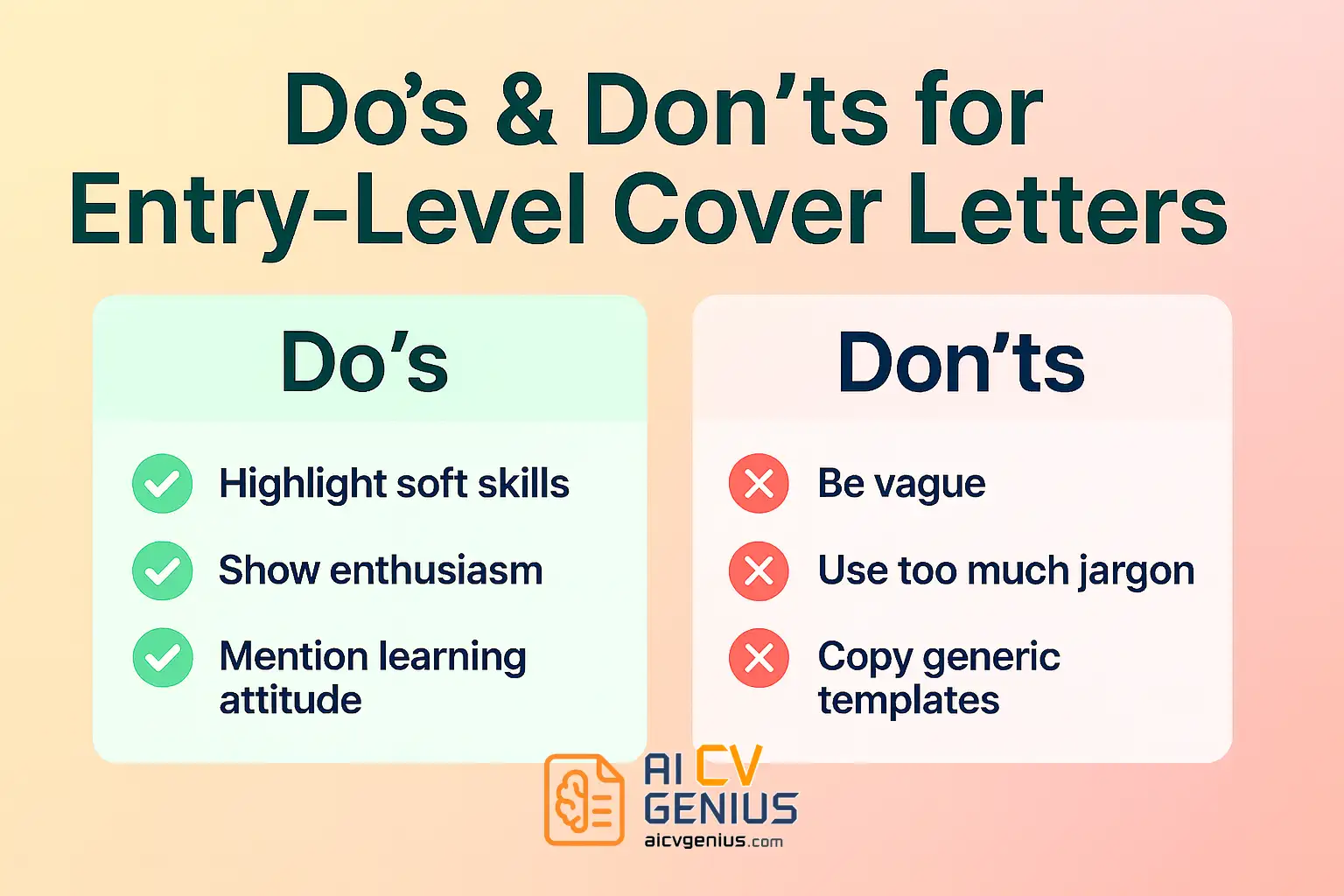
- ❌ Starting with an apology: Never, ever start with “I know I don’t have the experience you’re looking for, but…”.
- ❌ Being too formal or robotic: “It is with great interest that I tender my application…” sounds stiff. Write like a human.
- ❌ Focusing only on what you want: “I am looking for a company that will teach me everything and give me a chance to grow.” Reframe it: “I am looking for a place where I can contribute my skills and grow with the team.”
- ❌ Using a generic template: Recruiters can spot a copy-pasted letter a mile away. If you don’t mention the company’s name or the specific role, it will be deleted.
- ❌ Typos and grammatical errors: Forgetting to proofread is the #1 killer. It signals a lack of attention to detail. Use a tool like Grammarly.
- ❌ Making it too long: Keep it under one page. Aim for 300-400 words. Be concise.
Pros & Cons of Writing a Cover Letter with No Experience
| Pros | Cons |
|---|---|
| ✅ Lets you control your narrative and show personality. | ❌ Requires creativity to connect non-professional experiences. |
| ✅ Demonstrates motivation, coachability, and willingness to learn. | ❌ Risk of sounding vague or apologetic if poorly written. |
| ✅ Highlights transferable and soft skills (like communication) that a resume can’t show. | ❌ Harder to quantify achievements without business metrics. |
| ✅ Proves you have researched the company and are genuinely interested. | ❌ Takes significant time and self-reflection to get right. |
Mini Workshop: Rewriting Weak Sentences
Let’s polish a few “rookie mistakes” into confident, professional statements.
❌ Weak:
“I don’t have any real job experience yet, but I’m willing to learn.”
✅ Strong:
“As a recent graduate, I am eager to apply my academic knowledge and am confident in my ability to learn new processes quickly.”
❌ Weak:
“I’m looking for a company that will teach me everything and help me start my career.”
✅ Strong:
“I am eager to contribute my skills to your team and am looking for a company where I can grow with experienced mentors.”
❌ Weak:
“I am passionate about marketing.”
✅ Strong:
“I am passionate about the power of data to tell a compelling brand story, a skill I hope to bring to your marketing team.”
Confidence isn’t about claiming expertise; it’s about showing purpose.
In-Depth FAQs: Cover Letter With No Experience
- Academic: “My research for my 20-page thesis on [Topic] required intense analytical thinking and attention to detail, resulting in a departmental honor.”
- Volunteer: “Organizing the weekly food drive for [Charity] required me to coordinate 10 volunteers and manage logistics, which improved our delivery efficiency.”
- Personal Project: “I taught myself Python and built a small app to track my finances. This project proves my initiative and ability to learn technical skills independently.”
Final Thoughts: Your Story Is Your Experience
Everyone starts somewhere. Writing a cover letter with no experience isn’t about faking expertise – it’s about strategically showcasing your drive, humility, and readiness to learn. The first chapter of your career doesn’t need to be impressive with titles and decades of work; it just needs to be authentic.
Employers remember people who sound human. Your letter should reflect your unique voice – honest, curious, and forward-looking.
Pair your cover letter with a clean, modern resume from our Resume Templates Finder, or explore more real examples in our Cover Letters section. For advice on starting your career with confidence, visit our Career Resources hub.
Experience is what you get. Character, curiosity, and courage are what you bring. Start there.