

- Core message: A career break is not failure, it is a normal chapter, and the real risk is hiding it or sounding ashamed instead of framing it with calm confidence.
- How to explain it: Keep it brief, honest, and forward-looking, give one line of context, then immediately highlight what you gained (Resilience, clarity, coordination, communication, problem-solving).
- How to show value on your resume: Create a simple “Career Break (Year to Year)” entry and translate what you did into transferable skills, including caregiving, relocation, volunteering, freelancing, courses, or side projects.
- How to return strategically: Use a skills-first resume format (Combination or functional), then use the cover letter to control the story in 2 to 3 sentences before pivoting to enthusiasm and fit.
- How to rebuild momentum: Reconnect with people using a short, genuine message, use LinkedIn’s Career Break label for transparency, start with small wins (Freelance, volunteer, contract work), and keep the focus on what you are ready to deliver next.
Here’s a confession many professionals carry quietly: they feel guilty for pausing. Whether it’s raising children, caring for family, burnout recovery, or just taking time to breathe – stepping off the traditional career path still feels “taboo.” But let’s get this straight: a career break is not career failure.
It’s simply a chapter in your professional story. The real challenge isn’t the gap itself – it’s how you frame it. Employers care less about time off and more about what you’ve learned, how you’ve grown, and what you bring next.
Understanding and Reframing Career Breaks
Why Career Breaks Happen (and Why That’s Okay)
People take breaks for countless valid reasons: health, caregiving, education, relocation, or mental reset. The modern workplace is finally catching up to reality – employees aren’t machines. Periods of pause can lead to deeper skills, resilience, and clarity.
Still, many candidates hide their breaks out of fear. They remove months from their LinkedIn or stuff “consulting” into the gap. But that’s unnecessary – recruiters are increasingly empathetic when you explain your story honestly and positively.
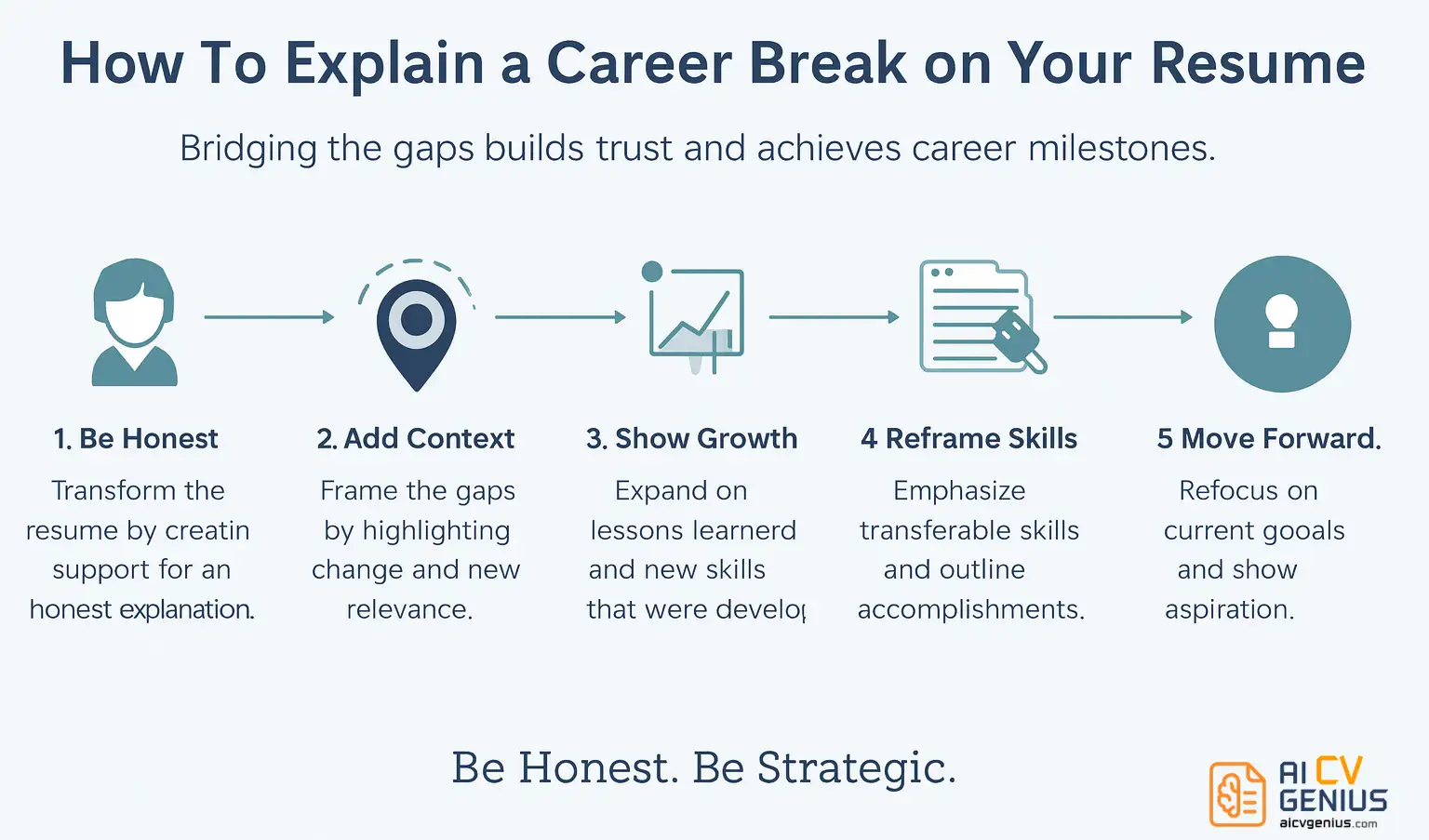
Honesty Builds Trust
Trying to hide a break usually backfires. Instead, frame it briefly and confidently. Example: “Took a one-year family sabbatical to care for a parent, during which I developed stronger project coordination and adaptability skills.”
Notice the shift – you’re not apologizing; you’re contextualizing. Employers value authenticity more than perfection.
- ✅ Keep explanations short, honest, and forward-looking.
- ✅ Emphasize what you learned or achieved during the break.
- ❌ Avoid overjustifying – it sounds defensive.
Translate Life Experience into Skills
Career breaks often sharpen real-world skills: organization, emotional intelligence, communication, problem-solving. For instance, volunteering, freelancing, or managing household projects all count as leadership and planning experience – if you frame them correctly.
Use bullet points under a section like “Career Break (2021–2023)” and describe transferable skills clearly:
| Activity | Skill Gained |
|---|---|
| Volunteered for a local nonprofit | Team coordination, community engagement |
| Managed household relocation | Project management, budgeting |
| Took care of family members | Empathy, time management, resilience |
| Completed online courses | Self-motivation, upskilling, adaptability |
Show You Stayed Curious
Employers love lifelong learners. Even if your break wasn’t career-focused, showing curiosity signals growth. Maybe you completed an online course, wrote a blog, mentored others, or explored a side project – that’s professional development too.
Adding a line like “Pursued independent learning in digital marketing and leadership communication” bridges the gap naturally.
Strategies for Returning to the Workforce
Update Your Resume Format
The right resume format can make a big difference. Instead of a traditional chronological resume, try a combination or functional format – these highlight skills and achievements over timeline.
- ✅ Start with a strong summary about your expertise and readiness to return.
- ✅ Include a “Relevant Experience” section before your work history.
- ✅ List transferable skills in bullet points.
This structure focuses attention on your value, not your gap. It’s subtle storytelling – one that moves the reader forward.
Use a Cover Letter to Tell the Story
Your cover letter is where you control the narrative. Address the gap briefly, then pivot to enthusiasm. Example:
“After taking a career break to care for family, I’m now eager to bring my refreshed perspective and renewed focus to a dynamic team environment.”
It’s honest, professional, and empowering – no apology, just clarity. You can even use our Cover Letter Templates to find the right structure for your comeback story.
Reconnect Through Networking
If you’ve been away for a while, your professional circle might feel distant – but reconnecting doesn’t need to be awkward. Reach out to past colleagues, mentors, or peers with a quick, genuine message. Share what you’ve been up to, not as an excuse, but as an update.
For example: “Hey Sam, I took a break to finish a certification and reflect on next steps. Would love to catch up and hear what you’re working on lately.”
Authentic reconnection rebuilds your professional confidence fast – and most people are kinder than you think.
Use LinkedIn to Your Advantage
LinkedIn now includes options to label “Career Break” with reasons like caregiving, health, relocation, or education. Use it. It normalizes the experience and shows you’re honest about your journey. Recruiters appreciate transparency more than empty titles.
- ✅ Add keywords in your headline or About section to stay discoverable.
- ✅ Post a short reflection on what you learned – it humanizes your profile.
- ✅ Engage with relevant content to stay visible while you transition back.
Rebuild Momentum Gradually
Returning to work doesn’t have to be all or nothing. Start small: freelance, consult, or volunteer. These bridge your gap and rebuild daily rhythm. They also generate fresh experience for your resume.
Remember, momentum matters more than speed. Progress is progress – even if it’s one step a day.
Focus on What’s Next, Not What’s Missing
Instead of worrying about “what you missed,” highlight how the break clarified your direction. Employers want self-aware candidates. Phrases like “ready to reenter with new focus on…” sound confident and forward-looking.
You can even address your growth in interviews. Example: “That time helped me gain perspective on prioritization and purpose – I’m returning more focused than ever.” It shifts the frame from “gap” to “growth.”
Summary, Final Thoughts & FAQs
Remember, You’re Not Alone
Career breaks are increasingly common. According to global HR surveys, nearly 60% of professionals have taken one. Many companies even run “returnship” programs – structured reentry paths for people restarting their careers. Look for these in industries like tech, finance, and consulting.
Taking time off doesn’t make you less employable. It makes you human. When you own your story, you reclaim your narrative – and that confidence shows through every line of your resume.
Summary Table: How to Reframe a Career Break
| Common Situation | How to Frame It on Your Resume |
|---|---|
| Family or caregiving break | Developed time management and empathy through full-time caregiving responsibilities. |
| Travel or relocation | Enhanced adaptability and cross-cultural communication while living abroad. |
| Health or burnout recovery | Focused on personal well-being and returned with renewed motivation and perspective. |
| Further education | Completed certifications and expanded domain knowledge relevant to role. |
| Entrepreneurial experiment | Gained business strategy and problem-solving experience through independent project. |
Final Thoughts
Your career isn’t a straight line; it’s a map with pauses, turns, and rest stops that make the journey sustainable. A break doesn’t erase your skills – it refines them. The key is not to hide, but to highlight how that time shaped your resilience, empathy, or creativity.
So the next time you hesitate to explain a gap, remember: you’re not defending your past – you’re defining your future.
For more resources on rebuilding your professional path, visit our Career Resources hub, or explore our Blog for stories of real professionals who returned stronger after time away.