
- Why it matters for students: A cover letter turns limited experience into a clear story of potential, motivation, and fit.
- What to highlight without a long work history: Transferable skills from coursework, projects, clubs, volunteering, and part-time jobs with specific proof.
- Structure that works: Header and greeting, A targeted opening, 1 to 2 evidence paragraphs, Then a confident close and professional sign-off.
- How to tailor fast: Adjust the emphasis for first-year, final-year, internship, or part-time roles and connect your examples to the job’s needs.
- Final quality rules: Stay one page, avoid apologizing or generic templates, proofread hard, and run a checklist before sending.
Introduction: The Student’s Strategic Advantage
Introduction: Bridging the Gap Between Classroom and Career
For students and recent graduates, navigating the job application process can feel like trying to solve a complex equation with missing variables. You meticulously scan job postings, only to be confronted repeatedly by the daunting phrase: “X years of experience required.” A wave of self-doubt washes over you: “How can I possibly compete when my resume mostly lists coursework and maybe a summer job?”
The encouraging truth is that discerning employers actively seeking interns or entry-level talent aren’t expecting seasoned professionals. They understand that students typically apply with limited formal work histories. What truly captures their attention is demonstrable motivation, clearly articulated transferable skills, and compelling evidence that you possess the raw potential and eagerness to learn and contribute. A strategically crafted student cover letter is precisely the instrument designed to convey this potential effectively.
This comprehensive guide is engineered to demystify the process. We will systematically dissect how to construct a student cover letter that resonates powerfully, even when professional experience is minimal or non-existent. We will provide diverse, adaptable examples and actionable tips designed to make your application not just seen, but remembered.
The Strategic Advantage: Why a Cover Letter Matters Crucially for Students
While your carefully formatted resume serves as the objective record – listing part-time roles, academic projects, volunteer activities, or extracurricular involvement – it often presents only a skeletal outline. Your cover letter provides the vital narrative tissue, transforming that outline into a compelling, three-dimensional story. It’s the dedicated space where you articulate the why behind your application: Why are you genuinely excited about this specific opportunity? How has your academic journey specifically prepared you for the challenges ahead? What unique combination of skills, perspectives, and raw enthusiasm can you inject into their team dynamics?
For employers evaluating student candidates, the hiring calculus fundamentally shifts from assessing past performance to predicting future potential. They are scouting for individuals who demonstrate initiative, adaptability, coachability, and alignment with the company’s culture and values. The cover letter functions as your primary platform to explicitly connect your nascent capabilities with their organizational needs, transforming perceived inexperience from a liability into an opportunity to showcase hunger and untapped potential.
Identifying Your Assets: Core Skills to Emphasize
In the absence of extensive professional history, students must strategically leverage skills honed through academic pursuits, extracurricular activities, and life experiences. Frame these not just as activities, but as demonstrations of capability:
- Communication (Written & Verbal): Evidence isn’t just “wrote essays.” It’s “Authored a 15-page research paper on [Topic], receiving commendation for clarity and analytical depth,” or “Presented project findings to a class of 30, effectively fielding questions and articulating complex concepts.” Include experiences from group projects, debate clubs, or volunteer roles involving public interaction.
- Teamwork & Collaboration: Go beyond “worked in groups.” Specify: “Collaborated within a four-person team to develop [Project], successfully integrating diverse perspectives to meet deadlines under pressure,” or “Coordinated logistics for the [Student Club] annual event, liaising with vendors and volunteers.” Sports teams, part-time retail/service jobs, or ensemble performances are rich sources.
- Technical & Research Skills: List specific software relevant to the role (e.g., Microsoft Office Suite, Google Workspace, basic coding languages like Python, specific design tools like Canva or Figma, research databases like JSTOR). Mention specific research methodologies employed in coursework (e.g., “Conducted qualitative interviews for [Project],” “Analyzed datasets using Excel pivot tables”).
- Time Management & Organization: Balancing academic rigor with other commitments is proof. Frame it: “Successfully managed a full course load (15 credits) while working 10 hours/week at [Job] and participating in [Club], maintaining a [GPA] GPA,” or “Organized study schedules for final exams, coordinating group sessions and resource sharing.”
- Initiative & Problem-Solving: Employers love self-starters. Showcase: “Identified an inefficiency in [Club]’s membership process and proposed a streamlined digital solution,” or “Volunteered to lead the fundraising subcommittee for [Event], exceeding targets by 15%.” Internships, leadership positions, or even independent projects demonstrate drive.
- Adaptability & Eagerness to Learn: Explicitly state your enthusiasm for learning new skills specific to the role or industry. Mentioning online courses taken (Coursera, LinkedIn Learning) or industry blogs you follow shows proactive engagement.
Structure and Examples
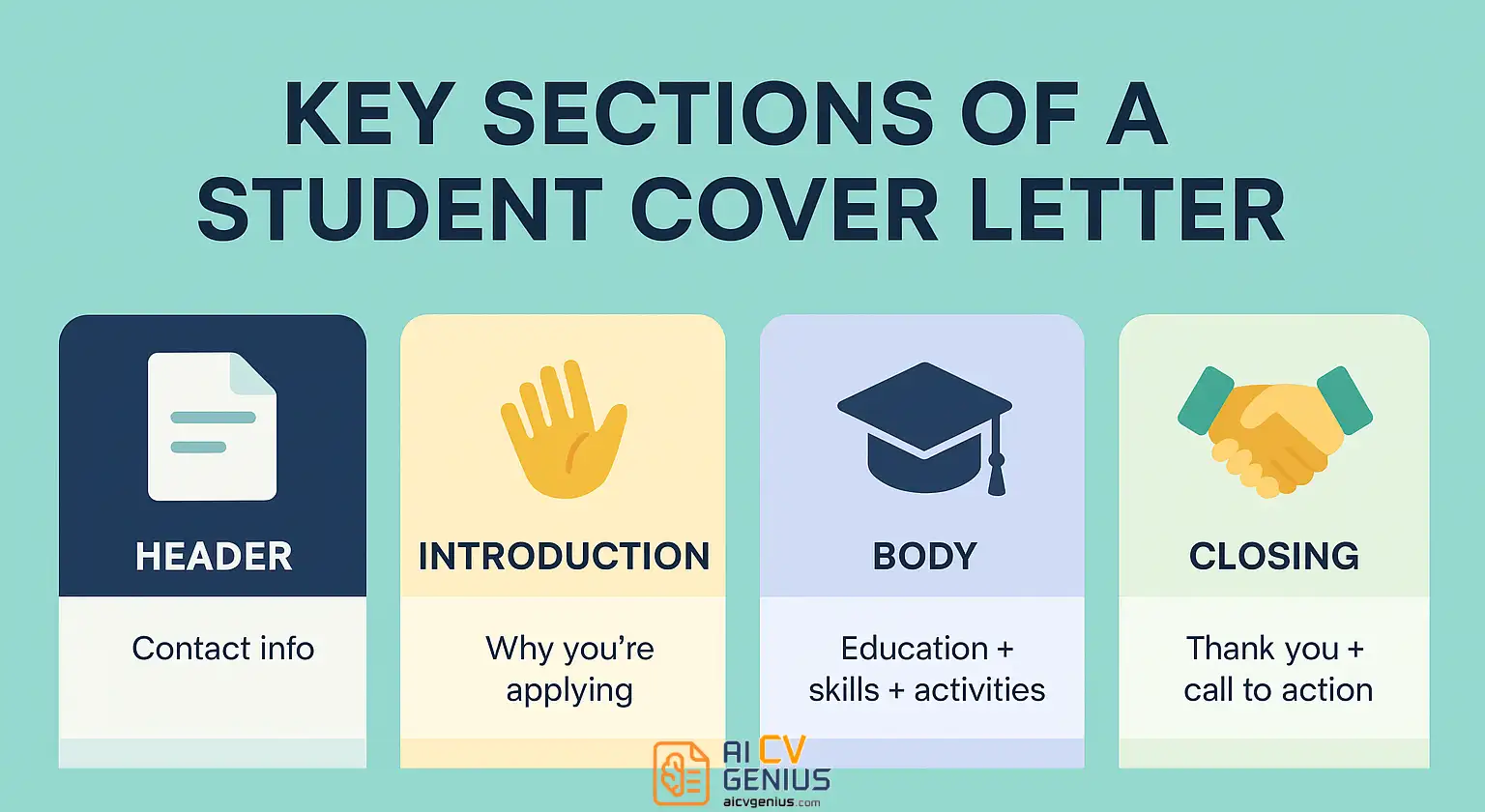
Blueprint for Success: Standard Student Cover Letter Structure
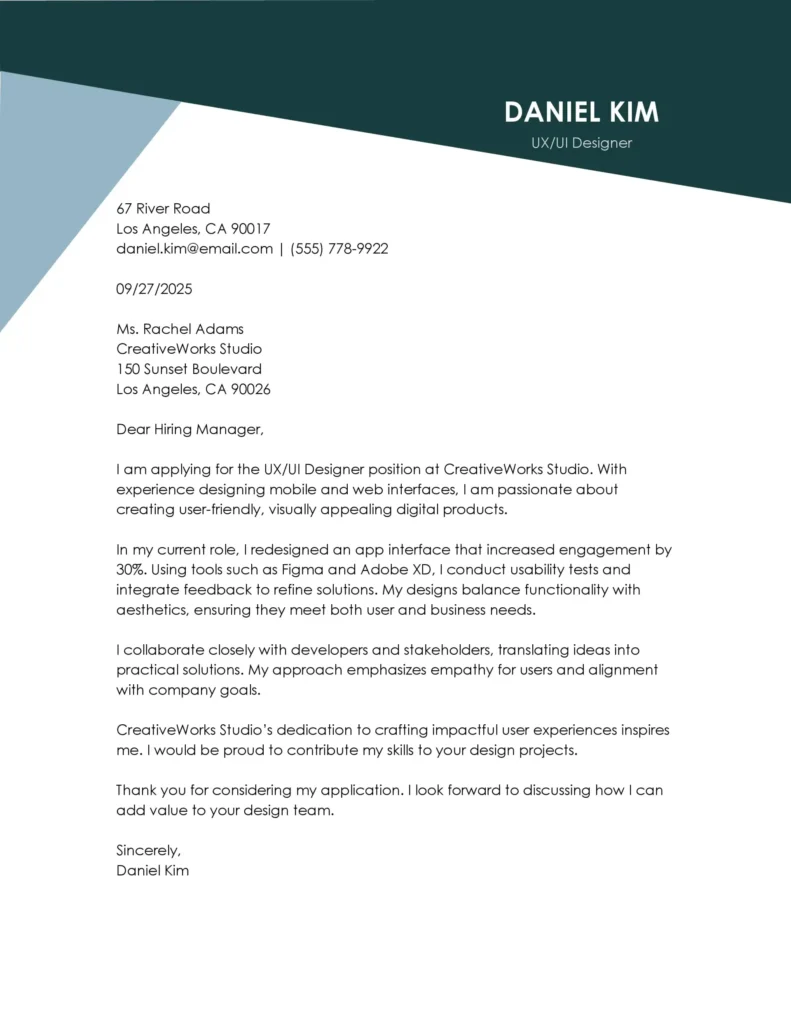
A well-organized cover letter is easy to read and makes a professional impression. Follow this standard business letter format:
- Header: Your full contact information (Name, Address, City/State/ZIP, Email, Phone), followed by the date, and then the employer’s contact information (Hiring Manager Name/Title, Company Name, Address). Ensure accuracy.
- Greeting (Salutation): Address it to a specific person whenever possible (e.g., “Dear Ms. Evans,”). Use LinkedIn or the company website to find the hiring manager’s name. If a name isn’t available, use a professional title (“Dear Hiring Manager,” or “Dear Recruitment Team,”). Avoid the outdated “To Whom It May Concern.”
- Opening Paragraph (Introduction): State the specific position you’re applying for (e.g., “Marketing Intern,” “Entry-Level Administrative Assistant”). Mention where you saw the opening (e.g., “advertised on LinkedIn,” “posted on the university career board”). Crucially, immediately express your enthusiasm and connect your core interest or academic background to the role or company mission.
- Body Paragraph(s) (Showcasing Skills & Alignment): This is the core section (usually 1-2 paragraphs). Connect your relevant experiences – coursework, projects, part-time jobs, volunteering, extracurriculars – directly to the key requirements listed in the job description. Use specific examples. Instead of saying “I have teamwork skills,” describe how you used teamwork in a project. Highlight 1-2 key transferable skills and briefly illustrate them. Explicitly mention why you are interested in this specific company – reference their values, recent projects, or industry impact.
- Closing Paragraph (Reiterating Interest & Call to Action): Briefly summarize your enthusiasm and key qualifications. Reiterate your strong interest in the role and the company. Confidently state your availability for an interview and express eagerness to discuss how you can contribute. Thank the reader for their time and consideration.
- Professional Closing: Use a standard closing like “Sincerely,” or “Best regards,” followed by your typed full name.
Sample Student Cover Letter (Annotated)
[Your Name]
[Your Address]
[City, State, ZIP]
[Email Address] | [Phone Number][Date]
Mr./Ms. [Hiring Manager’s Name] (Try hard to find this!)
[Hiring Manager’s Title]
[Company Name]
[Company Address]
[City, State, ZIP]Dear Mr./Ms. [Hiring Manager’s Last Name],
I am writing with immense enthusiasm to apply for the [Position Title, e.g., Summer Marketing Intern] position at [Company Name], which I discovered through [Platform, e.g., my university’s career portal]. As a highly motivated [Your Year, e.g., third-year] student pursuing a [Degree Program, e.g., Bachelor of Science in Marketing] at [Your University], I am eager to apply my academic knowledge in [mention 1-2 key areas, e.g., digital analytics and content creation] and my passion for [mention industry or company focus, e.g., sustainable branding] within a dynamic professional environment like yours. (States purpose, shows enthusiasm, connects studies to role).
Through my coursework, particularly in [mention relevant course, e.g., Digital Marketing Strategies], I developed strong foundational skills in SEO analysis and social media content planning. As part of a semester-long group project, I collaborated with four classmates to design and present a comprehensive digital marketing campaign proposal for a local non-profit. This experience honed my ability to conduct market research, utilize teamwork effectively to meet tight deadlines, and articulate strategic recommendations clearly. (Connects coursework to specific skills and teamwork). Additionally, my part-time role as a [Your Part-Time Job Title, e.g., Sales Associate] at [Part-Time Employer] has strengthened my communication skills, ability to manage multiple responsibilities efficiently, and aptitude for delivering positive customer experiences under pressure. (Highlights transferable skills from part-time work).
I am particularly drawn to [Company Name]’s innovative work in [mention something specific you admire, e.g., developing community engagement initiatives] and your stated commitment to [mention a company value, e.g., fostering creativity]. I believe my proactive learning attitude, strong organizational skills demonstrated through balancing academics and work, and genuine dedication to contributing positively make me a strong candidate eager to support your team’s goals. (Shows company research and aligns personal traits with company values).
Thank you sincerely for considering my application. My resume provides further details on my qualifications. I am available for an interview at your earliest convenience and would welcome the chance to discuss how my background, enthusiasm, and willingness to learn can be a valuable asset to your team this summer. (Reiterates interest, calls to action, expresses gratitude).
Sincerely,
[Your Typed Name]
Deconstructing Success: Why This Example Works
This sample resonates because it strategically shifts the focus from a lack of formal experience to a wealth of relevant potential. Instead of apologizing, it proactively highlights transferable skills acquired through academics and part-time work. It connects specific coursework and projects directly to the desired role’s requirements, demonstrating applied knowledge. Crucially, it shows genuine motivation by referencing specific company initiatives or values, proving the applicant did their homework. The tone is enthusiastic yet professional, conveying eagerness without sounding naive. It follows a clear, logical structure, making it easy for the recruiter to quickly grasp the candidate’s value proposition: a motivated, capable learner ready to contribute. For insights on understanding job requirements even without direct experience, external resources can provide valuable context.
Tailoring Your Narrative
Variations for Different Student Situations
Adapt your focus based on your specific circumstances:
First-Year Students (Focus: Enthusiasm & Foundational Skills)
Highlight academic motivation, eagerness to gain foundational experience, and basic transferable skills from high school or early college activities. Keep it concise and focused on learning.
Example Snippet:
“As a first-year student pursuing [Major], I am eager to gain foundational experience in [Industry/Field]. My coursework in [Relevant Subject] has sparked my interest in [Specific Area], and I am seeking opportunities to apply my strong work ethic and quick learning ability to real-world projects, contributing positively while developing practical skills.”
Final-Year Students (Focus: Capstone Projects & Specialization)
Showcase advanced coursework, capstone projects, internships, thesis research, or leadership roles demonstrating readiness for entry-level professional work. Emphasize specialization.
Example Snippet:
“Completing my final-year capstone project on [Project Topic] provided me with practical experience in [Skill 1] and [Skill 2, e.g., data analysis using Python]. This, combined with my internship at [Company], solidified my ability to apply theoretical knowledge to solve tangible business problems, and I am now seeking a full-time role where I can contribute these skills effectively.”
Internship Applicants (Focus: Learning Goals & Relevant Skills)
Clearly state what you hope to learn and how your existing skills (even basic ones from coursework or volunteering) make you a strong candidate capable of contributing while learning.
Example Snippet:
“Through volunteering weekly at the university’s [Department/Club], I have developed strong organizational and communication skills, which I believe are essential for supporting your team during the [Internship Program Name] internship. I am particularly eager to gain hands-on experience in [Specific Area Mentioned in Internship Description] and learn directly from industry professionals.”
Part-Time Job Applicants (Focus: Reliability & Practical Skills)
Emphasize dependability, time management (balancing work and study), customer service, cash handling, or any practical skills gained that directly relate to the part-time role.
Example Snippet:
“My current role as a [Part-Time Job Title] at [Employer] for the past year has taught me the importance of reliability, efficient task management, and providing excellent customer service, even during peak hours. I consistently maintain a positive attitude and am adept at handling [mention specific task, e.g., cash register operations] accurately.”
From Classroom to Cubicle: Case Studies of Student Success
Real stories illustrate how focusing on potential works:
- Case 1: Maya, The Club Leader (Sociology Student): Maya had no formal internships but was president of the university debate society. Her cover letter didn’t mention lack of work experience. Instead, it highlighted leadership (“Managed a budget of $X, organized Y events”), communication (“Presented arguments persuasively”), and teamwork (“Coordinated activities for 50+ members”). Recruiters saw initiative and organizational skills, leading to a project management internship offer.
- Case 2: Ethan, The Part-Time Barista (Engineering Student): Ethan applied for an engineering co-op. His cover letter connected his barista job to engineering principles: attention to detail (“Ensuring order accuracy mirrors process control”), time management (“Balancing peak-hour rushes with academic deadlines”), and customer interaction (“Explaining complex coffee orders parallels client communication”). The hiring manager was impressed by his ability to extract relevant skills from an unrelated role.
- Case 3: Sofia, The Volunteer Tutor (Computer Science Student): Sofia tutored high school students in math. Applying for a software development internship, her cover letter emphasized patience (“Explaining complex concepts simply”), problem-solving (“Adapting teaching methods to different learning styles”), and communication (“Building rapport with students”). This focus on soft skills, combined with her academic projects, secured her the interview.
Final Steps and FAQ
Final Quality Check: Checklist Before Sending
Before submitting, review your letter against these critical points:
- ✅ Is it addressed to a specific person (if possible) with correct spelling and title?
- ✅ Does it clearly mention the specific role and company name?
- ✅ Does it highlight 1-2 key transferable skills (teamwork, communication, problem-solving, adaptability) with brief examples?
- ✅ Does it connect experiences from school, part-time work, or volunteering to the job requirements?
- ✅ Does it express genuine enthusiasm specifically for this company or role (showing research)?
- ✅ Is the tone professional yet enthusiastic and authentic?
- ✅ Is it strictly one page and formatted cleanly (consistent font, good spacing)?
- ✅ Has it been meticulously proofread for any spelling, grammar, or punctuation errors? (Crucial!)
- ✅ Does the file name follow a professional convention (e.g., YourName_CoverLetter_CompanyName.pdf)?
Common Pitfalls: Mistakes to Avoid
Steer clear of these frequent errors that weaken student cover letters:
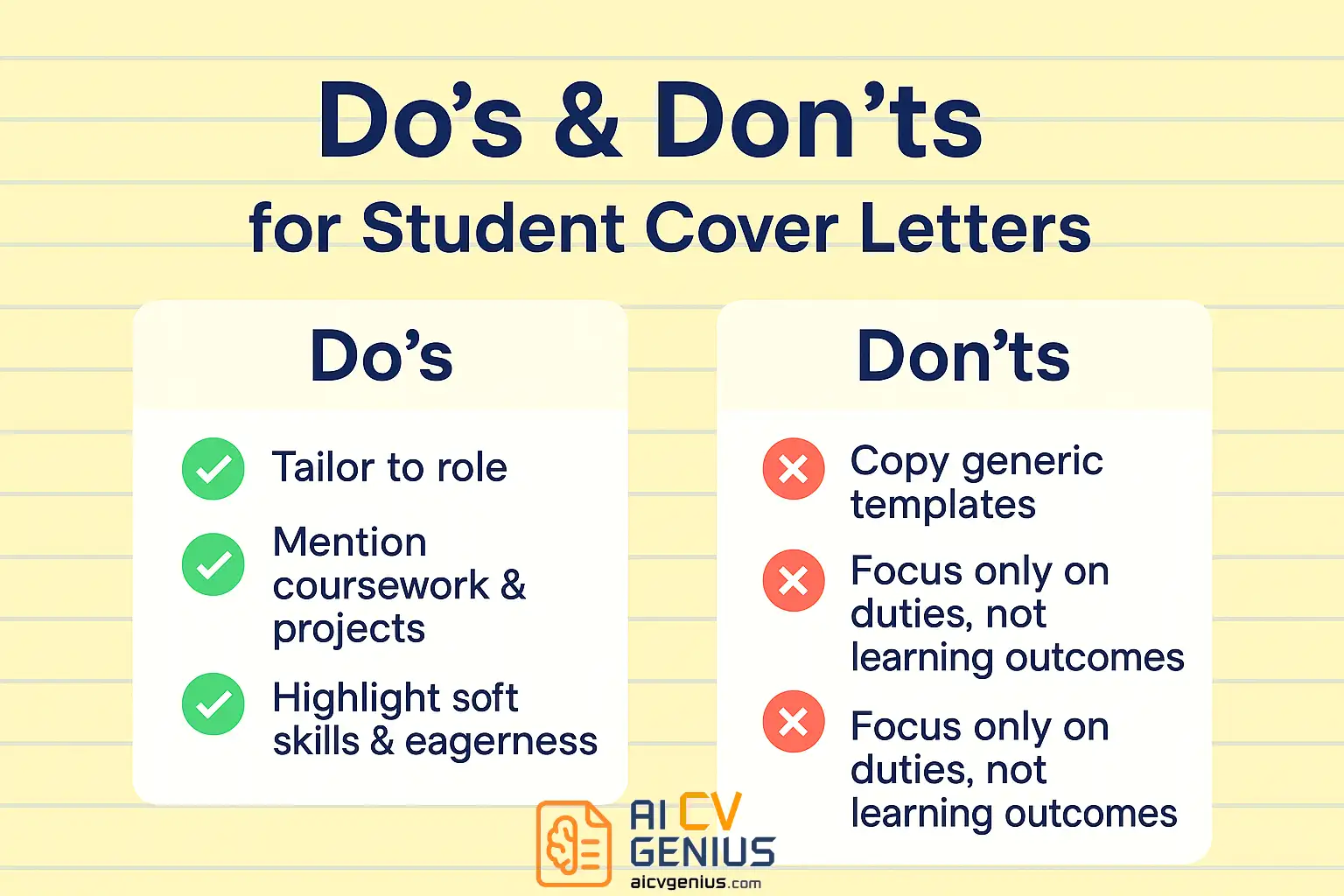
- ❌ Apologizing for Lack of Experience: Phrases like “Although I lack formal experience…” immediately frame you negatively. Focus on what you do bring (potential, skills, eagerness).
- ❌ Using Generic Templates Without Personalization: Sending the exact same letter to multiple companies is easily detectable and signals low effort. Tailor each letter.
- ❌ Focusing Too Much on Irrelevant Coursework: Only mention courses or projects directly applicable to the job’s skills or industry.
- ❌ Forgetting to Mention Enthusiasm for the Specific Company: Simply wanting a job isn’t compelling. Explain why you want this job at this company.
- ❌ Making it Too Long or Dense: Respect the reader’s time. Keep paragraphs short and focused. Use clear language.
- ❌ Typos and Grammatical Errors: These signal carelessness and lack of attention to detail – fatal flaws for any applicant, especially students needing to prove professionalism.
Frequently Asked Questions (FAQ)
Final Thoughts: Your Potential is Your Power
Writing a student cover letter when you feel inexperienced requires a shift in perspective. It’s not about compensating for what you lack; it’s about confidently showcasing what you already possess: curiosity, fresh perspectives, a strong work ethic honed through academics, transferable skills, and the adaptability that defines early-career potential. By highlighting relevant projects, connecting part-time work to professional competencies, and articulating genuine interest in the company, you demonstrate that you are not just asking for a chance – you are offering tangible value.
Remember, every seasoned professional once stood exactly where you are now, applying for their first significant role. Your cover letter isn’t just an application document; it’s the narrative bridge connecting your academic foundation to your professional future. Craft it with care, authenticity, and strategic focus, and it will open doors.