
- An internship resume is framed as proof of potential: Hiring managers look for curiosity, reliability, and a “figure-it-out” mindset more than long experience.
- Step-by-step structure is the backbone: Simple one-page layout, objective that shows contribution, education near the top, a scannable skills list, then projects and any work or volunteering as evidence.
- Projects are treated as your real experience: Use job-style formatting with a clear problem, tools, actions, and results, so skills like Excel, SQL, Canva, or Python read like applied ability.
- “Irrelevant” jobs get translated into signals: Barista, cashier, or campus roles become proof of accuracy, pressure handling, training others, communication, and leadership when written as achievements.
- Final checks focus on execution: Keep it ATS-friendly, use standard headings, avoid columns and graphics, choose PDF unless a system requires DOCX, name the file professionally, and run a mistake checklist before sending.
Why Your Internship Resume Matters More Than You Think: Even if you don’t have years of experience, your internship resume is your first handshake with opportunity. It is a strategic document designed to do one thing: prove your potential. It tells employers that you’re ready to learn, contribute, and grow. And when written well, it proves that potential, backed by initiative, can be just as powerful as experience.
Most students make the mistake of thinking they have “nothing to put” on their resume. They see blank space. A hiring manager, however, is not looking for a 10-year career. They are looking for clues – clues that you are curious, reliable, and possess a “figure-it-out” mentality. Your resume’s job is to make those clues easy to find.
This guide will deconstruct how to write a resume that stands out – even if you’re starting from scratch. We will transform academic projects, part-time jobs, and volunteer work from “things I did” into compelling evidence of “what I can do for you.”
Understanding the Internship Application
Step 1 – Understand What Employers Look For in Interns (The Psychology)
When hiring interns, recruiters don’t expect a long list of achievements. They are not hiring your past; they are investing in your future. They look for curiosity, reliability, and alignment with the company’s goals. In other words – they hire attitude first, skills second.
Your resume must provide evidence of these traits:
- Enthusiasm to learn and adapt.
- (The subtext: “Will they ask good questions? Or will they require constant hand-holding?”)
- They look for “Projects,” “Certifications,” or “Relevant Coursework” as proof of your curiosity.
- Communication and teamwork.
- (The subtext: “Can they write a professional email? Can they collaborate without creating drama?”)
- They look for “group projects,” “volunteer work,” or “customer-facing jobs.”
- Problem-solving attitude.
- (The subtext: “When they get stuck, do they give up, or do they try to find an answer first?”)
- This is where your project details become critical.
- Academic performance and relevant coursework.
- (The subtext: “Have they learned the foundational knowledge we need?”)
- This is your “technical experience” section in disguise.
- Basic technical or digital literacy.
- (The subtext: “Do they know the basic tools of our trade?”)
- Listing tools like Excel, Canva, Python, or even specific social media platforms is essential.
Keep these traits in mind while writing each section of your resume. Every bullet point should serve as a piece of evidence for one of these core qualities.
Building Your Resume: Format and Structure
Step 2 – Choose a Simple, Clean Format
Your resume’s format is its “user interface.” If it’s cluttered or confusing, the recruiter will close the file. For an intern, the format’s job is strategic: it must place your strongest assets (Education, Projects) “above the fold” or near the top.
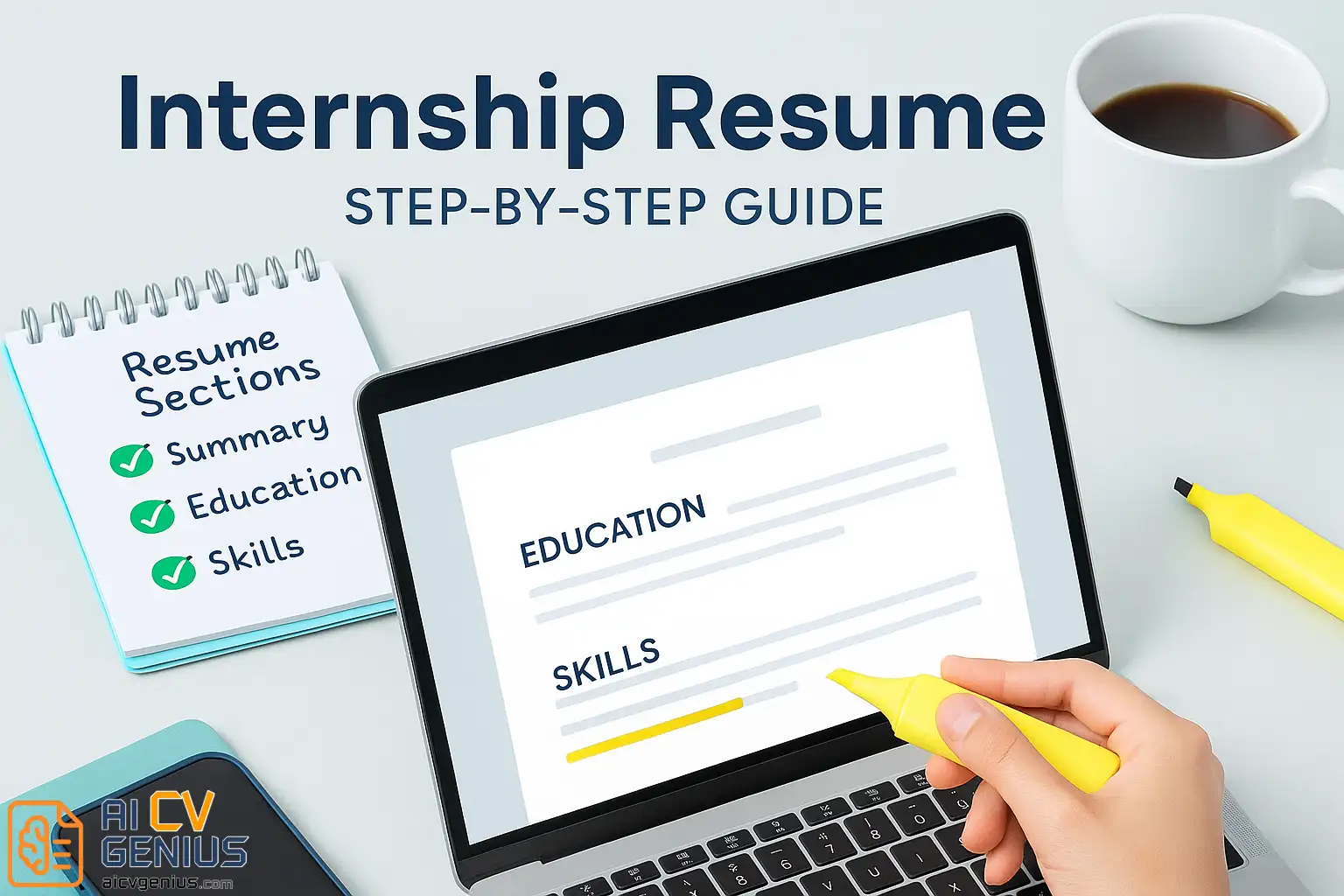
Pick a structure that highlights your strengths, not your gaps. Use a single-page layout with clear sections:
- Header (Name & Contact Info)
- Resume Objective (Crucial for providing context)
- Education (Your most important credential)
- Skills (A scannable list of your technical tools)
- Experience / Projects (The “proof” of your skills)
- Activities / Volunteering (Evidence of soft skills and initiative)
A reverse-chronological format is standard. Always choose simplicity over flashy design. An ATS (Applicant Tracking System) cannot read fancy columns, graphics, or text boxes. A clean, single-column resume is always the safest and most professional choice.
Writing Your Resume Section-by-Section
Step 3 – Write a Resume Objective That Shows Purpose
This replaces the “summary” you’d see on experienced resumes. Your objective is the most mis-used section on an intern resume. Do not make it about what you want to get. Make it about what you want to give.
Weak Objective (Self-Centered): “Looking for an internship to gain valuable experience and learn new skills in a fast-paced environment.” (This tells the recruiter nothing except that you want something from them).
Strong Objective (Contribution-Focused):
“Motivated business student with strong analytical and teamwork skills seeking a summer internship to apply classroom learning in [Data Analysis] and [Market Research] to real-world business challenges.”
Pro Tip: Always tailor this section to the company. Use their name and mention the department or role directly. This simple act of customization proves you are genuinely interested in them, not just an internship.
Highly-Tailored Objective:
“Enthusiastic Computer Science junior with hands-on project experience in Python and SQL, seeking a [Specific Role] internship at [Company Name] to contribute to your backend development team and help optimize database queries.”
Step 4 – Present Education Strategically
Since it’s your strongest credential, list it near the top. Include your university, major, expected graduation date, and GPA if above 3.0. Do not just list your degree; use this section to show what you are learning.
The “Relevant Coursework” subsection is your secret weapon. It allows you to list “keywords” that align with the job description, even if you’ve never held a job in the field.
Example:
University of Michigan – Ann Arbor, MI
B.A. in Communications (Minor in Digital Marketing)
Expected Graduation: May 2026 | GPA: 3.8/4.0
Relevant Coursework: Media Writing, Marketing Analytics, Public Relations Strategy, SEO/SEM Fundamentals, Social Media Campaign Management
By adding that coursework line, the applicant just told the recruiter they have foundational knowledge in SEO, Analytics, and PR – all without having a “real” job.
Step 5 – Highlight Transferable Skills (Even Without Experience)
Use the “Skills” section to show what you can bring. This section must be a clean, scannable list. Combine hard (technical) and soft (interpersonal) skills that fit the role.
Organize them by category to make it even easier for a recruiter to read.
- ✅ Technical Skills: Microsoft Office (Excel, PowerPoint), Google Workspace, Python (Pandas, NumPy), SQL, Canva, Adobe Premiere Pro
- ✅ Soft Skills: Written & Verbal Communication, Time Management, Research & Analysis, Collaboration & Problem-Solving
- ✅ Languages: English (Native), Spanish (Conversational)
Do not just list soft skills like “Time Management.” Be prepared to prove them in your experience and project sections. How did you manage your time? “Balanced a 15-credit course load with a 10-hour/week part-time job, maintaining a 3.8 GPA.” That is proof.
Step 6 – Add Experience That Proves Responsibility
This is where students say, “But I’ve only been a barista/waiter/cashier.” Perfect. Those jobs are not “irrelevant.” They are proof of your most important soft skills: reliability, punctuality, communication, and grace under pressure.
It doesn’t need to be paid work – include class projects, part-time jobs, or volunteer roles that show initiative. The key is to “translate” your duties into achievements.
Weak Description (Duty): “Barista. Took orders and made coffee.”
Strong Description (Achievement-Focused):
Barista – Starbucks, Ann Arbor, MI (Sept 2023–Present)
- Managed high-volume order queue with 99% accuracy during peak morning rush.
- Trained 2 new team members on POS system and drink preparation standards.
- Resolved customer complaints calmly, maintaining a high standard of service.
See? That “irrelevant” job just proved you are trainable, reliable under pressure, and have communication skills. Now, let’s look at a role more aligned with an office internship.
Student Ambassador – University Career Center
2023–Present
• Helped organize 3 career fairs, assisting over 1,000 students.
• Designed social media materials using Canva, increasing event attendance by 15%.
• Presented to 5 freshman orientation classes about career services.
Step 7 – Include Projects That Reflect Your Skills (Your New “Experience”)
For an internship resume, your Projects section is your real Experience section. This is where you show, not tell. A class project, a personal website, or a case study competition can all be framed as professional experience.
Use the same format as a job: A strong title, a brief description of the “problem,” and bullet points on your actions and results.
Marketing Analysis Project (Coursework) – Spring 2024
- Analyzed customer purchase data for a local Ann Arbor startup using Excel (Pivot Tables, VLOOKUP).
- Identified top 3 user demographics and presented findings to the CEO.
- Recommendations for a new social media campaign were adopted, leading to a 10% increase in student engagement.
This is infinitely more powerful than just listing “Excel” in your skills section. It proves you know how to use it to solve a real problem.
Personal Portfolio Website (Independent Project)
- Designed and built a 5-page personal portfolio using HTML, CSS, and basic JavaScript.
- Wrote and edited all blog content, focusing on SEO-friendly articles about digital marketing.
- Implemented Google Analytics to track user engagement and page views.
Step 8 – List Extracurriculars That Demonstrate Leadership
Employers love students who take initiative. Clubs, sports, and volunteering show teamwork and reliability. Again, focus on achievements, not just membership.
❌Weak Description: “Member, Student Sustainability Committee.”
✅Strong Description:
Treasurer – Student Sustainability Committee
2022–Present
- Manage a $5,000 annual budget, tracking all expenses and producing monthly reports.
- Led recycling awareness event for 300 students during Earth Week.
- Coordinated with city council for a local campus clean-up drive.
This shows financial literacy, leadership, and project management skills – all from a “club.”
Optimization, Samples, and Final Checks
Step 9 – Keep It ATS-Friendly
Many companies use Applicant Tracking Systems (ATS) to scan resumes before a human ever sees them. To ensure your resume gets seen:
- ✅ Use standard section titles (Education, Skills, Experience).
- ✅ Avoid tables, columns, or fancy graphics. A single-column layout is safest.
- ✅ Use standard, web-safe fonts like Arial, Inter, Lato, or Garamond.
- ✅ Save as PDF or Word format (.docx is preferred over .doc).
- ✅ Include keywords from the internship posting (e.g., “data analysis,” “social media,” “project management”).
Step 10 – Sample Internship Resume Breakdown
Here’s how a real example might look – with commentary explaining each part:
Jane Park | jane.park@email.com | (555) 123-4567 | LinkedIn.com/in/janepark
Objective: Motivated Marketing student passionate about digital strategy, seeking a social media internship at [Company Name] to apply hands-on project experience in campaign management and data analytics. (Note: It’s tailored and contribution-focused).
Education: University of California, Berkeley – B.S. in Business Administration (GPA: 3.7)
- Relevant Coursework: Digital Marketing, Consumer Behavior, Data Analytics, SEO Fundamentals
(Note: Keywords are loaded in.)
Skills:
- Social Media: Instagram, TikTok, Hootsuite, Sprout Social
- Tools: Excel (Pivot Tables), Canva, Google Analytics, Mailchimp
- Soft Skills: Public Speaking, Team Leadership, Data-Driven Storytelling
Projects:
“CalFresh” Student Outreach Campaign (Group Project)
- Developed a 4-week Instagram campaign strategy to increase student sign-ups for CalFresh benefits.
- Conducted a social media audit of 3 competitor accounts to identify content gaps.
- Our campaign proposal resulted in a 30% increase in engagement on mock-up posts and was voted top in class.
(Note: This is the “experience” section, proving the skills listed above).
Activities:
President, Berkeley Marketing Club (2023–Present)
- Grew club membership by 40% by launching a new “speaker series” with local alumni.
- Manage a $2,000 budget and lead a team of 5 officers.
Volunteer, Habitat for Humanity (2022–2023)
- Contributed 50+ hours to 3 local home builds, collaborating with diverse teams.
(Note: Proves leadership, budget management, and teamwork).
Notice how Jane’s resume focuses on impact, not titles. That’s the trick: highlight what you did, not what you didn’t have.
Step 11 – Polish the Design
Choose a simple font (Inter, Lato, or Arial), consistent spacing, and modest colors. Avoid heavy templates that distract from content. White space is your friend; it makes the document breathable and easy to read.
Need design inspiration? Explore our resume templates – many are built specifically for students and entry-level job seekers. They are all ATS-tested and approved.
Step 12 – Check for Common Mistakes
- ❌ File Name: Using “Resume.pdf” as a file name. Always use “YourName_Resume_Company.pdf”.
- ❌ Passive Language: Writing “Responsible for…” instead of action verbs (“Managed,” “Created,” “Analyzed”).
- ❌ Irrelevant Jobs: Listing “dog walker” without context.
- ✅ The Fix: Instead, show growth, teamwork, and enthusiasm. “Managed scheduling and communication for 5 weekly clients, ensuring 100% reliability.”
- ❌ Typos: One typo can signal a lack of attention to detail. Use a grammar checker and have a friend read it.
Step 13 – Add a “Certifications & Learning” Section
If you’ve taken online courses or certifications (Coursera, LinkedIn Learning, HubSpot Academy), include them here. It signals initiative and a genuine passion for the field outside of required schoolwork.
Certifications & Learning
- Google Analytics for Beginners (Google, 2024)
- Social Media Marketing Certified (HubSpot Academy, 2023)
Step 14 – Keep It Honest and Positive
Never fake experience. Recruiters can spot it, and it will kill your credibility. Instead, focus on your learning attitude and results from real projects. Recruiters appreciate humility paired with effort. It is perfectly fine to say “proficient” or “foundational knowledge” instead of “expert.” Honesty is always the best strategy.
Step 15 – Example of Strong Closing Statement (Email or Submission)
When you attach your resume to an email, the email body itself is part of the application. Keep it short, professional, and clear.
“Subject: Application for [Internship Role] – [Your Name]
Dear [Mr./Ms. Last Name],
Please accept this email as my application for the [Internship Role] at [Company Name]. My resume is attached for your review.
My project experience in [Key Skill 1] and [Key Skill 2] aligns well with the responsibilities you’ve outlined. I’m excited to bring my academic knowledge and creativity into a real-world environment.
Thank you for considering my application – I’d love the opportunity to contribute and keep learning.”
Pros & Cons of an Internship Resume
| ✅ Strengths | ⚠️ Pitfalls |
|---|---|
| Focuses on skills, projects, and potential, not just paid experience. | May feel light without strong, quantified examples from projects. |
| Shows growth and a dedicated learning mindset. | Overuse of buzzwords (“motivated”, “hardworking”) without proof. |
| Easy to tailor for different companies by swapping “Relevant Coursework” and “Projects.” | Can look generic if the objective and project descriptions are not personalized. |
Where to Learn More
Your resume is one part of a larger story. To see how professional layouts look, browse our cover letter examples for matching styles.
And don’t miss our career resources for interview prep, ATS optimization, and first-job strategies.
FAQ – Internship Resume Writing
- Academic Projects: Frame your most difficult class project as a professional case study.
- Volunteer Work: Shows reliability and teamwork.
- Transferable Skills: Translate skills from any job (e.g., “customer service” from retail, “logistics” from food service).