
- What Microsoft hires for now: Growth mindset, Collaboration, And customer focus over trivia and “smartest in the room”.
- Interview structure: Recruiter screen, One phone or case round, Then an onsite loop with multiple interviews and an AA senior leader check.
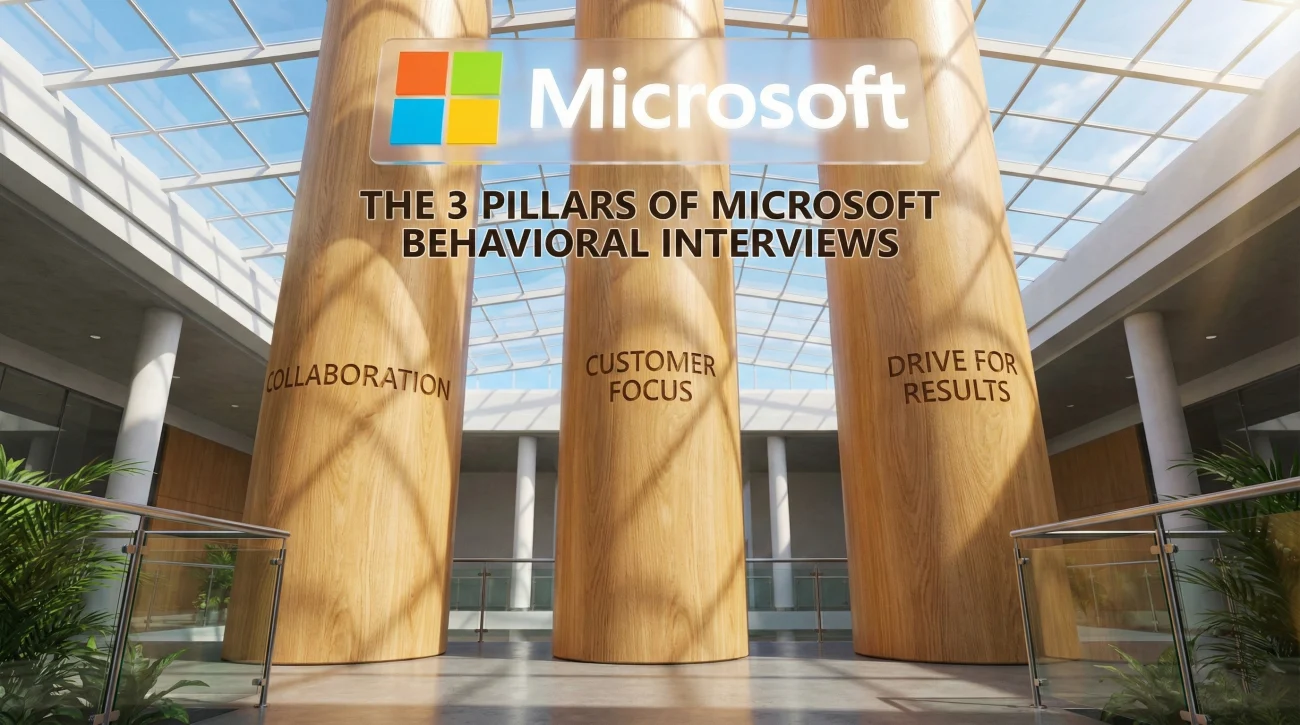
- Behavioral priorities: Collaboration, Customer focus, And drive for results, told with clear stories and measurable outcomes.
- “As if” hypotheticals: Clarify assumptions, Structure your thinking, Talk through trade offs, And admit gaps while showing how you learn.
- What to avoid: Fixed mindset claims, Blaming others, Competing with teammates, Or getting defensive when challenged.
Microsoft Has Changed – They Look for “Growth Mindset”
Old Microsoft valued technical brilliance and competitiveness. Candidates were tested on obscure trivia and brain teasers to prove they were the smartest person in the room.
That culture is dead. Under Satya Nadella’s leadership, Microsoft transformed into a company that values learning, collaboration, and customer focus over individual heroics.
The interview process now emphasizes “Growth Mindset” – Carol Dweck’s concept that abilities develop through dedication and learning, not fixed intelligence. Microsoft wants curious people who acknowledge what they don’t know, not know-it-alls who can’t admit mistakes.
This shift fundamentally changes how you should approach Microsoft interviews.
The Interview Process (4-5 Rounds)
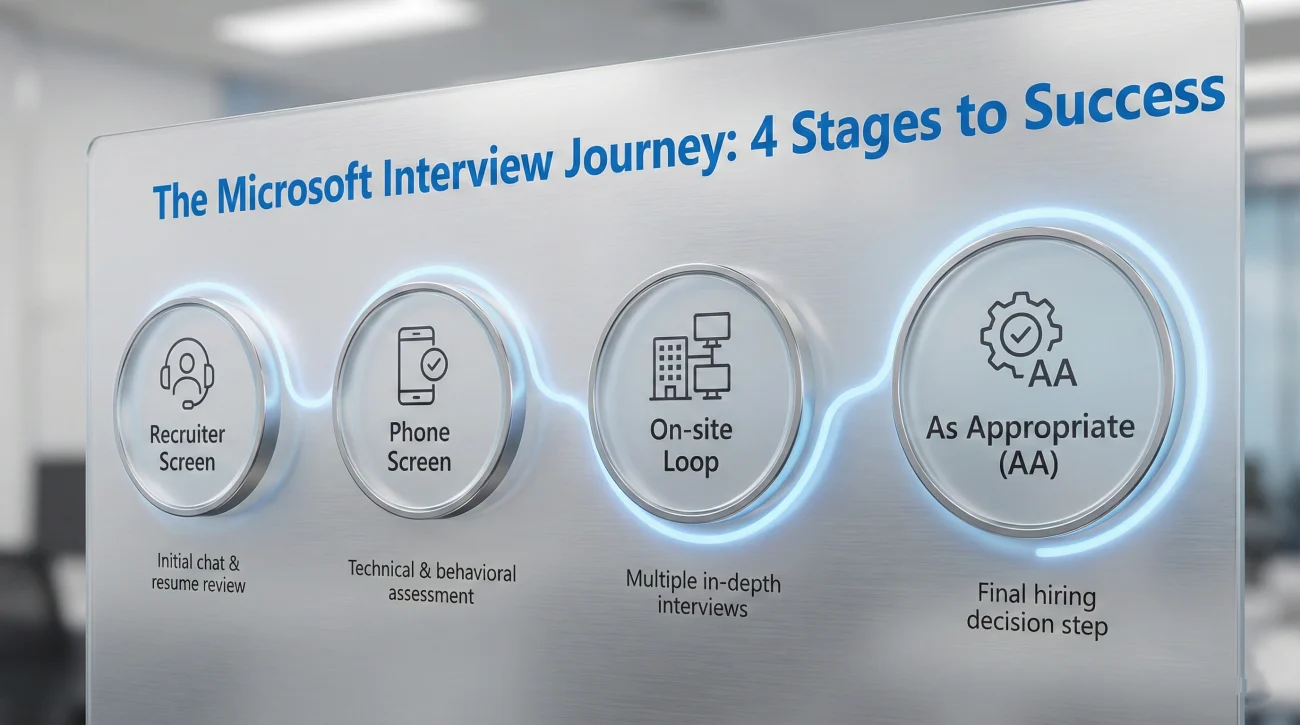
Stage 1: Recruiter Screen
30-45 minute phone call covering:
- Your background and experience
- Why Microsoft and this specific role
- Salary expectations and logistics
- Basic fit assessment
This is primarily administrative but still evaluative. Be prepared to explain your interest in Microsoft specifically.
Stage 2: Phone Screen (Technical or Behavioral)
One hour with a team member covering:
- For technical roles: Coding challenge, system design discussion, or technical problem-solving
- For non-technical roles: Case study, analytical scenario, or functional expertise test
- Brief behavioral questions about collaboration and learning
Stage 3: On-Site Loop (4-5 Interviews)
Full day (or virtual equivalent) with multiple interviewers:
- 2-3 technical/role-specific interviews
- 1-2 behavioral interviews focused on Growth Mindset
- 1 “As Appropriate” (AA) interview – senior leader who makes final call
Each interviewer evaluates different competencies and submits independent feedback.
The “As Appropriate” (AA) Interview
This is unique to Microsoft. A senior hiring manager joins partway through your loop if other interviewers give positive signals.
What it means: You’re doing well. AA presence indicates you’re a serious candidate.
What they assess: Cultural fit, leadership potential, long-term trajectory at Microsoft.
Key tip: Ask thoughtful questions. AA interviews are conversational – they want to see curiosity and strategic thinking.
For comprehensive interview preparation strategies, see our complete interview guide.
The “As If” Questions (Hypothetical Scenarios)
Microsoft frequently uses hypothetical questions that begin “What would you do as if…”

Common “As If” Questions
“What would you do as if you were the CEO of Microsoft and had to decide whether to acquire a competitor?”
“How would you approach this problem as if you were leading a team of 10 engineers with a 6-month deadline?”
“What would you prioritize as if you were the product manager for Teams?”
Why Microsoft Asks These
They test:
- Strategic thinking beyond your current level
- Ability to handle ambiguity
- How you prioritize with limited information
- Leadership potential
- Customer and business awareness
How to Answer
Step 1: Clarify assumptions
“Before I answer, I want to clarify: What’s the primary goal – market share, revenue growth, or strategic positioning? And what constraints should I consider – budget, timeline, existing commitments?”
Step 2: Structure your thinking
“I’d approach this by first understanding the customer need, then evaluating our options, considering trade-offs, and defining success metrics.”
Step 3: Think out loud
“The key trade-off I see is speed versus quality. If we prioritize speed, we can launch in Q1 but with limited features. If we prioritize quality, we’d launch Q2 with a more complete solution.”
Step 4: Show Growth Mindset
“I don’t have deep experience in acquisitions, so I’d consult with M&A experts and look at historical data on similar deals. What would you recommend I consider that I might be missing?”
The last part is critical – acknowledging gaps and asking for input demonstrates Growth Mindset.
Behavioral Questions: 3 Core Pillars
Microsoft behavioral interviews focus on three areas aligned with their values.
1. Collaboration
Microsoft shifted from competitive internal culture to collaborative. They want team players.
Sample questions:
“Tell me about a time you worked with a difficult team member.”
“Describe a project where you had to coordinate across multiple teams.”
“Give an example of when you helped a colleague succeed.”
How to answer: Show willingness to share credit, help others, and work across silos. Emphasize “we” not just “I.”
2. Customer Focus
Microsoft’s transformation centered on customer obsession rather than internal politics.
Sample questions:
“Tell me about a time you advocated for the customer when it wasn’t easy.”
“Describe a situation where you changed direction based on customer feedback.”
“How do you balance customer needs with business constraints?”
How to answer: Demonstrate genuine customer empathy, use of customer data to drive decisions, and willingness to prioritize customer value.
3. Drive for Results
Microsoft wants people who deliver outcomes, not just effort.
Sample questions:
“Tell me about a time you overcame significant obstacles to achieve a goal.”
“Describe your biggest professional achievement.”
“Give an example of when you had to deliver results with limited resources.”
How to answer: Use STAR format with quantified results. Focus on impact, not just activities.
For more behavioral interview strategies, explore our interview preparation guide.
Growth Mindset Questions
These questions directly assess whether you demonstrate Growth Mindset characteristics.

Learning and Development
“Tell me about a time you learned a completely new skill or technology.”
“Describe a situation where you didn’t know the answer and how you figured it out.”
“What’s something you’re currently learning?”
How to answer: Show genuine curiosity, systematic approach to learning, and comfort with not knowing everything.
Handling Failure
“Tell me about a significant failure and what you learned.”
“Describe a time you received critical feedback. How did you respond?”
“Give an example of a mistake you made and how you improved afterward.”
How to answer: Own failures completely, focus on learning, and show how you applied lessons to improve.
Example structure:
“I underestimated the complexity of migrating our database, which caused a 2-week delay and frustrated stakeholders. I took full ownership, communicated transparently about what went wrong, and implemented a more rigorous scoping process. Since then, I’ve delivered 15 projects on time by applying those lessons. This failure taught me the importance of breaking complex work into smaller estimates.”
Seeking Feedback
“How do you typically seek feedback on your work?”
“Tell me about a time you actively sought out criticism.”
“Describe how you’ve changed based on feedback you received.”
How to answer: Show proactive feedback-seeking, ability to receive criticism without defensiveness, and concrete changes based on input.
Technical Interview Tips (For Engineering Roles)
Coding Interviews
- Use your preferred programming language (C#, Python, Java most common)
- Think out loud throughout the problem
- Ask clarifying questions before coding
- Discuss time and space complexity
- Test your code with examples
System Design
- Focus on scalability – Microsoft operates at massive scale
- Discuss trade-offs between approaches
- Consider availability, consistency, and partition tolerance
- Think about cloud architecture (Azure knowledge helpful but not required)
Show Growth Mindset in Technical Rounds
When stuck, say:
“I’m not immediately seeing the optimal solution. Let me think through a brute force approach first, then optimize.”
This shows problem-solving process and comfort with not knowing everything instantly.
What NOT to Do
Don’t Pretend to Know Everything
“I’m an expert in all Microsoft products and have mastered every technology.”
This signals Fixed Mindset. Instead, be honest about gaps while showing eagerness to learn.
Don’t Blame Others for Failures
“The project failed because my team didn’t execute properly.”
Take ownership. Microsoft values accountability.
Don’t Frame Work as Competition
“I was the top performer on my team and always beat my colleagues.”
Old Microsoft valued this. New Microsoft wants collaboration and team success.
Don’t Get Defensive
If challenged on your approach, say:
“That’s a good point I hadn’t considered. Let me think through that alternative approach.”
Not:
“No, my way is definitely correct.”
FAQ
Show Curiosity, Not Know-It-All Attitude
Microsoft’s transformation from competitive internal culture to collaborative, learning-focused organization fundamentally changed what they value in candidates. Growth Mindset isn’t just a buzzword – it’s the central evaluation criterion.
Master “As If” hypothetical questions by clarifying assumptions, structuring your thinking, thinking out loud, and explicitly acknowledging knowledge gaps. These questions test strategic thinking and comfort with ambiguity.
In behavioral interviews, focus on the three core pillars: Collaboration (team success over individual heroics), Customer Focus (genuine empathy and data-driven decisions), and Drive for Results (quantified impact and overcoming obstacles).
Demonstrate Growth Mindset throughout every interview by showing genuine curiosity, owning failures completely, actively seeking feedback, and being comfortable saying “I don’t know, but here’s how I’d figure it out.”
Avoid pretending to know everything, blaming others for failures, framing work as competition, or getting defensive when challenged. These signal Fixed Mindset and cultural misalignment.
Remember: Microsoft changed because they realized know-it-alls who can’t collaborate eventually fail at scale. They want learners who grow, adapt, and help others succeed.
For additional Microsoft interview resources, check out our comprehensive career guide.