
- Your pharmacist resume should read like a clinical safeguard report: It must signal precision, patient safety, and empathetic counseling, not just degrees and duties.
- Recruiters scan for risk reduction first: Accuracy proof, high-volume efficiency, counseling and adherence impact, and compliance signals like DEA, HIPAA, and USP 797/800.
- Pass ATS before a human ever sees you: Use a clean one-column layout, standard headings, consistent credentials (Pharm.D, RPh), and mirror job keywords plus systems like Epic Willow, Cerner, QS/1.
- Structure it like a patient chart: Clear credential header, a tight 3 to 4 line summary, grouped competencies, then experience bullets written as Action Verb + Project + Metric.
- Tailor by setting and specialty: Retail emphasizes script volume, counseling, MTM, immunizations; Clinical emphasizes ADE prevention, stewardship, compounding, interdisciplinary work; Avoid errors, passive language, and missing license details.
In healthcare, precision is not just a goal; it is a life-saving requirement. Every prescription dispensed carries a profound weight of trust. Your Pharmacist resume must do the same. It is more than a list of degrees and duties; it is a clinical report on your accuracy, your empathy, and your ability to be the final, critical safeguard between a patient and their medication.
Whether you are a new Pharm.D graduate seeking your first retail position, an experienced clinical pharmacist moving into hospital administration, or a specialist in compounding or oncology, your resume has a unique challenge. It must instantly communicate two things: unwavering technical competence and compassionate patient-facing skill.
Most pharmacist resumes fail because they are passive. They list duties like “Filled prescriptions” or “Counseled patients.” This guide will deconstruct how to write an active, compelling resume. We will transform those duties into achievements, proving you don’t just dispense medication – you manage therapy, ensure safety, and improve patient outcomes. Let’s build a document that reflects the true value of your expertise.
The Recruiter’s Query: Passing the ATS and Impressing Management
When a Pharmacy Manager or Hospital Administrator reviews your resume, they are not just “filling a shift.” They are managing profound risk – financial, legal, and human. A single decimal point error can be catastrophic. Their scan is a rapid risk assessment.
In their brief review, they are subconsciously asking critical questions:
- 1. Are You Accurate? This is non-negotiable. They are hunting for any proof of your precision. Keywords like “dispensing accuracy,” “error reduction,” and “double-check protocols” are signals of a safe hire.
- 2. Are You Efficient? In both retail and clinical settings, volume is a reality. Can you handle a high-volume script count? Do you understand workflow? Metrics like “prescriptions filled per hour” or “reduced patient wait time” are extremely valuable.
- 3. Can You Counsel? (And Protect HCAHPS/Star Ratings) A pharmacist who just hands over a bag is a liability. They need a communicator who can conduct Medication Therapy Management (MTM), improve patient adherence, and provide counseling that is clear and empathetic. This directly impacts patient satisfaction scores (HCAHPS in hospitals, Star Ratings in retail), which affect funding and reputation.
- 4. Do You Understand Compliance? Do you know DEA regulations for controlled substances? Do you understand USP 797/800 for compounding? They are looking for keywords like “regulatory compliance,” “inventory audits,” and “HIPAA.”
Before a human ever sees your file, it must pass through an Applicant Tracking System (ATS). Healthcare systems and large retail chains (CVS, Walgreens, etc.) rely on these systems (like Taleo, Workday, and iCIMS) to manage applications. This software is a simple keyword filter. To pass, you must use consistent credentials (“Pharm.D”, “RPh”), align keywords with the job description (“MTM,” “immunization”), and list the specific software you know (Epic (Willow), Cerner, QS/1, etc.). Use standard headings and a clean, single-column format.
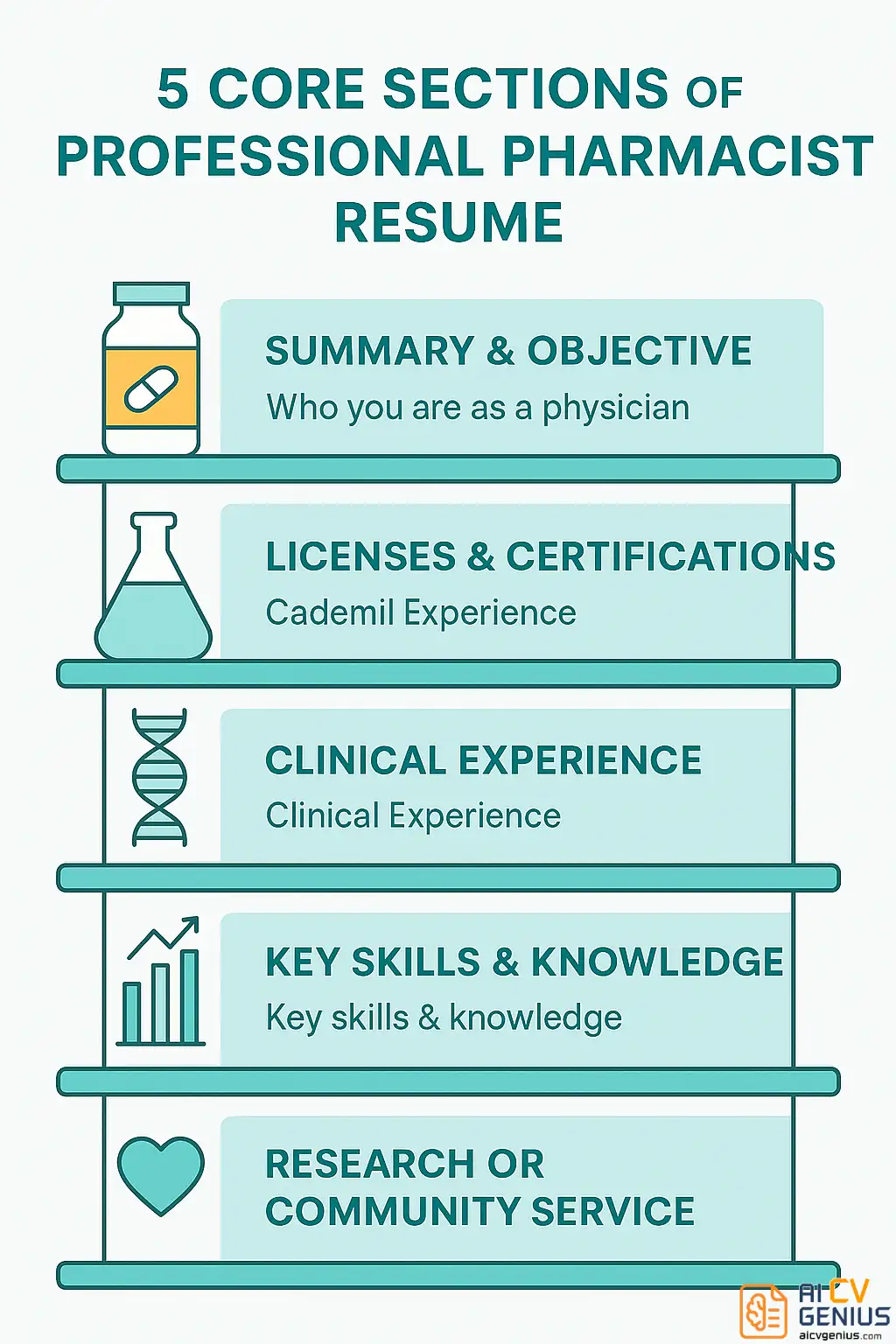
Core Structure: Your Resume as a Clinical Document
A great pharmacist’s resume is structured like a patient chart: logical, hierarchical, and instantly scannable, with the most critical information presented first.
1. Header: Your Credentials (The Non-Negotiables)
Make this clean and unambiguous. Your credentials are your first qualifier.
Your Name, Pharm.D, RPh
[Your Specialty, e.g., “Board Certified Oncology Pharmacist (BCOP)”] (If applicable)
City, State, Zip | (555) 123-4567 | your.email@domain.com | LinkedIn URL
Pro Tip: Always include your RPh (Registered Pharmacist) designation. It is a primary keyword.
2. Professional Summary: Your Abstract
This is your 3-4 line “abstract.” It must summarize your value, your core skills, and your commitment to patient safety.
❌Weak Summary:
“Pharmacist with 6+ years of experience. Hard-working and passionate about helping patients. Looking for a new and challenging role.”
(This is generic and passive).
✅Strong Summary (Retail):
“Patient-focused Registered Pharmacist (RPh) with 6+ years of experience in high-volume retail settings. Proven ability to dispense 400+ prescriptions daily with 99.9% accuracy. Expert in MTM, patient counseling, and immunization, helping to improve store-wide adherence ratings by 15%.”
✅Strong Summary (Clinical/Hospital):
“Detail-oriented Clinical Pharmacist (Pharm.D) with 8+ years of experience in acute care hospital environments. Specialist in sterile compounding (USP 797/800) and antibiotic stewardship. Proven to reduce medication errors by 20% through interdisciplinary collaboration with physicians and nursing staff.”
✅Strong Summary (New Graduate):
“Highly-motivated Pharm.D Graduate (RPh) with 1,500+ hours of rotational experience in both retail and clinical settings. Eager to apply rigorous training in patient counseling, MTM, and Epic Willow EMR to ensure patient safety and accuracy in a challenging Pharmacist role.”
3. Key Skills / Clinical Competencies
Do not use a generic “skills” list. Group your competencies logically. This shows you think in systems and is highly scannable for recruiters.
| Clinical Expertise | Medication Therapy Management (MTM), Patient Counseling, Immunization (APhA Certified), Compounding (Sterile & Non-Sterile), Pharmacovigilance, Antibiotic Stewardship |
| Dispensary & Operations | Prescription Verification (Data Entry & Final Check), Inventory Management, Quality Assurance, Regulatory Compliance (DEA, HIPAA, USP 797/800) |
| Pharmacy Software (EMR/PMS) | Epic (Willow), Cerner, QS/1, EnterpriseRx (McKesson), Rx30, PioneerRx, Meditech |
| Interpersonal & Leadership | Patient-Centered Care, Interdisciplinary Collaboration, Pharmacy Technician Training & Supervision, Conflict Resolution |
4. Clinical & Professional Experience
This is the core of your resume. Do not list duties. List achievements. Use the “Action Verb + Project + Metric” formula. Every bullet point should prove your value.
| ❌ Weak Bullet (Duty) | ✅ Strong Bullet (Impact) |
|---|---|
| “Responsible for filling prescriptions.” | “Managed the verification and dispensing of 3,000+ prescriptions weekly in a high-volume setting, maintaining a 99.9% accuracy rate.” |
| “Counseled patients on new medications.” | “Conducted 20+ daily patient consultations for new and complex prescriptions, improving patient adherence scores by 15% year-over-year.” |
| “Gave flu shots.” | “Administered 1,500+ immunizations (Influenza, COVID-19, Shingrix) during the 2023 season, exceeding company goals by 25%.” |
More High-Impact Examples:
- ✅ Performed meticulous inventory audits for all controlled substances, ensuring 100% DEA compliance with zero discrepancies over 3 years.
- ✅ Collaborated with physicians to review 30+ complex patient profiles daily, recommending therapeutic adjustments that prevented an estimated 50+ adverse drug events (ADEs).
- ✅ Trained and supervised a team of 5 pharmacy technicians, improving team efficiency and reducing patient wait times by 20%.
- ✅ Led the pharmacy’s MTM program, completing 200+ Comprehensive Medication Reviews (CMRs) and resolving over 500 drug therapy problems.
5. Licensure, Certifications & Education
This section must be clear, precise, and unimpeachable. Group it logically.
Licensure & Certifications
- Registered Pharmacist (RPh), [State Name] (License #), Active
- Board Certified in [Your Specialty], (BPS – If applicable)
- APhA Certified Immunization Provider
- Basic Life Support (BLS) / CPR Certified
- [Any other relevant, e.g., MTM Certified, USP 797/800 Certified]
Education
- Doctor of Pharmacy (Pharm.D), [University Name], [City, State] (Year)
- Bachelor of Science, [Major], [University Name], [City, State] (Year)
(For new grads, PGY-1/PGY-2 residencies would also go here).
Quantifying Your Impact: Metrics for Pharmacists
This is what separates a good resume from a great one. Numbers prove your effectiveness. You have more data than you think.
- Accuracy: “Maintained a 99.9% dispensing accuracy rate…”
- Volume: “Dispensed 400+ prescriptions per day…”
- Patient Outcomes: “Improved patient adherence by 15%…” or “Prevented 50+ potential adverse drug events…”
- Efficiency: “Reduced patient wait time by 20%…” or “Reduced inventory waste by 25%…”
- Initiative: “Administered 1,500+ immunizations…” or “Completed 200+ MTM reviews…”
- Training: “Trained and mentored 5 new pharmacy technicians…”
If you don’t have exact numbers, estimate. “Dispensed approx. 300-400 prescriptions daily” is still more powerful than “Dispensed prescriptions.”
The Complete Pharmacist Resume Example (Putting It All Together)
Theory is one thing; practice is another. Let’s apply every strategy we’ve discussed to build a complete resume for a fictional candidate, Dr. Sarah Chen, an experienced clinical pharmacist.
SARAH CHEN, Pharm.D, RPh, BCPS
Board-Certified Clinical Pharmacist
Philadelphia, PA 19104 | (555) 234-5678 | s.chen.pharmd@email.com | linkedin.com/in/sarahchenpharmd
PROFESSIONAL SUMMARY
Data-driven and patient-focused Clinical Pharmacist (BCPS) with 8+ years of experience in a 600-bed academic medical center. Proven leader in antibiotic stewardship, developing protocols that reduced broad-spectrum antibiotic use by 22%. Expert in interdisciplinary collaboration, EMR optimization (Epic Willow), and sterile compounding (USP 797/800), dedicated to improving patient safety and reducing medication errors.
CORE COMPETENCIES
|
|
|
CLINICAL EXPERIENCE
Clinical Pharmacist Specialist (Infectious Disease) | Hospital of the University of Pennsylvania | Philadelphia, PA (2018 – Present)
- Lead the antibiotic stewardship committee, collaborating with physicians to review 50+ complex patient profiles daily; new protocols reduced broad-spectrum antibiotic use by 22%.
- Develop and deliver clinical education to 30+ medical residents and pharmacy students annually on antimicrobial resistance and formulary management.
- Review and verify complex sterile compounding orders (e.g., TPNs, hazardous drugs) in strict compliance with USP 797/800 standards.
- Prevented an estimated 100+ potential adverse drug events (ADEs) in the last year through proactive medication reconciliation and chart review.
Staff Pharmacist (Central Pharmacy) | Jefferson University Hospital | Philadelphia, PA (2015 – 2018)
- Managed accurate verification and dispensing of 2,000+ medication orders daily in a high-volume central pharmacy using Epic Willow.
- Trained and supervised 8 pharmacy technicians in aseptic technique and automated dispensing cabinet (Pyxis) management, improving workflow efficiency by 15%.
- Conducted monthly inventory audits for all controlled substances, ensuring 100% DEA compliance and reducing formulary waste by 10%.
LICENSURE & CERTIFICATION
- Registered Pharmacist (RPh) | Pennsylvania (License #RP123456), Active
- Board Certified Pharmacotherapy Specialist (BCPS) | Board of Pharmacy Specialties
- APhA Certified Immunization Provider
- Basic Life Support (BLS) Certified
EDUCATION & CLINICAL TRAINING
- PGY-1 Pharmacy Practice Residency | Johns Hopkins Hospital | Baltimore, MD (2015)
- Doctor of Pharmacy (Pharm.D) | University of Pittsburgh School of Pharmacy (2014)
- Bachelor of Science in Pharmaceutical Sciences | University of Pittsburgh (2012)
Advanced Strategies: Specialization, Pitfalls, and Templates
Beyond the core structure, several advanced tactics can further refine your resume. This includes tailoring for your specialty, adding supporting achievements, and avoiding common errors.
Tailor for Your Specialty: Clinical vs. Retail vs. Industry
“Pharmacist” is a wide field. Your resume must be tailored to the specific role. A retail resume looks different from a clinical resume.
| Role Type | Focus | Resume Emphasis & Keywords |
|---|---|---|
| Retail / Community Pharmacist | Efficiency, patient counseling, inventory, immunizations. | Emphasize: Script volume, patient satisfaction, adherence, MTM, immunizations, technician supervision. |
| Clinical / Hospital Pharmacist | Patient safety, interdisciplinary care, specialized knowledge. | Emphasize: Patient profile reviews, ADE prevention, antibiotic stewardship, compounding, EMR (Epic/Cerner). |
| Industry (Pharma / MSL) | Data analysis, research, communication, regulatory. | Emphasize: Drug information, clinical trials, data analysis, presentations, regulatory affairs. (Often requires a CV). |
| Long-Term Care (LTC) / Mail Order | High-volume verification, compliance, data management. | Emphasize: Accuracy, high-volume verification, compliance packaging, regulatory audits. |
Research, Publications, and Memberships
Even for a retail resume, including these sections demonstrates your commitment to the field. Keep them concise.
Publications & Presentations
- Carter, E. (2023). “Trends in Antibiotic Stewardship.” Journal of Clinical Pharmacy. [Include 1-2 of your most relevant].
- Lead Presenter, “MTM in Community Pharmacy,” APhA Annual Meeting, 2024.
Professional Memberships
- American Pharmacists Association (APhA)
- American Society of Health-System Pharmacists (ASHP)
- [Your State] Pharmacists Association
Mistakes to Avoid (The “Adverse Events”)
- ❌ Typos and Errors: In pharmacy, attention to detail is your brand. A typo on a resume implies a potential dispensing error. It’s a critical failure.
- ❌ Passive Language: “Was responsible for…” or “Duties included…”. This is weak. Use strong action verbs: “Managed,” “Verified,” “Counseled,” “Optimized.”
- ❌ Forgetting Empathy: A resume full of cold, hard metrics without a single mention of “patient counseling” or “compassionate care” is a red flag.
- ❌ Not Listing Your License: Forgetting your RPh license number or its status is the #1 reason a resume gets instantly discarded.
Pros & Cons of Using a Resume Template
| Pros | Cons |
|---|---|
| ✅ Ensures a professional, ATS-friendly, and scannable layout. | ❌ Can feel generic if you don’t personalize the content. |
| ✅ Saves significant time on formatting, allowing focus on content. | ❌ Some templates are poorly designed and not ATS-compatible. |
| ✅ Creates a clear hierarchy that healthcare recruiters expect. | ❌ May not be flexible enough for a detailed academic/research CV. |
For a clean, professional template designed for healthcare roles, explore Resume Templates Finder.
In-Depth FAQs for a Pharmacist’s Resume
Weak: “Strong communication skills.”
Strong: “Consistently maintained a 95th percentile patient satisfaction score for counseling clarity.”
Strong: “De-escalated 100+ difficult patient interactions regarding insurance denials, finding affordable alternatives and retaining customer loyalty.”
Strong: “Trained 5 pharmacy technicians on empathetic communication and active listening.”
Final Thoughts: Your Resume is Your First Consultation
Healthcare is dynamic. Job offers appear through networks, conferences, or internal transfers. Keep a “master resume” document that you update quarterly. Treat it like your logbook, not a one-time document. Set reminders to add new certifications, completed CEs, or significant achievements (e.g., “Managed the rollout of the new flu vaccine”). Recruiters often ask for documents within 24 hours; having one ready shows professionalism and initiative.
Every pharmacist is both a scientist and a patient advocate – interpreting complex data and delivering it with human trust. Your resume should echo that duality: precise, evidence-based, yet compassionate. The right layout will help recruiters see not just your accuracy, but the profound care and responsibility behind it.
Explore healthcare templates at Resume Templates Finder or refine your application style through Career Resources and Cover Letters Tips.