

- An executive resume template is a leadership proof document: It must make your strategic impact obvious, not just list senior job duties.
- The core sections should prioritize board level signals: Executive Summary, Strategic Achievements, Leadership Scope with P&L, and Executive Core Competencies focused on strategy.
- Modern executive credibility comes from specifics: Remote or global leadership, cross border experience, and programs like ESG or governance backed by measurable outcomes.
- Tailoring is the highest leverage move: Align your summary and top accomplishments to the company’s goals like growth, turnaround, digital transformation, or expansion.
- Use a strict final checklist before sending: Two pages for most roles, quantified wins, clear scope, strategic initiatives, industry influence, clean formatting, PDF plus DOCX, and flawless proofreading.
At the executive level, your resume transcends a mere summary of employment history – it becomes your professional testimony. It functions as the closing argument in the trial of your career, meticulously designed to persuade boards, executive recruiters, and key stakeholders that you possess not just managerial competence, but visionary leadership capabilities.
An effectively chosen executive resume template transforms your significant achievements into a compelling narrative demonstrating authority, strategic influence, and consistently delivered, measurable results. It communicates fluently in the language essential to the C-suite: growth, strategic foresight, operational excellence, and organizational transformation.
Why Executive Resumes Demand a Unique Approach
An entry-level resume highlights potential. A mid-career resume showcases developed experience. An executive resume, however, is fundamentally centered on demonstrable impact. Decision-makers at this level need immediate, clear answers to critical questions: How did you define and drive corporate strategy? What quantifiable revenue growth, market share gains, or cost efficiencies did you directly deliver? What significant cultural shifts or organizational transformations did you successfully lead? What lasting legacy or structural improvements did you establish?
- ✅ Strategic Vision: Evidence of your ability to set long-term direction, anticipate market shifts, and inspire organizational alignment towards ambitious goals.
- ✅ Quantifiable Results: Concrete metrics demonstrating success – revenue growth ($ or %), market share expansion (%), cost reduction initiatives ($ or %), EBITDA improvement (%), successful capital raises ($).
- ✅ Leadership Scope & Scale: Clearly defined scale of leadership – size and complexity of teams managed (direct/indirect reports), P&L responsibility ($), geographic scope of operations (regions, countries).
- ✅ Stakeholder Influence: Demonstrated ability to effectively engage and influence boards of directors, investors, key clients, regulatory bodies, and industry leaders.
- ✅ Adaptability & Future-Focus: Experience navigating complex challenges like global market entry, digital transformation implementation, M&A integration, or embedding ESG principles into corporate strategy.
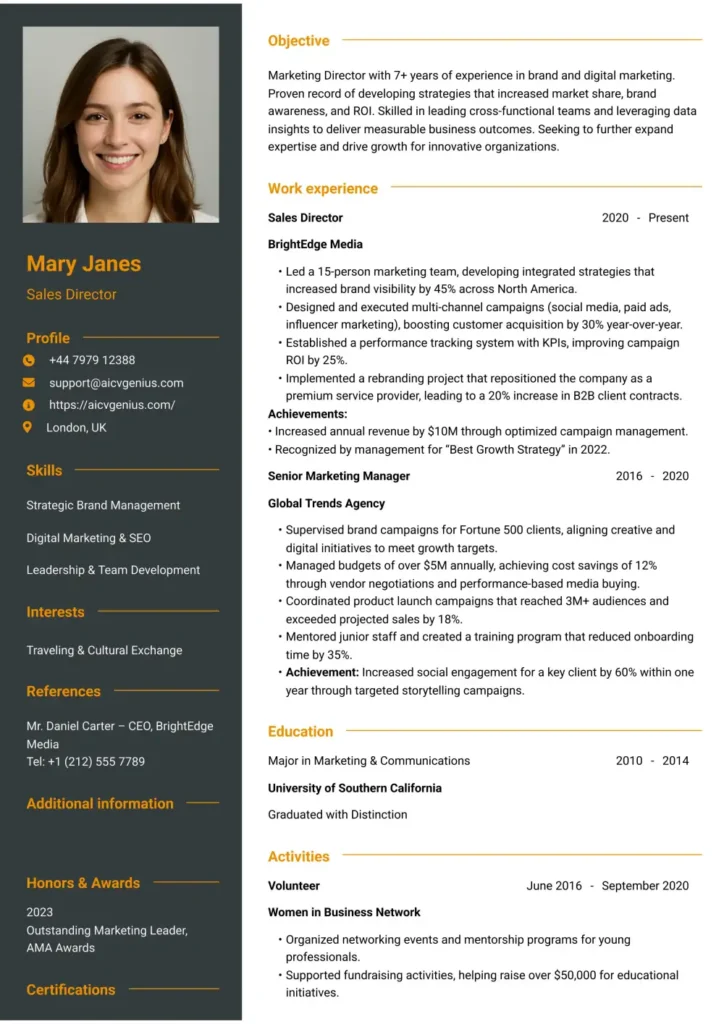
Key Sections of an Executive Resume Template
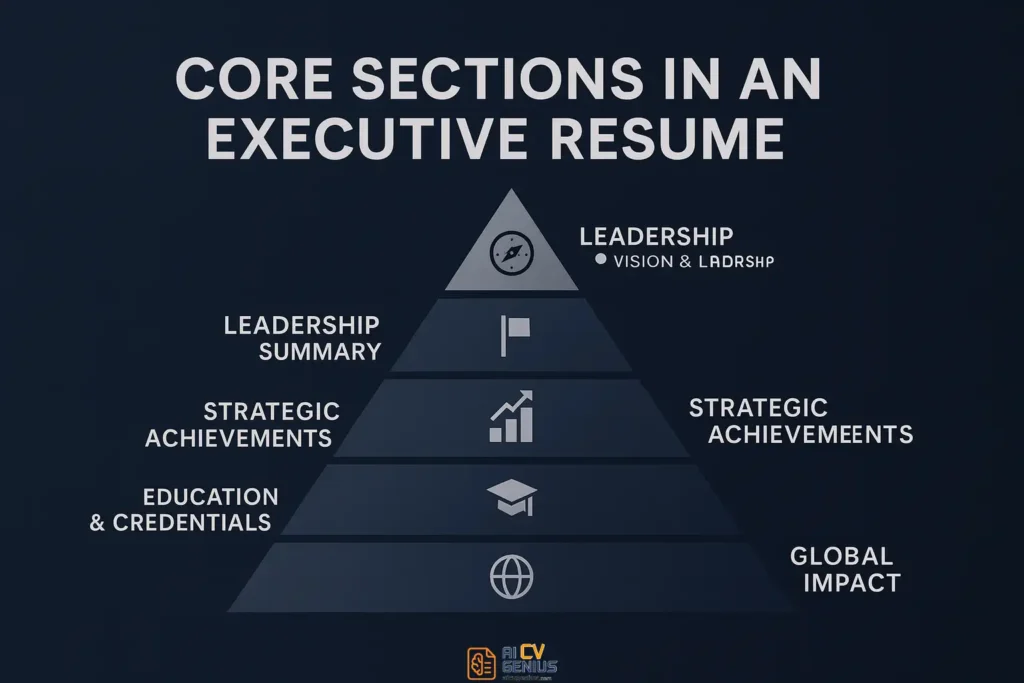
An effective executive resume template must structure information logically, prioritizing strategic impact:
Executive Summary / Professional Profile
This is your strategic headline – a concise, powerful personal brand statement, not a generic objective. Tailor it to the specific opportunity.
Example:
“Visionary and results-oriented C-suite executive with over 20 years of global leadership experience spanning the finance and technology sectors. Demonstrates a consistent track record of driving large-scale digital innovation, leading diverse multicultural teams across complex matrices, and delivering substantial revenue growth (exceeding $2B cumulative).”
Strategic Achievements / Key Accomplishments
Boards and recruiters prioritize measurable results and strategic impact over daily tasks. Focus on high-level outcomes directly tied to business goals:
- “Expanded market share within a highly competitive SaaS sector from 8% to 23% over a four-year period through targeted product innovation and aggressive go-to-market strategies.”
- “Executed a comprehensive organizational restructuring and process optimization program, resulting in a sustainable reduction of operational expenditures by $120M annually (15% decrease).”
- “Developed and integrated a corporate-wide Environmental, Social, and Governance (ESG) strategy, significantly enhancing investor confidence, improving public perception, and contributing to securing a $500M green bond issuance.”
Leadership Scope & P&L Responsibility
Numbers provide crucial context regarding the scale of your leadership. Clearly define the scope of your impact:
- “Led a global organization comprising 10,000+ staff members across 12 distinct geographic regions, fostering a high-performance culture.”
- “Held full P&L accountability for a $1.2B business unit, consistently exceeding profitability targets through effective cost management and revenue enhancement initiatives.”
- “Managed and developed a senior leadership team consisting of 5 divisional Vice Presidents and 40 Directors, implementing robust succession planning.”
Executive Core Competencies / Skills
Focus on strategic capabilities rather than basic technical skills.
- ✅ Strategic Planning & Execution
- ✅ P&L Management & Financial Acumen
- ✅ Mergers & Acquisitions (M&A) Lifecycle Management
- ✅ Business Transformation & Change Leadership
- ✅ Corporate Governance & Regulatory Compliance
- ✅ Stakeholder Engagement & Board Relations
- ✅ Global Market Expansion Strategy
- ✅ Digital Transformation & Technology Integration Leadership
- ✅ Talent Development & Organizational Design
Education & Professional Development
List advanced degrees (MBA, relevant Master’s/PhDs) and prestigious executive education programs (e.g., Harvard Business School AMP, INSEAD Global Executive MBA, Wharton Aresty Institute). At the executive level, education primarily serves to reinforce credibility and demonstrate continuous learning rather than being the primary qualification driver.
Board Memberships & Industry Influence
Executives often shape their industries beyond their primary roles. Include current or past memberships on corporate boards (public or private), non-profit boards, significant advisory roles, keynote speaking engagements at major industry conferences, impactful publications (books, widely cited articles), or patents held.
Complete Executive Resume Example (COO / Transformation)
This full, ATS-friendly resume example applies the core principles discussed, focusing on quantifiable impact, leadership scope, and strategic vision. This example uses bolding for internal section headers rather than heading tags for clean parsing.
ALEXANDER J. CHEN
(212) 555-0199 | a.j.chen@executive-email.com | LinkedIn.com/in/alexanderjchen
Executive Summary
Results-driven Chief Operating Officer with 20+ years of executive leadership experience, specializing in driving large-scale business transformation and operational excellence for Fortune 500 technology and logistics firms. A proven change agent with full P&L responsibility exceeding $1.5B. Consistent track record of executing global strategies, leading M&A integration, and delivering double-digit revenue growth and multi-million-dollar cost reductions.
Executive Core Competencies
Strategic Planning & Execution | P&L Management ($1.5B+) | Business Transformation & Change Leadership | M&A Integration & Synergy Realization | Global Operations Management | Supply Chain Optimization | Digital Transformation & AI Integration | Stakeholder Engagement & Board Relations
Professional Experience
Chief Operating Officer | GlobalTech Solutions Inc. | New York, NY | 2018 – Present
- Direct full P&L and operational responsibility for $1.5B global business unit, managing a workforce of 8,000+ across 15 countries in North America, EMEA, and APAC.
- Spearheaded a 3-year strategic transformation, diversifying product lines and entering 4 new international markets, resulting in revenue growth from $950M to $1.5B (58% increase).
- Led the successful post-acquisition integration of a $400M competitor, achieving $75M in annualized cost synergies within 24 months, 15% ahead of schedule.
- Championed the enterprise-wide adoption of an AI-driven predictive analytics platform for supply chain forecasting, increasing forecast accuracy by 35% and reducing inventory holding costs by $40M annually.
Senior Vice President, Global Operations | DataCorp Logistics | Chicago, IL | 2011 – 2018
- Managed $800M in operational budgets and directed a team of 4,500 across 3 continents.
- Executed a comprehensive operational restructuring program, consolidating 5 legacy platforms into a single global ERP system (SAP S/4HANA), improving operational efficiency by 28%.
- Negotiated and secured multi-year, $100M+ contracts with 3 key international partners, expanding the company’s global footprint and securing long-term revenue streams.
Vice President, Operations (North America) | SynCore Systems | 2005 – 2011
(Earlier career history summarized; full details available on LinkedIn)
Education & Board Memberships
Master of Business Administration (MBA), Finance & Strategy
The Wharton School, University of Pennsylvania
Bachelor of Science in Industrial Engineering
Massachusetts Institute of Technology (MIT)
Board Member | TechForGood (Non-Profit)
Provide strategic governance and financial oversight for a 501(c)(3) organization focused on digital literacy.
Executive Impact in Action: Case Studies & Comparisons
Case Study 1: Transitioning to the CEO Role
Michael, a highly effective COO, was targeting CEO positions but his initial resume read like a mid-level manager’s list of duties, lacking strategic context and quantifiable scale. After leveraging an executive template and reframing his accomplishments, it became a powerful statement of transformational leadership:
- “Spearheaded operational scaling initiatives that propelled company revenue from $300M to $750M over 5 years, achieving a consistent Compound Annual Growth Rate (CAGR) of 18%.”
- “Directed a global workforce of 4,500 employees across 7 countries, implementing process improvements that enhanced overall productivity by 21% while maintaining high employee engagement scores.”
- “Successfully led the $150M strategic acquisition and subsequent integration of a key competitor, realizing $40M in annualized cost synergies within the first 18 months post-acquisition.”
The revised presentation was striking. Instead of merely describing operational management, his resume unequivocally positioned him as a strategic, results-driven leader fully prepared for the top executive office.
Case Study 2: The CFO Demonstrating Financial Stewardship
Susan, a seasoned finance leader targeting CFO opportunities, transformed her resume from a list of responsibilities (“Responsible for financial reporting and compliance”) to a compelling narrative speaking directly to board-level concerns about profitability and efficiency:
- “Drove significant EBITDA growth from $180M to $260M within a 3-year turnaround period through strategic cost controls and revenue optimization initiatives.”
- “Successfully negotiated and secured a $900M multi-tranche credit facility on favorable terms to finance major international expansion and capital investments.”
- “Led the enterprise-wide implementation of SAP S/4HANA across 8 global regions, achieving go-live on schedule and improving financial reporting efficiency by an estimated 25%.”
By explicitly quantifying financial impact and highlighting strategic system implementations, Susan effectively shifted her positioning from that of a competent controller to a strategic Chief Financial Officer.
Distinguishing Mid-Level Contributions from Executive Impact
The language and scope of achievements must clearly differentiate executive leadership from mid-level management:
| Mid-Level Resume Focus | Executive Resume Focus |
|---|---|
| “Managed a team of 12 salespeople achieving regional targets.” | “Directed a national sales organization of 350+ staff across four regions, consistently exceeding annual revenue targets and delivering $220M in total sales.” |
| “Responsible for developing the annual marketing strategy.” | “Conceptualized and launched a global rebranding initiative across 20+ countries, resulting in a measurable 32% increase in brand equity scores and significant media recognition.” |
| “Oversaw departmental budgets and monthly variance reporting.” | “Held full P&L accountability for a $500M global division, implementing financial controls that yielded 8% operational cost savings year-over-year while funding strategic growth initiatives.” |
Case Study 3: The CMO Blending Creativity with Business Results
David, a successful marketing executive seeking a global CMO role, structured his resume to emphasize both innovative campaign leadership and tangible business impact:
- “Launched an integrated multi-channel product launch campaign leveraging digital, experiential, and traditional media, directly contributing to $120M in incremental sales within the first 12 months.”
- “Architected and executed digital market entry strategy into 5 new international markets (APAC and LATAM), growing the qualified customer base in these regions by 40% within two years.”
- “Led and restructured a global marketing organization of 250+ personnel across 15 countries, fostering a data-driven culture and improving campaign ROI measurement accuracy.”
By explicitly linking creative marketing initiatives to measurable enterprise value (sales, market expansion, team performance), David successfully demonstrated he was not just a functional marketing leader, but a strategic executive driving significant business growth.
Advanced Guidance: Trends, Checklists, and FAQs
Incorporating Current Global Trends in Executive Resumes
Modern executive resumes must reflect awareness and experience navigating key global business trends:
Digital Transformation & AI Leadership
Executives across all functions must demonstrate tech fluency and strategic adoption. Highlight experience leading major system implementations (ERP, CRM), leveraging data analytics for decision-making, or incorporating AI/ML initiatives. Example: “Championed the implementation of an AI-driven predictive analytics model for demand forecasting, increasing forecast accuracy by 30% and reducing inventory holding costs by $5M.”
ESG (Environmental, Social, Governance) & Sustainability Strategy
Boards and investors increasingly demand executives who understand and integrate ESG principles. Showcase initiatives related to environmental sustainability, diversity & inclusion programs with measurable outcomes, ethical supply chain management, or enhanced corporate governance structures.
Remote, Hybrid, & Global Team Leadership
Explicitly highlight your experience successfully leading distributed or international teams. Mention proficiency with digital collaboration tools (e.g., advanced usage of Microsoft Teams, Slack, Asana) and strategies for maintaining culture and productivity in non-traditional work environments.
Global Business Acumen & Cross-Border Experience
Demonstrate experience navigating international markets: managing cross-border M&A deals, launching products in new global regions, understanding international regulatory landscapes, possessing multilingual capabilities, or managing global supply chains.
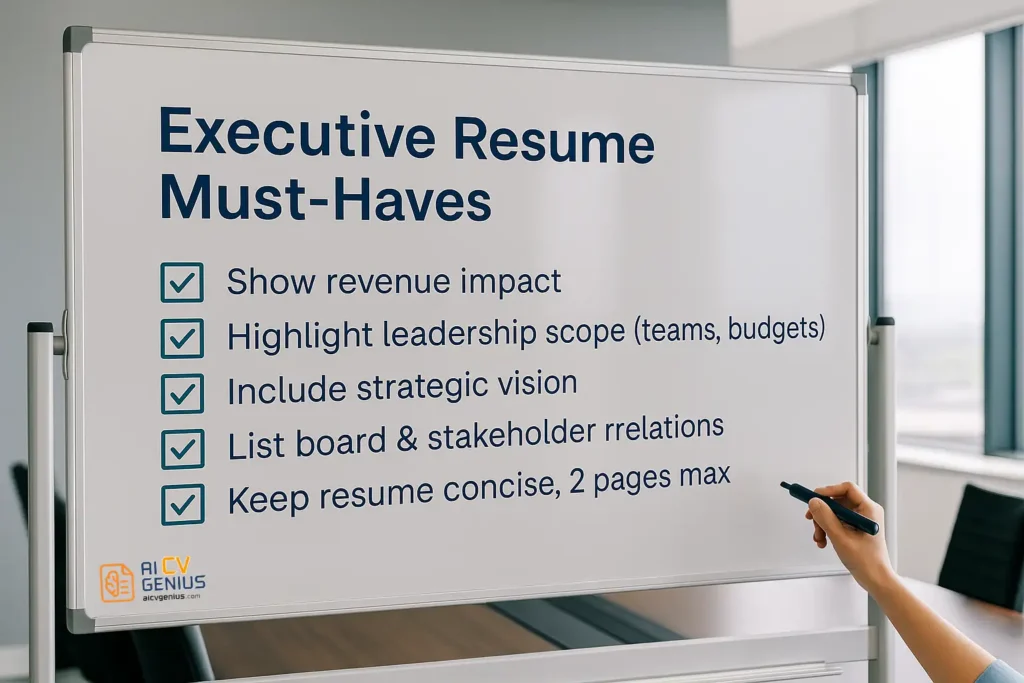
Final Checklist for an Impactful Executive Resume
Before finalizing, ensure your executive resume meets these critical standards:
- ✅ Concise Length: Strictly two pages maximum for most roles; three pages permissible only in rare cases with exceptionally long, highly relevant careers (e.g., academia, extensive board roles).
- ✅ Quantified, Metrics-Driven Achievements: Every significant accomplishment supported by specific numbers, percentages, or dollar values demonstrating tangible impact.
- ✅ Leadership Scope Clearly Defined: Explicitly states the size of teams managed (direct/indirect), budget responsibility ($), P&L oversight ($), and geographic scope.
- ✅ Strategic Initiatives Highlighted: Focuses on major projects, transformations, or strategic shifts led, rather than routine operational tasks.
- ✅ Industry Influence & Credibility Included: Mentions board roles, significant publications, keynote presentations, or major industry awards/recognition.
- ✅ Professional Formatting & File Types: Uses a clean, conservative, easily scannable layout. Saved and submitted as both a visually consistent PDF and an ATS-parsable DOCX file.
- ✅ Meticulously Proofread: Absolutely free of any typos, grammatical errors, or inconsistencies. Executive roles demand flawless attention to detail.
Extended FAQs for Executive Resumes
Two pages is the standard and generally expected maximum length for most executive roles in industry. While one page might feel too brief for extensive careers, exceeding two pages risks diluting impact and appearing unfocused. Prioritize the most relevant and impactful achievements from the last 10-15 years.
Yes, highly recommended. It functions as your strategic headline or “executive bio,” immediately conveying your core value proposition, leadership scope, key areas of expertise, and career trajectory focus. It sets the context for the detailed achievements that follow.
Focus on high-level business impact metrics: Revenue Growth ($ or %), EBITDA Improvement ($ or %), Market Share Gains (%), Significant Cost Savings or Reductions ($ or %), Successful Capital Raised ($), M&A Transaction Values ($) and Synergy Realization (%), ROI on major investments (%), improvements in key operational KPIs (e.g., efficiency, productivity), and positive impacts on shareholder value or company valuation.
Yes, they are complementary and both are crucial. Your LinkedIn profile allows for greater detail, endorsements, recommendations, and evidence of thought leadership (posts, articles). Recruiters will almost always review both. Ensure your LinkedIn profile is fully updated, professional, and consistent with the narrative presented in your resume.
No, focus primarily on the last 10–15 years of relevant experience. Earlier roles, especially if less significant or in different fields, can often be summarized briefly in a section like “Previous Professional Experience” or omitted entirely if they don’t add strategic value to your current target roles.
Very valuable. Board experience adds significant credibility, demonstrates strategic thinking, governance expertise, industry influence, and a broader understanding of organizational leadership beyond day-to-day operations. List them clearly in a dedicated section.
Demonstrate leadership through tangible outcomes attributed to your leadership rather than subjective adjectives. Highlight achievements related to team performance improvement (%), employee retention rate increases (%), successful development and promotion of direct reports (succession planning), positive employee engagement survey results (%), or the successful execution of complex initiatives requiring cross-functional alignment under your direction.
Only list technical skills if they are strategically relevant at the executive level. Examples include significant experience leading implementations or leveraging insights from major ERP systems (SAP, Oracle), CRM platforms (Salesforce), Business Intelligence tools (Tableau, Power BI), or understanding the strategic implications of emerging technologies like AI/ML within your industry. Avoid listing basic office software (Word, PowerPoint).
Aligning your highlighted achievements and strategic competencies directly with the target company’s stated goals, challenges, or strategic priorities. Research the company thoroughly (annual reports, investor calls, press releases) and customize your Executive Summary and key accomplishment bullet points to resonate specifically with their current business context – whether it’s growth, turnaround, digital transformation, market expansion, or innovation.
Yes, the emphasis shifts. While core leadership principles remain, Tech executives often highlight innovation, product leadership, and scaling technology platforms. Finance executives emphasize financial stewardship, risk management, compliance, and ROI. Healthcare executives focus on patient outcomes, regulatory navigation (e.g., HIPAA, FDA), operational efficiency in clinical settings, and potentially non-profit governance. Tailor industry-specific terminology and metrics accordingly.
Yes, absolutely. Significant industry awards, rankings (e.g., “Top 100 CFOs”), or other forms of external professional recognition serve as powerful third-party validation of your expertise and standing. List them concisely in a dedicated section or integrate them contextually within your summary or achievements.
No, they work in tandem. Networking and personal relationships are critical for uncovering executive opportunities and gaining initial consideration. However, a compelling, well-crafted resume is almost always required during the formal evaluation process to provide concrete evidence of your qualifications, achievements, and strategic fit for the role. Both are essential components of a successful executive job search.
Final Thoughts: Your Resume as a Strategic Imperative
At the pinnacle of your career, your resume ceases to be merely a historical document proving your capability to perform job functions – it must function as compelling evidence demonstrating your proven ability to lead organizations, drive transformative change, and deliver substantial business outcomes. Executive recruiters, board members, and CEOs seek leaders who bring not just experience, but strategic vision and a quantifiable track record of success.
A meticulously crafted executive resume template provides the indispensable framework to present your most significant achievements as irrefutable evidence supporting your leadership case: ensuring clarity, highlighting strategic impact, and projecting unwavering authority. Approach your resume not as an administrative task, but as a critical strategic communication – a detailed report to the board articulating not just your past accomplishments, but the future value and visionary direction you can bring to their enterprise.