
- Your construction worker resume should read like a jobsite blueprint: It must prove safety, reliability, and practical skill, not just list past jobs.
- Supervisors scan for risk fast: Show OSHA 10 or OSHA 30, accident-free habits, PPE and safety compliance, and evidence you follow site protocols.
- Reliability is a hiring filter: Highlight stable work history, punctuality, consistent attendance, and being the person crews can count on.
- Prove skill with specifics: Include blueprint reading, exact tools and equipment, certifications like forklift or scissor lift, and trade skills that match the posting.
- Turn duties into impact: Use action verbs plus scope and results, add numbers when possible, and show teamwork through collaboration with other trades and clear communication.
There is a profound satisfaction in construction. It is one of the few careers where, at the end of the day, you can physically point to what you have built. A foundation laid, a wall framed, a system brought to life. Your construction worker resume must do the same. It is not just a list of past jobs; it is a blueprint of your reliability, your skill, and your commitment to safety.
Hiring managers, site supervisors, and general contractors are not just hiring a “worker.” They are managing immense risk, tight deadlines, and complex teams. They need to know, in a single glance, that you are not a liability. They need to see a professional who understands that showing up on time is as important as knowing how to read a blueprint.
This guide will deconstruct how to build a resume that gets you on-site. We will move beyond passive lists of duties and transform your experience into a powerful testament to your value, proving you don’t just “do construction” – you build projects safely, efficiently, and as part of a team.
The Recruiter’s View: Passing Filters and Impressing Supervisors
When a site superintendent or a general contractor scans your resume, they are not reading it like an HR manager. They are performing a rapid risk assessment. Their job is to deliver a multi-million dollar project on time and under budget, all while keeping everyone safe. A single bad hire can cause delays, accidents, or quality issues that cost thousands.
In their brief 10-second scan, they are subconsciously asking four critical questions:
- 1. Are You Safe? This is the non-negotiable, number-one concern. Liability in construction is massive. They are hunting for keywords like “OSHA 10,” “OSHA 30,” “accident-free,” “safety compliance,” “PPE,” and “toolbox talks.” A resume that ignores safety is an immediate “no.”
- 2. Are You Reliable? Construction runs on a tight schedule. If the concrete crew is late, the framers are late. If the framers are late, the electricians are late. They need to know you will show up, every day, on time. They look for stable work history, punctuality, and words like “dependable” or “consistent attendance.”
- 3. Are You Skilled & Efficient? Can you do the job without constant hand-holding? Do you know your trade? They look for proof: “blueprint reading,” “tool proficiency” (specifics like Hilti, grinders, etc.), “equipment operation” (forklift, scissor lift), and the ability to “work independently.”
- 4. Are You a Team Player? A construction site is a high-stress, collaborative environment. No one works alone. They need to know you can communicate, take direction without an ego, and “assist other trades.” Words like “collaborated,” “assisted,” and “communicated with crew” are gold.
Before a human ever sees your file, it must pass through an Applicant Tracking System (ATS). Large general contractors (like Turner, Bechtel, Skanska) and staffing agencies rely on these systems to manage thousands of applications. This software is a simple keyword filter. It scans for “OSHA 10,” “OSHA 30,” and “Forklift Certified.” To pass, you must match keywords from the job description (e.g., “commercial framing”), use standard headings, and a clean, single-column format.
How to Structure a Construction Worker Resume
A construction worker’s resume should be simple, clean, and functional – just like a well-organized job site. Keep sections clear and focus on experience, safety, and specific trade skills. A reverse-chronological format is the industry standard.
✅ 1. Header: Your Name, Trade, and Top Certification
Start with your name, phone number, email, and location. Add your trade specialization (e.g., Masonry, Framing, Electrical, Plumbing). Crucially, if you have a key certification like OSHA 30, put it right in your header. It’s an instant qualifier.
Strong Header Example:
Carlos Mendoza
Skilled Carpenter | OSHA 30 Certified
(555) 123-4567 | carlos.mendoza.builds@email.com | Denver, CO
✅ 2. Professional Summary: Your 3-Line Blueprint
This is your 3-4 line summary. It must summarize your years of experience, your core skill, and your commitment to safety and reliability. Keep it concise but confident.
Weak Summary (This is generic and proves nothing):
“Hard-working construction worker with 8+ years of experience. Looking for a good job with a good company. Skilled in many areas and a team player.”.
Strong Summary (General Laborer):
“Dedicated and safety-conscious General Laborer with 5+ years of experience on large-scale commercial sites. Proven reliability and punctuality, with a strong ability to assist multiple trades, maintain site safety, and operate light equipment. OSHA 10 Certified.”
Strong Summary (Skilled Trade):
“Journeyman Carpenter with 8+ years of experience in residential and commercial framing. Expert in blueprint reading, layout, and erecting structures with 100% accuracy. OSHA 30 Certified and committed to site safety and quality craftsmanship.”
✅ 3. Key Skills Section: Your Toolbox
Employers want proof that you can handle tools, follow plans, and work well with others. Divide skills into logical categories. This is where you match keywords from the job description.
| Safety & Compliance | Technical & Trade Skills |
|---|---|
| OSHA 10/30, Site Safety Protocols, PPE Compliance, Toolbox Talks, First Aid/CPR, Hazard Recognition | Blueprint Reading, Framing, Concrete (Mixing, Pouring, Finishing), Masonry, Drywall Installation, Welding, Electrical Wiring, Plumbing |
| Equipment Operation | Core Competencies |
| Forklift (Certified), Scissor Lift, Bobcat/Skid Steer, Basic Excavator, Power Tools (Sawzall, Hilti drills, etc.) | Team Collaboration, Time Management, Punctuality & Reliability, Problem-Solving, Assisting Other Trades |
✅ 4. Professional Experience: Prove Your Value
This is the most important section. Do not list duties. List achievements. Use numbers to show the scope of your work. Use the “Action Verb + Task + Result/Metric” formula.
| Weak Bullet (Duty) | Strong Bullet (Impact) |
|---|---|
| “Responsible for site cleanup.” | “Maintained 100% site cleanliness and safety compliance across a 50,000 sq. ft. commercial project, assisting all trades by organizing materials.” |
| “Operated heavy machinery.” | “Operated a forklift and skid steer with zero incidents for 3+ years, moving over 1,000+ pallets of materials for a high-volume framing crew.” |
| “Helped build houses.” | “Assisted in the ground-up framing of 25+ single-family homes, ensuring all structures were plumb and level according to blueprint specifications.” |
More High-Impact Examples:
- ✅ Led daily “toolbox talk” safety meetings for a 6-person crew, contributing to a 12-month accident-free record on site.
- ✅ Poured and finished over 10,000 sq. ft. of concrete for foundations and driveways, consistently meeting QC standards.
- ✅ Trained 4 new laborers on site safety protocols, tool maintenance, and material handling procedures.
- ✅ Collaborated with electrical and plumbing subcontractors to resolve 15+ on-site blueprint discrepancies, preventing project delays.
The Complete Construction Resume Example (Putting It All Together)
Theory is one thing; practice is another. Let’s apply every strategy we’ve discussed to build a complete resume for our fictional candidate, Carlos Mendoza, a skilled carpenter.
CARLOS MENDOZA
Skilled Carpenter | OSHA 30 Certified
Denver, CO 80204 | (555) 123-4567 | carlos.mendoza.builds@email.com
PROFESSIONAL SUMMARY
Journeyman Carpenter with 8+ years of experience in high-volume residential and commercial framing. Expert in blueprint reading, layout, and erecting complex structures with 100% accuracy. Committed to safety and quality, holding an OSHA 30 certification and maintaining a zero-incident record for 5 consecutive years. Proven leader known for reliability and training junior laborers.
CORE COMPETENCIES
|
|
|
PROFESSIONAL EXPERIENCE
Journeyman Carpenter | Turner Construction | Denver, CO (2019 – Present)
- Lead a 4-person framing crew on a $15M commercial office project, reading complex blueprints to erect all interior and exterior walls.
- Conduct daily “toolbox talk” safety meetings, contributing to a site-wide zero-incident record for over 18 months.
- Train and mentor 3 apprentices in proper framing techniques, safety protocols, and tool maintenance, resulting in all three passing their formal reviews.
- Collaborate with plumbing and electrical subs to identify and resolve 10+ blueprint conflicts, preventing significant project delays.
Carpenter / General Laborer | PCL Construction | Aurora, CO (2016 – 2019)
- Assisted in the ground-up framing of 25+ single-family homes, ensuring all structures were plumb and level per specifications.
- Operated a forklift and skid steer to move over 1,000+ pallets of lumber and materials, supporting a 15-person crew.
- Maintained 100% site cleanliness and safety compliance; praised by superintendent for reliability and perfect attendance.
CERTIFICATIONS
- OSHA 30-Hour Certification (2021)
- Certified Forklift Operator (Class 1-5) (2019)
- First Aid & CPR/AED Certified (American Red Cross) (2023)
EDUCATION
- Carpenter Apprenticeship Program | Associated Builders and Contractors (ABC), Denver (2018)
- High School Diploma | East High School, Denver, CO (2016)
Advanced Strategies: Certifications, Tailoring, and Avoiding Mistakes
Beyond the core structure, several advanced tactics can further refine your resume. This includes highlighting certifications, tailoring for your specific trade, and avoiding common red flags.
Certifications and Licenses
In construction, certifications are proof. This section is critical and should be easy to find. Do not bury it. Include certifications like OSHA, forklift operation, or specialized trade training. They prove you’re not just experienced – you’re responsible and compliant with safety standards.
- OSHA 30-Hour Certification (2023)
- Certified Forklift Operator (Class 1-5) (2022)
- First Aid & CPR/AED Certified (American Red Cross) (2024)
- Scissor Lift Operator Certification (2021)
- (List any trade licenses here, e.g., “Journeyman Plumber License, [State]”)
Education & Apprenticeships
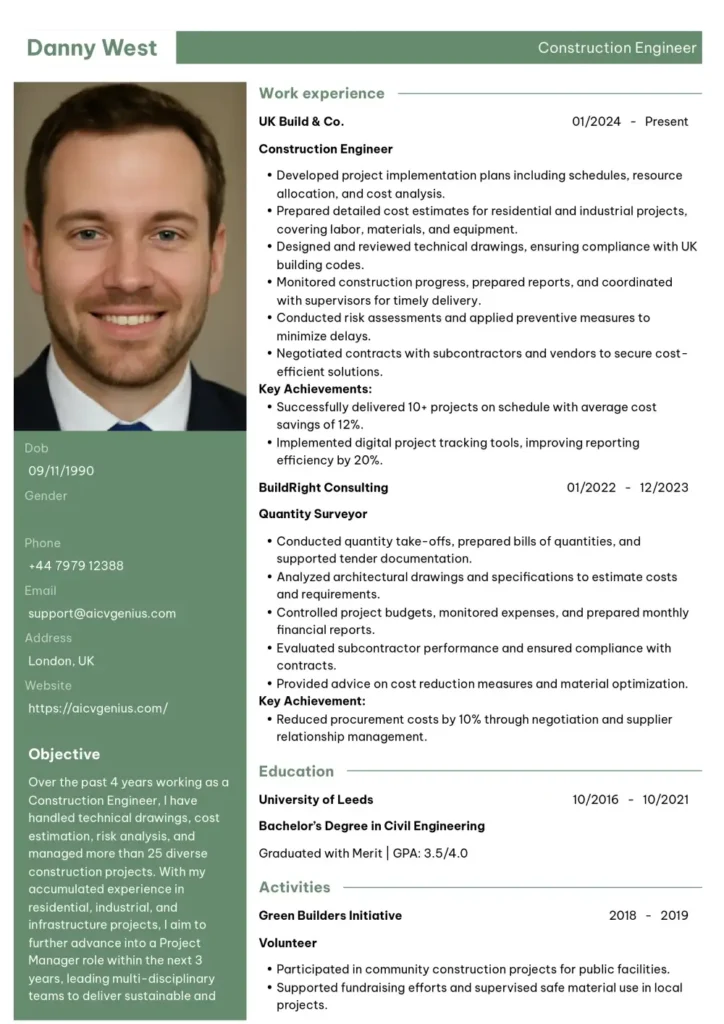
Even if you don’t have a degree, list relevant training programs or apprenticeships. Employers respect continuous learning in this industry. An apprenticeship is the equivalent of a college degree in the trades and should be highlighted.
Journeyman Carpenter Apprenticeship (2018 – 2022)
Associated Builders and Contractors (ABC), [City, State]High School Diploma (2018)
[High School Name], [City, State]
Tailoring for Different Roles
“Construction worker” is a broad term. Your resume must be tailored to the specific job you want. A General Laborer resume emphasizes different skills than a Foreman’s resume.
For the General Laborer
- Focus: Reliability, stamina, safety, and versatility.
- Resume Emphasis: Your summary and skills should scream “reliable and safe.” Show you can switch between tasks, assist multiple trades, and follow directions perfectly. You are the versatile backbone of the crew.
Example Bullets:
- Assisted journeyman electricians and plumbers by running conduit, moving materials, and preparing work areas, increasing trade efficiency by 20%.
- Maintained a perfect attendance record over 24 months, ensuring project continuity.
- Organized and inventoried all site tools and materials daily, reducing time lost searching for equipment.
For the Skilled Trades (e.g., Electrician, Carpenter, Plumber)
- Focus: Technical precision, blueprint reading, and tool mastery.
- Resume Emphasis: Your resume must prove you are a craftsman. Highlight your apprenticeship, your specific technical skills, and your ability to read blueprints and schematics. Mention completed apprenticeships or trade school credentials. Quantify your work.
Example Bullets:
- Read and interpreted complex blueprints to frame and erect 15+ multi-story residential structures, ensuring 100% code compliance.
- Installed, tested, and repaired over 1,000 electrical fixtures, outlets, and panel boards in a new commercial complex.
- Fabricated and installed custom cabinetry and trim for 10+ high-end residential remodels, finishing all projects on or ahead of schedule.
For the Site Supervisor or Foreman
- Focus: Leadership, safety enforcement, and project coordination.
- Resume Emphasis: You are a leader. Your resume must reflect this. Use metrics related to team size, project value, and safety. Show how you manage people, schedules, and problems.
Example Bullets:
- Led and mentored a crew of 12 general laborers and 4 apprentices on a $2M commercial project, ensuring all work was completed to spec.
- Conducted daily “toolbox talks” and site safety inspections, resulting in zero lost-time incidents over 18 months.
- Coordinated with 3+ subcontractors (HVAC, Electrical) and the Site Superintendent to resolve scheduling conflicts, preventing 5+ potential delays.
Common Resume Mistakes
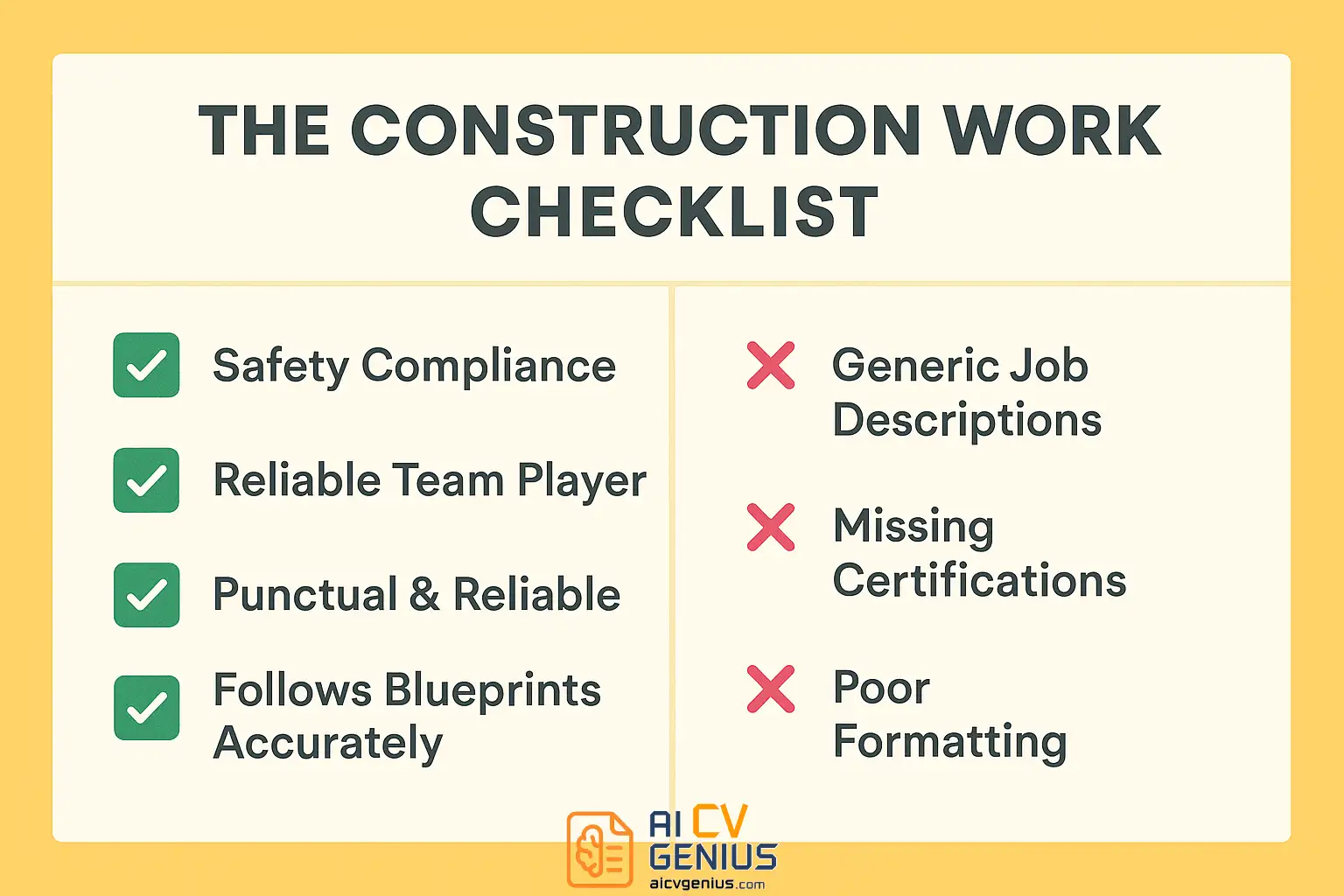
- ❌ Mistake: Using vague terms like “helped build” or “worked on projects.”Fix: Be specific. “Assisted in framing 10+ residential homes.”
- ❌ Mistake: Skipping safety details. Employers assume you don’t care about it.Fix: Create a dedicated “Certifications” section and list your OSHA card first. Mention safety in your summary.
- ❌ Mistake: Forgetting achievements. “Poured concrete” is a duty.Fix: “Poured and finished 200+ cubic meters of concrete weekly” is an achievement. Quantify.
- ✅ Pro-Tip: Always include certifications, especially OSHA or trade licenses. This is non-negotiable.
Example Resume Summary (Expanded)
Here is another take on a strong summary, combining all the elements:
Construction Worker | 10+ Years Experience | OSHA 30 Certified
“Safety-focused and highly reliable construction professional specializing in residential framing and concrete work. Proven ability to lead small crews, read blueprints, and operate heavy equipment (forklift, skid steer) with a 10-year zero-incident record. Known for exceptional teamwork, meticulous attention to detail, and consistent punctuality.”
Pros & Cons of Using a Resume Template
| Pros | Cons |
|---|---|
| ✅ Saves time with a clean layout and predefined structure. | ❌ Can look generic if not personalized with your specific metrics. |
| ✅ Keeps resume ATS-friendly and professional (if you pick a simple one). | ❌ Some “creative” templates are unreadable by ATS software. |
| ✅ Ensures a visually balanced, easy-to-read document. | ❌ May not reflect personal creativity (which is fine for construction). |
The consensus for construction: use a simple, clean, professional template. Focus your energy on the content (your metrics and safety record), not on fancy design. A simple resume template is your best bet.
Tips for Standing Out
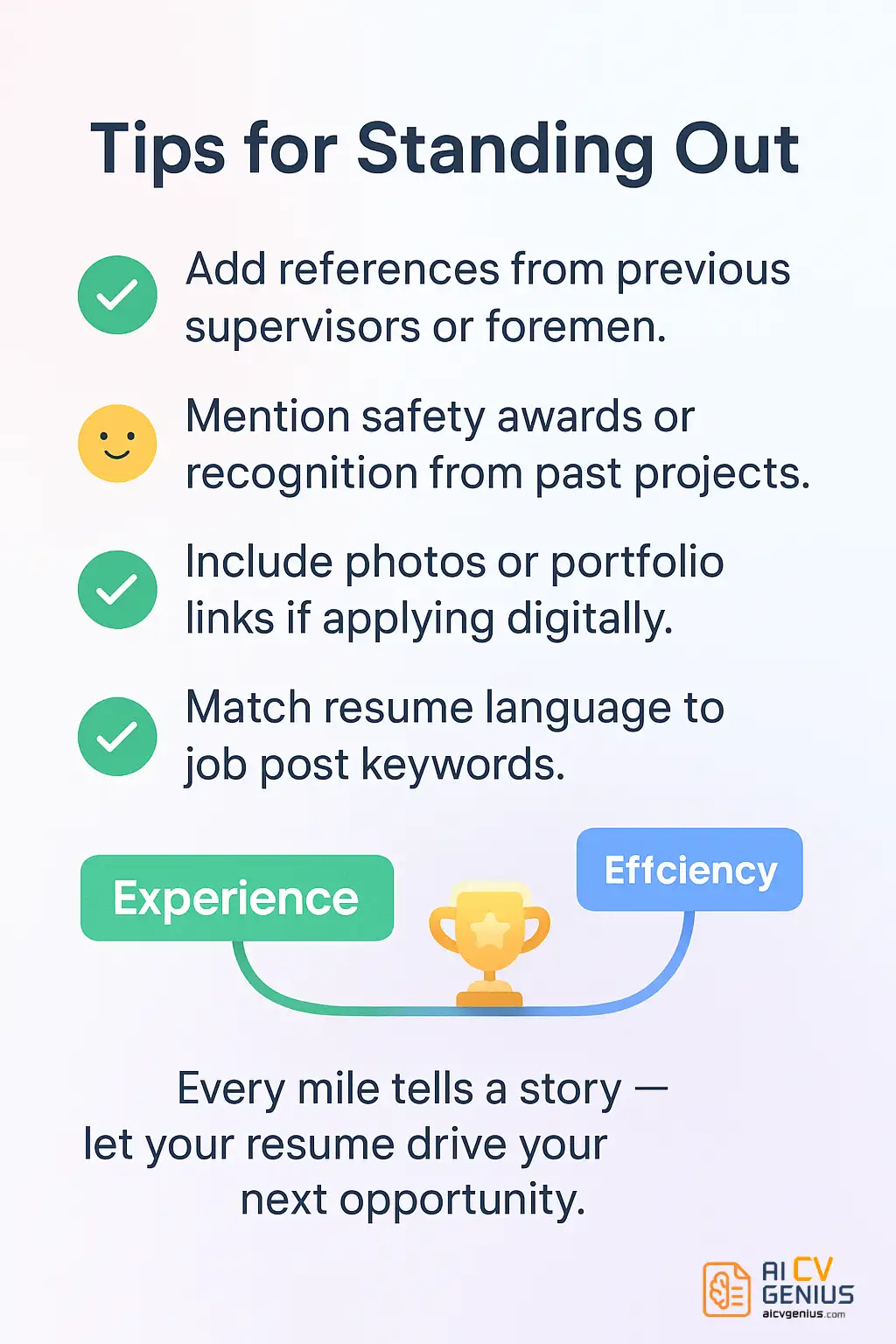
- ✅ Add a “References” line: Simply writing “Professional References Available Upon Request” is standard. Have a list of 3 former supervisors ready.
- ✅ Mention safety awards: If your crew won a “Safety First” award, add it. “Contributed to ‘Project of the Month’ award for safety and efficiency.”
- ✅ Include a portfolio link (for Foremen/Trades): If you are a carpenter or foreman, a simple LinkedIn profile or Google Drive folder with photos of your finished work (anonymized) can be powerful.
- ✅ Match resume language to the job post: If they ask for a “Carpenter,” your resume header should say “Carpenter,” not “Construction Worker.”
Final Advice for Construction Workers
Your resume is your construction blueprint – each word should fit perfectly into place. Show employers that you build with precision, safety, and pride. Whether you’re on scaffolding or managing a crew, your resume should prove one thing: you build more than structures – you build trust.