
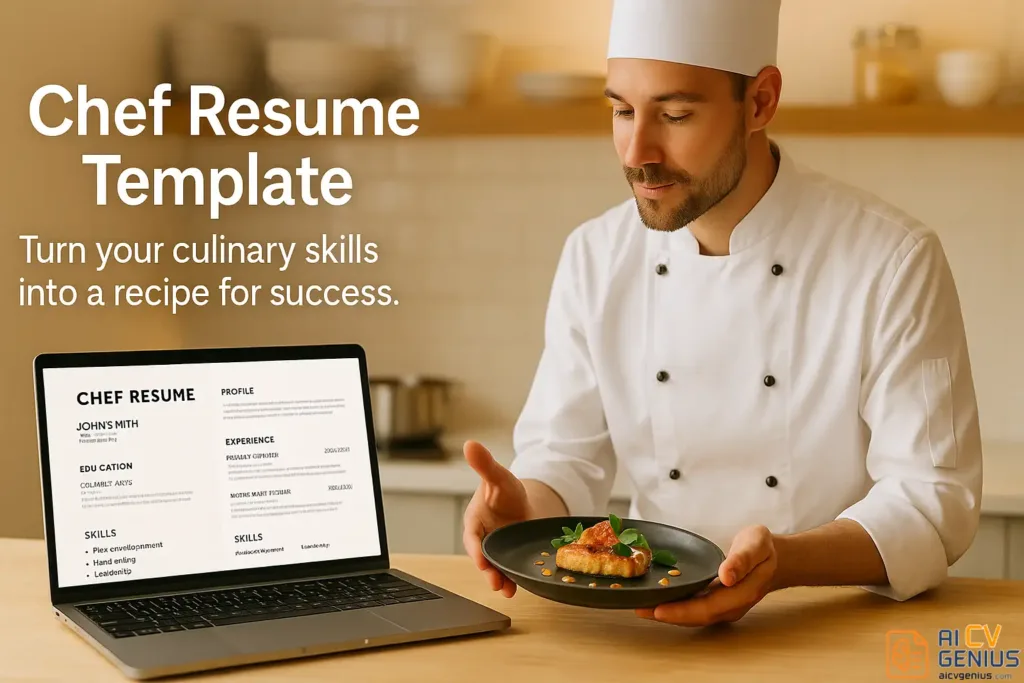
- Chef resume template is framed like plating: Your resume must look organized and premium while proving three roles at once: Reliable operator, cost-aware manager, and creative leader under pressure.
- Recruiter scan logic is spelled out as a risk check in this order: Safety and discipline (ServSafe, HACCP), cost control (Food cost, waste, inventory, vendor negotiation), leadership without toxicity (Training, retention), then creativity and consistency (Menu development, cuisine strengths).
- ATS guidance is practical for big hospitality groups: Use standard headings, mirror job-description phrases, include certifications exactly as written, and keep layout clean and readable with enough white space and restrained styling.
- Section-by-section build shows what “proof” looks like: A tight summary that blends craft plus business metrics, a skills section grouped like mise en place, and experience bullets rewritten into Action Verb + Task + Result with strong examples (Food cost reduction, ticket time improvement, staff turnover reduction, inspection compliance).
- Putting it together plus the close: A full Executive Chef resume example, pros and cons of structured vs overly creative templates, common mistakes, a real rewrite case study, and FAQs on photos, staging across kitchens, best format, awards, and one-page versus two-page length.
Cook Up a Resume That’s as Impressive as Your Signature Dish
Every chef knows that presentation matters. A dish can have flawless flavor, but if it arrives at the table disorganized, the guest’s entire perception is diminished. The same is true for your career. A strong chef resume template is more than a list of recipes or past kitchens – it’s the clean, meticulously organized story of your discipline, your creativity, and your leadership under fire.
In the high-pressure, high-turnover world of hospitality, restaurant owners and executive chefs are not just hiring a cook; they are hiring a reliable manager, a creative artist, and a disciplined soldier all in one. Your resume must prove you are all three.
“A good resume, like a good dish, is all about balance – flavor, texture, and timing. It must show creativity, but it must be built on a foundation of discipline.”
This guide will deconstruct how to build a resume that gets you a tasting. We will move beyond passive lists of “duties” and into the art of quantifying your impact, proving you don’t just “cook food” – you manage costs, lead teams, and create experiences that bring customers back.
The Recruiter & ATS View: What to Know
The Recruiter’s View: What an Executive Chef or Owner Really Wants
When a restaurant owner or executive chef scans your resume, they are performing a rapid risk assessment. The kitchen is the heart of their business, but it’s also the single biggest source of risk: food cost, labor cost, quality control, and safety. A single bad hire can ruin their reputation, destroy their profit margin, or worse, get someone sick. They need to know, in seconds, that you are a professional they can trust.
In their brief 10-second scan, they are subconsciously asking four critical questions:
- Are You Disciplined & Safe? This is the non-negotiable foundation. Can you handle a chaotic Saturday night service without compromising quality or safety? They scan for keywords like “ServSafe,” “HACCP,” “inventory management,” “food safety,” and “kitchen hygiene.”
- Can You Control Costs? A kitchen lives or dies by its margins. Can you create a stunning dish while respecting the budget? They hunt for proof. Keywords: “Food cost reduction,” “waste control,” “inventory management,” “vendor negotiation,” and “portion control.”
- Are You a Leader (Not a Tyrant)? The old stereotype of the screaming chef is dead. Modern kitchens need leaders who can teach, mentor, and inspire a team, not just command it. They look for “team leadership,” “training,” “mentoring,” and “staff retention.”
- Are You Creative & Consistent? After all the above, they look for the spark. Can you innovate? Do you understand flavor? Keywords: “Menu development,” “seasonal ingredients,” “special creation,” and any specific cuisine types (e.g., “French technique,” “Pastry”).
Your resume’s job is to answer “yes” to these questions, in that order. Discipline first, then business sense, then leadership, and finally, creativity.
The ATS Hurdle: Passing the Hospitality Group’s Filter
While a boutique restaurant owner might read your resume personally, large hotel chains and restaurant groups (like Four Seasons, Marriott, or major hospitality corps) use Applicant Tracking Systems (ATS) to manage the volume. This bot scans your resume for keywords before any human sees it.
- Certification Keywords: The ATS is looking for your credentials. It will scan for “ServSafe Certified,” “HACCP,” “Culinary Arts Diploma,” or any specific certifications mentioned in the job post.
- Keyword Alignment: Read the job description. If it asks for “menu costing” and “inventory management,” those exact phrases must be in your resume.
- Standard Headings: Do not get creative with section titles. Use standard, clear headings like “Professional Experience,” “Culinary Skills,” and “Education & Certifications”.
Choose a Layout That Reflects Professional Taste
Your resume should feel structured, elegant, and easy to digest. It should look like a high-end menu: clean, well-spaced, and premium. Avoid overly designed templates that distract from the content. Use clear sections, consistent professional fonts, and just enough style to show personality without looking chaotic.
- ✅ Stick to clean, readable fonts (like Lato, Inter, Helvetica, or Garamond for a classic feel).
- ✅ Use ample white space. A cramped resume looks like a chaotic mind.
- ✅ A subtle touch of color (like a deep burgundy or navy for headers) can add elegance.
- ✅ Use clear, bold headings to guide the reader’s eye.
If you want a pre-built format that mirrors hospitality standards, check the Resume Templates Finder – it includes chef-ready designs that are both elegant and ATS-compliant.
Building Your Chef Resume: Section by Section
1. Start With a Flavorful Summary (Your Amuse-Bouche)
Think of your summary as the first bite – the amuse-bouche. It’s a small, potent taste that sets the tone for the entire meal (your resume). Recruiters decide in seconds whether to keep reading based on this section. Keep it short, confident, and packed with value. It must blend your discipline and your creativity.
Weak Summary: “Passionate chef with 8+ years of experience. Good at cooking and working on a team. Looking for a new challenge in a good restaurant.”
✅Strong Summary (Head Chef):
“Creative and disciplined Head Chef with 8+ years leading fine dining kitchens across Asia and Europe. Proven expert in menu development, food cost control (maintained 28% margin), and team leadership. Known for balancing innovative culinary techniques with uncompromising standards for quality and consistency.”
✅Strong Summary (Sous Chef):
“Detail-oriented Sous Chef with 5+ years of experience in high-volume, Michelin-starred environments. Expert in team training, station management, and inventory control. Dedicated to executing the Executive Chef’s vision with 100% precision and supporting a positive, efficient kitchen culture.”
2. Showcase Your Key Ingredients: Skills Section
This is your “Mise en Place.” It’s the list of everything you have prepped and ready to go. A hiring manager needs to see at a glance that you have the right tools. Organize them into logical categories.
| Culinary Techniques | Classic French Technique, Saucier, Garde Manger, Pastry & Baking, Butchery, Sous Vide, Fermentation |
| Kitchen Management | Food Cost Control, Inventory Management, Vendor Negotiation, P&L Analysis, Staff Scheduling, Waste Reduction |
| Leadership & Safety | Team Leadership & Training, Menu Development, Quality Control, ServSafe Certified, HACCP Compliance |
| Cuisine Specialties | Italian, Japanese (Sushi/Kaiseki), Modern European, Farm-to-Table, Vegan/Plant-Based |
Balancing management skills (like “Cost Control”) with hard skills (like “Saucier”) shows you understand both the craft and the business.
3. Professional Experience: Focus on Achievements, Not Just Ingredients
This is the main course. Hiring managers care about results, not just duties. Every restaurant in the world expects a chef to “cook food” and “manage a team.” You must prove how well you did it. Use metrics (numbers) to show growth, savings, or quality improvements. Use the Action Verb + Task + Result formula.
| Weak Bullet (Duty) | Strong Bullet (Impact) |
|---|---|
| “Responsible for ordering supplies.” | “Negotiated with 3 new local vendors to source seasonal produce, improving ingredient quality and reducing food costs by 12%.” |
| “Trained new kitchen staff.” | “Developed and implemented a new cross-training program for a 10-person team, increasing station efficiency by 25% and reducing ticket times.” |
| “Helped design the menu.” | “Designed and launched a new seasonal tasting menu that accounted for 30% of total revenue and was featured in ‘Gourmet Monthly’.” |
More High-Impact Examples:
- ✅ Maintained a consistent food cost of 28% (2% below industry average) through meticulous waste tracking and inventory control.
- ✅ Reduced staff turnover by 40% by creating a positive kitchen culture focused on mentorship and professional development.
- ✅ Led a 15-person team through 100+ services per week, maintaining a 4.8-star average restaurant rating for quality and consistency.
- ✅ Oversaw all kitchen operations, ensuring 100% compliance with HACCP and local health department standards during 3 consecutive inspections.
Show them you understand both creativity and business impact. Numbers are your proof.
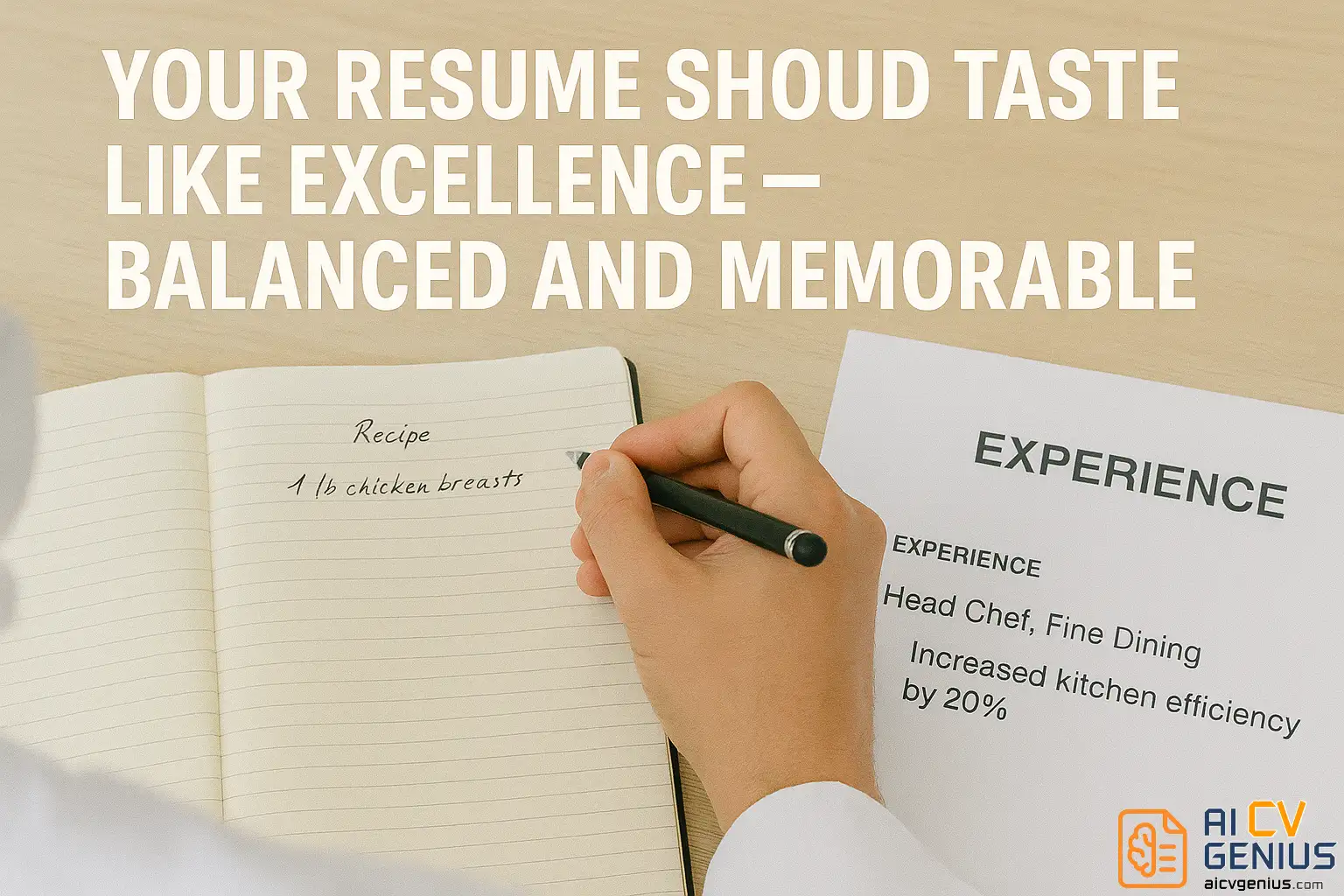
4. Organize Experience Like a Menu (Your Career Progression)
Arrange your experience from most recent to oldest (reverse-chronological). This shows your career path and growth. Your titles show your journey and increasing responsibility.
- Executive Chef (Manages the entire kitchen, business, and menu)
- Sous Chef (Manages the team, operations, and executes the vision)
- Chef de Partie / Station Chef (Manages a specific station, e.g., Saucier, Grill)
- Line Cook / Prep Cook (Works a station, focuses on execution and prep)
- Pastry Chef / Dessert Specialist (Manages the pastry/baking program)
For each role, list the restaurant name, location, your title, and the dates. Then, add 3-5 bullet points of your achievements (like the examples above), not your duties.
5. Add a Section for Culinary Education & Certifications
Even if you learned entirely on the job, including your formal credentials shows professionalism and a commitment to your craft. This section is critical for ATS scans and proves your commitment to safety.
Education & Certifications
- ServSafe Food Protection Manager Certification (Valid through 2028)
- Diploma in Culinary Arts – Le Cordon Bleu, Paris (2019)
- Advanced Pastry Workshop – Institute of Culinary Education (2022)
- HACCP Systems Certified (2021)
6. Highlight Creativity Through Special Projects or Achievements
If you have accomplishments that don’t fit under a specific job, create a small, separate section. This is where you put awards, publications, or high-profile events. This is the “garnish” that makes your resume memorable.
Awards & Recognition
- – Designed the “Tropical Fusion” tasting menu featured in Gourmet Monthly (2023).
- – Represented the restaurant and won “Best Dish” at the local “Chef Masters Challenge” (2022).
- – Guest Chef for a charity gala, designing and executing a 5-course meal for 200 attendees.
The Complete Chef Resume Example (Putting It All Together)
Theory is one thing; practice is another. Let’s apply every strategy we’ve discussed to build a complete resume for a fictional candidate, Executive Chef Antoine Dubois.
ANTOINE DUBOIS
Executive Chef | Culinary Director
New York, NY 10011 | (555) 555-5555 | chef.dubois@email.com | linkedin.com/in/antoinedubois
PROFESSIONAL SUMMARY
Creative and disciplined Executive Chef with 12+ years of experience leading 2-Michelin-Star and fine dining kitchens. Proven expert in menu development, food cost control (consistently maintaining a 28% food cost), and team leadership. Known for blending classic French technique with modern, sustainable ingredients, resulting in a 40% reduction in staff turnover and a 4.9-star guest rating.
AREAS OF EXPERTISE
|
|
|
PROFESSIONAL EXPERIENCE
Executive Chef | The Gilded Horn | New York, NY (2019 – Present)
- Lead a 20-person kitchen brigade, overseeing all operations for a $10M/year fine dining establishment, maintaining a 2-Michelin-Star rating for 3 consecutive years.
- Engineered 4 new seasonal menus, sourcing 80% of ingredients from local farms and negotiating vendor contracts to reduce food costs by 15% ($200k annually).
- Maintained a consistent food cost of 28% and labor cost of 30% through meticulous inventory (FIFO), waste tracking, and staff scheduling.
- Reduced kitchen staff turnover by 40% by implementing a formal training and mentorship program, promoting 3 line cooks to Sous Chef positions.
Chef de Cuisine | Le Fantôme | Paris, France (2016 – 2019)
- Managed all daily kitchen operations, including scheduling, ordering, and station management, ensuring 100% precision in executing the Executive Chef’s vision.
- Trained and supervised a 12-person team in classic French technique, plating, and HACCP standards, resulting in zero health code violations.
- Developed 10+ daily specials, with 4 items later being adopted onto the permanent tasting menu.
EDUCATION & CERTIFICATIONS
- ServSafe Food Protection Manager Certification (Active)
- Grand Diplôme, Culinary Arts | Le Cordon Bleu | Paris, France
- Bachelor of Arts, Hospitality Management | Cornell University | Ithaca, NY
AWARDS & RECOGNITION
- Two Michelin Stars | The Gilded Horn (2021, 2022, 2023)
- James Beard Foundation Nominee, “Best Chef: New York” (2022)
Final Analysis, Advice & FAQs
Balance Art and Organization: Pros & Cons
Your resume should reflect both sides of your brain – you’re not just an artist, but also a manager of chaos and timing. That’s what makes chefs extraordinary. A good template choice reflects this.
| Pros ✅ (Of a Structured Template) | Cons ❌ (Of a Purely “Creative” Template) |
|---|---|
| Structured yet expressive layout shows professionalism. | Overly creative design distracts from key data (like food cost %). |
| Quantified results (metrics) prove business impact. | Generic “duties” (like “cooked food”) sound flat and uninspired. |
| Mix of creativity + business logic stands out to owners. | Ignoring metrics makes your resume forgettable and weak. |
| ATS-friendly, ensuring it passes filters at large hotels/groups. | Heavy graphics or unusual fonts will be rejected by ATS. |
Keep the Tone Fresh – Not Overly Formal
Hospitality hiring managers want to hire approachable, confident professionals, not robotic applicants. Keep your writing genuine, direct, and strong. If your passion for food and leadership comes through in your achievement bullets, it will connect naturally.
Avoid These Common Mistakes
- ❌ Forgetting food cost & safety. Owners care about profit and safety first. Mentioning them is mandatory.
- ❌ Listing duties, not achievements. “Cooked on the grill line” is a duty. “Managed the grill station during 200-cover nights with zero re-fires” is an achievement.
- ❌ Overusing buzzwords. Avoid empty words like “passionate” or “innovative.” Prove it with your achievements instead.
- ❌ Ignoring layout. A messy, inconsistent resume signals a messy, inconsistent chef.
Case Study: From Kitchen Chaos to Career Clarity
Marco, a talented sous chef, struggled to land interviews for an Executive Chef role despite his years of hard work. His old resume focused on tasks (“prepared dishes,” “maintained kitchen”). After using an updated chef resume template, he reframed his experience around metrics: “Reduced prep time by 15% by redesigning station workflow,” and “Supervised 12 cooks, reducing staff turnover by 30% through active mentoring.” Within two weeks, he got calls from two Michelin-recognized restaurants. He wasn’t just a cook anymore; he was a leader and a manager.
“Data gives your talent flavor – it makes your story stick.”
Pair Your Resume With a Personalized Cover Letter
Your resume tells what you’ve done. Your cover letter tells why you love doing it and why you want to do it for them. A cover letter is where you can connect your culinary philosophy to their specific restaurant. Combine both for the perfect pairing. Explore our Cover Letters library to match tone and design.
Continue Learning and Seasoning Your Career
Cooking is constant learning – new ingredients, new methods, new cost-control software, and new leadership trends. Your career is no different. Visit Career Resources for skill development, hospitality tips, and career growth ideas tailored for chefs and culinary professionals.
FAQs About Chef Resume Templates
Final Thoughts
Your chef resume template should “taste” of skill, leadership, and financial discipline – not just good food. Present yourself as both an artist and a strategist, a craftsman and a manager. You don’t just make dishes; you manage a complex, high-stress business that creates experiences.
Let your resume reflect that total package every step of the way. When it does, you’re no longer just another applicant; you’re a solution to their biggest problems.
“Great chefs design more than meals – they design moments, manage teams, and master margins.”