
- Finance resumes are judged on precision and proof: Quantify impact with dollar amounts and percentages, and use a clean structure that reads correctly for recruiters and ATS.
- A finance template should stay conservative and scannable: Single-column layout, consistent headings, readable fonts, balanced white space, and stable PDF export.
- Keep the core sections tight and complete: Contact info, targeted summary or objective, reverse-chron experience with 3 to 5 achievement bullets per role, education, certifications, and a categorized skills section.
- Make credentials and tools impossible to miss: Highlight CFA, CPA, ACCA, FRM, or CMA, plus specific skills like advanced Excel, financial modeling, SQL, ERP systems, and platforms like Bloomberg.
- Tailor for the employer and run a final check: Big firms value pedigree, compliance, and specialization, while fintech values breadth and automation, then save PDF and DOCX, mirror job keywords, and proofread every number.
In finance, precision is everything. A single decimal point can dramatically alter a financial report, and the same rigorous standard applies to your resume. Recruiters in finance don’t just want to know that you “handled budgets” – they demand concrete proof, such as evidence that you managed $2M in assets under management (AUM), reduced operational costs by 15% year-over-year, or directly contributed to a 20% increase in portfolio ROI. This is precisely why a specialized finance resume template is indispensable. It provides the essential structure to showcase your analytical prowess, quantifiable professional achievements, and critical certifications in a format that immediately communicates credibility and competence to hiring managers and Applicant Tracking Systems (ATS).
Why Finance Resumes Require a Special Approach
Finance roles – spanning investment banking, corporate financial planning & analysis (FP&A), accounting, and risk management – uniformly demand exceptional attention to detail, strong quantitative skills, and a verifiable track record of delivering measurable results. Unlike creative industries where visual flair might be valued, finance resumes prioritize clarity, substance, and professional conservatism. Recruiters and hiring managers actively seek candidates who demonstrate a deep understanding of financial principles, regulatory compliance, data analysis, and tangible business impact. A meticulously structured, ATS-friendly resume template ensures you present yourself as both technically proficient and unequivocally trustworthy.
- ✅ Precision & Quantification: Utilize specific numbers, percentages, and dollar values ($/€/£) whenever possible to demonstrate measurable impact (e.g., “managed a $5M budget,” “improved forecast accuracy by 10%”).
- ✅ Professionalism & Trustworthiness: Employ clean, traditional formatting with ample white space and consistent font usage to signal professionalism and attention to detail.
- ✅ Credentials & Certifications: Prominently display industry-standard certifications like CFA, CPA, ACCA, FRM, or CMA to immediately validate expertise and commitment.
- ✅ Analytical & Technical Skills: Clearly highlight proficiency in essential tools and techniques such as advanced Excel (VBA, macros), SQL, financial modeling, valuation methods, and specific software (Bloomberg Terminal, SAP, Oracle NetSuite).
Key Sections in a Finance Resume Template
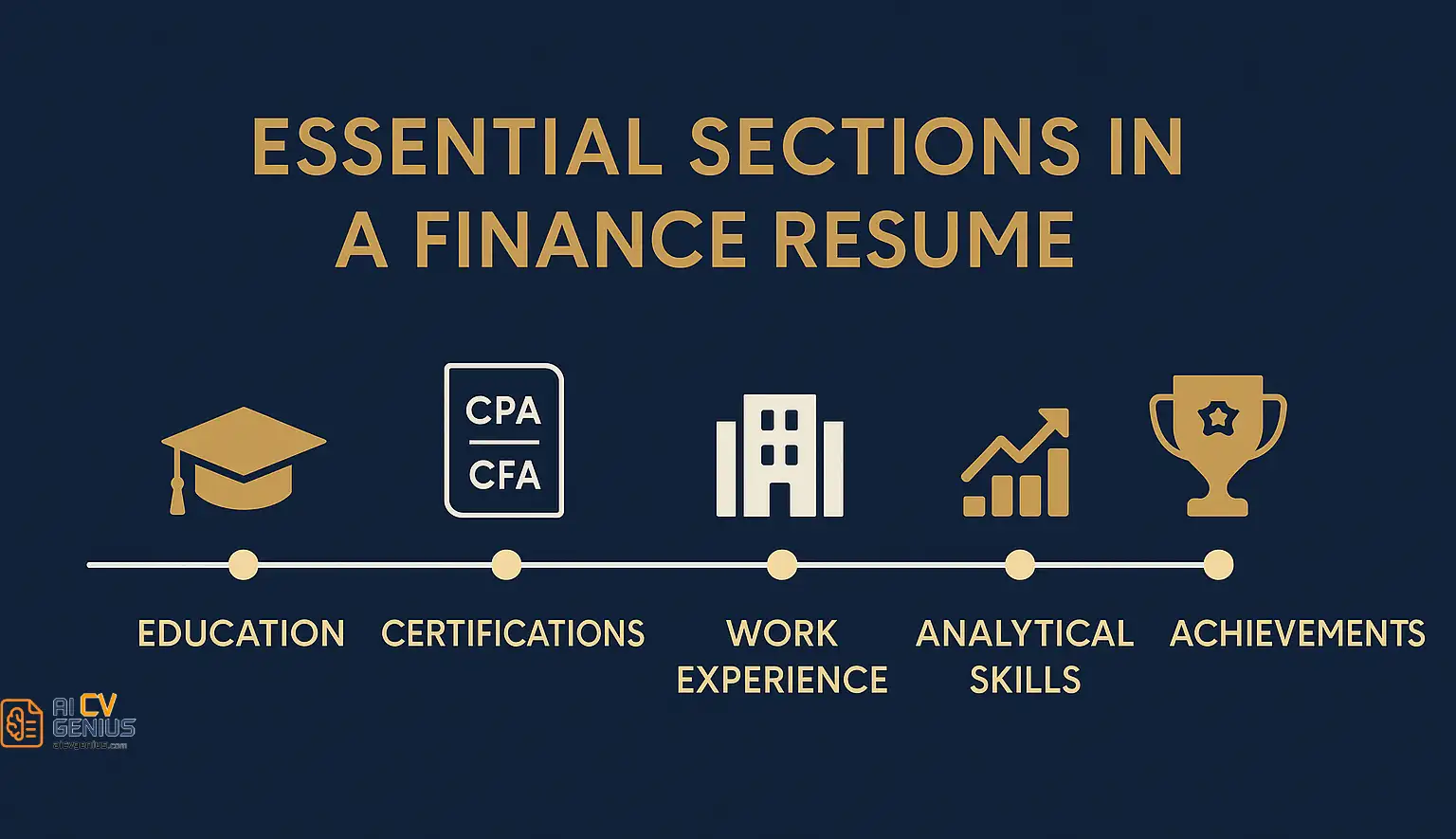
An effective finance resume template should logically organize the following critical sections:
Contact Information
Keep it concise and professional: Full Name, Phone Number, Professional Email Address (e.g., firstname.lastname@email.com), LinkedIn Profile URL, and City/State. Avoid unnecessary personal details or overly casual email addresses.
Resume Summary or Objective
A targeted 2–3 line overview tailored to the specific role. For experienced professionals, a Summary should emphasize years of experience, key financial specialties (e.g., M&A, risk management, FP&A), and 1-2 significant, quantifiable achievements. Example: “Chartered Financial Analyst (CFA) with 6 years of experience in equity research and investment strategy within the tech sector. Proven ability in complex financial modeling, DCF valuation, and portfolio management, contributing to a 15% outperformance against benchmark indices.” For graduates or career changers, an Objective should state the desired role and highlight relevant skills and academic background.
Work Experience (Professional Experience)
This is the core of your resume. Use reverse-chronological order. For each role, include Job Title, Company Name, Location, and Dates of Employment. Under each position, use 3-5 bullet points starting with strong action verbs (e.g., Analyzed, Managed, Developed, Optimized, Forecasted, Led, Reduced, Increased). Focus relentlessly on accomplishments with measurable outcomes. Examples:
- “Developed complex financial models (DCF, LBO) for potential M&A targets, improving valuation accuracy by an estimated 25% based on back-testing.”
- “Reduced departmental operating costs by $500K annually (a 10% decrease) through identifying and implementing process optimization measures using Lean Six Sigma principles.”
- “Managed a $20M fixed-income portfolio for institutional clients, consistently achieving an average annual ROI of 12%, exceeding benchmark returns by 2%.”
- “Prepared monthly and quarterly variance analysis reports comparing actuals vs. budget/forecast, presenting findings and recommendations to senior management.”
Education
Finance places significant emphasis on academic credentials. Always include the full Degree Name (e.g., Master of Science in Finance, Bachelor of Business Administration in Accounting), Institution Name, Location, and Graduation Date (or expected date). Include GPA only if it is strong (e.g., 3.5/4.0 or higher) and you are early in your career. Optionally list relevant coursework (e.g., Corporate Finance, Investment Analysis, Financial Statement Analysis, Derivatives), academic honors (e.g., Magna Cum Laude, Beta Gamma Sigma), or thesis titles if highly relevant.
Certifications & Licenses
Crucial for demonstrating specialized knowledge and commitment. List prominent certifications like CPA (Certified Public Accountant), CFA (Chartered Financial Analyst), ACCA (Association of Chartered Certified Accountants), FRM (Financial Risk Manager), CMA (Certified Management Accountant), Series 7/63/66 (if applicable for financial services). Include the full name of the certification and the issuing body. Status (e.g., “CFA Level III Candidate”) is also acceptable.
Skills
Categorize skills for clarity and ATS optimization. Be specific about your proficiency level where appropriate.
- ✅ Financial Analysis & Modeling: Financial Statement Analysis, DCF Valuation, LBO Modeling, Sensitivity Analysis, Budgeting & Forecasting, Variance Analysis, KPI Tracking
- ✅ Accounting Standards: GAAP (Generally Accepted Accounting Principles), IFRS (International Financial Reporting Standards), SOX Compliance
- ✅ Software & Tools: Advanced Microsoft Excel (Pivot Tables, VLOOKUP, Macros, VBA), Bloomberg Terminal, QuickBooks, SAP ERP, Oracle NetSuite, Hyperion, Capital IQ, FactSet
- ✅ Data Analysis & Visualization: SQL (basic to intermediate), Power BI, Tableau, Python (for finance applications like Pandas, NumPy – if applicable)
- ✅ Risk Management & Compliance: Risk Assessment Methodologies, Regulatory Reporting (e.g., Basel III, Dodd-Frank – if relevant), Internal Controls
- ✅ Soft Skills: Analytical Thinking, Problem-Solving, Attention to Detail, Communication (Written & Verbal Presentations), Financial Reporting, Time Management, Ethical Judgement
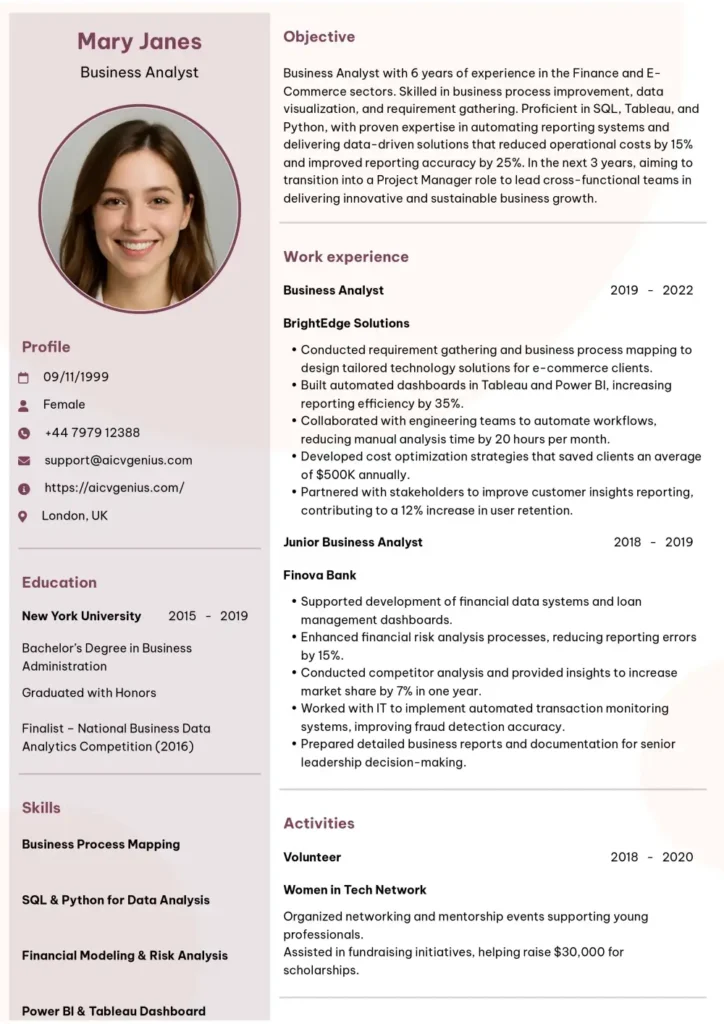
Case Study: The Entry-Level Finance Graduate
Meet Anna, fresh out of university with a B.S. in Finance, seeking her first analyst role. She lacks extensive corporate experience but strategically structures her resume template to emphasize potential and foundational skills:
- ✅ Academic Projects Prominently Featured: Detailed a university case study where she “Built a comprehensive Discounted Cash Flow (DCF) valuation model for a publicly traded tech company, projecting financials and determining intrinsic value using Excel.”
- ✅ Internship Experience Quantified: Highlighted a summer internship where she “Assisted the finance team in tracking departmental budgets totaling $500K, identifying potential cost savings of 5% through variance analysis.”
- ✅ Certifications in Progress Clearly Stated: Listed “Passed CFA Level I Exam (June 202X)” to demonstrate commitment and advanced knowledge.
- ✅ Strong Academic Record Emphasized: Included her GPA (3.8/4.0) and relevant coursework like “Investment Portfolio Management” and “Financial Derivatives.”
- ✅ Targeted Skills Section: Listed specific Excel functions (Pivot Tables, VLOOKUP), basic financial modeling concepts, and familiarity with Bloomberg Terminal (from university lab).
Anna’s resume doesn’t overstate her experience. Instead, it effectively highlights her potential, strong academic foundation, analytical aptitude, and proactive steps toward professional certification, making her a compelling candidate for entry-level positions.
Case Study: The Mid-Level Financial Analyst
Now consider James, a financial analyst with 5 years of experience in corporate FP&A seeking a senior analyst role. His resume template is optimized to showcase progression and measurable impact:
- Quantified Budgeting & Forecasting Achievements: Instead of “Involved in budgeting,” wrote “Developed and managed annual departmental budgets ranging from $2M-$5M, consistently achieving forecast accuracy within +/- 3% through rigorous variance analysis and driver-based modeling.”
- Specific ERP System Experience: Highlighted “Proficient in SAP ERP system for financial reporting, data extraction, and month-end close processes.”
- Cross-Functional Collaboration & Impact: Included a bullet point like “Collaborated with Sales and Operations teams to build financial models for new product initiatives, providing insights that contributed to a successful launch generating $1.2M in first-year revenue.”
- Professional Development & Certifications: Listed “Passed CFA Level II Exam” and relevant internal company training programs completed.
- Advanced Excel & BI Tool Skills: Mentioned “Advanced Excel skills including complex formulas, macros, and VBA scripting for process automation; experience creating dashboards in Power BI to visualize financial performance.”
James’ resume clearly demonstrates his ability to handle significant financial responsibilities, utilize key enterprise systems, collaborate effectively, and deliver tangible results, positioning him strongly for roles requiring greater responsibility and analytical depth.
Case Study: The Finance Manager
Finally, Rebecca, with 12 years in corporate finance, now targeting a Finance Director or VP role. Her resume template is structured to highlight strategic leadership and executive-level impact:
- Leadership & Team Management Scope: Explicitly stated “Led, mentored, and developed a high-performing finance team of 10 analysts and accountants responsible for FP&A, accounting operations, and reporting.”
- Strategic Financial Planning & Business Partnership: Highlighted achievements like “Developed and implemented a 5-year strategic financial plan that supported key business initiatives, contributing to a 15% increase in company valuation during tenure.”
- Regulatory Compliance & Risk Oversight: Included responsibilities such as “Ensured compliance with GAAP/IFRS standards and SOX regulations; implemented enhanced internal controls framework, reducing audit findings by 40%.”
- Advanced Certifications & Executive Presence: Prominently featured credentials like “CFA Charterholder” and “Certified Public Accountant (CPA).” Bullet points emphasized presenting financial results and strategic recommendations directly to the C-suite and Board of Directors.
- Major System Implementation or Process Re-engineering: Mentioned “Led the successful implementation of Oracle NetSuite ERP system across the organization, streamlining financial processes and improving reporting timeliness by 25%.”
Rebecca’s resume effectively shifts the focus from day-to-day analysis to strategic direction, team leadership, risk management, and significant contributions to overall business growth and financial health, aligning perfectly with executive-level expectations.
Common Mistakes in Finance Resumes (And How to Fix Them)
Even qualified candidates can undermine their applications with simple resume errors. Avoid these common pitfalls:
- ❌ Myth: Listing job duties and responsibilities is sufficient.
✅ Reality: Focus relentlessly on measurable achievements and quantifiable results. Instead of “Prepared financial reports,” write “Prepared monthly financial reports for executive review, identifying key performance trends and variances.” Better yet: “Prepared monthly financial reports, highlighting variances that led to a cost-saving initiative saving $50K annually.” - ❌ Myth: A visually creative or heavily designed resume will make me stand out in finance.
✅ Reality: Finance hiring managers prioritize clarity, professionalism, and ease of reading. Stick to clean, traditional, single-column ATS-friendly layouts with standard fonts. Avoid excessive graphics, colors, skill bars, or photos. - ❌ Myth: A generic skills section listing terms like “Excel” or “Analysis” is adequate.
✅ Reality: Be highly specific about your technical skills and proficiency. Instead of just “Excel,” list “Advanced Excel (Pivot Tables, VLOOKUP, Index/Match, Macros, VBA).” Instead of “Analysis,” specify “Financial Statement Analysis,” “Variance Analysis,” or “DCF Modeling.” - ❌ Myth: A longer resume demonstrates more expertise and is always better.
✅ Reality: Conciseness is valued. Stick to 1–2 pages maximum. Prioritize relevance to the target role. Remove outdated or irrelevant experience. Recruiters appreciate brevity and focus.
Tailoring Your Resume: Big Finance Firms vs. Startups/Fintech
The emphasis of your finance resume should adapt based on the type of organization you’re targeting:
Targeting Large Banks, Investment Firms, or Established Corporations:
- Emphasize Credentials and Pedigree: Prominently display certifications (CFA, CPA), degrees from reputable universities, and strong academic records (especially early career).
- Highlight Compliance, Regulation, and Process Knowledge: Demonstrate understanding and experience with relevant financial regulations (e.g., SEC reporting, Basel III, SOX) and established financial processes.
- Show Experience with Large-Scale Operations: Quantify achievements related to managing large portfolios ($), significant budgets ($), complex financial instruments, or enterprise-level systems (SAP, Oracle).
- Focus on Specialization: Clearly define your area of expertise (e.g., Equity Research, M&A Advisory, Corporate Treasury, Audit).
Targeting Startups, Fintech Companies, or Smaller Firms:
- Show Flexibility and Breadth of Experience: Highlight your ability to handle multiple finance functions simultaneously (e.g., budgeting, reporting, forecasting, basic accounting, fundraising support).
- Emphasize Tech Skills and Automation Aptitude: Showcase proficiency with modern cloud-based finance tools (NetSuite, Xero, QuickBooks Online), data analysis tools (SQL, Power BI, Tableau), and any experience automating financial processes (e.g., using Python or VBA).
- Demonstrate Adaptability and Problem-Solving in Dynamic Environments: Frame achievements around building financial processes from scratch, working effectively with limited resources, or providing financial insights to support rapid growth and strategic pivots.
- Highlight Initiative and Impact: Show how you proactively identified issues, proposed solutions, and drove tangible results in a fast-paced setting.
Optimizing for Remote Finance Roles
As more finance positions shift to remote or hybrid models, your resume should explicitly address skills relevant to this work style:
- ✅ Demonstrate Independence and Self-Management: Highlight experience in preparing financial reports, conducting analysis, and meeting deadlines autonomously with minimal supervision.
- ✅ Showcase Familiarity with Cloud-Based Finance & Collaboration Tools: List proficiency with tools like NetSuite, Xero, QuickBooks Online, Slack, Microsoft Teams, Zoom, Asana, or Jira.
- ✅ Emphasize Strong Written and Verbal Communication Skills: Frame achievements around effectively communicating complex financial information across teams, time zones, or through virtual presentations.
- ✅ Mention Experience with Remote Audits or Reporting Processes: If applicable, highlight successful participation in virtual audits or remote financial closing procedures.
Resume Evolution: Tailoring Through Your Finance Career Stages
Your resume’s focus should mature as your finance career progresses:
- ✅ Graduate / Entry-Level Analyst (0-2 years): Focus heavily on Education (GPA, relevant coursework), internships, academic projects demonstrating analytical skills, technical tool proficiency (especially Excel), and certifications in progress (e.g., CFA Level I passed).
- ✅ Financial Analyst / Senior Analyst (2-7 years): Emphasize quantifiable achievements in core functions like forecasting, reporting, budgeting, financial modeling, variance analysis. Highlight specific industry experience and mastery of relevant ERP/BI systems. Show increasing responsibility.
- ✅ Finance Manager / Controller (7-15 years): Focus shifts to strategic contributions, process improvement, compliance oversight, team leadership/mentoring, managing month/year-end close, and presenting financial insights to management. Highlight budget size managed and significant cost savings or efficiency gains.
- ✅ Director / VP / Executive (15+ years): Emphasis moves almost entirely to strategic leadership, driving overall financial strategy, significant business impact (P&L responsibility, M&A involvement, fundraising), investor relations, enterprise risk management, team building, and C-suite/Board level interaction.
Final Checklist Before Sending Your Finance Resume
Perform this crucial final review before submitting your application:
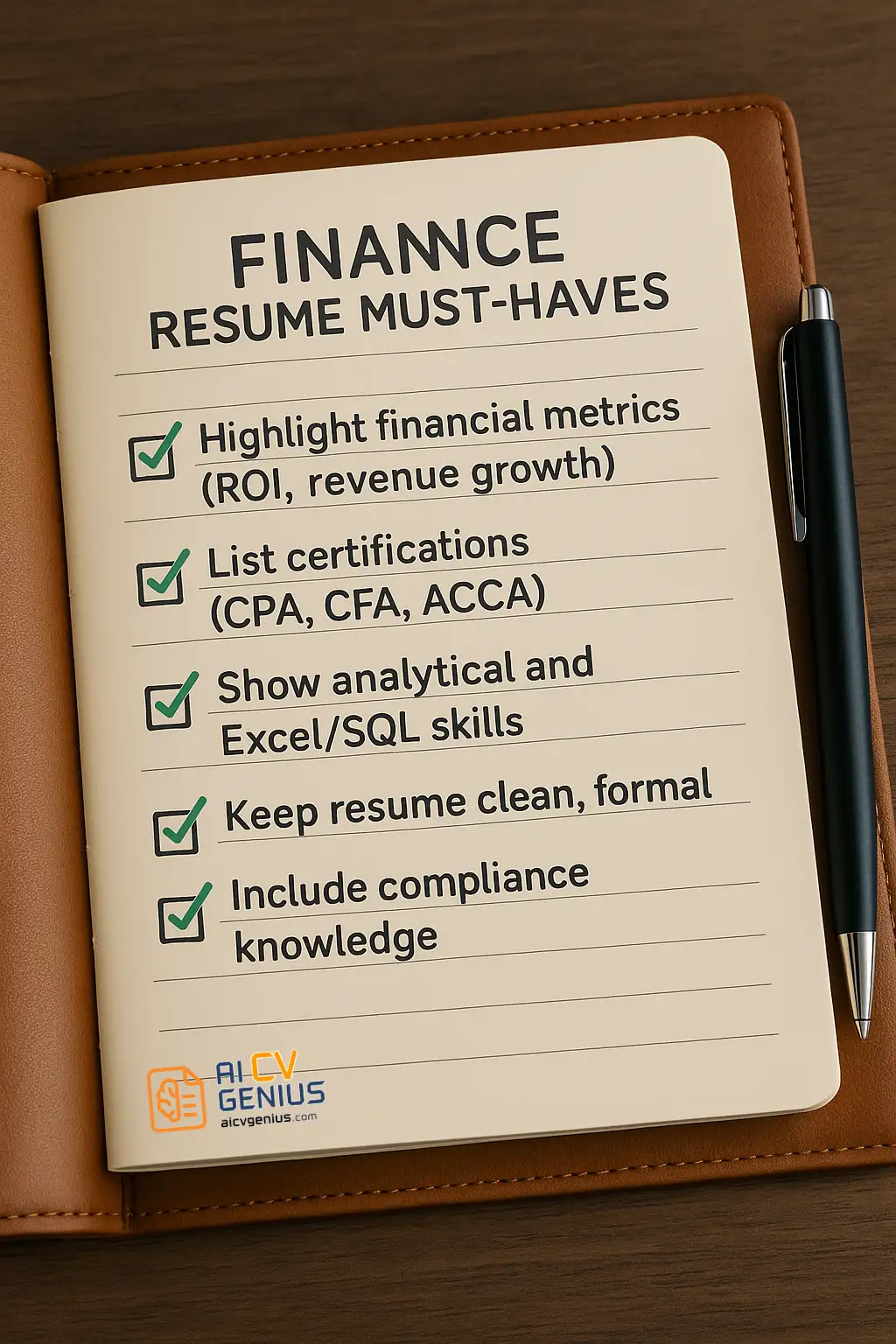
- ✅ Quantification is King: Are key achievements supported by specific numbers, percentages, or dollar values wherever possible?
- ✅ Certifications & Credentials Clear: Are relevant certifications (CFA, CPA, etc.) and licenses listed accurately and prominently?
- ✅ Layout is Clean & Professional: Is the template ATS-friendly (preferably single-column), easy to scan, with consistent formatting and professional fonts?
- ✅ Skills are Specific: Does the skills section list concrete tools (Excel, SAP, Bloomberg) and techniques (DCF Modeling, Variance Analysis), not vague terms?
- ✅ Formats Ready: Have you saved the resume in both visually consistent PDF and ATS-parsable DOCX formats, as recommended by best practices?
- ✅ Tailored to the Role: Have you customized the Summary/Objective and highlighted experiences/skills that directly match the target job description keywords?
- ✅ Proofread Meticulously: Has the resume been checked multiple times (ideally by another person too) for any typos, grammatical errors, or numerical inaccuracies? Precision is paramount in finance.
Extended FAQs for Finance Resumes
Yes, if you are a recent graduate (within 1-3 years) or early-career professional and your GPA is strong (generally considered 3.5/4.0 or higher). If you have several years of relevant work experience, GPA becomes less important and can often be omitted to save space for achievements.
Absolutely, especially for career progression in many finance fields. Certifications like the CFA Charter (for investment management), CPA license (for accounting/audit), ACCA, FRM (for risk), and CMA (for management accounting) are often required or strongly preferred for mid-level to senior roles. They demonstrate a high level of expertise, commitment, and adherence to professional standards.
Focus on metrics that demonstrate tangible business impact. Examples include: Return on Investment (ROI) percentages, cost reduction amounts ($ or %), revenue growth generated ($ or %), forecast accuracy improvement (%), efficiency gains (time saved, process steps reduced), size of budgets or portfolios managed ($), variance reduction (%), or specific transaction values ($ in M&A deals).
One page is strongly preferred for entry-level applicants, analysts, and professionals with up to ~7-10 years of experience. Two pages are generally acceptable for Finance Managers, Directors, VPs, and executives with extensive, relevant experience and significant leadership achievements. Conciseness and relevance are key; avoid filler content just to reach two pages.
No, and it’s generally discouraged. The finance industry values professionalism, clarity, and substance over creative flair in resumes. Stick to clean, traditional, minimalist, and ATS-friendly templates with standard fonts and ample white space. Let your quantified achievements be the standout element.
Very important. Proficiency in core finance tools is often a baseline requirement. Be specific: mention Advanced Excel (and specific functions/capabilities like modeling, VBA), specific ERP systems (SAP, Oracle NetSuite, Microsoft Dynamics), BI tools (Power BI, Tableau), database querying (SQL), and specialized platforms (Bloomberg Terminal, FactSet, Capital IQ) relevant to the roles you are targeting.
While important, avoid simply listing generic soft skills. Instead, demonstrate these skills through your achievement bullet points. Example: Instead of listing “Leadership,” write “Led a cross-functional team of 5 to successfully implement a new forecasting process, delivering the project 2 weeks ahead of schedule.” This shows leadership and results simultaneously.
Final Thoughts: Let the Numbers Speak
Finance is fundamentally a field where data drives decisions and quantifiable results define success. Your resume must rigorously reflect this reality by highlighting your achievements with precision, clarity, and concrete metrics. Utilizing an effective finance resume template provides the essential structure to ensure that your analytical skills, critical certifications, technical proficiencies, and measurable contributions are presented in a compelling, professional, and ATS-compatible manner that resonates instantly with recruiters and hiring managers. Whether you are launching your career as an analyst, advancing into management, or positioning yourself for executive leadership, remember: the most persuasive finance resume is not merely about describing what you did, but about unequivocally proving the tangible value you delivered.