
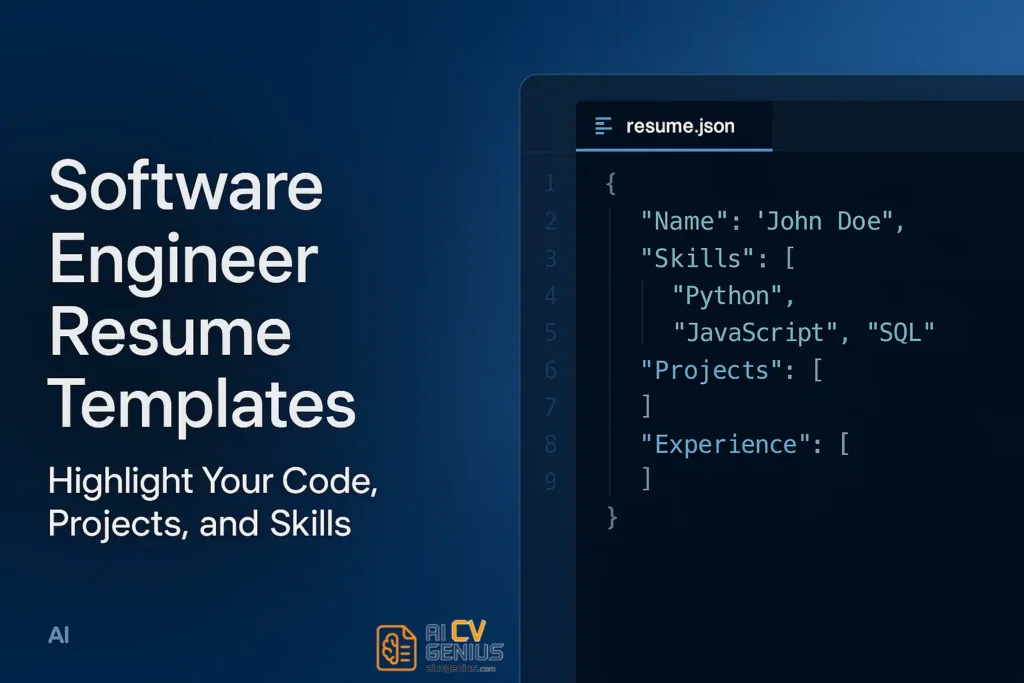
- A software engineer resume template matters because tech hiring is a fast scan: The right structure surfaces keywords, projects, and quantified impact for both ATS and humans.
- Tech hiring focuses on proof, not prose: Recruiters scan for role-specific keywords, measurable outcomes, and projects that demonstrate problem solving.
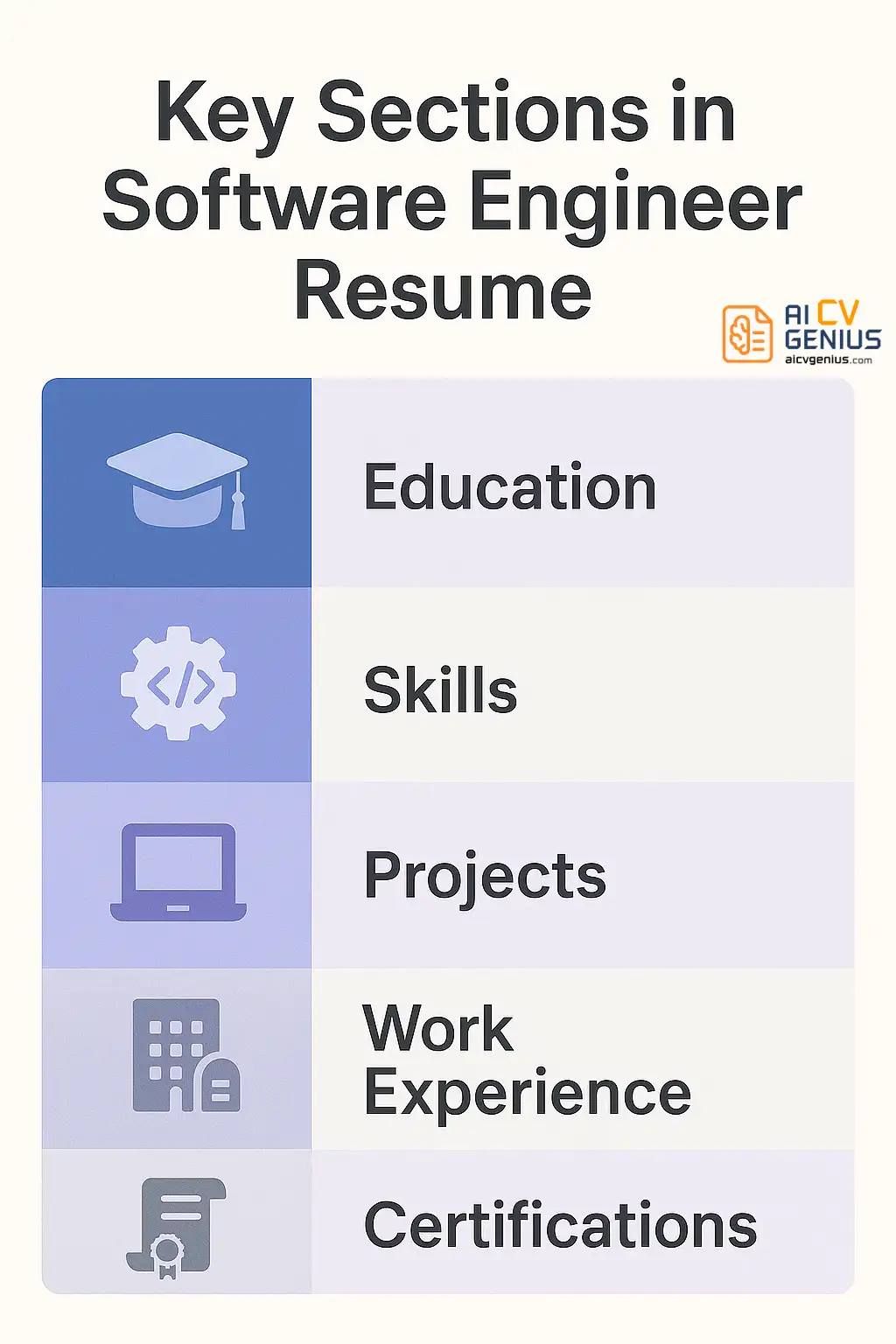
- Templates should change by seniority: Entry-level resumes lead with education, coursework, and 2 to 3 strong projects with GitHub or live links, while senior resumes lead with a powerful summary, quantified wins, leadership, and relevant certifications.
- Core components are consistent: Categorized skills, high-signal project links, and strong bullets that replace vague statements with specific scope, tools, and results.
- Tailor by target environment: Big Tech needs strict ATS optimization and fundamentals, startups reward versatility and visible work, and remote roles should highlight async collaboration, tools, time zone clarity, and communication.
Imagine this: Alex, a recent computer science graduate, meticulously crafts fifty resumes and sends them out. Only two companies reply. Meanwhile, Sarah, a mid-level developer with five years under her belt, uploads her resume to LinkedIn and fields three interview calls within a week. What’s the crucial difference? Both possess coding skills. Both have completed projects. But Sarah’s resume communicates her value proposition in a language recruiters and hiring managers instantly grasp. Alex’s, unfortunately, used a cluttered layout that obscured his key strengths.
This is precisely where a dedicated software engineer resume template becomes a game-changer. A well-structured resume isn’t merely a document – it’s your personal API endpoint for the recruitment process. It efficiently returns essential data points (skills, impactful projects, quantified results) in a format that can be parsed and understood in mere seconds. And in the fast-paced world of tech hiring, those seconds are critical currency.
Why Templates Matter in Tech Hiring
Tech hiring managers aren’t sifting through prose searching for generic soft skills like “team player” – they’re executing targeted scans for specific keywords: JavaScript, Python, React, Kubernetes, AWS. They demand tangible proof of problem-solving abilities showcased through concrete projects and measurable metrics.
A strategically structured template ensures your resume isn’t lost in translation, particularly when navigating the initial gauntlet of Applicant Tracking Systems (ATS). Think of it like adhering to coding conventions: you could write functional code all on one line, but adopting a clean, readable style significantly eases debugging and collaboration.
Similarly, a well-chosen resume template enhances the readability and parsability of your career narrative for recruiters and automated systems alike.
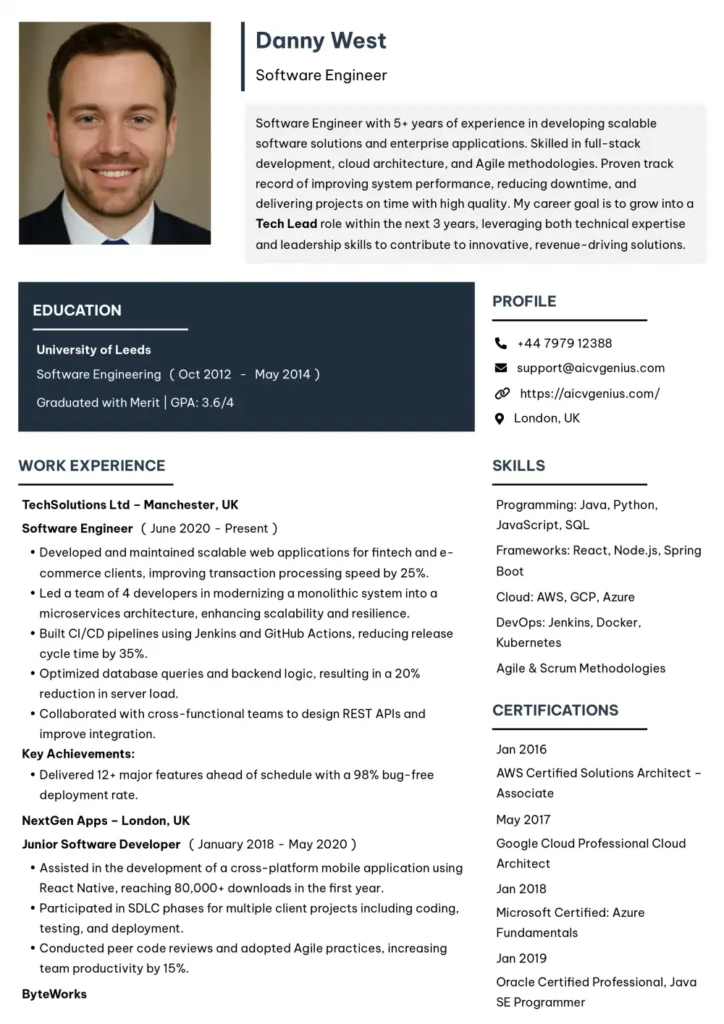
Software Engineer Resume Case Studies
Case Study 1: The Entry-Level Developer
Let’s revisit Alex. As a fresh graduate, his primary assets aren’t years of professional tenure but rather compelling projects, relevant coursework, and applicable transferable skills. An effective resume template for him must strategically highlight:
- ✅ Education section placed prominently, detailing key courses (e.g., Data Structures, Algorithms, Machine Learning) and a strong GPA (if applicable).
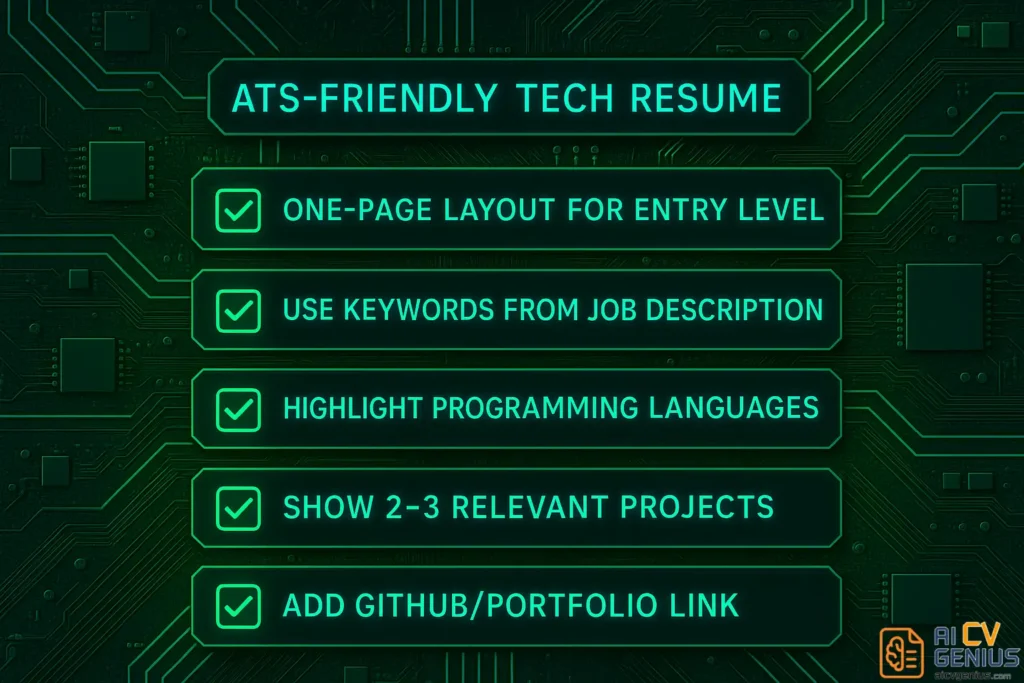
- ✅ 2–3 significant academic or personal projects, described with impact and including direct links to GitHub repositories or live demos.
- ✅ Skills section clearly categorized: Programming Languages, Frameworks/Libraries, Databases, Tools.
- ✅ Any relevant internship experience, coding bootcamp participation, or contributions to hackathons, focusing on skills learned and results achieved.
By utilizing such a template, Alex successfully reframes his narrative from “a graduate lacking experience” to “a promising junior engineer with demonstrated project capabilities.” Recruiters take notice. His callback rate significantly improves, doubling within weeks.
Case Study 2: The Senior Engineer
Now consider Sarah. Her role transcends writing code – she’s architecting systems, leading development teams, and delivering measurable business impact. Her resume template requires a different focus, emphasizing:
- ✅ A powerful summary at the top encapsulating her expertise (e.g., “Senior Software Engineer with 7 years of experience architecting and deploying scalable cloud-native applications, specializing in microservices and distributed systems”).
- ✅ Work experience section rich with quantifiable achievements (e.g., “Reduced API latency by 40% through performance optimization,” “Led a team of 5 engineers in migrating legacy system to AWS, completing project 15% under budget”).
- ✅ Explicitly highlighting leadership responsibilities, mentorship activities, and successful cross-functional collaborations.
- ✅ Prominent display of relevant certifications (e.g., AWS Certified Solutions Architect, Certified Kubernetes Administrator).
Sarah’s resume strategically focuses less on listing every known technology and more on demonstrating significant impact and leadership at scale. This targeted approach attracts interview invitations from leading tech companies.
Core Components of an Impactful Tech Resume
Deep Dive: Key Skill Categories for Impact
A common mistake among developers is compiling all technical skills into one undifferentiated, lengthy list. A more effective strategy involves organizing them into logical categories. This improves scannability for recruiters and enhances keyword recognition for ATS.
- ✅ Programming Languages: Python, Java, JavaScript (ES6+), C++, Go, TypeScript, Ruby
- ✅ Frameworks & Libraries: React, Angular, Vue.js, Node.js, Express, Django, Spring Boot, .NET Core
- ✅ Databases & Storage: SQL (PostgreSQL, MySQL), NoSQL (MongoDB, Cassandra), Redis, Kafka, S3
- ✅ DevOps & CI/CD Tools: Docker, Kubernetes, Jenkins, GitLab CI, Terraform, Ansible
- ✅ Cloud Platforms: AWS (EC2, Lambda, S3, RDS), Google Cloud Platform (GCP), Microsoft Azure
- ✅ Testing & QA Frameworks: Jest, Cypress, Selenium, JUnit, PyTest
- ✅ Methodologies & Soft Skills: Agile/Scrum, Problem-Solving, Code Review, System Design, Team Collaboration
Categorizing skills demonstrates structure and prioritization – qualities valued in software engineering itself. Tailor the specific skills listed to match the requirements of the target job description.
GitHub & Portfolio Links: Your Tangible Differentiator
Here’s a crucial insight: recruiters, especially technical ones, value links to your work. A GitHub profile acts as a dynamic portfolio, revealing your coding practices, contribution frequency, collaboration on open-source projects, and overall passion for development.
For front-end developers or UI/UX engineers, a personal portfolio website showcasing live projects is equally vital. For most software engineers, GitHub is the primary portfolio. Ensure your resume template prominently features:
- ✅ A clean, professional GitHub profile link (ensure your profile is curated).
- ✅ Links to live project deployments (hosted on platforms like Heroku, Netlify, Vercel, or AWS).
- ✅ Well-written documentation (README files) that demonstrate clear communication and thought processes.
- ✅ Optional: Links to relevant profiles on coding challenge platforms (HackerRank, LeetCode) if you perform well.
For Alex, his GitHub clearly showcased a functional React weather application and a Python data analysis script using Pandas. This provided tangible proof of his ability to build, not just learn. For Sarah, her active contributions to a popular open-source library validated her expertise beyond her formal job titles.
Resume Comparison: Weak vs. Strong Entries
| Weak Resume Entry | Strong Resume Entry |
|---|---|
| Lists a dozen programming languages without context: “Programming languages: Java, Python, C, C++, PHP, Perl, Ruby, Go, Swift, Kotlin, Scala, R” | Highlights relevant proficiency with context: “Programming Languages: Java (Expert, 5+ yrs), Python (Proficient, 3 yrs), JavaScript (Intermediate, 2 yrs).” Shows depth and relevance over sheer quantity. |
| Vague work experience description: “Responsible for backend development tasks.” | Specific, quantified work experience: “Developed and maintained backend RESTful APIs handling over 10,000 daily requests using Spring Boot, resulting in a 25% reduction in server response time.” |
| Generic project description: “Built a personal website.” | Impactful project description: “Created a full-stack e-commerce website using React/Node.js, integrated Stripe for payments, and deployed on AWS. Achieved 500+ unique monthly visitors within 3 months post-launch. [Link to Live Demo / GitHub]” |
Complete Software Engineer Resume Example (Mid-Level)
This full, ATS-friendly resume example applies the core principles discussed. It is structured for clarity, categorizes skills, and uses quantifiable achievements, making it ideal for a mid-level developer like the “Sarah” example.
SARAH M. CHEN
(123) 456-7890 | sarah.chen.dev@email.com | LinkedIn.com/in/sarahchendev | github.com/sarahchen
Professional Summary
Software Engineer with 5+ years of experience in developing and scaling full-stack web applications. Proven ability to deliver high-quality, efficient code in fast-paced Agile environments. Specialized in React/Node.js ecosystems and cloud-native development with AWS. Seeking to leverage expertise in distributed systems to build impactful solutions at [Target Company].
Technical Skills
Programming Languages: JavaScript (ES6+), TypeScript, Python, Java
Frameworks & Libraries: React, Node.js, Express.js, Spring Boot, Django, Jest, React Testing Library
Databases & Storage: PostgreSQL, MongoDB, Redis, Amazon S3
Cloud & DevOps: AWS (EC2, S3, Lambda, RDS), Docker, Kubernetes, Terraform, Jenkins, GitLab CI
Professional Experience
Software Engineer II | TechSolutions Inc. | San Francisco, CA | July 2021 – Present
- Led the development of a new microservice architecture for the core product, improving system modularity and enabling independent team deployments, reducing deployment conflicts by 40%.
- Optimized critical API endpoints by implementing Redis caching and database query enhancements, reducing average latency from 450ms to 80ms and supporting a 3x increase in user traffic.
- Mentored 2 junior engineers through code reviews, pair programming, and regular 1:1 sessions, improving their code quality and onboarding speed.
- Collaborated with product managers to define technical requirements for 6 major features, ensuring alignment between business goals and engineering implementation.
Junior Software Engineer | WebInnovate LLC | Austin, TX | June 2019 – July 2021
- Developed and maintained 20+ responsive front-end components for a client-facing dashboard using React and TypeScript, improving user satisfaction scores by 15%.
- Contributed to a full-stack internal tool using the MERN stack (MongoDB, Express, React, Node) that automated a manual reporting process, saving 10+ hours of administrative work per week.
- Participated in an Agile/Scrum team, contributing to sprint planning, daily stand-ups, and retrospectives, and consistently delivering tasks on schedule.
Projects
E-Commerce Platform (Full-Stack) | [github.com/sarahchen/ecom-project] Personal project built with React, Node.js, and PostgreSQL. Features full user authentication, product catalog, shopping cart, and Stripe payment integration. Deployed on AWS using Docker and EC2.
Education
Bachelor of Science in Computer Science
University of Texas at Austin, Austin, TX | Graduated May 2019
Advanced Strategies, Myths, and Career-Level Tailoring
Extended Myth-Busting for Tech Resumes
| ❌Myth | ✅Reality |
|---|---|
| A highly creative, visually complex design demonstrates superior skills. | ATS software often fails to parse complex formatting, leading to rejection. Clarity and structure are paramount. |
| Soft skills like communication are secondary for engineers. | Recruiters actively seek evidence of teamwork, clear communication (especially in documentation), and effective problem-solving approaches. |
| You must list every technology you’ve ever touched. | Focus on skills relevant to the target role. Listing outdated or irrelevant tech dilutes your core strengths. Prioritize depth over breadth. |
| GPA remains critical throughout your career. | GPA is primarily relevant for internships and first jobs post-graduation. After 2–3 years of experience, professional achievements matter far more. |
| Only work-related projects count. | Well-documented personal projects and significant open-source contributions are highly valued as proof of passion and initiative. |
| Simply listing keywords from the job description is sufficient. | Recruiters and hiring managers look for quantified results and context demonstrating how you used those skills, not just that you possess them. |
Big Tech vs. Startup Hiring: Tailoring Your Resume Priorities
The expectations at a FAANG company differ significantly from those at a nascent five-person startup. Your resume template and content should adapt accordingly:
Targeting Big Tech (e.g., Google, Meta, Amazon):
- ATS Optimization is Non-Negotiable: These companies rely heavily on automated screening. Use clean, single-column templates and precise keywords.
- Emphasize Fundamentals: Highlight strong understanding of algorithms, data structures, system design principles, and scalability challenges.
- Showcase Academic Excellence & Competition: Mention strong academic records (GPA for recent grads), prestigious universities, and achievements in coding competitions (ICPC, Google Code Jam).
- Focus on Impact at Scale: Quantify results related to large user bases, high traffic volumes, or significant performance improvements.
Targeting Startups:
- Demonstrate Versatility & Initiative: Highlight your ability to wear multiple hats (e.g., full-stack capabilities, some DevOps knowledge). Show proactivity and problem-solving in resource-constrained environments.
- Projects Carry More Weight: Tangible projects (personal or professional) demonstrating practical skills often matter more than academic pedigree.
- Portfolio/GitHub is Crucial: Startups often value seeing your actual code or live projects more than certifications. A strong GitHub profile can be a major advantage.
- Highlight Adaptability: Mention experience with rapid iteration, Agile methodologies, and learning new technologies quickly.
Optimizing for Remote Jobs & Global Applications
As remote work becomes standard, engineers frequently apply for roles across different regions (e.g., US, Europe). Adapt your template and content:
- ✅ Explicitly Mention Remote Work Experience: Highlight successful collaboration using remote tools.
- ✅ Emphasize Communication Skills: Frame achievements around effective communication (e.g., “Collaborated asynchronously with international teams across 3 time zones using Slack and Jira to deliver features on schedule”).
- ✅ Specify Time Zone & Flexibility: Clearly state your primary time zone and express willingness to adjust working hours for team alignment if applicable.
- ✅ Highlight Remote Collaboration Tools: List proficiency with tools essential for remote teams (e.g., Slack, Zoom, Jira, Confluence, Miro, Figma).
- ✅ Note Language Proficiency: Clearly state your fluency level in required languages (e.g., “English: Native/Fluent”).
Career Growth Timeline: How Your Resume Evolves
Your software engineer resume isn’t static; it evolves alongside your career. Think of it like version control for your professional narrative:
| Stage / Level | Focus | Goal |
|---|---|---|
| Junior Developer (0–2 years) | Education, foundational skills, key projects (academic/personal), internships. | Demonstrate potential and core technical abilities. |
| Mid-Level Engineer (2–5 years) | Quantified achievements in previous roles, specific technologies mastered, contributions to team projects. | Show growing expertise and impact. |
| Senior Engineer (5+ years) | Leadership, system architecture/design contributions, mentoring junior engineers, significant project outcomes. | Highlight technical leadership and strategic impact. |
| Tech Lead / Architect (8+ years) | Driving technical strategy, cross-team collaboration, business impact of technical decisions, team management (if applicable). | Demonstrate vision, influence, and business acumen. |
Each career stage represents a new feature branch or major release. Your resume template and content should reflect this progression, becoming the changelog of your professional journey.
Extended FAQs About Software Engineer Resume Templates
Yes, frequently. Especially for smaller companies, startups, and roles requiring specific coding styles or open-source familiarity. A well-maintained GitHub profile is strong evidence of passion and practical skills. Ensure your profile is clean and showcases your best work.
Absolutely, especially early in your career. Winning or actively participating demonstrates initiative, rapid problem-solving abilities, teamwork under pressure, and genuine interest in technology beyond coursework or job duties.
Leverage academic projects, personal projects, internships, and hackathon contributions. Focus on quantifying results where possible (e.g., “Developed a mobile app using React Native that achieved 500+ downloads in the first month,” or “Contributed a key feature to an open-source project, merged after passing rigorous code reviews”). Describe the problem you solved and the skills you applied.
Yes, if they are from reputable platforms (e.g., Coursera specialization, AWS/GCP/Azure certifications, specific framework certifications) and directly relevant to the target role. However, prioritize demonstrated skills through projects and experience over just listing courses. Don’t clutter your resume with dozens of minor course completions.
Generally, no. In most Western tech hiring contexts (especially US/Canada/EU), including a photo is unnecessary and sometimes discouraged to avoid potential bias. Focus entirely on your skills and experience. Exceptions might exist in specific cultural contexts or for client-facing roles, but err on the side of omitting it.
Always provide a PDF to preserve formatting consistency across different devices and operating systems. However, some older ATS systems might prefer DOCX (Word) for parsing. Best practice: Have both versions ready. If the application portal allows only one upload, PDF is usually the safer choice unless DOCX is explicitly requested. Ensure your PDF is text-based (selectable text), not an image scan.
One page is strongly recommended for junior to mid-level engineers (up to ~7-10 years of experience). Two pages are acceptable for senior engineers, tech leads, or architects with extensive, relevant experience and significant achievements that cannot be concisely presented on one page. Never exceed two pages for industry roles.
Readability and professionalism are key. Stick to clean, standard sans-serif fonts like Arial, Calibri, Helvetica, Roboto, or Lato. Serif fonts like Georgia or Times New Roman are also acceptable if used consistently. Choose one font and maintain consistency in size (10-12pt for body, 14-18pt for headings). Avoid overly decorative or script fonts.
Closing: Treat Your Resume as Your Most Critical Project
Your resume isn’t merely administrative paperwork – it’s arguably the most critical “coding project” you’ll undertake for your career. It demands meticulous structure, high readability, and continuous optimization. Consider the recruiter and the ATS as your primary end-users.
Your chosen resume template serves as the User Interface (UI). The content – your skills, projects, quantified achievements – constitutes the backend logic. Together, they must deliver a seamless experience that compels the user (the hiring manager) to take the desired action: scheduling an interview.
By selecting the right software engineer resume template, tailoring its content strategically to your experience level and the target role, and refining it with the same care you’d give to production code, you transform a simple document into your most effective career advancement tool. Like elegant code, a well-crafted resume doesn’t just function – it delivers tangible results.