
- Tesla’s core filter: First principles thinking, they want to see how you reason from fundamentals, not repeat memorized answers.
- Hard questions are the point: Expect deep technical probes and open ended problems, talk through assumptions, trade offs, and what you would test first.
- Behavioral themes: Speed and urgency, resilience in chaos, and real mission alignment beyond “cool cars”.
- Typical process: Phone screen, technical interview, onsite loop with 4 to 6 rounds, sometimes a senior leadership round.
- What fails fast: Long planning talk, surface level depth, saying “I can’t”, or emphasizing work life balance as your top priority.
Tesla Seeks “First Principles Thinking”
Tesla’s interview process reflects Elon Musk’s philosophy: break problems down to fundamental truths and reason up from there, rather than reasoning by analogy or accepting conventional wisdom.
Interviewers don’t just want to know what you’ve done – they want to see how you think. They’ll push you with technical depth, challenge your assumptions, and test whether you can solve problems from scratch without relying on standard approaches.
The questions are intentionally hard. Tesla wants people who don’t give up when faced with difficult challenges and who can think creatively under pressure.
Here’s how to prepare for Tesla’s demanding interview process and demonstrate the problem-solving skills they value.
The “Hard” Questions: Technical Depth and Problem-Solving
Tesla is famous for difficult technical and problem-solving questions. These aren’t designed to have easy answers – they test your thinking process.
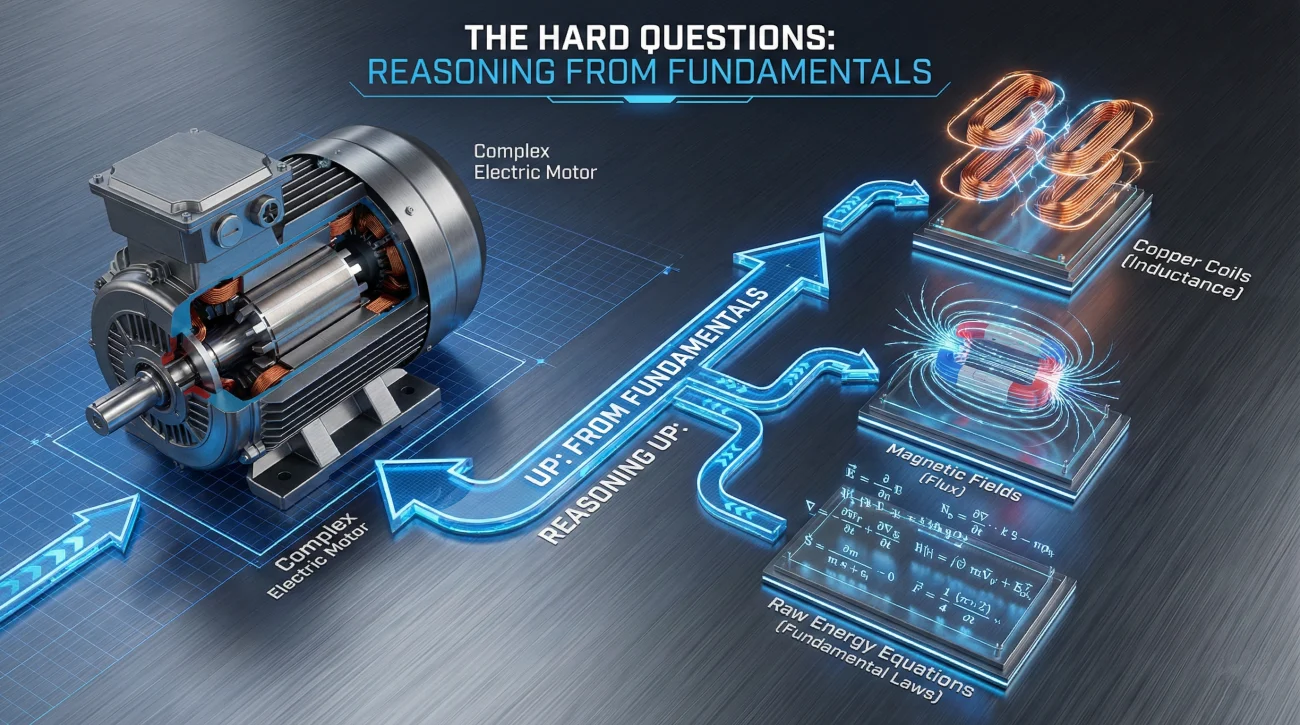
Deep Technical Questions
For engineering roles, expect questions that go far beyond surface knowledge:
“Explain how a battery management system works at the circuit level.”
“Design a motor control system for an electric vehicle from first principles.”
“Why does Tesla use cylindrical cells instead of pouch cells?”
What they’re testing: Deep technical understanding, not just memorized facts. Can you explain the physics, chemistry, or engineering principles underlying your work?
Problem-Solving Challenges
These questions have no single right answer – they test your approach:
“You’re stranded on an island. How do you generate electricity?”
“Design a manufacturing process for producing 10,000 battery packs per day.”
“How would you reduce the cost of solar panels by 50%?”
What they’re testing: First principles thinking. Do you break problems into fundamentals? Do you make reasonable assumptions? Can you think creatively?
How to Approach Hard Questions
Step 1: Break down to fundamentals
“Let me start with the basic physics. Electricity generation requires converting some form of energy into electrical energy. On an island, I have access to solar, wind, mechanical, and potentially chemical energy sources.”
Step 2: Think out loud
“The most reliable option would be solar since islands typically have sun exposure. I could create a basic photovoltaic effect using materials available – even rudimentary solar panels can be built from silicon-based materials found in sand.”
Step 3: Show trade-off analysis
“The trade-off is efficiency versus feasibility. A wind turbine might generate more power but requires precision manufacturing. Solar is less efficient but more achievable with limited tools.”
Step 4: Acknowledge gaps
“I don’t know the exact process for refining silicon from sand without proper equipment, but I’d research or experiment to figure it out.”
Tesla values intellectual honesty. Admitting knowledge gaps while showing how you’d fill them demonstrates first principles thinking.
For comprehensive technical interview strategies, see our complete interview guide.
Behavioral Questions: 3 Core Themes
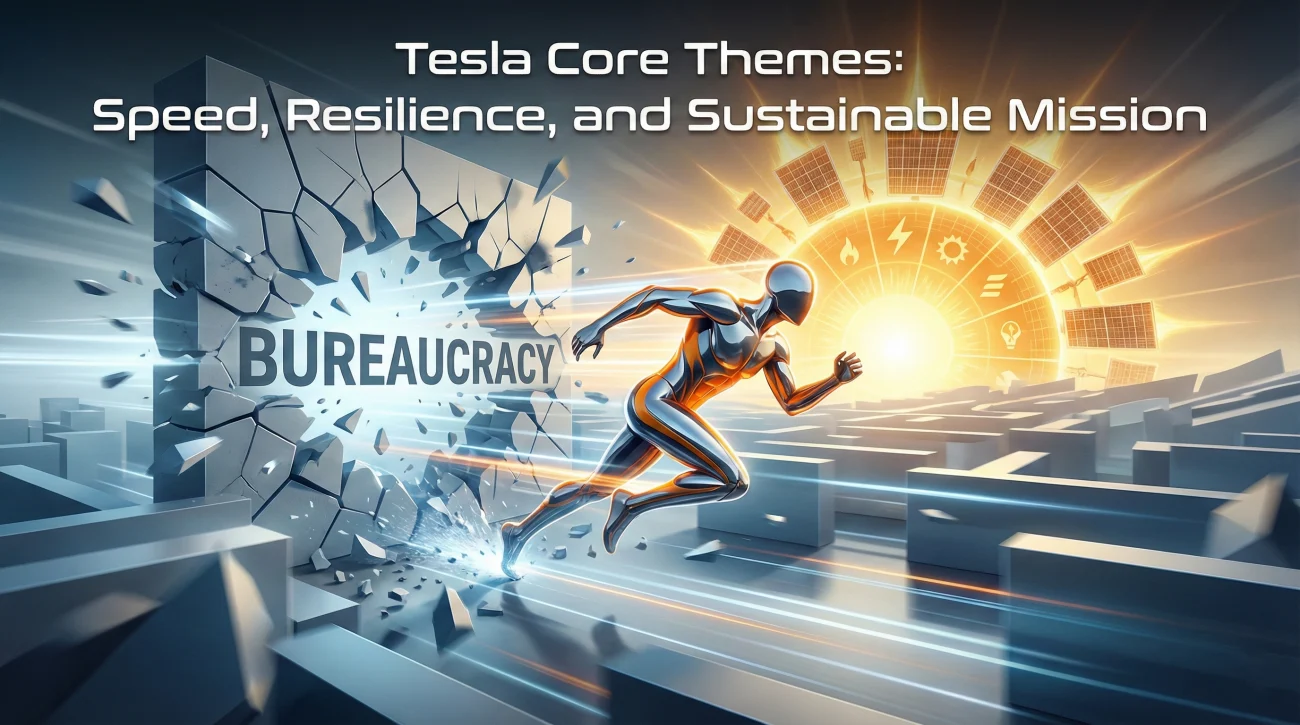
1. Speed and Urgency
Tesla operates with extreme urgency. They want people who move fast and iterate quickly.
Sample questions:
“Tell me about a time you had to deliver something in an impossibly short timeframe.”
“Describe a situation where moving fast was more important than being perfect.”
“Give an example of when you cut through bureaucracy to get something done.”
How to answer: Show bias toward action, ability to prioritize ruthlessly, and comfort with imperfect solutions when speed matters.
Example:
“We had 48 hours to fix a critical production issue before missing our quarterly deadline. I assembled a team, we worked around the clock, and we implemented a temporary solution that wasn’t elegant but worked. We shipped on time, then improved the solution in the next sprint. The temporary fix is still running 6 months later because it works well enough.”
2. Adaptability and Resilience
Tesla’s environment is chaotic and constantly changing. They need people who thrive in chaos.
Sample questions:
“Tell me about a time everything went wrong and how you handled it.”
“Describe a situation where you had to completely change direction mid-project.”
“Give an example of when you solved an impossible problem.”
How to answer: Show resilience, creative problem-solving, and ability to stay calm under extreme pressure.
Example:
“Our main supplier went bankrupt 3 weeks before launch. Everyone said we’d have to delay. I refused to accept that. I found an alternative supplier, negotiated rush production, personally drove to their facility to oversee quality, and we shipped only 5 days late instead of 2 months. It required 80-hour weeks and creative problem-solving, but we made it work.”
3. Mission Alignment and Passion
Tesla wants people genuinely passionate about accelerating sustainable energy, not just those seeking a job.
Sample questions:
“Why Tesla?”
“What do you think about our mission?”
“How do you stay motivated during difficult times?”
How to answer: Show genuine connection to Tesla’s mission, not generic enthusiasm for electric cars.
Bad answer:
“Tesla makes cool cars and is a successful company.”
Good answer:
“Climate change is the defining challenge of our generation. Transportation is 29% of emissions. Tesla is the only company actually accelerating the transition to sustainable energy at the scale and speed necessary. I want to contribute to something that matters beyond quarterly profits. I’ve followed Tesla’s progress for years and believe in the mission deeply.”
For more behavioral interview strategies, explore our interview preparation guide.
The Tesla Interview Process
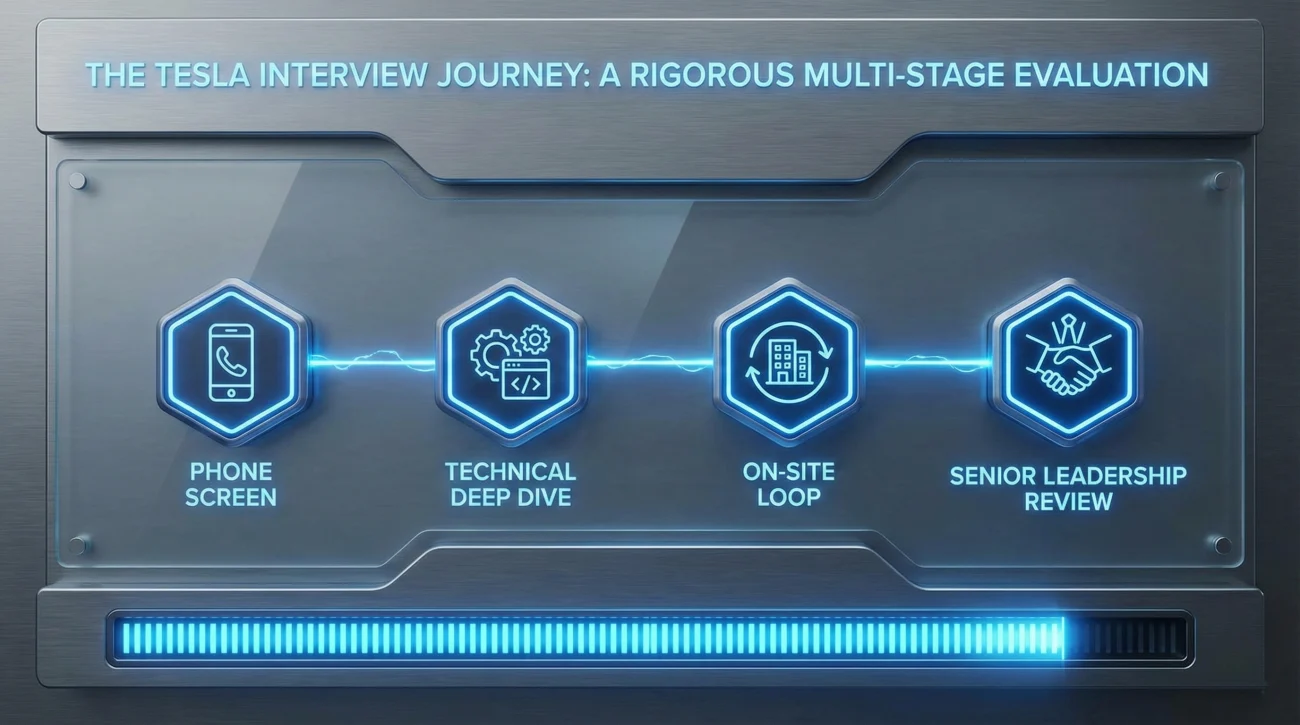
Typical Stages
Stage 1: Phone Screen
- Brief conversation with recruiter or hiring manager
- Basic technical questions or case studies
- Initial assessment of fit and motivation
Stage 2: Technical Interview
- Deep technical assessment (1-2 hours)
- Problem-solving exercises
- Whiteboard challenges or technical discussions
- First principles thinking evaluation
Stage 3: On-Site Loop
- 4-6 interviews in one day (or virtual equivalent)
- Mix of technical, behavioral, and problem-solving
- Meet potential teammates and manager
- Intense and exhausting by design
Stage 4: Final Interview (Sometimes)
- Additional round with senior leadership
- Strategic thinking and cultural fit
- Not all candidates get this round
Timeline
Can be very fast (1-2 weeks) or longer (4-6 weeks). Tesla moves quickly when they find the right person but also won’t rush a decision.
Important Notes
- Expect long hours during on-site interviews
- Interviewers may be direct or challenging – don’t take it personally
- The process tests endurance intentionally
- Some candidates get offers same day; others wait weeks
How to Prepare
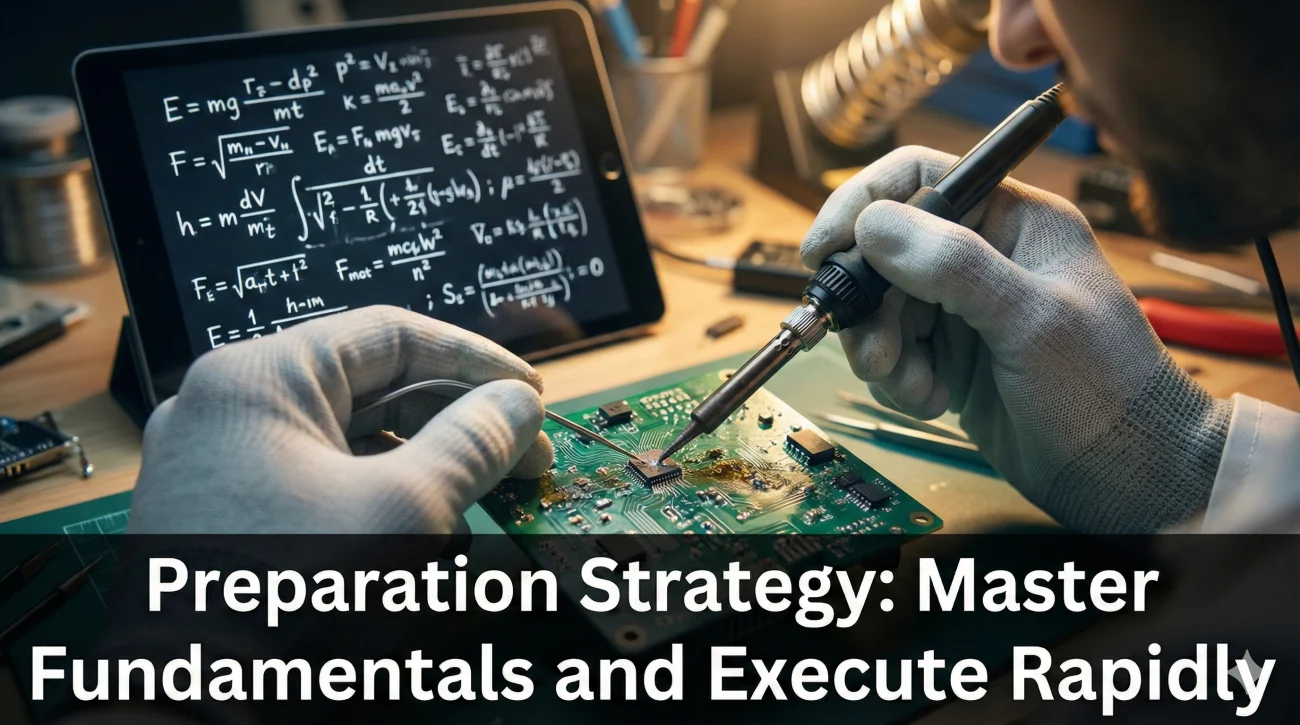
Master Technical Fundamentals
Review core principles in your domain:
- Engineers: Physics, thermodynamics, electrical systems, manufacturing processes
- Software: Algorithms, data structures, system design, optimization
- Operations: Supply chain fundamentals, logistics, process optimization
- Business: Unit economics, market dynamics, competitive strategy
Don’t just memorize – understand the underlying principles.
Practice Problem-Solving
Work through challenging problems out loud:
- Explain your thinking process
- Break problems into components
- Make and state assumptions explicitly
- Consider multiple approaches
- Discuss trade-offs
Research Tesla’s Mission
- Understand their products deeply
- Know their competitive advantages
- Read about their manufacturing innovations
- Follow recent news and developments
- Have informed opinions about their strategy
Prepare High-Intensity Stories
Have examples of:
- Working under extreme time pressure
- Solving problems everyone said were impossible
- Recovering from major setbacks
- Making fast decisions with limited information
- Going far beyond job requirements
Tesla wants doers who thrive in high-pressure environments.
What NOT to Do
Don’t Be a Talker, Not a Doer
Bad approach:
“I would create a comprehensive plan, conduct thorough research, build consensus across stakeholders, and carefully execute each phase.”
Why it fails: Tesla wants people who do things, not plan endlessly.
Better approach:
“I’d build a quick prototype in 2 days to test the concept, gather feedback, iterate rapidly, and ship something functional within a week.”
Don’t Expect Work-Life Balance
Tesla is known for demanding hours. If you say “work-life balance is my top priority,” you’ll likely be rejected.
Be honest with yourself about whether you can handle the intensity.
Don’t Give Surface-Level Answers
When asked technical questions, don’t stop at the obvious answer. Go deeper:
“The standard approach would be X, but that has limitations Y and Z. From first principles, a better solution might be to…”
Don’t Say “I Can’t”
When given impossible-seeming problems, show how you’d approach them even if you don’t know the answer:
“I don’t have direct experience with this, but here’s how I’d think through it using first principles…”
FAQ
Be a Doer, Not a Talker
Tesla’s interview process intentionally filters for people who thrive in high-pressure, fast-moving environments and who think from first principles rather than conventional wisdom.
Expect genuinely hard technical questions that test deep understanding, not surface knowledge. Prepare for problem-solving challenges with no right answers that evaluate your thinking process. Show first principles thinking by breaking problems into fundamentals and reasoning up from there.
In behavioral interviews, demonstrate the three core themes: speed and urgency (bias toward action over perfect planning), adaptability and resilience (thriving in chaos and solving impossible problems), and genuine mission alignment (real passion for sustainable energy, not just job seeking).
Avoid being a talker who plans endlessly instead of doing. Don’t expect work-life balance or complain about demanding hours. Don’t give surface-level technical answers or say you can’t solve difficult problems.
Tesla wants builders who execute quickly, solve problems creatively, and care deeply about accelerating sustainable energy. The interview process is hard because the work is hard and the mission is urgent.
If you’re looking for stability, clear processes, and reasonable hours, other companies will fit better. But if you want to work on problems that matter at breakneck speed with exceptional people – Tesla might be exactly right.
For additional Tesla interview resources, check out our comprehensive career guide.