
- A Police Officer resume is framed as a first official statement: It must signal judgment, integrity, calm under pressure, and community-minded service, not just enforcement.
- Hiring leaders scan for low-risk signals fast: De-escalation and crisis intervention language, clean report-level writing, community partnership, and a stable record with progressive training and commendations.
- ATS is treated as a strict gatekeeper in public sector hiring: Use standard headings, avoid graphics, include both acronyms and full terms (Example: Crisis Intervention Team (CIT)), and mirror job-description keywords.
- Structure is built like a strong report: Clear header, a “sworn statement” summary, grouped competencies, and impact bullets using Action Verb + Context + Metric instead of duty lines like “Responsible for.”
- The guide pushes proof where policing feels hard to quantify: Response time, de-escalation rate, report accuracy, case support, mentorship (FTO), and community programs, then warns against red flags like typos, aggressive tone, and misread hobbies.
In law enforcement, your resume is more than a career summary; it is your first official statement. It is a testament to your judgment, your integrity, and your ability to remain calm under pressure. A Police Officer resume must project authority and empathy in equal measure, proving you are a guardian of the community, not just an enforcer of the law.
Whether you are a new cadet graduating from the academy, a seasoned patrol officer seeking a promotion to detective, or a veteran transferring departments, your document has a unique challenge. It must pass the rigorous, filter-heavy scrutiny of an Applicant Tracking System (ATS) and then immediately connect with a human hiring manager – likely a Sergeant, Lieutenant, or Captain – who is looking for one thing above all: character.
Most police resumes fail because they are sterile lists of duties. They say “Patrolled assigned areas” but fail to show the judgment, community engagement, and de-escalation skills used during that patrol. This guide will deconstruct how to write a resume that truly reflects the values of modern policing – discipline, courage, honesty, and an unwavering dedication to public safety. Let’s build a document that speaks to your integrity.
The Recruiter’s Query: Passing the ATS and Impressing Leadership
When a hiring manager in a police department reviews your resume, they are not just “filling a role.” They are managing profound risk. A bad hire in law enforcement is a multi-million dollar liability. They are looking for signals that you are a stable, high-value, low-risk professional.
In their brief scan, they are subconsciously asking critical questions:
- 1. Can You De-escalate? This is the most sought-after skill in modern policing. They are hunting for keywords like “de-escalation,” “crisis intervention,” (CIT), and “conflict resolution.” Can you solve a problem with your words before you solve it with force?
- 2. Can You Write? Your reports (and by extension, your resume) are legal documents. Is your resume clear, concise, and free of typos? If you can’t write a clean resume, they assume you can’t write a clean incident report, which is a critical failure in court.
- 3. Are You a Community Partner? Do you see yourself as part of the community or separate from it? They look for “community engagement,” “public outreach,” and “youth mentorship.”
- 4. Are You Reliable and Disciplined? They check your work history for stability. They look for progressive training, commendations, and a clean service record.
Before a human ever sees your file, it must pass through an Applicant Tracking System (ATS). Public sector and government jobs, including police departments, rely heavily on these systems (like NeoGov, Taleo, and Workday). This software is not smart; it is a simple keyword-matching filter. To pass, you must align your keywords with the job description, use standard headings (e.g., “Professional Experience”), avoid graphics, and list both acronyms and their full phrases (e.g., “Crisis Intervention Team (CIT)”).
Your resume’s job is to proactively answer “yes” to these questions, using quantified achievements and strategic language. Recruiters in law enforcement look for two things: proven skill and proven character.
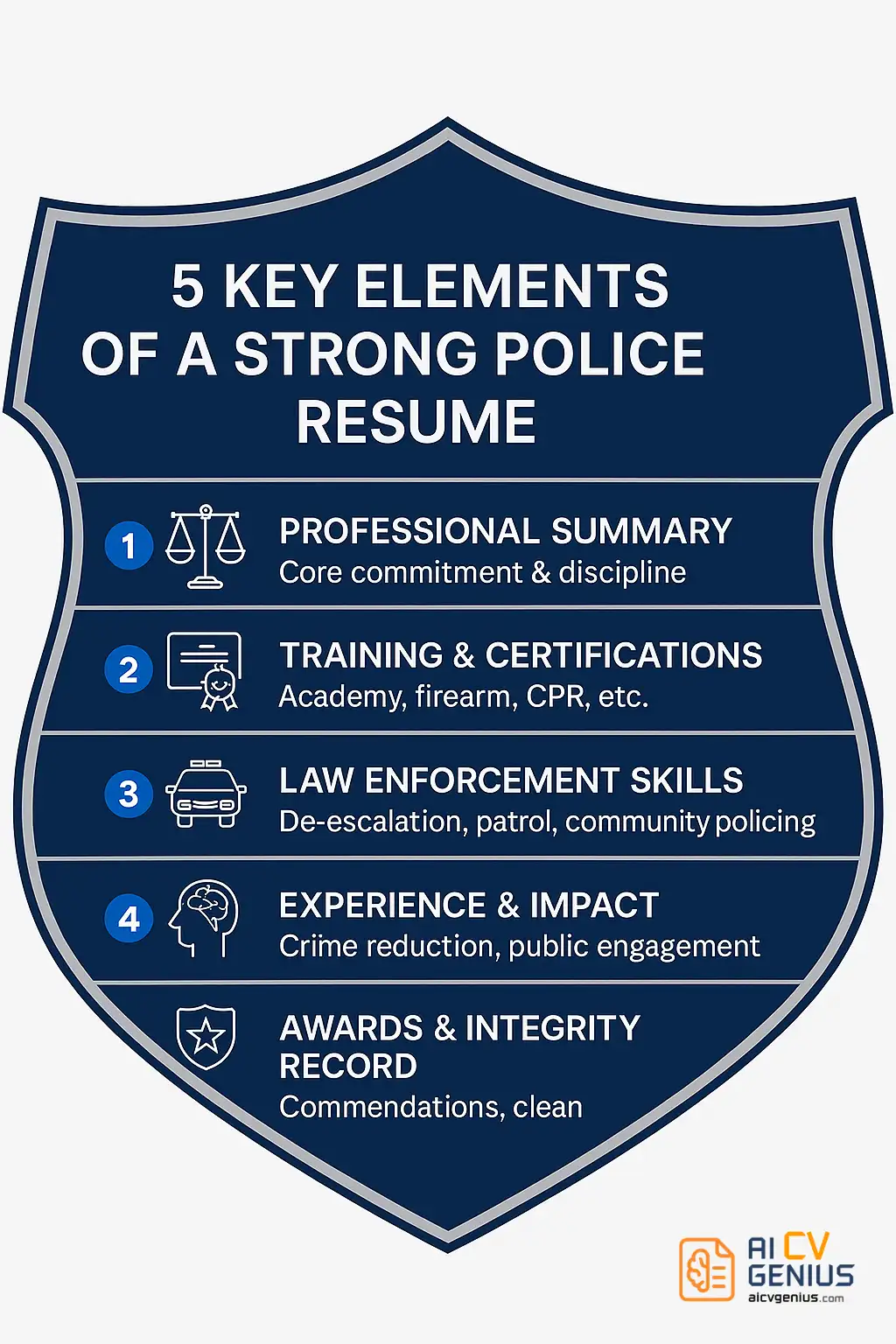
Core Structure for a Police Resume: Building Your Case
Your resume should be structured like a good police report: logical, factual, and easy to follow. Guide the reader from your identity to your proof.
1. Header: Your Professional Identity
Make this clean and unambiguous. Include your professional title. If you have a rank, lead with it.
Sergeant James Walker
(or Officer Jane Chen | Police Cadet)
City, State, Zip | (555) 123-4567 | professional.email@domain.com | LinkedIn URL
Pro Tip: A LinkedIn profile is increasingly expected, even in law enforcement. Use it to detail commendations and training.
2. Professional Summary: Your Sworn Statement
This is your 3-4 line “abstract.” It must summarize your value, your core skills, and your commitment to the department’s values (e.g., integrity, community).
❌Weak Summary (This is generic and passive):
“Police officer with 7+ years of experience. Hard-working and good at patrol. Looking for a new and challenging role.”
✅Strong Summary (Experienced Officer):
“Disciplined and community-focused Police Officer with 7+ years of experience in high-volume urban patrol and criminal investigation. Proven ability in de-escalation and crisis intervention, resulting in a 90% success rate in resolving disputes without force. Committed to fair, respectful, and constitutional enforcement of the law.”
✅Strong Summary (New Cadet):
“Highly-motivated Police Academy Graduate with top-of-class honors in Defensive Tactics and a 98% score in the Legal Procedures exam. Eager to apply rigorous training in patrol operations, incident reporting, and community policing to serve the [City Name] community with integrity.”
3. Key Skills / Core Competencies
Do not use a generic “skills” list. Group your competencies logically. This shows you think in systems and is highly scannable for recruiters.
| Law Enforcement & Operations | Patrol Operations, Criminal Investigation, Evidence Collection, Incident Reporting, Defensive Tactics, Firearm Safety |
| Crisis & Communication | De-escalation & Crisis Management, Conflict Resolution, Public Speaking, Community Outreach, Interview & Interrogation |
| Procedural & Technical | Search & Seizure Law, Constitutional Law, Report Writing (NIBRS), Records Management Systems (RMS), First Aid/CPR |
4. Professional Experience: The Proof
This is the core of your resume. Do not list duties. List achievements. Use the “Action Verb + Project + Metric” formula. Every bullet point should prove your judgment and initiative.
| ❌ Weak Bullet (Duty) | ✅ Strong Bullet (Impact) |
|---|---|
| “Responsible for patrolling assigned area.” | “Conducted proactive daily patrols in [District Name], resulting in a 15% reduction in reported burglaries in the area over 12 months.” |
| “Handled calls and wrote reports.” | “Responded to over 500+ emergency and non-emergency calls annually, maintaining an average response time 20% faster than the department average.” |
| “Dealt with upset people.” | “Utilized Crisis Intervention Team (CIT) training to successfully de-escalate 90%+ of mental health-related calls, ensuring subject safety without use of force.” |
More High-Impact Examples:
- ✅ Authored 200+ detailed and accurate incident reports, with a 100% submission rate on time and zero procedural violations noted by supervisors.
- ✅ Led a community outreach program connecting with local youth, helping to reduce juvenile incidents in the precinct by 30%.
- ✅ Served as Field Training Officer (FTO), mentoring and training 5 new recruits, all of whom passed their probationary periods.
- ✅ Assisted detectives in 20+ felony investigations by meticulously collecting and processing evidence, leading to 15 successful prosecutions.
5. Education & Certifications
Show your formal education and your tactical training side by side. Training is often more important than a degree in this field.
Police Academy & Certifications
- Police Academy Graduate – [Name of Academy], [City, State] (Year)
- Crisis Intervention Team (CIT) Certified (Year)
- Advanced First Aid & CPR/AED Certified (Year)
- [Other relevant, e.g., Field Training Officer (FTO), Defensive Tactics Instructor]
Education
- Bachelor of Science in Criminal Justice – [University Name], [City, State] (Year)
Quantifying the Unquantifiable: Metrics for Police Work
This is what separates a good resume from a great one. Numbers prove your effectiveness. You have more data than you think.
- Crime Reduction: “Contributed to a 15% reduction in burglary rates…”
- Response Time: “Maintained an average response time 20% faster than…”
- De-escalation: “Resolved 90% of domestic disputes without arrest…”
- Efficiency/Accuracy: “Wrote 300+ reports with a 0% error rate…”
- Community Impact: “Organized 3 workshops, reaching 500+ residents…”
- Training: “Trained 10 new recruits with a 100% pass rate…”
Don’t just say you served with honor – show it through facts.
Community Involvement: Proving You’re More Than the Badge
Community trust is central to modern policing. This section is no longer “optional.” It proves you are invested in the community you serve, both on and off duty. Include volunteer roles or outreach programs.
- Community Workshop Organizer, [Precinct Name] (2022 – Present)“Organized and led annual ‘Coffee with a Cop’ and community safety workshops, reaching 500+ residents to build trust and open lines of communication.”
- Youth Mentor, [Local Youth Center] (2021 – Present)“Volunteered 10 hours per month to mentor at-risk youth, promoting law awareness and positive life choices.”
- Collaborator, [Local NGO]“Collaborated with local NGOs to support domestic violence victims, helping to streamline the process for obtaining protective orders.”
The Complete Police Officer Resume Example (Putting It All Together)
Theory is one thing; practice is another. Let’s apply every strategy we’ve discussed to build a complete resume for a fictional candidate, Officer James Walker, who is an experienced officer and FTO.
JAMES R. WALKER
Senior Police Officer | Field Training Officer (FTO)
Denver, CO 80203 | (555) 123-4567 | j.walker@email.com | linkedin.com/in/jameswalkerleo
PROFESSIONAL SUMMARY
Disciplined and community-focused Senior Police Officer with 8+ years of experience in high-volume urban patrol and crisis intervention. CIT-certified with a proven talent for de-escalation, resolving over 95% of volatile situations without use of force. Serves as a Field Training Officer (FTO), mentoring 10 new recruits with a 100% pass rate. Committed to procedural justice, community partnership, and accurate, detailed reporting.
CORE COMPETENCIES
|
|
|
PROFESSIONAL EXPERIENCE
Senior Police Officer & FTO | Denver Police Department | Denver, CO (2019 – Present)
- Serve as Field Training Officer (FTO), mentoring 10 new recruits in procedural justice, de-escalation, and report writing; achieved a 100% probationary pass rate.
- Utilize Crisis Intervention Team (CIT) training to respond to 150+ mental health and crisis calls, successfully de-escalating over 95% of situations without force.
- Conduct proactive community patrols in District 4, contributing to a 15% reduction in reported burglaries and a 20% increase in positive community contacts.
- Author 300+ detailed incident and arrest reports annually with a 100% accuracy rate upon supervisory review, ensuring case integrity for prosecution.
Patrol Officer | Aurora Police Department | Aurora, CO (2016 – 2019)
- Responded to 500+ emergency (Code 3) and non-emergency calls annually, maintaining an average response time 15% faster than the department benchmark.
- Launched and organized the precinct’s first “Coffee with a Cop” program, improving community relations and opening new dialogues with 50+ local business owners.
- Assisted detectives in 30+ felony investigations by securing crime scenes and meticulously gathering and processing evidence.
EDUCATION & CERTIFICATIONS
- Colorado POST Certified Police Officer | Denver Police Academy (2016)
- Certified Field Training Officer (FTO) | Colorado POST (2020)
- Crisis Intervention Team (CIT) Certified | (2019)
- Bachelor of Science in Criminal Justice | University of Colorado Denver (2015)
COMMENDATIONS
- Medal of Merit | Denver PD (2022) – For de-escalating a volatile armed-subject situation, resulting in a safe surrender with no injuries.
- Officer of the Month | Denver PD, District 4 (May 2021) – For outstanding community engagement and mentorship.
Advanced Strategies: Tailoring, Tone, and Common Mistakes
Beyond the core structure, several advanced tactics can further refine your resume. This includes tailoring for your specific role, adding commendations, and avoiding common red flags.
Tailor for Specific Law Enforcement Roles
“Police Officer” is a wide field. Your resume must be tailored to the specific role. A Patrol Officer resume looks different from a Detective resume.
| Role Type | Focus | Resume Emphasis & Keywords |
|---|---|---|
| Patrol Officer | Field operations, incident response, visibility. | Emphasize: De-escalation, response time, community engagement, incident reporting, physical readiness. |
| Detective / Investigator | Investigation, analysis, case management. | Emphasize: Case closure rates, interview & interrogation, evidence processing, report accuracy, search warrants. |
| Community Liaison Officer | Public engagement, trust-building, education. | Emphasize: Community outreach projects, public speaking, youth mentorship, program development. |
| Field Training Officer (FTO) | Mentorship, evaluation, internal leadership. | Emphasize: Training, mentoring, performance evaluation, leadership, procedural compliance. |
| New Cadet / Recruit | Trainability, discipline, physical fitness. | Emphasize: Academy scores, physical fitness awards, education (Criminal Justice), high integrity. |
Use the Right Tone and Action Verbs
Your resume should sound confident, not aggressive; respectful, not robotic. Use verbs that show control, authority, and service.
- Authority & Action: Enforced, Investigated, Responded, Secured, Patrolled, Conducted, Apprehended
- Communication & Intellect: De-escalated, Coordinated, Authored, Documented, Interviewed, Mediated, Testified
- Leadership & Community: Led, Assisted, Mentored, Trained, Collaborated, Organized, Protected
These words show discipline and collaboration – exactly what law enforcement agencies value.
Include Awards and Commendations
A separate section for honors is highly recommended. It provides third-party validation of your performance and character. Even small recognitions speak volumes.
Honors & Commendations
- Medal of Merit, [Department Name] (2023) – “For outstanding crisis leadership during [Event Name].”
- Officer of the Month, [Precinct Name] (June 2022) – “For launching a successful community partnership initiative.”
- Public Service Recognition, [Local Council Name] (2021)
- Perfect Attendance Award (2020, 2021) – (Shows reliability)
Keep Design Professional and Respectful
Your resume’s design reflects your professionalism. In this field, clarity and order are non-negotiable.
- ✅ Layout: Use a clean, single-column layout. This is the most ATS-friendly and professional format.
- ✅ Color: Stick to black and white. You may use a very dark, conservative navy for headings, but black is safest.
- ✅ Font: Use a standard, readable font like Inter, Roboto, Open Sans, or Calibri.
- ✅ Format: Always save and send as a PDF to preserve your formatting.
- ❌ Avoid: Photos, colored icons, skill bars, or graphics.
Check professional layouts at Resume Templates Finder for polished, ATS-ready templates built for public service sectors.
Mistakes to Avoid (Red Flags for Recruiters)
- ❌ Overly Aggressive Tone: Using verbs like “controlled,” “forced,” or “dominated.” Focus on “de-escalated,” “resolved,” and “secured.”
- ❌ Typos and Errors: A typo in a resume implies a typo in a report, which can get a case thrown out. Proofread three times.
- ❌ Listing Unrelated Hobbies: Hobbies like “hunting” or “shooting” can be misinterpreted. Stick to professional skills or community-focused volunteer work.
- ❌ Forgetting Teamwork: Policing is never solo work. Highlight collaboration: “Collaborated with detectives…” or “Worked with EMTs…”
- ❌ Gaps in Employment: Be prepared to explain any gaps in your work history clearly and honestly during the interview.
Pros & Cons of Using a Resume Template
| Pros | Cons |
|---|---|
| ✅ Keeps format consistent, professional, and orderly. | ❌ Can sound generic if you don’t customize the content. |
| ✅ Saves significant time on formatting and design. | ❌ Overly “creative” templates are unprofessional for this field. |
| ✅ Ensures ATS-compatibility and scannability. | ❌ Some templates may not fit public sector norms (e.g., two-column). |
In-Depth FAQs for a Police Officer Resume
Weak: “Patrolled District 5.”
Strong: “Conducted proactive patrols in District 5, focusing on high-traffic areas, which contributed to a 10% reduction in vehicle break-ins.” Also, mention any community engagement during patrols.
Military: “Led a 4-man fireteam.”
Police Resume: “Led a 4-person team in high-stress environments, ensuring procedural compliance and safety.”
Final Thoughts: Service, Not Show
Law enforcement is about service, not show. The best police resumes demonstrate calm under pressure, respect for procedure, and genuine care for the community. Your document should be a factual, clear, and powerful statement of your integrity.
Write with pride, but also with humility. Show your achievements, but frame them as contributions to the team and the community. These are the two values that truly define the badge.
For more resume layouts, visit Resume Templates Finder or explore career guidance at Career Resources.