

- Main idea: You do not need to be extroverted to fit in, you just need to be present and genuine.
- Low-stakes start: Use kitchen and coffee moments for short, repeatable chats that build familiarity over time.
- Best format for introverts: Schedule 15 to 20 minute 1-on-1 coffee chats with a few teammates each week.
- Conversation tool: Use the FORD method to ask better small-talk questions and keep it feeling natural.
- Social boundaries: Say yes to lunch 1 to 2 times per week, attend a few key events, and protect recharge time without overexplaining.
You Don’t Need to Be the Life of the Party – Just Present
Introverts dread the social demands of starting a new job. The small talk, the group lunches, the team happy hours, the expectation to be “on” all day while also learning a new role.
Here’s the good news: you don’t need to be extroverted to build solid work relationships. You don’t need to be popular or the center of attention. You just need to be present and genuine in ways that feel sustainable to you.
Workplace socializing isn’t about collecting friends or being universally liked. It’s about building trust and rapport with the people you work with so collaboration is easier and work is more enjoyable.
These five strategies help introverts navigate workplace socializing without exhausting themselves or pretending to be someone they’re not.
Tip 1: Use Low-Stakes Environments (Kitchen, Coffee Machine)
The kitchen and coffee area are perfect for introverts. Interactions are naturally brief, one-on-one or small group, and don’t require sustained energy.

Why This Works for Introverts
Low-stakes environments have built-in exit strategies. You’re making coffee or grabbing lunch – there’s a natural endpoint to the conversation. You’re not trapped in a 30-minute forced interaction.
Plus, these spaces create repeated casual contact with the same people, which builds familiarity without requiring deep conversations every time.
How to Use These Spaces
Make coffee or lunch at consistent times. People will start recognizing you. Casual nods become brief hellos become short conversations over time.
Simple conversation starters that work:
“How’s your day going?”
“Have you tried the new coffee blend?”
“Busy week for you?”
These require minimal energy but create connection through repeated friendly interactions.
Strategic Timing
Go to the kitchen during peak times occasionally (10am, noon, 3pm) when more people are around. This maximizes exposure without requiring you to seek out interactions elsewhere.
But also go during quiet times when you need an actual break. Balance social visibility with genuine recharge time.
For comprehensive relationship-building strategies, see our complete career guide.
Tip 2: Prioritize 1-on-1s (Best Format for Introverts)
One-on-one conversations are where introverts thrive. No competition for airtime, no performing for a group, no social exhaustion from managing multiple people’s energy simultaneously.

Proactively Schedule Coffee Chats
Don’t wait for group invitations. Actively schedule 15-minute coffee chats with teammates:
“Hi [Name], I’m new to the team and would love to grab 15 minutes to learn about what you do. Do you have any time this week?”
Most people say yes. New employees get a grace period for requesting people’s time.
Keep Them Short and Structured
Introverts often overthink social interactions. Give yourself structure:
- 15-20 minutes maximum (this prevents exhaustion)
- Come with 3-4 questions prepared (eliminates awkward silences)
- Focus on learning about them (takes pressure off you)
Having a time limit and agenda reduces social anxiety.
Sustainable Frequency
Schedule 2-3 per week in your first month. This builds connections without overwhelming you. Quality over quantity – five genuine 1-on-1s beat twenty surface-level group interactions.
Tip 3: Ask Questions Using “FORD”
Introverts struggle with small talk because it feels superficial and draining. The FORD method gives you a framework for conversations that feel more substantial.
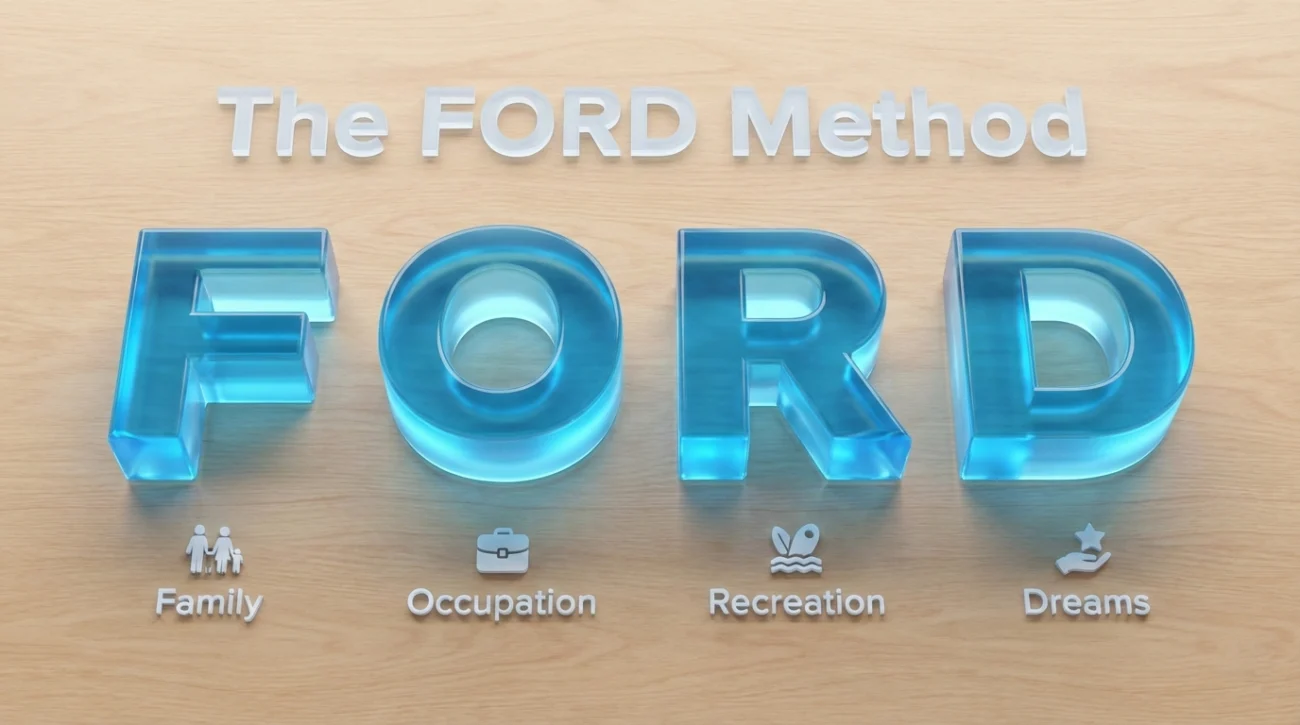
FORD Framework
F – Family: “Do you have kids?” “Are you from around here originally?”
O – Occupation: “What does your day-to-day look like?” “What projects are you working on?”
R – Recreation: “What do you do outside work?” “Any hobbies or interests?”
D – Dreams: “What are you hoping to work on next?” “Where do you see your career going?”
How to Use FORD
Pick one letter and ask a question. Then actually listen and follow up based on their answer. You’re not running through a checklist – you’re using FORD as a mental backup when conversation stalls.
Example flow:
You: “What do you do outside work?”
Them: “I’ve been getting into rock climbing.”
You: “That’s cool. Indoor or outdoor?”
Them: [explains their climbing routine] You: “How did you get into it?”
One FORD question can sustain 5-10 minutes of conversation when you actually engage with their answers.
What to Avoid
Don’t interrogate people by asking rapid-fire questions without sharing anything yourself. Balance questions with brief personal shares when appropriate.
Also avoid: politics, religion, salary, complaints about the company. Stick to neutral topics until you know people better.
Tip 4: Say “Yes” to Lunch (1-2 Times Per Week)
Introverts want to eat lunch alone to recharge. This is understandable but strategically risky in your first 30 days.
The Minimum Viable Socializing
You don’t need to eat lunch with people every day. But aim for 1-2 team lunches per week in your first month.
This shows you’re making an effort without draining you completely. The other 3-4 days, eat alone or with one person you’re comfortable with.
How to Make It Easier
Join lunches that already have a small group (3-4 people is manageable). Large groups are overwhelming and harder to contribute to meaningfully.
If someone invites you to lunch one-on-one, say yes. These are easier than groups and build stronger connections.
Build in Exit Strategies
Have legitimate reasons to leave lunch after 30 minutes:
“I need to jump on a call at 1pm, but wanted to grab at least part of lunch with you all.”
This lets you be present without committing to a full hour if you’re exhausted.
For more workplace relationship strategies, explore our professional development guide.
Tip 5: Set Boundaries (And That’s Okay)
Introverts need alone time to recharge. This is non-negotiable for your wellbeing. The key is setting boundaries strategically.

Be Selectively Social
You can’t attend every happy hour, team lunch, and social event. Pick strategically:
- Attend welcome events for new employees (worth the energy)
- Go to one happy hour in your first month (shows you’re making an effort)
- Say yes to lunch with your immediate team regularly
- Skip optional social events when you’re genuinely drained
Attending some events strategically is better than avoiding all of them or forcing yourself to attend everything and burning out.
How to Decline Gracefully
You don’t need elaborate excuses. Simple and friendly works:
“Thanks for the invite! I can’t make it tonight, but I’d love to catch the next one.”
“I’m pretty exhausted today, but have fun!”
Most people understand. Don’t over-explain or apologize excessively – this makes it awkward.
Protect Your Recharge Time
Block time on your calendar for actual breaks. Take a walk alone at lunch sometimes. Eat at your desk when you need quiet. Close your door (if you have one) when you need to focus.
Sustainable socializing requires protecting recharge time. Don’t sacrifice your wellbeing trying to appear extroverted.
For Remote Workers
Virtual socializing can be even more draining. Decline optional video social calls guilt-free. Participate in async Slack conversations where you can engage on your own timeline. Turn your camera off occasionally if that’s acceptable in your culture.
Connection Matters More Than Popularity
Success at work doesn’t require being the most social or popular person. It requires genuine connections with the people you work with directly.
Quality Over Quantity
You don’t need 50 work friends. You need:
- A good relationship with your manager
- Trust with your immediate teammates
- Rapport with 2-3 key stakeholders in other departments
- One or two people you actually like talking to
Five solid connections beat twenty superficial ones. Introverts excel at depth – lean into that.
Be Authentically You
Don’t pretend to be extroverted. People sense inauthenticity. Instead, be the best version of yourself:
- Friendly without being the loudest in the room
- Engaged without dominating conversations
- Present without being constantly available
- Helpful without being everyone’s best friend
Leverage Introvert Strengths
Introverts are often:
- Better listeners (people appreciate being heard)
- More thoughtful in communication (quality over quantity)
- Stronger in 1-on-1 relationships (deeper connections)
- More observant of team dynamics (strategic awareness)
These are valuable workplace skills. Don’t view introversion as a deficit to overcome.