
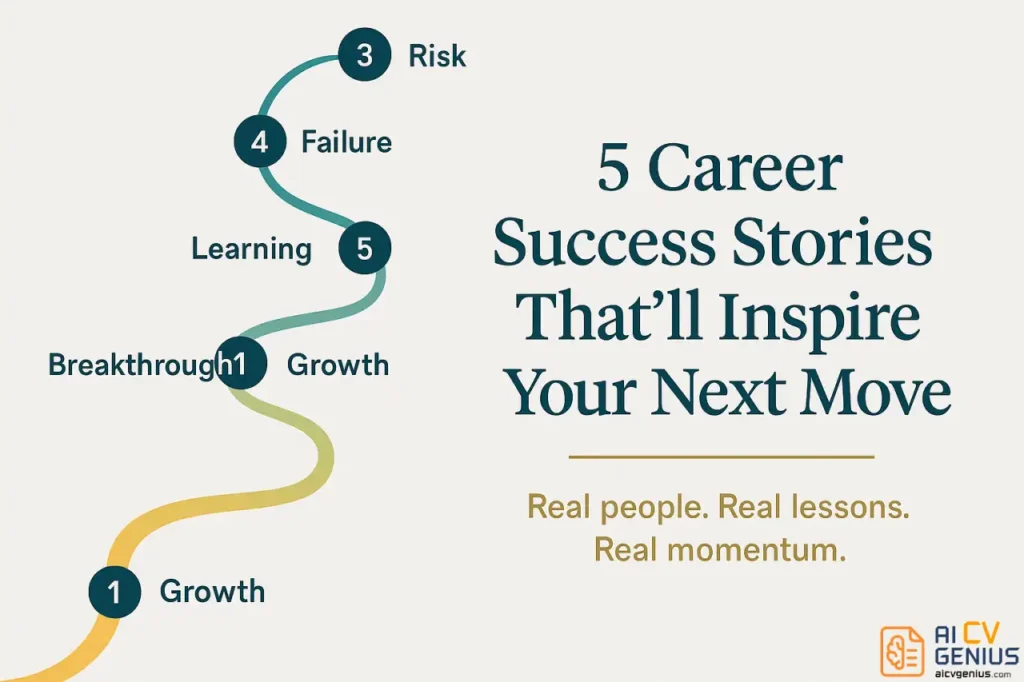
- Main idea: Real career success is rarely linear, and the messy path is often the one that finally fits.
- Five proof stories: A lawyer becomes a pastry chef, a laid-off manager becomes a C-suite people leader, a firing turns into a seven-figure agency, a “scattered” resume becomes a growth toolkit, and a teacher’s public work opens a tech door.
- Shared pattern: Persistence through discomfort, curiosity over certainty, and brutal self-awareness about what you need to thrive.
- What to do this week: Find one “bright spot,” run a small low-risk experiment, and talk to people for insight not a job.
- Final takeaway: Your real success story is the decision to try, then build momentum through small honest moves.
We are raised on a myth: the myth of the straight line. The idea that you pick a major, get a job, climb a ladder, and retire. This linear path is clean, predictable, and for most people, a complete fantasy. Real success is messy. It zigs when you expect it to zag. It takes painful detours through jobs you hate, industries you never planned, and late-night moments of profound doubt.
But here is the secret that makes career success stories so compelling: they prove that the messy, winding path is the only one that leads to a place that truly fits. The straight line is for drones; the messy path is for humans.
These five stories aren’t about overnight luck or genetic genius. They are about people who made terrifying, bold, and necessary moves – sometimes at 25, sometimes at 50 – to reclaim their narrative. No fluff, no sanitized LinkedIn posts. Just the raw, real decisions, the uncomfortable challenges, and the hard-won outcomes that define what it means to build a life, not just a resume.
Story 1: The Calculated Leap – From Corporate Law to Pastry Chef
For seven years, Sarah was the perfect picture of success. A high-floor office at a Manhattan law firm. A clear view of the partner track. A six-figure salary that afforded her a life many would envy. And she was, in a word, miserable. “It wasn’t just the work,” she says. “It was a hollowness. I’d wake up at 3 AM with my heart racing, not because of a big case, but because I had a terrifying vision I’d be doing the exact same thing in 30 years.”
The “a-ha” moment wasn’t a lightning bolt. It was a quiet, persistent whisper. The only time she felt truly present was on weekends, covered in flour, baking for friends. At 32, she did the unthinkable: she quit. She cashed out her 401k, enrolled in culinary school, and traded her legal briefs for an apron. Five years later, she owns two small, thriving Brooklyn bakeries. She makes less money, works physically harder, and has never been happier.
The Lesson: Passion Isn’t a Blind Leap; It’s a Calculated Compass
Sarah’s story isn’t a fluffy “follow your passion” cliche. It was a calculated escape. “I didn’t just walk out,” she clarifies. “For two years, I baked every weekend. I took a night class in small business accounting. I saved aggressively.” The passion wasn’t the jump; it was the data. It proved she could endure the grind. “Passion gives you the fuel to do the boring, hard work,” Sarah says. “And you need that fuel, because running a business is 80% boring, hard work. Without it, you’d quit the first time a supplier shorts you or an oven breaks.”
Story 2: The “Late Bloomer” Pivot – First C-Suite Role at 53
Marcus spent 25 years in the trenches of middle management at a global tech company. He was the good soldier. The reliable manager. He was consistently “meets expectations,” but never quite “VP material.” At 52, during a brutal restructuring, his loyalty was rewarded with a layoff. “It was a shock, but not a surprise,” he says. “I was too expensive to keep, not senior enough to be ‘essential.’ I felt obsolete.”
Instead of panic-applying to similar roles, he took a month and a severance package to “conduct an autopsy” on his own career. He asked himself a hard question: In 25 years, what parts actually made him feel competent and energized? The answer wasn’t spreadsheets or budgets. It was training new managers. He loved the “a-ha” moment when they “got” it.
On a whim, he pivoted. He used his network to start a small leadership consulting practice. Within 18 months, a fast-growing startup, tired of “brilliant jerk” managers, hired him as their first Chief People Officer. He got his first C-suite title at 53.
The Lesson: Experience Is a Lens, Not Baggage
These career success stories after 40 are a powerful counter-narrative to the ageism of tech. “My age became my single greatest advantage,” Marcus says. “The startup didn’t need another 28-year-old growth hacker. They needed someone who had seen, and made, every management mistake in the book. I’d seen the patterns. Your experience isn’t baggage – it’s pattern recognition. You just have to find the people who value your library.”
Story 3: The Failure That Filters – Fired, Then Founder
Jessica was fired from her marketing director job at 29. The official reason was “performance issues.” The unofficial reason was a toxic clash with a new boss. She was devastated. “It wasn’t just losing a job. It felt like a permanent stain on my record,” she recalls. “I thought my career was over. I couldn’t even get interviews for junior roles. The shame was suffocating.”
With rent due and nothing to lose, she emailed her network and offered to do freelance social media work. One small client. Then two. Then a referral. She was terrified, but she was also… good at it. Really good. Within three years, that “side hustle” grew into a 15-person creative agency with seven-figure revenue.
The Lesson: Failure Is a Filter, Not Just Data
Getting fired forced Jessica to confront a hard truth: she was bad at that job. “I was terrible in rigid corporate structures. I hate politics. I need autonomy to execute. That insight became the foundation of my entire business.” The failure wasn’t just data; it was a filter. It violently ejected her from an environment she was not built for. “When I pitch new clients, do you know how many ask me about being fired? Zero. They care that I can solve their problem. Results erase history.”
Story 4: The Toolkit Builder – Five Careers in Ten Years
By age 35, David’s resume looked like a chaotic mess. He’d been a journalist, a nonprofit fundraiser, a B2B salesman, a high school teacher, and was now learning to code. His parents called it “finding himself.” Recruiters called it “scattered.” But David saw something else.
Journalism taught him to find a story in data. Nonprofits taught him mission-driven communication. Sales taught him to overcome rejection. Teaching taught him to explain complex concepts simply. Coding taught him logic. At 35, he found a role as “Head of Growth” at an edtech startup. His job? Tell stories with data, communicate a mission, close deals, and explain a complex product. His “scattered” background wasn’t a liability; it was the exact toolkit for the job.
The Lesson: Exploration Is Intentional Toolkit Building
“I was never lost,” David says. “I was building a toolkit. Each job added a specific, high-value tool.” Don’t let the world force you into a narrow lane too early. The people who explore widely often hit their stride later. But that stride lasts longer because it’s built on a unique, un-replicable combination of skills. Your “random” jobs are your “generalist” superpower.
Story 5: The Accidental Expert – From Teacher to Tech
Maria taught high school math for eight years. She loved her students but was burning out on the bureaucracy. During COVID, she started creating short, funny video tutorials for her struggling students. They loved them. Parents shared them. Other teachers in her district started using them. Before she knew it, her YouTube channel had 50,000 subscribers.
A fast-growing learning platform reached out. They had seen her videos. Would she be interested in designing their entire high school math curriculum? The salary offered was double her teaching income. She left the classroom in 2021.
The Lesson: Career Success Can Find You (If You Work in Public)
Maria didn’t have a 5-year plan to leave teaching. She was just trying to solve a problem: “How do I make remote learning not suck?” But she solved that problem publicly. And that visibility created an opportunity that a thousand “networking” coffees never could have. “Start solving the problems you see,” she advises. “Share what you know, even if you think it’s simple. Opportunities emerge from visibility.” These career change success stories often happen to people who put their work, their ideas, and their solutions where others can see them. Need more advice on career transitions? Check out our career change CV guide.
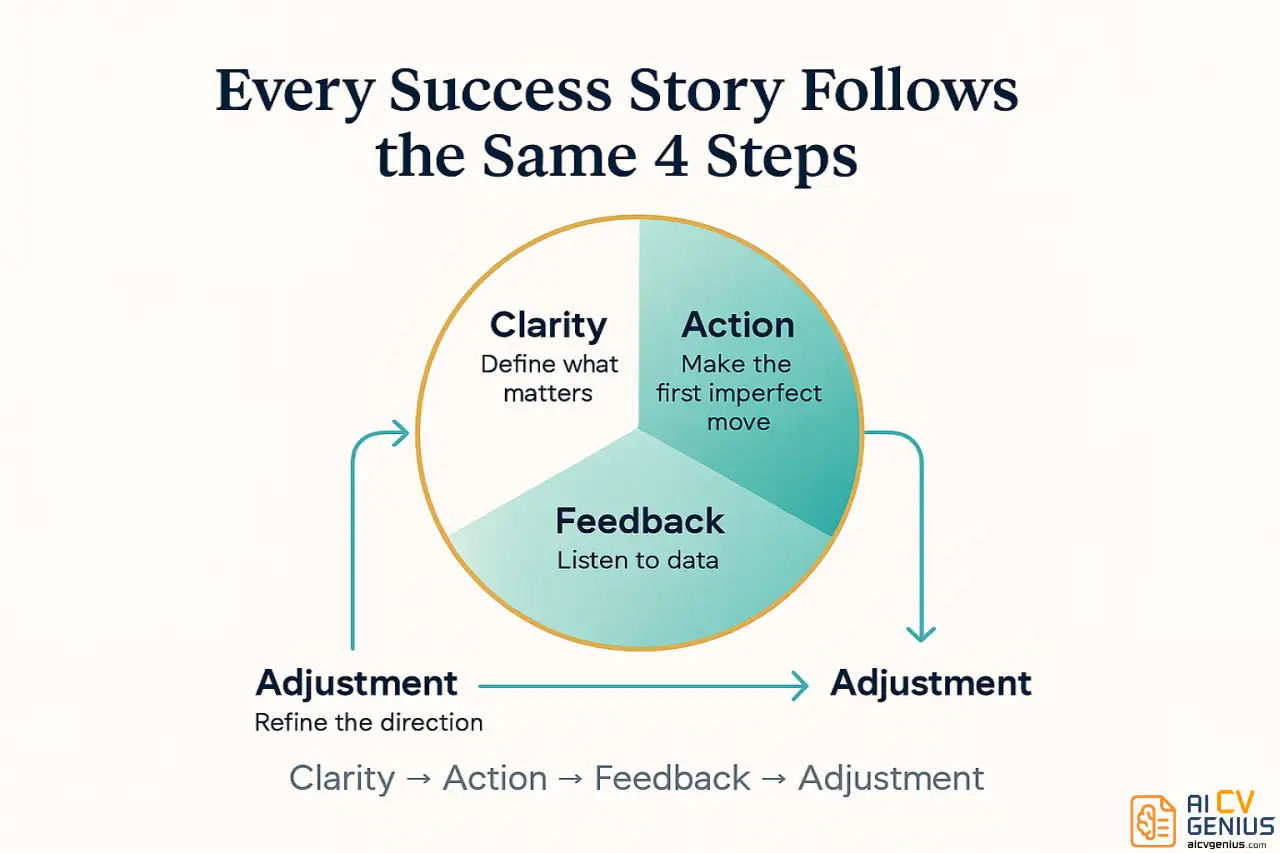
Five different people, five different messy paths. But the patterns are clear.
1. Persistence Through Discomfort
None of these transitions were easy or smooth. They were full of fear, doubt, and discomfort. What separated them from people who stay stuck? They pushed through. “The first six months of owning the bakery were hell,” Sarah admits. “I cried in the walk-in cooler. But I gave myself permission to fail for two full years. Having a deadline for the ‘experiment’ made the daily discomfort bearable.”
2. Curiosity Over Certainty
They followed interesting threads without demanding a five-year plan. Marcus didn’t know consulting would lead to a CPO role. Jessica didn’t plan an agency. They took the next right step. The final destination revealed itself through a series of small, curiosity-driven actions, not a grand, top-down plan.
3. Brutal Self-Awareness
Each person had a deep, hard-won understanding of what they were good at and what mattered to them. Sarah valued creativity over prestige. Marcus excelled at teaching, not just managing. Jessica needed autonomy to thrive. Self-awareness means knowing your own “user manual” well enough to finally recognize an environment where you can win.
What Your Next Move Might Look Like
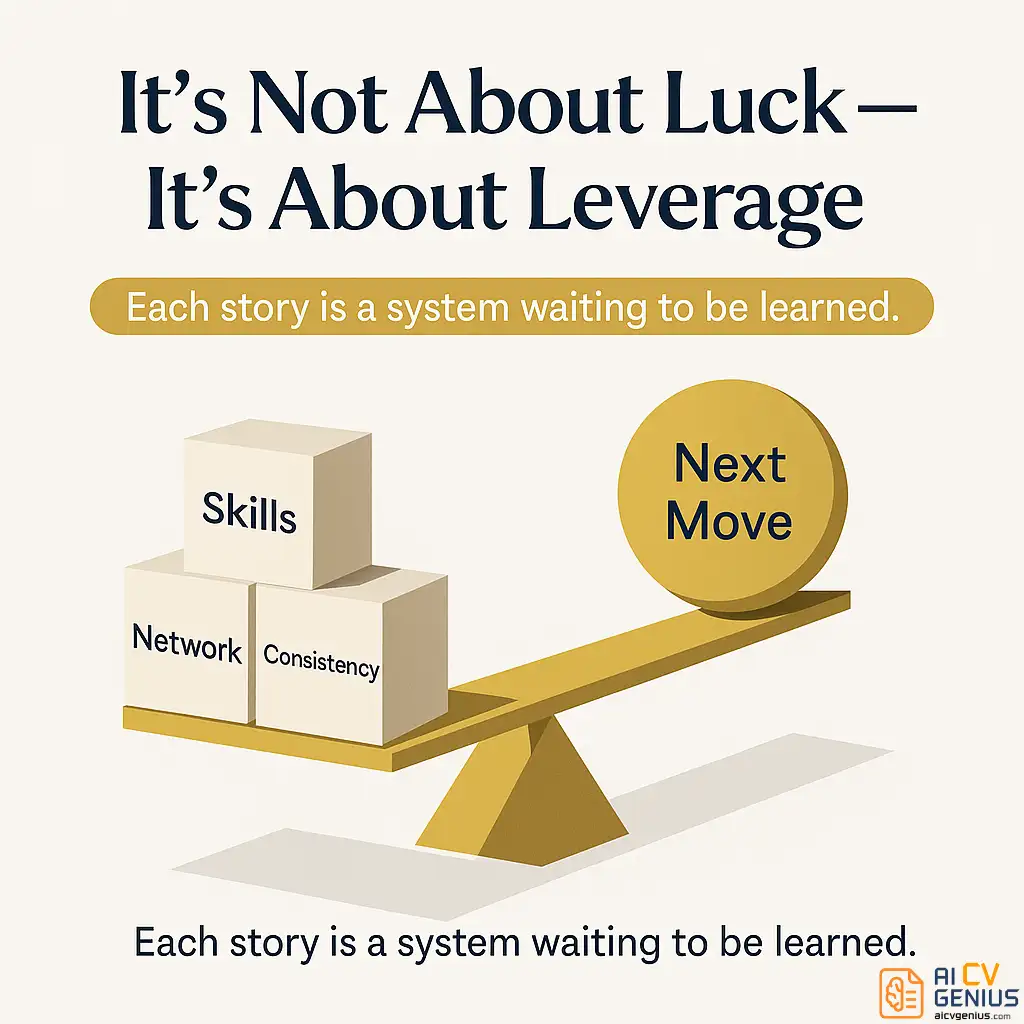
You don’t need to quit your job, burn your ships, or start a business tomorrow. Most famous career success stories don’t start with a dramatic leap. They start with a small, quiet experiment.
Here’s what you can do this week:
- Identify one 10% “bright spot.” Forget your job description. Identify one 10% part of your workweek that you genuinely enjoyed. A project, a task, a conversation. What was it? Why did it energize you?
- Start a “small bet” outside of work. Don’t quit. Test. If you loved teaching, offer to mentor a junior colleague or start a blog. If you loved strategy, offer free consulting to a small non-profit. Create a low-risk “proof of concept” for your new interest.
- Interview for curiosity, not a job. Talk to people who’ve made moves you’re curious about. Don’t ask “Are you hiring?” Ask “How did you know it was time to leave? What was the hardest part? What do you know now that you wish you knew then?”
- Give yourself permission to explore without committing. You don’t need a five-year plan. You just need a six-month experiment.
Finding career success isn’t about having it all figured out. It’s about being honest about what’s working, what’s not, and what you’re curious enough to try next. For more resources on navigating career transitions, visit our career resources page.
The Real Success Story Is the One You Write
The real success in these career success stories isn’t the final job title. It’s not the bakery, the C-suite, or the agency. The real success was the decision to try. Sarah could still be a miserable lawyer. Marcus could be bitter and unemployed. Jessica could be paralyzed by her firing. David could be forcing himself to stay in one lane. Maria could have kept her helpful tutorials private.
They didn’t. In their own way, they each chose discomfort over stagnation. Curiosity over fear. Action over endless, circular planning.
Your career success story doesn’t have to look like theirs. It just has to be yours. And it probably requires the same core decision: trying something, even when – especially when – you’re not sure it’ll work. Ready to take that next step? Explore our blog for more career insights and practical advice.