
- Core idea: Your hospitality cover letter is the first customer service test, not a formality.
- Why it matters: It proves warmth, brand fit, and soft skills your resume cannot show.
- Winning structure: Use 3 paragraphs, Connection, Proof with a short service story, Confident close.
- How to tailor fast: Do 10 minutes of research, then mirror their language and priorities.
- Make it credible: Avoid typos and clichés, focus on guest-first outcomes, even with no experience.
Your hospitality cover letter example is not a formality. It is not a pointless hoop to jump through. It is, quite simply, the first test of your customer service skills. This is the single most important concept you must understand.
Think about it. A hiring manager at a busy hotel or restaurant is drowning in applications. They are tired, stressed, and looking for a reason to say “no.” If your cover letter is generic, full of typos, or sounds like it was copied from a template, you have failed the service test before the interview even begins. You have shown them you are lazy, have no attention to detail, and cannot be bothered to personalize an experience – the very skills you are being hired for.
The best hospitality cover letters do something magical. They don’t just list qualifications; they demonstrate warmth, empathy, attention to detail, and grace under pressure. When a hiring manager reads your letter, they shouldn’t just learn about you; they should feel what it’s like to be taken care of by you. They should feel like they are already experiencing your personal service approach.
This is not a simple task, but it is the key to separating yourself from the 99% of applicants who get it wrong. This guide is a complete strategic framework for writing a hospitality cover letter that actually works. We will move beyond basic advice and give you a proven 3-paragraph structure, full examples for roles from the front desk to management, and the deep, psychological tips for showing your service skills instead of just claiming them.
Why Hospitality Cover Letters Actually Matter (More Than in Any Other Industry)
In tech, you can get a job with a great GitHub profile. In finance, you can get a job with a bulletproof resume full of metrics. But in hospitality, your skills are invisible. How do you “prove” empathy on a resume? How do you list “grace under pressure” in a way that anyone believes?
You can’t. Not on a resume. That’s what the cover letter is for.
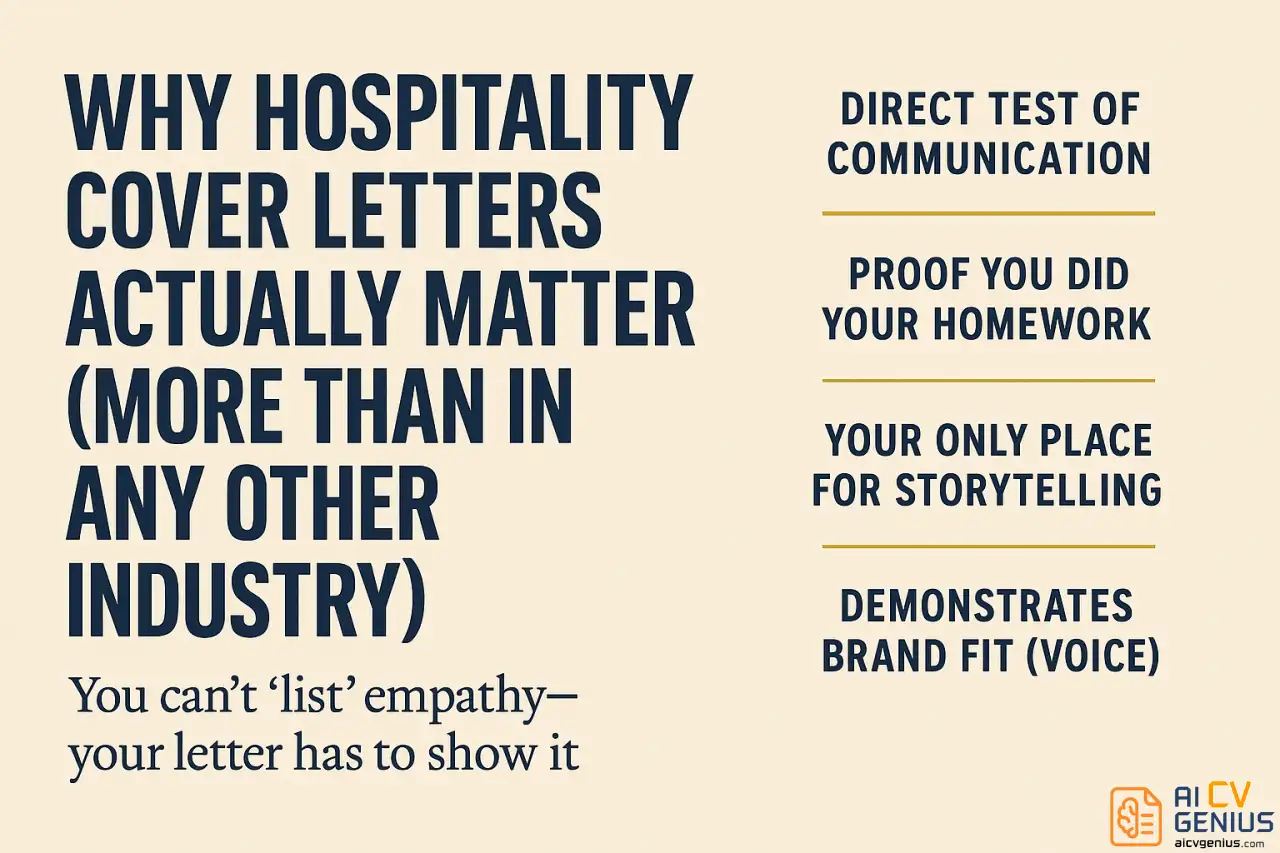
Some industries treat cover letters as optional. In hospitality, it is arguably the most important part of your application. Here’s why:
- 1. It’s a Direct Test of Communication: Can you communicate warmly, clearly, and professionally in writing? Can you do it without typos? If you can’t, a manager knows you’ll write sloppy, unprofessional emails to guests and colleagues.
- 2. It Proves You Did Your Homework: A generic letter sent to Marriott, Hilton, and a local boutique hotel is an instant-delete. A letter that says, “I was so impressed by your hotel’s commitment to sustainability, specifically your new rooftop garden…” proves you researched their property. It’s the cover letter equivalent of “anticipating a guest’s needs.”
- 3. It’s Your Only Chance for Storytelling: Your resume shows what you did. Your cover letter shows how and why you did it. It’s the only place you can tell the story of the angry guest you turned into a loyal regular, or the chaotic dinner rush you helped save. These stories are the only way to prove your soft skills.
- 4. It Demonstrates “Brand Fit”: How you write should change depending on the brand. A cover letter to a fun, edgy W Hotel should have a different voice than a letter to a formal, refined Four Seasons. Your ability to adjust your tone shows “brand awareness,” a critical skill.
A hotel manager reading your application is scanning for answers to these critical, high-level questions:
- Can this person handle a difficult, irrational guest with grace and patience?
- Do they actually understand our brand, or do they just want a paycheck?
- Will they treat a ‘nothing’ interaction, like a request for a toothbrush, like it’s the most important moment of their day?
- Are they genuinely, authentically interested in service, or are they just faking it?
Your resume shows what you’ve done. Your hospitality cover letter example shows who you are, how you think, and most importantly, how you will make their guests feel. That’s the difference between an application that gets an interview and one that gets deleted in ten seconds.
The 3-Paragraph Formula That Wins Interviews
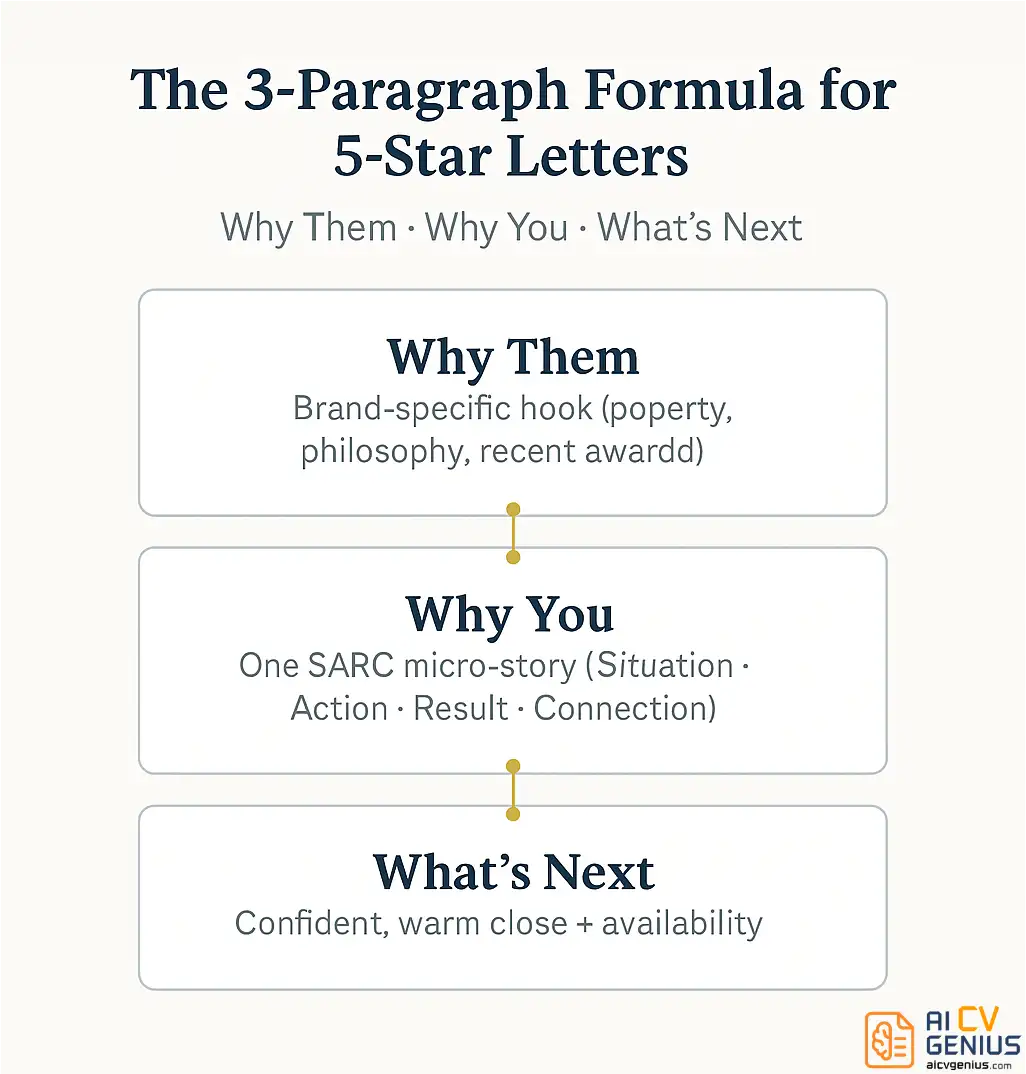
Forget everything you’ve read about 5-paragraph business letters. The strongest, most effective hospitality cover letters are ruthlessly concise. They follow a simple, powerful, 3-paragraph structure. Each paragraph has one specific job to do.
Paragraph 1: The Connection (Why Them)
This paragraph is not about you. It’s about them. Your goal is to immediately prove you are not a generic applicant. You must connect your genuine passion for service with something specific about their brand, property, or restaurant. This is where your 15 minutes of research pays off.
What to include:
- The specific role: “I am writing to express my enthusiastic interest in the Front Desk Agent position…”
- The specific “Why Them”: This is the secret. Mention their service philosophy, a recent award, a specific menu item, their community involvement, or even a personal (and positive) experience you had as a guest.
- The Connection: A single sentence that links their “why” to your personal “why.”
Weak (Generic) Opening:
“I am writing to apply for the server position I saw on Indeed. I have 3 years of experience and am a hard worker. I am very passionate about customer service.”
(This is a 99% failure. It’s all about “I” and says nothing specific.)
Strong (Hotel) Opening:
“I am writing to apply for the Guest Service Agent position at The Sinclair. I have followed your hotel’s story since the stunning art deco renovation, but what truly impresses me is your “Beyond Service” philosophy. That commitment to anticipating needs, not just reacting to them, aligns perfectly with my personal approach to hospitality.”
Strong (Restaurant) Opening:
“I am excited to apply for the Server position at Union Square Cafe. Your long-standing commitment to Danny Meyer’s philosophy of ‘Enlightened Hospitality’ is the reason I am pursuing a career in restaurants, not just a job. The idea that taking care of the team first creates a world-class guest experience is a principle I am eager to contribute to.”
See the difference? The strong examples are respectful, specific, and show they understand the soul of the business, not just the job title. You’ve now earned the right to talk about yourself in paragraph two.
Paragraph 2: The Proof (Why You)
This is the heart of your letter. This is where you show, don’t tell. Do not list your skills. Do not use vague adjectives like “passionate” or “hard-working.” Instead, you will tell one specific, compelling micro-story that proves you possess the exact skills they’re hiring for.
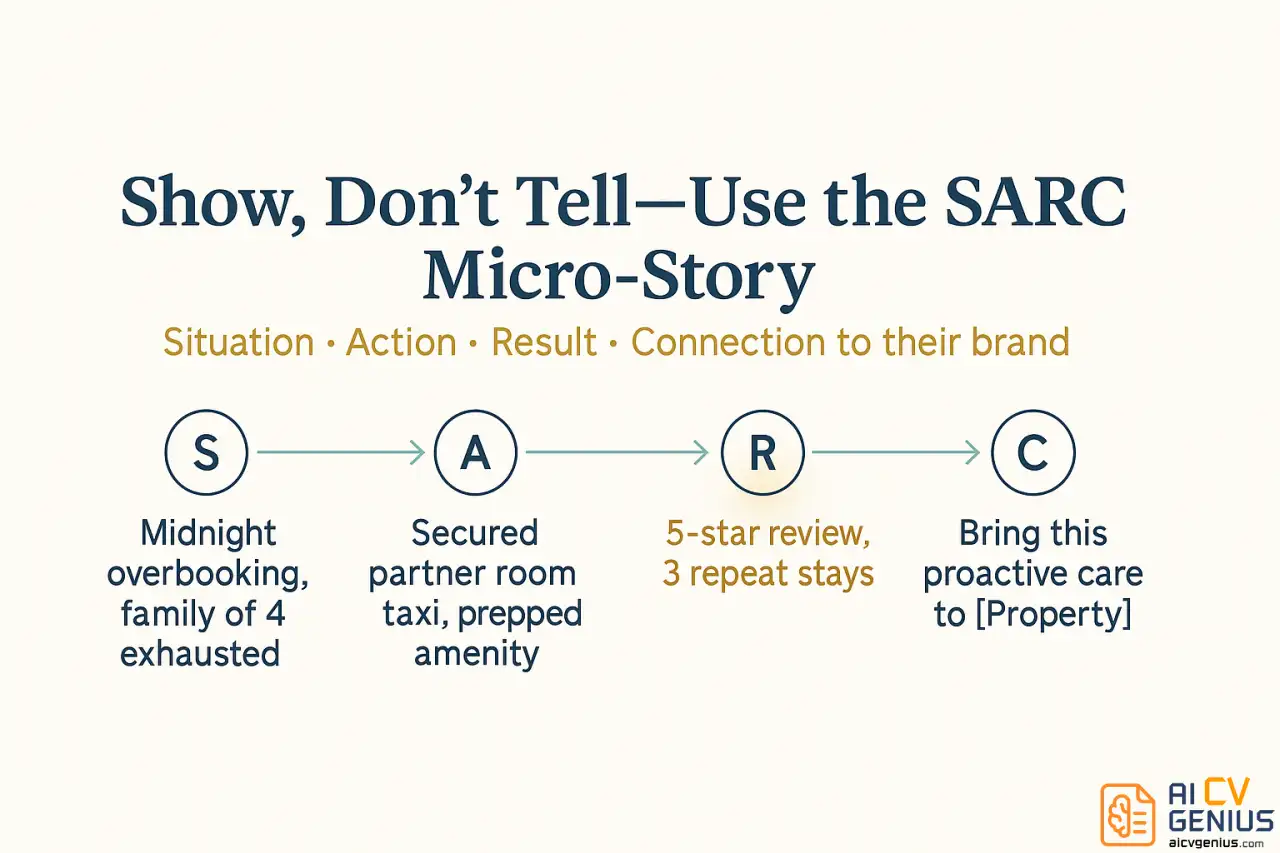
The Formula: Situation, Action, Result, Connection (S.A.R.C.)
- Situation: Briefly set the scene. “A guest arrived at 2 AM after a cancelled flight…”
- Action: What you did. “Instead of just checking them in, I…”
- Result: The outcome. “The guest wrote a 5-star review mentioning me by name…”
- Connection: The most important step. “That’s the level of proactive care I want to bring to…”
Example (Front Desk – Proving Problem-Solving):
“In my current role at the Hilton Garden Inn, I am proficient in Opera PMS and handle over 60 check-ins daily. But my real value is in service recovery. Last month, a guest arrived at midnight to find his reservation was mistakenly booked for the following night, and we were sold out. Instead of just ‘walking’ him, I took personal responsibility. I called a partner hotel to secure a room, paid for his taxi, and had a welcome amenity and an apology note from the GM waiting when he returned the next day. He has since re-booked with us three times. That is the level of proactive problem-solving I am eager to bring to your team.”
Example (Server – Proving Attention to Detail):
“As a server at The Cheesecake Factory, I learned to thrive in a high-volume, 30-table section. My strength, however, is observation. I overheard a couple at my table quietly celebrating an anniversary they hadn’t mentioned. On my own initiative, I arranged for a small dessert with a ‘Happy Anniversary’ plate and comped their coffee, turning a simple dinner into a memorable event. They were so moved they asked for my manager to praise the service. It’s that kind of personal, attentive touch I’m excited to practice at a fine-dining level at Union Square Cafe.”
Paragraph 3: The Close (The Next Step)
Your closing is simple, professional, and confident. Do not be passive (“I hope to hear from you…”). Be active and enthusiastic. You are not a beggar; you are a professional colleague initiating a conversation.
What to include:
- ✅ A thank you: “Thank you for your time and consideration.”
- ✅ Enthusiasm: “I am very enthusiastic about this opportunity…”
- ✅ The Call to Action: “…and I would welcome the chance to discuss how my service-first approach can benefit your team.”
- ✅ Availability/Contact: “I am available for an interview at your convenience and can be reached at [phone_number] or [email].”
Example Closing:
“Thank you for your time and for considering my application. My resume outlines my full qualifications, but I believe my passion for creating memorable guest experiences truly sets me apart. I would welcome the opportunity to discuss how I can contribute to your team. I am available for an interview at your earliest convenience and can be reached at (555) 123-4567 or myemail@email.com. I look forward to hearing from you.”
Full Hospitality Cover Letter Examples (Steal These Formulas)
Let’s put the 3-paragraph formula into action. Here are four complete, annotated examples for different hospitality roles and experience levels.
Example 1: Experienced Front Desk Agent
Sarah Martinez
sarah.martinez@email.com | (555) 234-5678
Philadelphia, PAMarch 15, 2026
Michael Chen, Front Office Manager
The Ritz-Carlton Philadelphia
10 Avenue of the Arts
Philadelphia, PA 19102Dear Mr. Chen,
I am writing to express my profound interest in the Front Desk Agent position at The Ritz-Carlton Philadelphia. I have admired your property’s “Ladies and Gentlemen serving Ladies and Gentlemen” credo for my entire career, as it perfectly articulates my own service philosophy. I am not just looking for my next job; I am looking for a place where my dedication to anticipating needs and delivering flawless service is the standard, not the exception.
In my current role at the Hilton Garden Inn, I manage 60+ check-ins daily using Opera PMS and maintain a 98% guest satisfaction score. This role has taught me that true service is what happens when things go wrong. Last month, a family arrived exhausted after an 8-hour flight delay, only to find their adjoining rooms were not ready. Rather than make excuses, I immediately upgraded them to our two-bedroom suite, coordinated with room service to send up complimentary meals, and included a small welcome basket with coloring books for their children. The father later wrote a Google review specifically mentioning my name and “turning a disaster into a core memory.” That is the level of personal responsibility and care I am eager to bring to The Ritz-Carlton.
Thank you for taking the time to review my application. I am confident that my skills and service-first mindset are a perfect match for your team. I would welcome the opportunity to discuss this role further and am available for an interview at your earliest convenience. I can be reached at (555) 234-5678 or sarah.martinez@email.com.
Sincerely,
Sarah Martinez
Example 2: Entry-Level Server (Career Changer)
James Rodriguez
james.rodriguez@email.com | (555) 876-5432
New York, NYMarch 15, 2026
Maria Gonzalez, General Manager
Union Square Cafe
21 East 16th Street
New York, NY 10003Dear Ms. Gonzalez,
I am writing to enthusiastically apply for the Server position at Union Square Cafe. As a long-time admirer of Danny Meyer’s “Enlightened Hospitality,” I believe that great service is a craft, and your restaurant is the best place to practice it. My goal is to transition from a successful career in high-end retail into a restaurant that values creating genuine connections as much as serving exceptional food.
For the past two years at the Apple Store, I learned that world-class service means anticipating needs before a customer even has to ask. My role was not to sell products, but to solve problems. I specialized in “frustrated customer” interactions, taking the time to listen, validate their concerns, and find a solution, which led to my 95% positive feedback score and a role training new hires. I have already completed my Food Handler’s Card and TIPS certification, and I am eager to apply that same ethos – listen first, solve second, and always be patient – to serving guests and supporting the team at Union Square Cafe.
Thank you for considering my application for this career transition. I would love the opportunity to discuss how my unconventional background in customer service can be an asset to your team. I am available for an interview any day this week and can be reached at (555) 876-5432. I look forward to hearing from you.
Sincerely,
James Rodriguez
Example 3: Hotel Management (Internal Promotion or Move)
David Kim
david.kim@email.com | (555) 345-6789
Boston, MAMarch 15, 2026
Jennifer Walsh, Regional Director
Marriott Hotels
245 Summer Street
Boston, MA 02210Dear Ms. Walsh,
I am writing to apply for the Assistant Hotel Manager position at the Boston Marriott Copley Place. Having spent five years with the Hilton family, I am ready to bring my proven track record of improving guest satisfaction and team performance to a flagship Marriott property. I have always respected Marriott’s focus on operational excellence and associate development, and I am eager to contribute.
As Front Desk Supervisor at the Hilton Boston Downtown, I lead a team of eight agents in a 360-room property. When I was promoted to this role, our GSS score was 82% and front desk turnover was 40%. I immediately implemented a new training program focused on empowerment – giving agents the tools and confidence to resolve issues on the spot. Within six months, our GSS score increased to 91%, guest complaints dropped by 35%, and our team turnover fell to 18%. I believe these results prove my core philosophy: a manager’s first priority is to treat their team with the same level of care that we expect them to show our guests.
My resume details my operational and P&L management skills, but I believe my true strength lies in building, mentoring, and retaining high-performing teams. Thank you for your time, and I welcome the chance to discuss how my leadership approach can support your team at Copley Place. I am available at your convenience.
Sincerely,
David Kim
Example 4: Event Coordinator (Specialized Role)
Aisha Khan
aisha.khan@email.com | (555) 789-0123
Chicago, ILMarch 15, 2026
Director of Events
The Langham, Chicago
330 North Wabash Avenue
Chicago, IL 60611Dear Director of Events,
I am writing to apply for the Event Coordinator position at The Langham, Chicago. As a professional event planner, I know that success is measured in flawless execution and tiny, invisible details. Your property’s reputation for orchestrating some of the city’s most elegant and complex events is precisely why I am so eager to join your team.
In my role as Event Assistant at a local catering company, I have been the primary point of contact for over 50 clients, from initial booking to day-of execution. While my resume shows my proficiency in Cvent and Social Tables, my real skill is grace under pressure. During a 300-person wedding last summer, our linen vendor delivered the wrong color tablecloths two hours before guest arrival. I quickly mobilized our team, contacted an emergency vendor, and personally oversaw the room flip, all without the bridal party ever knowing there was a problem. The client’s review praised our “calm and professional” team. That is the standard of excellence I wish to bring to The Langham.
Thank you for considering my application. I am passionate about the logistics and creativity of event planning and am confident I can be an immediate asset to your team. I am available for an interview next week and can be reached at (555) 789-0123.
Sincerely,
Aisha Khan
How to Tailor Your Cover Letter (Without Rewriting It Every Time)
A generic, “To Whom It May Concern” cover letter is an insult to the hiring manager. It shows you don’t care enough to spend 10 minutes researching their property. Here is a simple, repeatable process for customizing your letter for each application.
Step 1: The 10-Minute Research Plan
Before you write a word, open four tabs in your browser:
- The Property’s “About” Page: Look for their mission statement or service philosophy. Are they “luxury,” “boutique,” “efficient,” “family-friendly”? These are your keywords.
- Recent Reviews (TripAdvisor, Google, Yelp): What do guests love? What do they complain about? If they love the “friendly staff,” you know to highlight your teamwork. If they complain about “slow check-in,” you know to highlight your efficiency with Opera PMS.
- Their Social Media (Instagram): What’s the vibe? Are they showing off a new menu, a “pet of the month,” or a big corporate event? This tells you what they value.
- LinkedIn: Find the hiring manager’s name (e.g., “Front Office Manager at Marriott Copley Place”). Addressing the letter to a specific person (“Dear Mr. Chen”) is a massive advantage. If you can’t find it, “Dear Hiring Manager” is the next best thing.
Step 2: Match Their Language and Values
Now, use your research to subtly mirror their brand. Your “Why You” story (Paragraph 2) can stay mostly the same, but your “Why Them” (Paragraph 1) must change every time.
| Property Type | Their Language / Vibe | Your Cover Letter’s Focus |
|---|---|---|
| Luxury Hotel (Four Seasons, Ritz) | “White-glove,” “anticipatory,” “discretion,” “flawless” | Focus on your attention to detail, professionalism, and stories about personalization. |
| Boutique Hotel (Kimpton, W) | “Unique,” “curated,” “local,” “energetic” | Focus on your personality, creativity, and knowledge of the local city/scene. |
| Business Hotel (Marriott, Hilton) | “Efficiency,” “reliability,” “consistency,” “service” | Focus on your technical skills (PMS), speed, problem-solving, and reliability. |
| Upscale Restaurant (Michelin, Fine Dining) | “Craft,” “provenance,” “culinary excellence,” “steps of service” | Show your deep knowledge of food/wine and your passion for the “craft” of service. |
| Casual Dining (Chain or Local Spot) | “Family-friendly,” “fun,” “fast,” “teamwork” | Emphasize your high energy, speed, multitasking, and ability to be a great team player. |
For more on personalization, our guide on cover letter best practices offers strategies for any industry.
5 Cover Letter Mistakes That Are Fatal in Hospitality
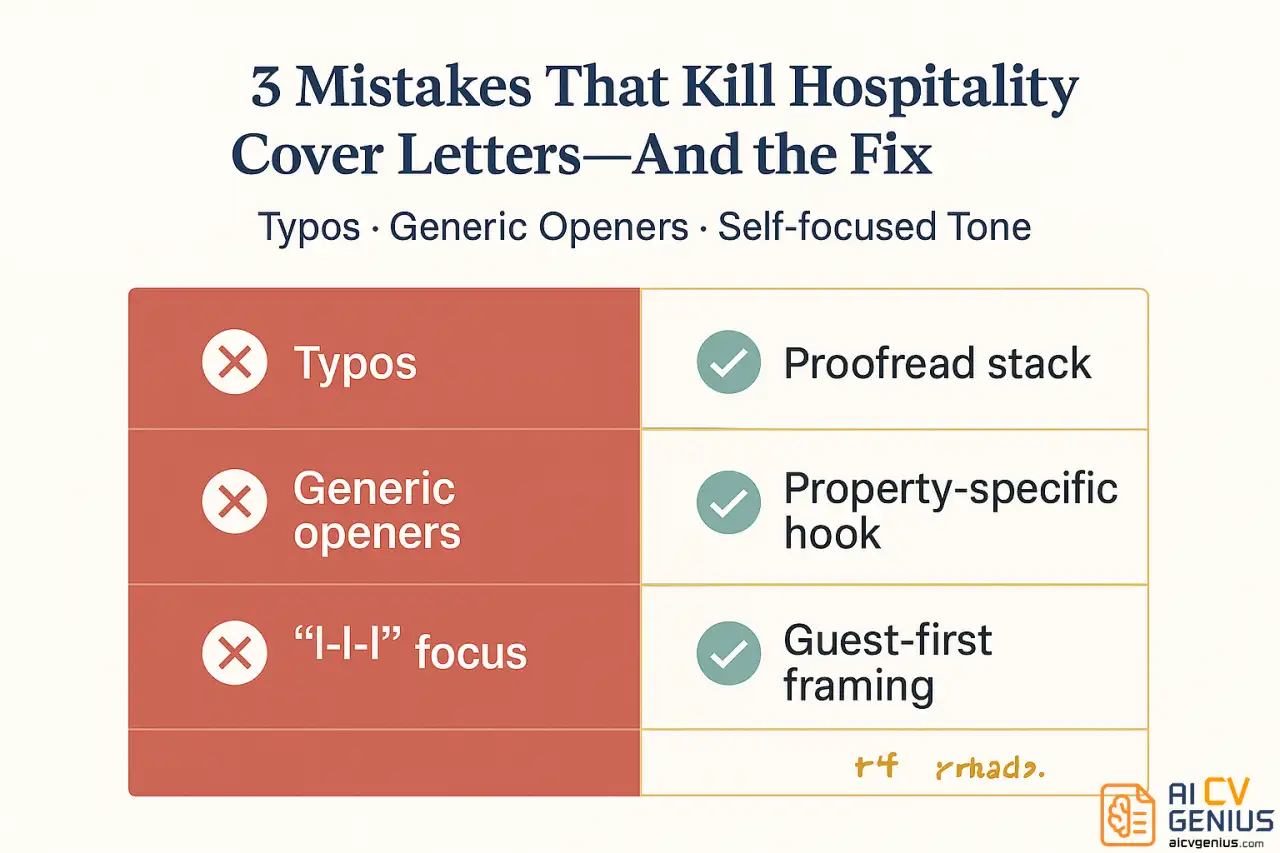
A hiring manager is looking for reasons to cull their stack of 200 resumes. Don’t give them an easy one. Avoid these fatal errors.
- ❌ Mistake 1: Typos or Grammar Errors.Why it’s fatal: Hospitality is attention to detail. A typo in your cover letter signals to a manager that you will make a typo in a guest’s reservation, a room-service order, or a banquet event order. It is the #1 deal-breaker.The Fix: Proofread. Then read it out loud. Then use a grammar checker. Then email it to a friend to read. Be obsessive.
- ❌ Mistake 2: Making It About What You Want.Why it’s fatal: “This job would be a great experience for me,” or “I am looking for a position where I can grow my career.” The manager doesn’t care about you. They care about their guests and their team.The Fix: Frame everything around them.Instead of: “I want to gain management experience.”Say: “I am eager to apply my 5 years of service experience to help mentor new team members and support your operational goals.”
- ❌ Mistake 3: Using Vague, Cliché “Service” Language.Why it’s fatal: Phrases like “I’m a people person,” “I’m passionate about customer service,” or “I’m a team player” are meaningless filler.The Fix: Show, don’t tell.Instead of: “I’m a good problem solver.”Say: “I resolved a 30-minute wait time for angry guests by… [your story].”(For more, see our article on why “responsible for” kills your resume – the same logic applies here.)
- ❌ Mistake 4: Being Too Formal or Stiff.Why it’s fatal: Hospitality is about warmth. A letter that starts “Dear Sir or Madam: Pursuant to the advertisement…” sounds like a robot.The Fix: Be professional, but personable. Write like a human. Use “I’m” and “you’re.” Aim for a “professionally warm” tone.
- ❌ Mistake 5: Regurgitating Your Resume.Why it’s fatal: The manager has your resume. If your cover letter just lists the same jobs and duties, it’s a waste of their time.The Fix: Your resume is the “what.” Your cover letter is the “how” and “why.” It’s for the story that won’t fit in a bullet point.
Writing a Cover Letter With No Hospitality Experience
This is where the cover letter is most critical. A resume with no experience is an easy “no.” A cover letter that shows grit, research, and transferable skills is a definite “maybe.”
Step 1: Focus on Transferable Skills
You have experience in “grace under pressure,” you just call it something else. Mine your past for these skills:
- Retail: Handling difficult customers, working a POS, multitasking during a holiday rush, upselling.
- Food Service (Fast Food): Speed, accuracy, teamwork, cleanliness, following procedures.
- Office/Admin: Answering phones (professional voice), scheduling, attention to detail, communicating by email.
- Anywhere: Reliability, showing up on time, being coached, learning a new skill.
In your cover letter, frame these as hospitality skills.
“Working in high-volume retail at Target taught me how to de-escalate a customer’s frustration and find a solution, all while the line grew. That is the exact calm I want to bring to your front desk.”
Step 2: Show You Have Prepared
This is how you beat the other entry-level candidates. Show you are serious and didn’t just apply on a whim.
- ✅ Get Certified: “To prepare for this career move, I have already completed my ServSafe Food Handler’s Card and TIPS certification.”
- ✅ Learn the Lingo: “I have been studying for this transition and am familiar with the basics of PMS systems like Opera…”
- ✅ Visit the Property: “I had dinner at your restaurant last week to observe the flow of service, and I was so impressed by…”
If you’re making a big leap, our career change resume guide offers more strategies.
Expert FAQ: Your Toughest Hospitality Cover Letter Questions
Final Thoughts: Your First Act of Service
Your hospitality cover letter example is not a summary of your resume. It is your first, best, and sometimes only chance to prove that you get it. That you understand that hospitality isn’t just a job, but a craft. It’s the craft of making people feel seen, cared for, and welcome.
A hiring manager reading your letter is evaluating one simple thing: “Would I trust this person with my most difficult, high-value guest?”
Use the 3-paragraph formula. Start with a specific, researched connection (Why Them). Prove your value with a compelling, detailed story (Why You). And close with confidence and enthusiasm (The Next Step). Customize every letter. Proofread it obsessively. And let your genuine warmth and professionalism shine through every word. This is your first act of service. Make it a 5-star experience.
Ready to complete your application? Pair your world-class cover letter with an equally strong resume using our resume templates, or explore more strategies in our career resources section.