
- An entry-level resume is not supposed to look “full.” It should prove potential by turning school, projects, volunteering, and part-time work into evidence of relevant skills.
- Employers hiring for entry-level roles screen for three signals: Trainability, transferable skills, and motivation, so your bullets should show learning speed, teamwork, and initiative.
- A strong template puts the right sections in the right order: Contact info, objective or summary, education, projects, experience (including volunteer and part-time), extracurriculars, and a skills list that mirrors the job description keywords.
- The best examples in the article win interviews by being specific: What was built, what tools were used, what changed, and what result happened, even when the “experience” came from class projects or retail jobs.
- The last pass matters: Keep it one page, avoid vague buzzwords, proofread hard, and use a clean ATS-friendly format before sending.
Everyone remembers crafting their first resume. The task often feels intimidating: “I don’t have enough traditional work experience. How can I possibly compete with seasoned professionals?” The reassuring truth is, employers reviewing entry-level applications aren’t expecting a decade-long career history. Instead, they actively seek signs of potential. They look for demonstrated curiosity, applicable transferable skills learned through various experiences, solid educational foundations, and the inherent ability to learn and grow within their organization. This is precisely where an effective entry-level resume template becomes your most strategic asset – it provides the essential structure to transform your existing experiences (academic, volunteer, part-time) into a compelling narrative that signals readiness for the professional world.
The Challenge of the First Resume: Reframing Your Experience
When you’re just starting your career journey, it’s natural to feel like your resume appears “empty” compared to those with established careers – no full-time job titles, no senior-level responsibilities, perhaps few large-scale accomplishments. However, it’s crucial to shift your perspective: your resume isn’t solely about paid employment history. It’s fundamentally about presenting evidence of relevant skills and capabilities. Academic projects that required problem-solving, internships where you learned specific tools, volunteer roles that demanded responsibility, part-time jobs that honed customer service skills, and active participation in extracurricular activities – these are all valuable data points. A well-chosen template helps you strategically organize these diverse experiences, ensuring your inherent potential and acquired skills shine through clearly.
What Employers Look For in Entry-Level Candidates
Hiring managers recruiting for entry-level positions understand they are investing in future talent, not acquiring a fully formed expert. Their screening process focuses on identifying key indicators of success potential:
- ✅ Trainability & Aptitude for Learning: Does the candidate demonstrate an ability to grasp new concepts quickly? Is there evidence of proactive learning (e.g., online courses, self-taught skills)?
- ✅ Transferable Skills: Can they communicate effectively (written and verbal)? Do they show evidence of teamwork and collaboration (group projects, team activities)? Have they demonstrated problem-solving abilities in any context?
- ✅ Motivation & Work Ethic: Does the candidate show genuine interest in the role or industry? Is there evidence of initiative (personal projects, leadership roles)? Do past experiences suggest reliability and commitment?
Your resume needs to strategically provide evidence supporting these three core qualities, even if that evidence comes from academic or extracurricular activities rather than traditional jobs.
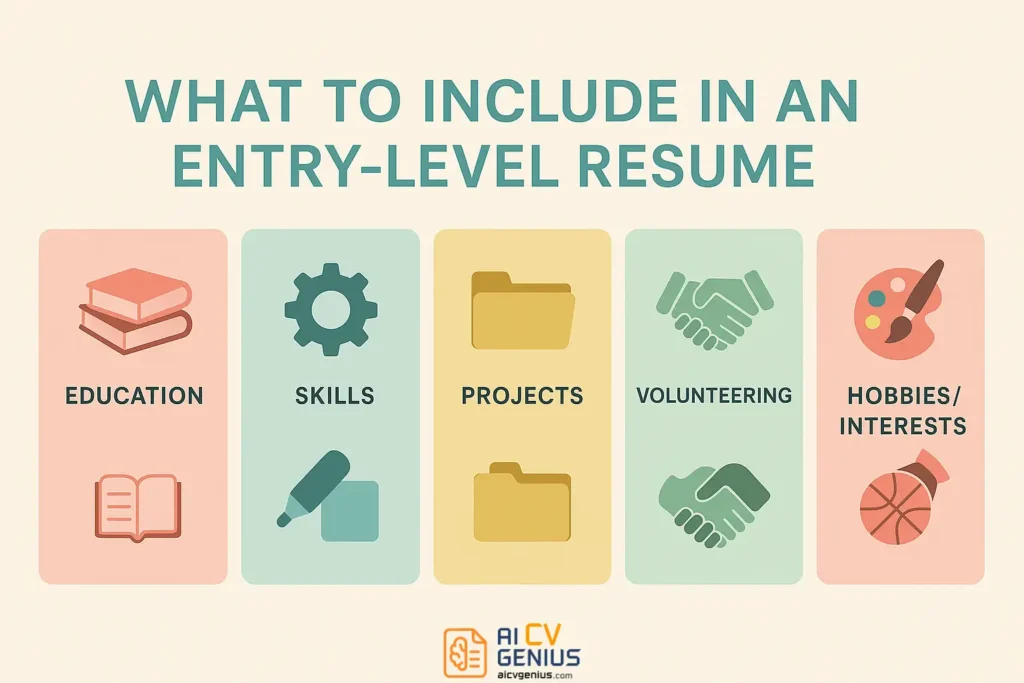
Core Sections in an Entry-Level Resume Template
A strong entry-level resume template effectively organizes these critical sections:
Contact Information
Ensure accuracy and professionalism: Full Name, professional-sounding Email Address (e.g., firstname.lastname@email.com), Phone Number, LinkedIn Profile URL (if updated and relevant), and optionally City/State. Keep it clean and easy to find.
Resume Summary or Objective
A concise 2-3 sentence introduction tailored specifically for each job application. An Objective clearly states your immediate career goal and enthusiasm for the specific opportunity. A Summary (if you have some internship or significant project experience) briefly highlights key relevant skills and accomplishments. Example Objective: “Highly motivated recent Communications graduate with proven writing and social media skills gained through university coursework and managing the [Student Club]’s online presence. Eager to contribute creative content strategies as a Marketing Assistant at [Company Name].”
Education
For entry-level candidates, this section is often placed prominently near the top. Include: Full Degree Name (e.g., Bachelor of Science in Biology), University Name, Location, Graduation Date (or Expected Graduation Date). Optionally, add: GPA (if strong, typically 3.5+), relevant coursework (list 3-5 key courses directly related to the target job), academic honors (Dean’s List, scholarships), or thesis/capstone project title if applicable and impactful.
Projects
This section is crucial for demonstrating practical application of skills when formal work experience is limited. Include academic projects (significant class assignments, group work, capstone research) and relevant personal projects (e.g., building a website, developing an app, conducting independent research). For each project:
- List a clear, descriptive project title.
- Specify the timeframe or context (e.g., Senior Capstone Project, Fall 2024; Personal Project, Summer 2025).
- Briefly describe the project’s goal and your specific contribution or role (use action verbs).
- Highlight the key skills or technologies utilized (e.g., “Utilized Python and Pandas for data analysis,” “Developed user interface using Figma”).
- Quantify results or outcomes if possible (e.g., “Presented findings to a panel of 5 professors,” “Resulted in a functional prototype demonstrated via live demo”).
Example Project Entry:
Market Analysis for Local Non-Profit | University Consulting Project (Team Lead) | Spring 2025
- Led a 4-person student team to conduct market research and develop strategic recommendations for [Non-Profit Name].
- Analyzed competitor activities and target audience demographics using survey data and online research tools (e.g., Google Trends, Statista).
- Presented final report with actionable insights on potential outreach strategies, receiving positive feedback from the client.
- Skills Utilized: Market Research, Data Analysis, Team Leadership, Presentation Skills, Microsoft Excel.
Work Experience (Internships, Part-Time Jobs, Volunteer Roles)
Even experiences not directly related to your target field can showcase valuable transferable skills. Include internships, volunteer positions, part-time jobs (retail, food service, tutoring), or campus employment. Focus on demonstrating responsibility, time management, customer interaction, teamwork, and problem-solving. Use bullet points starting with strong action verbs. Example (Part-Time Barista):
- Provided efficient and friendly customer service in a high-volume café environment, consistently receiving positive customer feedback.
- Managed cash register operations accurately, handling approximately $500+ in daily transactions.
- Collaborated effectively with team members during peak hours to ensure smooth workflow and timely order fulfillment.
Volunteering & Extracurricular Activities
Participation in clubs, sports teams, student government, community service, or other organizations demonstrates initiative, teamwork, leadership potential, and commitment outside of academics. Mention any leadership roles held (e.g., President of the Debate Club, Treasurer of the Student Volunteer Association) and briefly describe key responsibilities or notable achievements (e.g., “Organized a fundraising event that raised $1,500 for [Cause]”).
Skills
Organize your skills into clear categories for better readability and ATS parsing. Tailor this section to include keywords from the job description.
- ✅ Technical Skills: Relevant software (e.g., Microsoft Office Suite – Excel, PowerPoint; Google Workspace), specific industry tools (e.g., Canva, Adobe Creative Suite basics, AutoCAD basics), programming languages (if applicable – Python, Java basics), research databases, laboratory techniques. Be specific about proficiency where possible.
- ✅ Soft Skills: Communication (Written & Verbal), Teamwork & Collaboration, Problem-Solving, Time Management & Organization, Adaptability, Critical Thinking, Leadership (demonstrated through activities), Customer Service.
- ✅ Languages: Specify language and proficiency level clearly (e.g., Fluent in Spanish, Conversational French (B1 Level)).
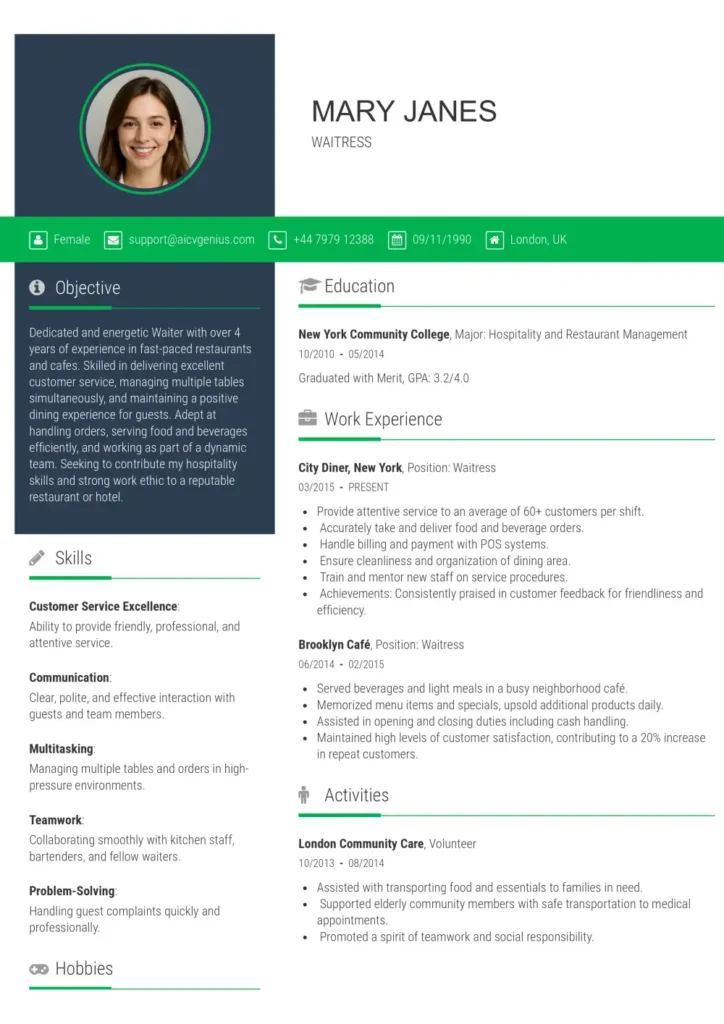
Case Studies: Real Entry-Level Resumes That Worked
Case 1: The Computer Science Student with No Formal Internships
Sofia aimed for a junior developer role but lacked traditional work experience. Her resume successfully highlighted:
- ✅ Capstone Project: Detailed her role in building a functional web application using React and Node.js as part of a 4-person student team, including a link to the live demo hosted on Heroku. Mentioned specific features implemented.
- ✅ Hackathon Participation: Described developing a mobile app prototype using Flutter within a 24-hour hackathon, showcasing rapid prototyping and teamwork skills under pressure.
- ✅ Volunteering Experience: Included teaching basic coding concepts (Scratch, basic Python) to high school students weekly for one semester, demonstrating communication and mentoring abilities.
- ✅ Skills Section: Clearly listed proficiency in Java, Python, JavaScript, React, Node.js, Git, and SQL, aligning with typical junior developer requirements.
Result: Sofia secured interviews by effectively showcasing practical coding skills, initiative, and communication abilities through non-traditional experiences.
Case 2: The Retail Worker Transitioning to Marketing
Alex worked part-time in retail throughout college but aspired to enter digital marketing. His tailored resume emphasized transferable skills and proactive learning:
- Quantified retail achievements relevant to marketing: “Consistently exceeded personal sales targets by 15% through proactive customer engagement and effective upselling strategies.”
- Highlighted self-initiated marketing activity: “Voluntarily managed the store’s Instagram account, creating engaging content (photos, stories) that grew local followers by 300+ within 6 months.”
- Showcased relevant education and certifications: “Completed Google Analytics for Beginners certification and HubSpot Content Marketing certification online.”
- Skills section listed: Customer Service, Sales, Social Media Content Creation, Communication, Google Analytics (Basic), HubSpot (Certified).
Result: Alex proved his marketing potential and understanding of customer engagement, landing his first marketing internship.
Case 3: The Finance Graduate with One Internship
Priya completed a 3-month finance internship and wanted an entry-level Financial Analyst position. Her resume focused on specific tasks and skills gained:
- Detailed internship responsibilities with specifics: “Assisted senior analysts in preparing monthly financial variance reports for 5 key departmental budgets using Microsoft Excel (Pivot Tables, VLOOKUP).”
- Quantified contributions where possible: “Created Excel models to track project expenses, identifying potential discrepancies totaling ~$10K.”
- Listed software exposure: “Gained foundational familiarity with QuickBooks and SAP during internship for data entry and report generation.”
- Education section highlighted relevant coursework: Financial Modeling, Corporate Finance, Investment Analysis, and a strong GPA (3.7/4.0).
Result: Priya effectively presented herself as a detail-oriented, analytical candidate with foundational corporate finance exposure, securing interviews for analyst roles.
Complete Entry-Level Resume Example (Putting It All Together)
Here is a full, one-page resume example that follows all the principles in this guide. This candidate is a recent Communications graduate applying for a “Marketing Assistant” role, and they are strategically highlighting their projects and part-time experience to showcase potential.
SARAH JENKINS
Philadelphia, PA 19103 | (215) 555-1234 | sarah.jenkins@email.com | linkedin.com/in/sarahjenkins
PROFESSIONAL OBJECTIVE
Highly motivated recent Communications graduate with proven writing and social media skills gained through university coursework and managing the [Student Club]’s online presence. Eager to contribute creative content strategies as a Marketing Assistant at [Company Name].
EDUCATION
Bachelor of Arts in Communications, Minor in Marketing | Temple University | Philadelphia, PA
Expected Graduation: May 2026
- GPA: 3.8/4.0 (Dean’s List 6 semesters)
- Relevant Coursework: Digital Marketing Strategies, Public Relations Writing, Social Media Analytics, Market Research
ACADEMIC & PERSONAL PROJECTS
Digital Marketing Strategy (Capstone Project) | Team Lead | Spring 2025
- Led a 4-person student team to develop a comprehensive digital marketing plan for a local non-profit (Philly Reads).
- Conducted audience analysis and competitor research; designed a 3-month content calendar for Instagram and TikTok.
- Presented the final strategy to the client, providing actionable recommendations that they adopted for their summer outreach program.
Personal Blog (The Philly Post) | Content Creator | 2024 – Present
- Write, edit, and publish weekly articles on local events and food, optimizing content for SEO (using basic Google Trends research) to attract organic traffic.
- Grew blog to over 1,000 monthly unique visitors and manage an accompanying Instagram account with 500+ followers.
WORK & VOLUNTEER EXPERIENCE
Barista & Shift Lead | The Local Grind | Philadelphia, PA (2023 – Present)
- Provided high-quality customer service in a fast-paced environment, resolving customer issues with professionalism.
- Trained 3 new hires on store procedures, point-of-sale systems, and quality standards, fostering a collaborative team atmosphere.
- Managed opening/closing procedures and balanced cash drawers, demonstrating reliability and attention to detail.
SKILLS
|
|
Essential Tips for Writing an Entry-Level Resume
- ✅ Strictly One Page: Conciseness is critical. Recruiters expect brevity for entry-level candidates. Prioritize the most relevant information.
- ✅ Emphasize Projects & Transferable Skills: Make these sections robust. Detail what you did, the skills you used, and the outcome or learning.
- ✅ Use Strong Action Verbs: Start bullet points with impactful verbs like “Led,” “Created,” “Analyzed,” “Managed,” “Developed,” “Coordinated,” “Assisted,” “Presented.” Avoid passive phrases like “Responsible for…”
- ✅ Quantify Achievements Whenever Possible: Numbers grab attention and demonstrate impact. Even estimates are better than vague statements (e.g., “Increased event attendance by approx. 20%,” “Managed a budget of ~$500”).
- ✅ Tailor Relentlessly to Each Job Description: Analyze the job posting for required skills and keywords. Customize your Objective/Summary, Skills section, and highlighted projects/experiences to directly match what the employer is seeking. Generic resumes get overlooked.
Perform this crucial check before submitting any application: Embarking on your professional career can feel overwhelming, but remember that your entry-level resume isn’t about proving you’ve “done it all” before you’ve even started. Its primary purpose is to showcase your potential – demonstrating that you possess the foundational knowledge, relevant skills, adaptability, and motivation to learn quickly and contribute effectively. A strong entry-level resume template provides the essential structure to translate your academic achievements, hands-on projects, extracurricular involvement, and transferable skills into a compelling narrative of readiness. Think of it as your professional launchpad. By selecting the right template, focusing on clear communication, quantifying where possible, and tailoring relentlessly, you can create a resume that makes employers confidently say: “This candidate has the potential we’re looking for.”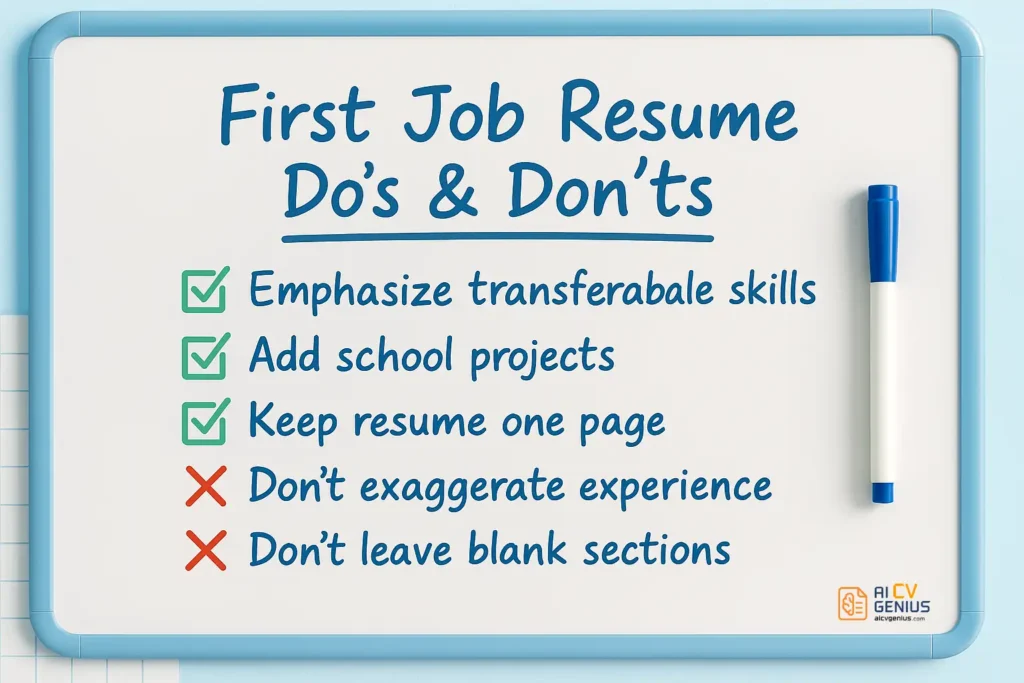
Common Mistakes to Avoid on Your First Resume
Final Checklist Before Sending Your Entry-Level Resume
FAQs about Entry-Level Resume Template
Final Thoughts: Showcasing Potential is Key