
- What it is: A freelancer cover letter is a sales pitch that proves you read the brief, understand the pain, and have a measurable solution.
- What clients want: Clarity, credibility, and chemistry, they are really asking if you will make their life easier and deliver without drama.
- Winning structure: Use Hook, Value, Proof, Close, keep it short, scannable, and client-first.
- Personalization and tone: Reference one real detail from the post, sound professional but human, and avoid stiff, generic template language.
- Proof and next steps: Lead with one strong metric or mini case study, include only relevant links, end with an easy CTA, and follow up once after 3–5 business days.
Why Your Freelancer Cover Letter Matters More Than You Think
As a freelancer, your cover letter isn’t just an introduction – it’s your handshake, your sales pitch, and your first impression all rolled into one. It’s often the only thing standing between you and dozens of competing proposals. Most freelancers treat it like a formality: “Hi, I’m interested in your project.” But clients don’t hire profiles – they hire connection. A great freelance cover letter transforms a cold pitch into a warm conversation.
“In freelancing, your words do the handshaking for you – so make them feel like a person, not a template.”
In the digital marketplace, clients are overwhelmed by generic pitches. Your cover letter’s primary job is to cut through the noise by proving three things immediately: you read the brief, you understand their pain, and you have a specific, measurable solution. This guide breaks down the strategy to achieve exactly that, moving beyond basic advice to explore the psychological nuances that win projects.
The Client Psychology: What They Actually Want to See
Forget the stiff tone of traditional job letters. Freelance clients, whether small business owners or corporate managers, want clarity, confidence, and chemistry. They’re subconsciously asking one simple question: Can this person make my life easier and deliver the results I need without creating more problems? Your letter should answer that question implicitly before they even finish reading.
A strong pitch addresses the client’s underlying emotional needs (reducing anxiety, saving time, mitigating the risk of a bad hire) alongside their practical requirements (achieving specific outcomes, staying within budget, meeting deadlines). A winning letter effectively combines three crucial traits:
- ✅ Clarity & Understanding: Prove you grasped the project requirements within the first two sentences. This shows attention to detail and respect for their time.
- ✅ Competence & Credibility: Demonstrate you can deliver tangible results, ideally backed by specific proof (a relevant metric, a link to a similar project, or a brief testimonial quote).
- ✅ Connection & Professionalism: Sound like an authentic, reliable human being who is easy to communicate with and understands professional etiquette.
The Emotional Layer: Empathy and Safety
Freelance work is fundamentally built on trust, especially when hiring someone remotely. Clients are often feeling vulnerable – they are investing money and time, risking project failure or delays. When your tone incorporates empathy, it immediately builds psychological safety and rapport:
“I understand how challenging it can be to find reliable, high-quality [Type of Service, e.g., content writing] help, especially when juggling tight deadlines. My goal is to make this process entirely stress-free for you by delivering [Specific Benefit, e.g., polished, ready-to-publish articles] consistently.”
This subtle display of empathy is frequently overlooked but incredibly powerful. It humanizes you instantly and shows you understand the client’s internal pressures (stress, uncertainty) not just their external project requirements.
The Anatomy of a Perfect Freelancer Cover Letter
The best freelance pitches follow a concise, logical formula that respects the client’s limited time. This structure is universally effective because it gets straight to the point, provides validation immediately, and makes it easy for the client to take the next step. Remember: short paragraphs (2-4 lines) are essential for scannability, especially on mobile devices where many clients first review proposals.
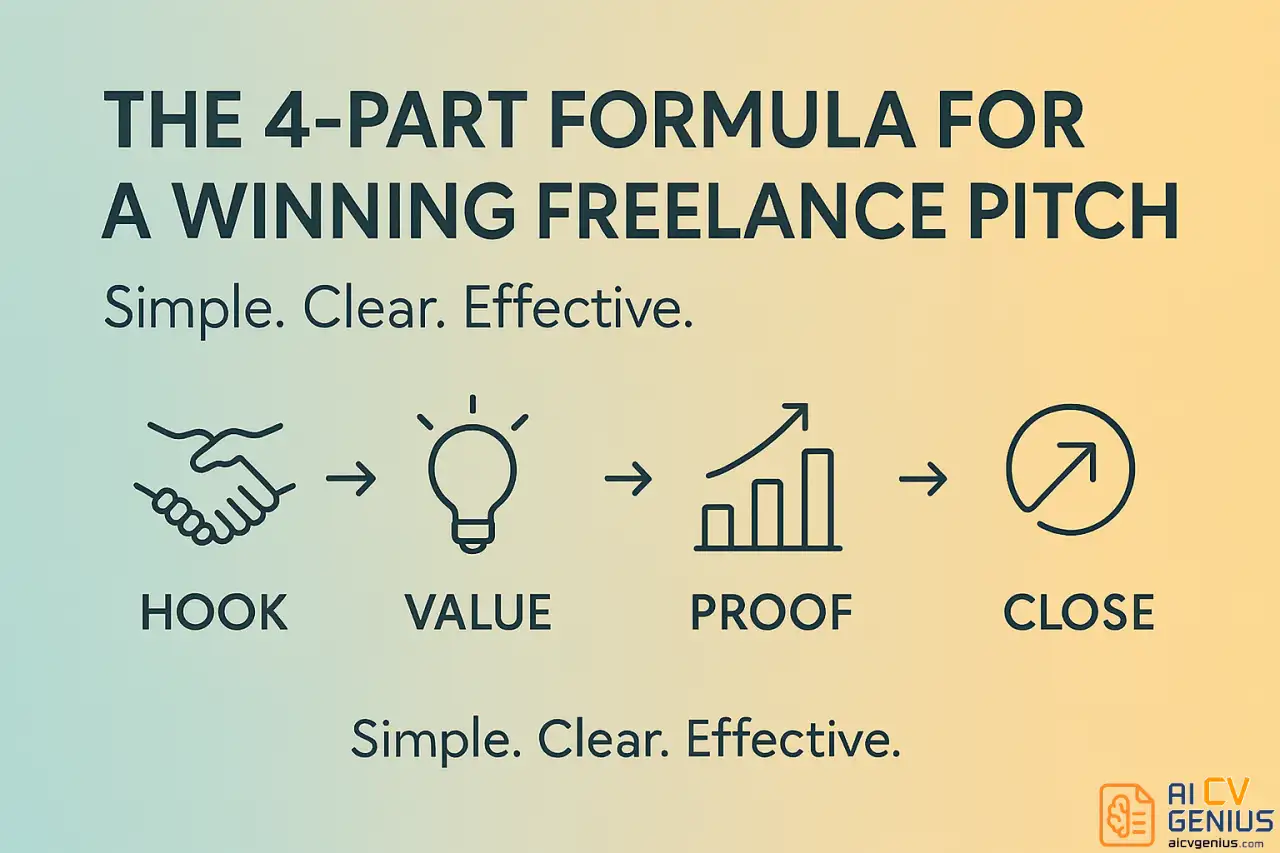
The Four-Part Formula: Hook, Value, Proof, Close
Structure your letter around these four key components:
| Section | Length | Purpose | Strategic Focus |
|---|---|---|---|
| 1. Opening Hook | 1-2 sentences | Grab attention immediately by referencing their specific project or a key pain point mentioned in the brief. | Instantly show you read the job post thoroughly, not just skimmed the title. Use their name if possible. |
| 2. Value Proposition | 2-3 sentences | Clearly state how your core skills or experience will directly solve their problem or achieve their desired outcome. | Connect your capabilities to their specific needs and goals. Focus on benefits, not just features of your service. |
| 3. Proof & Metrics | 1-2 sentences | Support your value proposition with concrete evidence: a quantifiable result from a similar project, a brief testimonial snippet, or a direct link to a highly relevant portfolio piece. | Build credibility and differentiate yourself with tangible impact. Numbers speak louder than adjectives. |
| 4. Call to Action (Close) | 1-2 sentences | End with a clear, professional, and low-friction next step. Express enthusiasm and make it easy for them to reply. | Invite collaboration, suggest a brief call (“15-minute chat”), or offer a small, relevant value-add (like a quick outline). Avoid passive closings. |
This framework – Hook → Value → Proof → Close – provides a solid foundation. Keep the language simple, direct, and personal. Clients often respond more positively to sincerity and clarity than to overly complex credentials or jargon.
Example: A Freelancer Cover Letter That Works (The Writer)
Here’s a sample applying the formula for a freelance content writer targeting a job post seeking “clear, engaging content to drive organic traffic for a SaaS startup.” Adapt the specifics for your niche (design, development, consulting, etc.).
Hi [Client’s Name, e.g., Sarah],
I saw your post seeking clear, engaging blog content specifically designed to attract and convert organic visitors in the [mention target audience, e.g., B2B marketing] space – that’s precisely where my expertise lies.
Over the past 3 years, I’ve specialized in writing for SaaS and marketing tech startups (like [Mention one relevant Niche/Client Type, e.g., CRM platforms]) that need content to educate prospects and build authority, not just chase keywords. I excel at translating complex product features into simple, compelling narratives that resonate with decision-makers.
For instance, a recent long-form blog post series I developed for a similar legal tech client resulted in a 48% increase in organic traffic within six months and contributed to an 11% reduction in bounce rate. I achieve these results by blending strategic SEO insights with clear, concise storytelling that addresses reader pain points directly.
I’d be excited to bring that same clarity, strategic approach, and consistency to [Client’s Company Name]’s brand. Would a brief 15-minute call this week be helpful to discuss how my content approach could align with your goals? Alternatively, I can share a couple of relevant writing samples.
Looking forward to potentially collaborating,
[Your Name] [Link to Your Portfolio – Optional]
This example is concise (around 180 words), structured logically, client-focused, and provides tangible proof early on. It doesn’t sound desperate or generic; it builds trust and demonstrates capability efficiently.
Strategic Pitching: Personalization, Tone, and Proof
The Art of Personalization: Making Them Feel Seen
You don’t need to spend hours researching a client’s entire life story. Effective personalization is about showing you paid attention to their specific request. The goal is simply to prove you didn’t send a generic, mass-emailed template. Mentioning one unique detail – a specific challenge from their job post, their company’s tone of voice, a recent campaign they launched – and connecting it briefly to your expertise is often enough.
Levels of Personalization
| Level | Effort | Example Hook |
|---|---|---|
| 1. Basic (Minimum Requirement) | Address the client by name (if possible); mention the specific project title or role accurately. | “Hi Sarah, I saw your Upwork post seeking a designer for your new e-commerce website…” |
| 2. Medium (Recommended Standard) | Reference one specific problem, goal, or required skill mentioned in their job description. | “I noticed you specifically need someone experienced with optimizing Shopify checkout flows to reduce cart abandonment – that’s an area where I have achieved measurable results.” |
| 3. High (The Closer – Use Sparingly) | Briefly reference their current work (website, app, content) and suggest one small, relevant, actionable idea or observation without sounding critical. | “I briefly reviewed your current landing page and noticed the call-to-action could potentially be strengthened by [mentioning a specific, simple tweak]. I have experience optimizing CTAs based on audience psychology.” |
Level 2 personalization is usually the sweet spot – effective without requiring excessive time per application. If you’re unsure how to balance tone and structure consistently, using professional Cover Letter Templates can provide a clean, flexible format that saves time while ensuring your message sounds natural and tailored.
The Tone That Converts: Professional Yet Real
Your goal is not to sound like an overly formal corporate robot. It’s to sound like a competent, reliable, and pleasant professional they’d actually want to work with. The perfect freelance cover letter reads as if you’re already collaborating, offering solutions, not just applying for a task. This means adopting an empathetic, confident, and solution-focused voice.
- ✅ Friendly, but not overly casual: Use a warm greeting (e.g., “Hi [Name],” or “Hello [Name],”) but get straight to the business value. Avoid slang or excessive informality unless the client’s brand voice is extremely casual.
- ✅ Confident, but not arrogant: Let data and specific examples demonstrate your capability. Avoid vague superlatives like “world-class,” “guru,” or “ninja.” Use phrases like “I specialize in,” “I have a proven track record of,” or “My expertise lies in.”
- ✅ Clear and concise, not wordy: Use short sentences and paragraphs. Break up complex ideas. Avoid dense corporate jargon unless the client uses it first and you’re mirroring their language.
- ✅ Collaborative, not isolated: Use language that implies partnership, such as “I can help your team achieve,” “Let’s discuss how we can approach this,” or “I believe we can reach [goal] by…”
Think of it as initiating a professional conversation focused on solving their problem, not just closing a deal for yourself. You’re inviting them to a potential partnership.
The Irrefutable Argument: Proof Beats Promises
Every freelancer claims they “deliver high-quality work on time.” Such statements are meaningless without concrete proof. The critical difference between a generic, forgettable pitch and a winning proposal often comes down to one compelling metric or specific success story. Numbers build credibility and trust far faster than subjective adjectives.
Translate your past successes into quantifiable evidence:
| Weak (Abstract Claim) | Strong (Quantified Proof / Specific Example) |
|---|---|
| “I’m very detail-oriented and accurate.” | “Consistently maintained 100% accuracy in data entry tasks for [Previous Client], resulting in zero error reports over a 6-month project.” OR “Received positive feedback specifically mentioning attention to detail on my last 5 completed projects.” |
| “Clients love my work and find me reliable.” | “Rated 5/5 stars on 32 completed Upwork projects with a 100% Job Success Score.” OR “Achieved an 80% repeat business rate from clients in the past year, demonstrating consistent satisfaction.” |
| “I deliver fast and meet deadlines.” | “Delivered all assigned projects an average of 24–48 hours ahead of schedule during Q3, allowing the client team extra time for review.” |
| “I helped improve the client’s website performance.” | “Implemented image optimization techniques on the client’s e-commerce site, reducing average page load time by 1.5 seconds and contributing to an 8% decrease in bounce rate.” |
Even one specific, relevant number or outcome can significantly elevate your proposal above competitors relying solely on generic claims.
Logistics and Professionalism: Closing the Deal Smoothly
Navigating Attachments: Should You Include Links and Attachments?
Yes – but strategically and sparingly in the initial contact. Clients appreciate quick access to your most relevant work samples without needing to download large, unsolicited files. The best approach is to use direct hyperlinks.
Prioritize Links Over Attachments
Avoid sending heavy attachments (like large PDFs or image files) in your first message unless specifically requested. Instead, provide one or two highly relevant samples via links, ideally hosted online:
- Portfolio Link: Include a clean URL to your main portfolio (e.g., your personal website, Behance, Dribbble, GitHub) in your email signature or contact details section.
- Targeted Sample Link: If the client asks for experience with e-commerce copywriting, provide a direct link within the body of your letter to your best e-commerce writing sample or case study. Example: “You can see an example of my work for a similar Shopify store here: [Direct Link].”
- Project Summary Link (for complex roles): For roles like developers, project managers, or consultants, consider creating a concise, one-page project summary PDF (hosted on Google Drive or Dropbox) or a dedicated portfolio page detailing a specific, relevant case study. Link to this directly.
If you haven’t built a comprehensive online portfolio yet, consider using clean, editable layouts found in tools like our AI Resume Templates. Many templates can be adapted to showcase projects visually and structurally, creating a professional online presence quickly.
The Psychology Behind a “Yes”: Removing Friction
Clients are busy. They hire freelancers who make the decision process easy and low-risk. A strong cover letter removes friction at every stage by anticipating their questions and providing clear answers upfront. Aim to make the project feel already understood and the next steps effortless.
- Show Specificity (Reduces Ambiguity): Prove you understand the exact task or deliverable they need (e.g., “Regarding the 5-page landing page copy you require for the upcoming product launch…”).
- Provide Immediate Proof (Reduces Risk): Give the necessary validation without making them search for it (e.g., “My similar project for [Client Type] increased lead generation by 30% in the first quarter. You can view the case study here: [Link]”).
- Offer an Effortless Next Step (Reduces Commitment Barrier): Make the call to action simple and low-pressure (e.g., “Would a quick 10-minute chat be helpful to discuss alignment?” or “Happy to send over a brief outline of my proposed approach.”).
“Clarity creates trust. Trust creates contracts.”
By making it easy for them to visualize success and take the next step, you significantly increase your chances of getting a positive response.
Closing the Loop: When to Follow Up (and How)
Persistence demonstrates professionalism, but excessive follow-ups can seem desperate or annoying. Keep your follow-up communication brief, polite, and focused on offering additional value rather than simply demanding an update.
Timing and Tone for Follow-Up
- ✅ Timing: Wait approximately 3–5 business days after sending your initial proposal (or after the application deadline, if one was specified) before sending a single, polite check-in email.
- ✅ Tone: Keep it light, professional, non-pressured, and value-focused. Reiterate your interest briefly and offer something helpful if appropriate.
Example Follow-Up Email:
“Hi [Client’s Name],
Just wanted to briefly follow up on my proposal regarding the [Project Topic] from last [Day, e.g., Tuesday]. I remain very interested in the opportunity to help [Client’s Company Name] achieve [Key Goal, e.g., improve website engagement].
Happy to provide any further information or samples if helpful. Otherwise, no worries at all!
Hope you have a productive week.
Best regards,
[Your Name]”
This approach shows continued interest, professionalism, and respect for their time without creating pressure or client guilt.
Advanced Strategies: From Proposal to Long-Term Partnership
Adapting Your Pitch to Different Platforms (Upwork, Fiverr, Direct Clients)
While the core message (Hook-Value-Proof-Close) remains consistent, the delivery and emphasis should be tailored to the specific platform or context:
- ✅ Upwork/Freelancer Platforms: Be highly concise, often aiming for 150 words or less. Use bullet points for key qualifications or results. Lead with proof relevant to the platform itself (e.g., “As a Top Rated Plus freelancer with a 100% Job Success Score, I specialize in delivering projects like yours…”). Mentioning platform-specific achievements builds immediate trust within that ecosystem.
- ✅ Direct Outreach (Cold Email/Website Contact Form): Focus heavily on personalization. Show you’ve researched their company. Reference a specific blog post, product feature, recent news, or even a team member you admire. Use a more human, conversational tone. Your goal here is to build rapport before pitching.
- ✅ LinkedIn Pitch (Direct Message or Connection Request): Be extremely brief and direct. Often, the focus should be solely on the “Hook” and the “Call to Action.” Offer value immediately. Example: “Hi [Name], I saw your recent post about needing a UX writer for your app redesign. I recently completed a similar project for [Competitor/Similar Company] that increased user retention by 15%. Happy to send a link to the brief case study if it’s relevant?”
Understanding the context and adjusting your approach accordingly significantly increases your response rate.
The Long Game: Turning a One-Time Project Into Long-Term Work
The cover letter gets you the initial project; your performance and communication during the project get you the retainer or repeat business. Once you land the job, consistently aim to overdeliver on value and communication, not just the required tasks. This includes:
- ✅ Proactive Communication: Provide regular, concise updates without needing to be asked. Clearly communicate any potential roadblocks early and suggest solutions.
- ✅ Timeliness: Aim to deliver work slightly ahead of schedule, not just on the deadline. This provides a buffer and shows excellent time management.
- ✅ Adding Unexpected Value: Offer one small, actionable suggestion outside the direct scope that genuinely helps the client (e.g., “While working on the blog post, I noticed a minor typo on your homepage header,” or “Based on the research for this article, you might consider exploring [Related Topic] for future content”).
This extra mile of thoughtfulness, professionalism, and proactive problem-solving is what makes clients view you as a long-term partner rather than just a temporary contractor. It leads to repeat business, higher rates, and valuable referrals.
Balancing Professionalism and Personality
Don’t Hide Your Humanity
Clients prefer working with freelancers who sound like real, relatable people. It’s okay, and often beneficial, to include a short, authentic touch that gives a glimpse of your personality – as long as it aligns with professional norms and potentially the client’s company culture.
Example of adding a brief personal touch:
“Beyond my technical skills, clients often mention my clear communication style and proactive approach. I’m based in Lisbon, thrive on early morning writing sessions fueled by espresso, and my core commitment is always to deliver polished work on time, every time.”
Subtle personality makes you memorable; consistent professionalism makes you trusted. Excelling as a freelancer requires demonstrating both qualities to transition from single projects to valuable, long-term client relationships.
Transitioning from Proposal to Partnership: The Interview Stage
When a client responds positively to your cover letter and wants to chat, remember – you’ve already made a strong first impression. They likely trust your proof; now they need to verify your communication style and professional fit. During the call or subsequent messages, keep your tone collaborative and solution-oriented, not overly sales-y. Avoid simply reselling yourself; instead, start discussing their specific challenges, potential solutions, and your proposed process. The moment you effectively shift the conversation from “why you should hire me” to “how we will solve this challenge together,” you begin transitioning from an applicant to a trusted partner.
Core Principles: The 4 Golden Rules Revisited
Regardless of your niche or platform, these four principles underpin every successful freelance cover letter:
| Rule | Explanation & Rationale |
|---|---|
| 1. Talk About the Client First. | Open by immediately addressing their problem, need, or project goal mentioned in the brief. This instantly shows you’re client-centric, not self-centric. |
| 2. Prove One Result, Not Ten Claims. | One specific, relevant, and ideally quantified example of past success builds more credibility and trust than ten vague adjectives like “skilled” or “experienced.” |
| 3. End With an Easy, Clear Next Step. | Make it effortless for the client to respond. Invite collaboration with a low-commitment action, such as scheduling a “quick 10-minute chat” or offering to send a relevant sample, rather than demanding a large commitment upfront. |
| 4. Keep It Highly Readable. | Use short paragraphs (max 3-4 lines), ample white space, clear headings (if applicable in the platform), and direct, concise sentences. Assume they are scanning quickly, possibly on a mobile device. |
The Freelance Letter That Grows With You
Each successfully completed project adds another data point, another story, another piece of proof to your professional arsenal. Make it a habit to update your core cover letter template(s) periodically as your skills evolve and your portfolio of results grows. The same fundamental structure and principles that help you land your first $200 project can, with updated proof and refined positioning, eventually help you secure your first $20,000 contract. Keep tracking your metrics (percentages, dollar amounts saved/earned, time saved) and strategically weave your most impressive and relevant wins into the “Proof” section of your future pitches. This demonstrated consistency and continuous improvement become your ultimate, long-term selling points.
“The best freelancers don’t just sell services – they sell certainty and peace of mind.”
Common Mistakes and Frequently Asked Questions
Spilling the Coffee: Common Freelancer Cover Letter Mistakes
Let’s be honest – most freelancers send generic, forgettable letters. Here are common mistakes that quietly sabotage your chances, even if your skills are world-class:
| ❌ Mistake | ✅ Strategic Correction |
|---|---|
| Sending the Exact Same Template to Every Job. | Personalize at least the first two sentences for each client. Mention a specific detail from their post to show you actually read it. |
| Focusing Only on Yourself (“I have 5 years experience…”, “My skills include…”). | Immediately shift the focus to the client’s needs (“I can help you solve [Client’s Problem] by leveraging my expertise in…”). Frame your experience as the solution to their challenge. |
| Using Overly Formal, Stiff, or Robotic Language. | Adopt a professional yet conversational tone. Use clear, direct language. Sound like a reliable human, not an automated response. Avoid excessive jargon unless the client uses it first. |
| Making Claims Without Any Proof or Specific Examples. | Include at least one brief mini-case study, a quantifiable metric (e.g., “Increased client’s sales conversions by 12%”), or a link to a directly relevant portfolio piece. Evidence builds trust. |
| Ending with Vague or Passive Closings (“Hope to hear from you soon.”). | End with a clear, proactive, and low-friction next step. Suggest a specific action, like “Would you be open to a brief 15-minute call next week?” or “I can send over a relevant work sample if that’s helpful.” |
FAQs
Formatting and Final Thoughts
Formatting Tips That Boost Readability
Clients and recruiters are often reading proposals quickly, sometimes on mobile devices or tablets. Your formatting must be clean, professional, and optimized for scannability.
- ✅ Use Short Paragraphs: Keep paragraphs to 2-4 sentences maximum. Break up longer thoughts.
- ✅ Incorporate Bullet Points: Use bullet points for listing skills, results, or key benefits. They are easier to scan than dense text.
- ✅ Ensure Ample White Space: Use empty lines between paragraphs and sections. Avoid large walls of text. White space improves readability and reduces reader fatigue.
- ✅ Stick to Standard Fonts: Use professional, universally compatible fonts like Arial, Inter, Lato, Calibri, or Georgia (size 10-12pt). Avoid overly decorative or script fonts.
- ✅ Maintain Consistency: Ensure consistent formatting for headings, spacing, and bullet points throughout the letter.
Professional simplicity always outperforms cluttered or overly designed layouts. Let your expertise and clear communication be the elements that stand out, not distracting formatting choices.

Final Thoughts: Your First Step Towards Partnership
Your freelance cover letter serves as your essential opening pitch and your first demonstration of professionalism. It doesn’t need to sound perfect or boast exaggerated claims; it needs to sound intentional, client-focused, and genuinely capable.
Show that you aren’t merely selling a generic service – you are offering a potential partnership built on clear communication, quantifiable results, and the empathy required to understand and solve their specific problem, making the project stress-free for the client.
That powerful combination of clarity, competence, and connection is what differentiates a successful freelancer and wins not just projects, but long-term client loyalty and retainers.