

- What it solves: A projects section turns “skills” into proof that hiring teams can scan fast.
- Who it helps most: Students, career changers, freelancers, and senior hires who need credibility without overexplaining.
- Where to place it: Standalone projects, inside experience, or a hybrid block, based on what must stand out first.
- How to write each project: Title, Context, Problem, Action, Tools, Result, with at least one measurable outcome.
- What to avoid: Vague bullets, no ownership, no results, and too many projects, so pick 3–5 that match the target role.
The New Resume: Why “Proof” Beats “Promise” Every Time
In today’s hyper-competitive job market, your resume has evolved. It is no longer a simple historical record of your employment. It is a marketing document, and you are the product. For decades, candidates have relied on “promises” – long lists of skills like “Strong leader,” “Proficient in Python,” or “Excellent communicator.” Recruiters are tired of promises. They want proof.
The answer? Showcasing your projects.
A well-crafted project section is the single most powerful element on a modern resume. It is the bridge between your claims and your capabilities. It transforms abstract skills into tangible, undeniable achievements. It provides the concrete evidence that recruiters, and the Applicant Tracking Systems (ATS) that filter them, are desperately seeking.
For a recruiter spending a mere seven seconds on an initial scan, a section packed with results is a beacon of light. It’s the critical difference between saying, “I know Python,” and proving, “I built a Python script that automated a 20-hour monthly process, saving the company $4,000 annually.” One is a claim; the other is a fact. Facts win interviews.
This guide will deconstruct the art and science of leveraging projects. We will explore the psychology of why they work, where to place them for maximum impact, and how to describe a project on a resume with a formula that commands attention. This is how you stop telling them what you can do and start showing them what you have done.
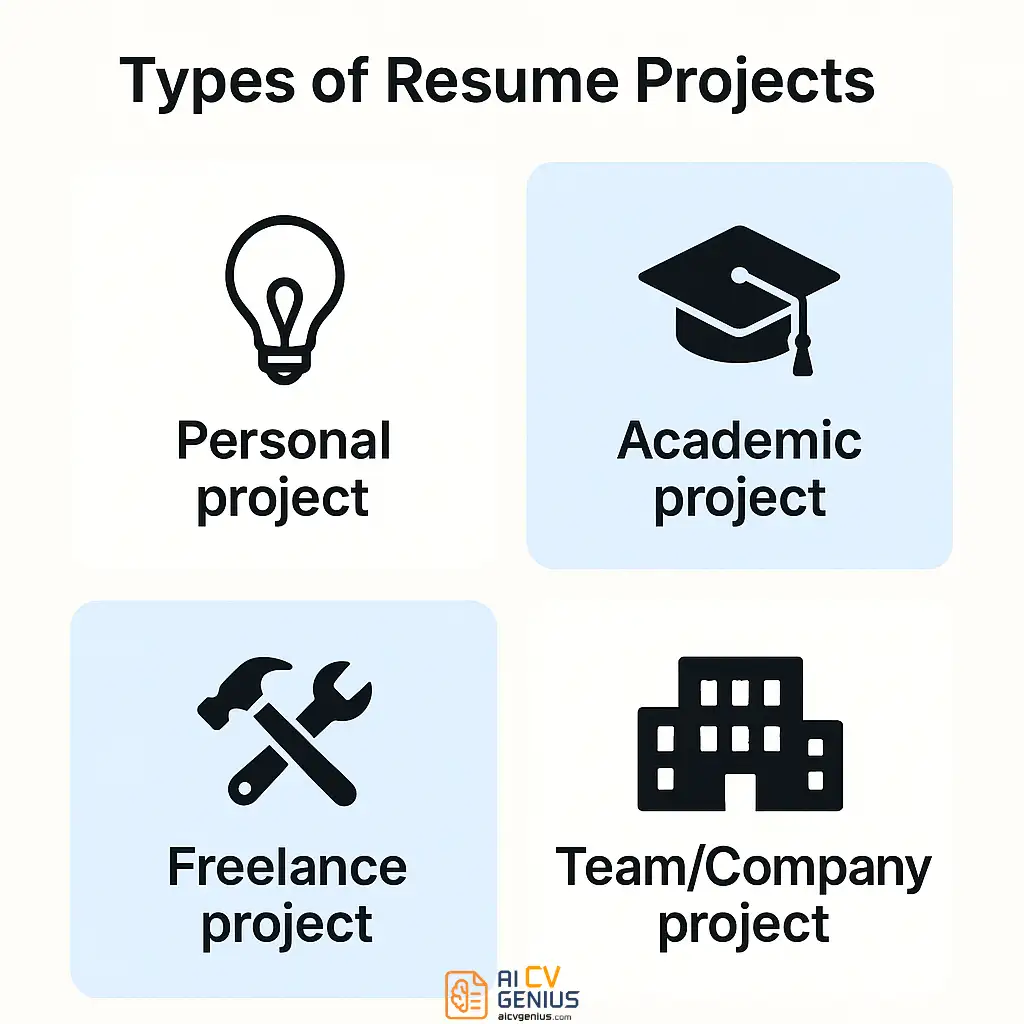
The Recruiter’s Mind: Why a Project Section is Critical
Hiring is an exercise in risk management. A recruiter’s primary fear is making a bad hire. Your resume’s job is to de-risk that decision. A project section is your single best tool for building trust and proving your value across every career stage.
For Students and Recent Graduates: Bridging the “No Experience” Chasm
The Problem: The classic “entry-level” job demands 2-3 years of experience. Your academic history shows theory, not application.
The Solution: Projects are your experience. Academic coursework, capstone projects, and personal endeavors are not “just schoolwork”; they are your professional portfolio. Listing them proves initiative – a quality that cannot be taught. It shows you are passionate enough about your field to build things in your own time. This is where adding academic projects to resume becomes a non-negotiable strategy for standing out.
For Career Changers: De-Risking the Pivot
The Problem: Your ten-year history as an “Accountant” makes your application for “Data Analyst” look like a mistake. The recruiter is skeptical.
The Solution: Your project section is your “translation layer.” It proves your commitment. A project titled “Predictive Sales Model in Python” or “Customer Segmentation Analysis in SQL” instantly reframes your entire narrative. It demonstrates you have already done the work, mitigating the risk and proving your new skills are practical, not just theoretical.
For Freelancers and Consultants: Your Portfolio of Results
The Problem: Your employment history is a series of short-term contracts, which can look “jumpy” to a traditional employer.
The Solution: Your projects are your product. A detailed project section acts as a mini-portfolio. It focuses the narrative on the outcomes you delivered for clients, not the duration of the engagement. It builds trust and demonstrates your value proposition upfront, positioning you as a high-impact “problem solver” rather than a temporary employee.
For Established Professionals: Demonstrating Ownership and Innovation
The Problem: Your day-to-day responsibilities at a large corporation are vast, but they don’t capture specific “wins.”
The Solution: Projects highlight work that transcends your job description. Did you lead a cross-functional team to launch a new feature? Did you develop an internal tool that improved efficiency? Did you spearhead a volunteer initiative? These demonstrate leadership, proactivity, and a commitment to innovation – key differentiators for senior and principal-level roles.
Strategic Placement: Where to Put the Projects Section on Your Resume
The location of your projects section is a strategic choice that signals its importance. The question of where to put projects section on resume depends entirely on its relevance compared to your other experiences.
Scenario 1: The Dedicated “Key Projects” Section
This is the most popular and often most effective approach. It creates a distinct, easily scannable section that immediately draws the recruiter’s eye. It’s a clear signal to both the human reader and the ATS that your project work is a core part of your value.
- ✅Pros: High visibility. Clearly separates project work from formal employment. Ideal for skills-focused roles (tech, design, marketing).
- ❌Cons: Takes up significant resume real estate, so projects listed must be highly relevant.
- Best For:
- Students/Graduates: Place it directly after “Education” to build credibility.
- Career Changers: Place it before “Professional Experience” to reframe your narrative immediately.
- Tech Professionals: Place it after “Skills” and before “Experience” to provide immediate proof.
Scenario 2: Integrated Within “Professional Experience”
If a project was a core component of a specific job, you can embed it as a sub-section within that job’s description. This anchors your project to a real-world business context and shows your impact within a formal role.
- ✅Pros: Shows direct business impact. Provides context for the project. Keeps the resume in a traditional chronological format.
- ❌Cons: Projects can get lost within other bullet points. Not suitable for personal or academic projects.
- Best For: Project managers, consultants, or senior employees whose primary role involved executing high-impact, company-specific projects.
- Example Format:
- Senior Analyst | XYZ Corp | 2020 – Present
- [Bullet point on day-to-day responsibility]
- [Bullet point on day-to-day responsibility]
- Key Project: Global Market Analysis
- Spearheaded a 3-month analysis of new market viability, resulting in a data-driven recommendation to expand into APAC.
- Senior Analyst | XYZ Corp | 2020 – Present
Scenario 3: A Hybrid “Technical Skills & Projects” Section
This modern approach is highly effective for tech-centric roles. It combines your list of skills with direct proof, which is perfect for showcasing technical projects on resume. You essentially categorize your projects by the technologies used.
- ✅Pros: Creates a powerful, evidence-based skills section. Allows you to demonstrate proficiency immediately.
- ❌Cons: Can become cluttered if not formatted carefully. Less effective for non-technical roles.
- Best For: Developers, Data Scientists, and IT professionals.
- Example Format:
- Technical Skills
- Python (Pandas, Scikit-learn): Developed a customer churn prediction model with 88% accuracy.
- React (Node.js, Express): Built a full-stack e-commerce platform with Stripe integration.
- SQL (PostgreSQL): Optimized database queries, improving report generation speed by 40%.
- Technical Skills
Which Placement is Right for You? A Simple Comparison
| Placement Method | Best For | Key Advantage |
|---|---|---|
| Dedicated Section | Students, Career Changers, Tech Roles | Maximum visibility and focus on skills. |
| Integrated in Experience | Project Managers, Senior Roles | Connects projects directly to business impact. |
| Hybrid Skills & Projects | Developers, Data Scientists | Provides immediate, undeniable proof of technical ability. |
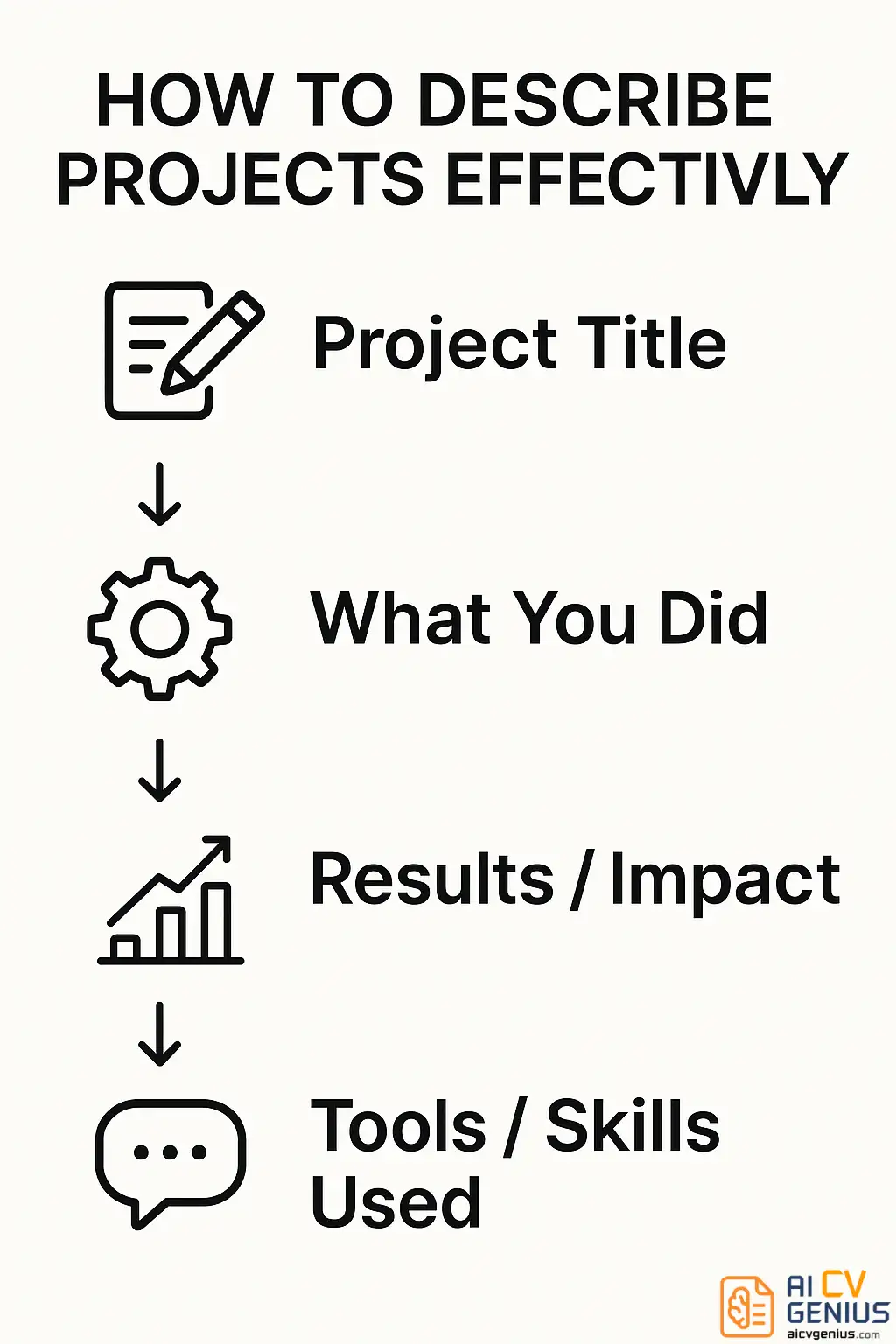
The Anatomy of a Perfect Project Entry: The 5-Part Formula
A project’s impact is determined entirely by how you describe it. A weak description makes a great project look trivial. A strong description makes a simple project look strategic. Here is what to include in a project description on a resume.
Part 1: The Compelling Title (and The All-Important Link)
Your title should be a clear, concise summary. It needs to be more descriptive than a generic label. Crucially, if you can, include a hyperlink to a GitHub repo, live website, or detailed portfolio case study. This is the ultimate proof.
- ❌Bad: My Website
- ✅Good: E-commerce Website
- Best: Full-Stack E-commerce Platform (React & Node.js)
Part 2: Context, Role, and Timeframe
Provide 1-2 lines of context. Was this solo or a team effort? Was it for a class, a client, or yourself? This helps the recruiter gauge the scope and professionalism of your work.
- Personal Project (Solo), Feb 2025 – May 2025
- Senior Capstone Project (Team Lead on 4-person team), Spring 2025
- Freelance Project for XYZ Corp., Q4 2024
Part 3: The Problem & Action (Your 1-2 Sentence Pitch)
In one or two bullet points, explain the project’s purpose (the problem) and your main contribution (the action). Use powerful action verbs to describe what you did. Instead of “was responsible for,” use words like Architected, Engineered, Spearheaded, Optimized, Revamped, Executed.
- “Spearheaded the development of a new inventory system to address frequent stock discrepancies.”
- “Engineered a full-stack web app to solve the problem of manual appointment booking for a local barbershop.”
Part 4: The Technology Stack (ATS Optimization)
This is your keyword optimization section for Applicant Tracking Systems (ATS). List the most relevant tools, programming languages, methodologies, and software you used. Mirror the language in the job description you’re targeting.
- Skills Used: Python (Pandas, Scikit-learn), SQL, Tableau, Docker.
- Skills Used: SEO, Google Analytics, Ahrefs, HubSpot, Content Strategy.
Part 5: The Quantified Result (The Knockout Punch)
This is the single most important component. You must demonstrate the result of your work. The STAR method (Situation, Task, Action, Result) is the perfect framework, and the “Result” is the only part that truly matters on a resume.
- Situation: What was the initial problem or context? (e.g., “Frequent stock discrepancies.”)
- Task: What was your specific goal? (e.g., “Reduce tracking errors.”)
- ️Action: What specific steps did you take? (e.g., “Spearheaded development…”)
- Result: What was the measurable outcome? (e.g., “95% reduction in errors.”)
Before (Weak): “Developed a new inventory management system.”
After (Strong): “Spearheaded the development of a new inventory system (Action) to address frequent stock discrepancies (Situation). The new system resulted in a 95% reduction in inventory errors and a 15% decrease in carrying costs within the first quarter (Result).”
Show, Don’t Just Tell: In-Depth Project Examples
Here are detailed personal projects on resume examples and academic project showcases for various fields. For more inspiration, you can always check our resume templates.
Resume project description examples for software engineer
Automated Log Analysis Tool | [GitHub Link] | Personal Project
- Architected and built a Python script to parse, analyze, and visualize over 1GB of daily server logs to identify critical error patterns previously missed.
- Technologies Used: Python, Regex, Pandas, SQLite, Docker, Matplotlib.
- Outcome: The tool automated a process that took 5+ hours of manual work per week (a 100% reduction) and contributed to a 10% improvement in application uptime via proactive error detection.
Example for a Marketing Specialist
B2B SaaS Content Strategy Execution | [Portfolio Link] | Freelance Client Project
- Developed and executed a comprehensive Q4 content strategy for a B2B SaaS client, focusing on SEO-driven blog posts and a lead-generating whitepaper to address a gap in organic leads.
- Skills Used: SEO, Content Strategy, Ahrefs, Google Analytics, HubSpot, Lead Generation.
- Outcome: Drove a 300% increase in organic search traffic to the blog M/M and generated 85 qualified MQLs from the whitepaper, exceeding the client’s goal by 70%.
Example for a Data Analyst
Customer Churn Prediction Model | [GitHub Link] | Academic Capstone Project (Team Lead)
- As team lead, built and trained a machine learning model to predict customer churn for a subscription service, using a dataset of 10,000 users.
- Technologies Used: Python, Scikit-learn, Pandas, Matplotlib, Jupyter Notebook, SQL.
- Outcome: The final logistic regression model achieved an 88% accuracy rate in predicting churn, providing actionable insights that could potentially reduce churn by 15% by targeting at-risk users.
Example for a UX/UI Designer
Mobile App Redesign (Habit Tracker) | [Behance Portfolio Link] | Personal Project
- Conducted user research (5 interviews, 20 surveys) to identify key pain points in existing habit trackers, revealing a need for simplified onboarding.
- Designed a high-fidelity prototype with a streamlined, 3-step user flow.
- Tools Used: Figma, Adobe XD, Maze (for usability testing), User-Centered Design.
- Outcome: Usability testing with 10 users showed a 40% reduction in time-to-task and a 90% user satisfaction score for the new onboarding flow.
From the Recruiter’s Desk: Insider Tips to Make Your Projects Shine
“I’ve seen it all. The good, the bad, and the projects that are just plain confusing. When I scan a resume, I’m not just looking for a list of tasks; I’m looking for evidence that you can solve problems. Your project section is where you provide that evidence.” – Sophia Lee, Career Consultant
The Relevance Rule: “Does This Project Solve My Company’s Problem?”
Your awesome mobile game is cool, but if you’re applying for a backend enterprise software role, it’s irrelevant. Before you list a project, re-read the job description. I want to see projects that use the technologies, address the challenges, and demonstrate the skills mentioned in that description. Always tailor your list to the specific role. Your resume is not a history of everything you’ve done; it’s a targeted argument for this job.
The Impact Imperative: “Can I See Measurable Results?”
This is the number one differentiator. A project without a quantified result is just a hobby. I don’t just want to know you built a website; I want to know what happened because you built it. Did it increase sales? Attract users? Improve performance? Win an award? Always lead with the impact. No metric is too small. “Increased user sign-ups from 2 to 10” is infinitely better than “Increased user sign-ups.”
The Link-Out Litmus Test: “Are You Confident Enough to Show Me Your Work?”
When I see a link to a GitHub repo, a live website, or a detailed portfolio, it’s a massive sign of confidence. It tells me you’re proud of your work and have nothing to hide. It’s an invitation to see your thought process. Conversely, a description of a groundbreaking project with no link makes me skeptical. Always provide a link if possible. It’s the ultimate form of proof.
Common Mistakes to Avoid (And How to Fix Them)
Even the best projects can be undermined by poor presentation. Here are common mistakes to avoid:
Mistake 1: Being Too Vague or Generic
Descriptions like “Worked on a team to build an app” tell the recruiter nothing. What was your role? What did the app do? What was the result?
Fix: Be specific. “As the front-end lead on a team of four, I developed the user interface for a mobile app that tracked personal fitness goals, using React Native.”
Mistake 2: Forgetting to Quantify
Saying you “improved efficiency” is not as powerful as saying you “improved efficiency by 30%.” Numbers stick in a recruiter’s mind.
✅Fix: Go back and estimate your impact. Even if you don’t have exact numbers, a well-reasoned estimate (“cut processing time by an estimated 50%”) is better than nothing.
Mistake 3: A “One-Size-Fits-All” Approach
Sending the same resume to every job application is a recipe for rejection. Your project section, like the rest of your resume, must be tailored.
✅Fix: Create a “master list” of all your projects. For each application, pick the 2-3 most relevant projects and highlight the skills and outcomes that match the job description.
Mistake 4: Describing Team Projects Vaguely
Using “we” in a project description is a red flag. The recruiter wants to know what you did.
✅Fix: Clearly define your role. “On a 4-person team, I was personally responsible for engineering the backend API…” This shows collaboration and individual ownership.
In-Depth FAQ: Your Toughest Project Questions Answered
Good: “As the backend developer on a 4-person team, I was responsible for building the REST API and database schema…”
Bad: “We built a full-stack application…”
This shows you are a team player who also has individual accountability.
- Marketer: Create a 5-page social media strategy for a local nonprofit.
- Analyst: Download a free dataset from Kaggle and create a 3-slide analysis in Tableau.
- Developer: Build a simple weather app or a to-do list with a new framework.
A simple project completed with clear results is better than no project at all.
Final Takeaways: Your Checklist for a Perfect Project Section
Before you hit “Save” on your updated resume, run through this final checklist for every project you’ve listed:
- ✅ Relevance: Is this project highly relevant to the specific job I am applying for?
- ✅ Title: Is the title descriptive and professional?
- ✅ Context: Is my role and contribution clearly defined (e.g., “Team Lead,” “Solo Project”)?
- ✅ Verbs: Have I used strong action verbs (e.g., “Architected,” “Optimized”) instead of passive ones (“Was responsible for”)?
- ✅ Keywords: Have I listed the specific skills and technologies used, mirroring the job description?
- ✅ Result: Is there a clear, quantified result or outcome (e.g., “Saved 20 hours/month,” “Increased sign-ups by 15%”)?
- ✅ Proof: Have I included a hyperlink to a portfolio, GitHub, or live demo?
If you can confidently check every box, you’ve successfully transformed a simple list into a powerful testament to your skills and abilities. For more in-depth guides, explore our Career Resources.