

- Core purpose: Show motivation, research, and growth potential so you stand out when GPAs and coursework look similar.
- Winning structure: Use a clean header and named greeting, then 3 to 4 short paragraphs, Hook, Proof, Fit, Confident close.
- What to include: Tie 1 to 2 projects, classes, or volunteer wins to the role using specific action plus result, add numbers when possible.
- What to avoid: Generic templates, resume rehashes, buzzwords, and empty claims like “Hardworking” without an example.
- Quick checklist: Keep it one page (about 300 to 400 words), match resume formatting, proofread hard, end with enthusiasm and a clear next step.
The First Step Into the Professional World: Why Your Internship Cover Letter Matters
An internship isn’t merely a temporary role or a line item on a future resume – it represents your first deliberate step into the professional arena, a chance to bridge the gap between academic theory and real-world application. A thoughtfully written internship cover letter sample serves as that crucial bridge. Its primary goal isn’t to showcase extensive experience (which you likely don’t have yet), but rather to articulate your engagement, genuine curiosity, and capacity for growth under mentorship. It’s your opening statement, setting the tone for how potential mentors perceive your potential.
Recruiters and hiring managers reviewing internship applications operate with a different lens. They understand that candidates are students, not seasoned professionals. Consequently, they aren’t scanning for years of proven results; they’re searching for indicators of future potential. Key traits they seek include a demonstrable willingness to learn, proactive preparation (evidenced by research into the company and role), and authentic motivation for wanting this specific opportunity, not just any internship. Your cover letter is the primary vehicle for conveying these intrinsic qualities.
Why Every Internship Application Needs a Cover Letter: Beyond the Resume
Internship programs, particularly at desirable companies, often attract hundreds, if not thousands, of applicants. Many of these candidates will present similar academic profiles – comparable GPAs, relevant coursework, and perhaps some extracurricular involvement. In this sea of similarity, what truly distinguishes one applicant from another isn’t solely their academic record, but the narrative they construct around their aspirations. A cover letter provides the essential space to articulate this narrative: to explain why you are genuinely passionate about this specific field or company, and how you intend to maximize the learning opportunity presented by the internship.
Think of your cover letter not as a mere formality or a rehash of your resume’s bullet points, but as a personalized introduction – a direct address to the hiring manager. It serves several critical functions beyond simply stating your interest:
- ✅ Demonstrates Initiative and Professionalism: Taking the time to write a tailored cover letter signals effort, maturity, and respect for the application process itself. It shows you’re serious.
- ✅ Highlights Relevant Learning and Application: It allows you to connect specific coursework, projects, or even volunteer experiences directly to the internship’s requirements, showing you can translate academic knowledge into potential practical contributions.
- ✅ Conveys Enthusiasm for Mentorship and Teamwork: You can explicitly state your eagerness to learn from experienced professionals and contribute positively to the team environment – key attributes sought in interns.
- ✅ Showcases Written Communication Skills: In a professional setting, clear and concise writing is paramount. Your cover letter is your first live demonstration of this essential skill, offering insight beyond the resume’s factual points.
In essence, your cover letter shapes the crucial first impression. In the context of internships – where potential often outweighs past performance – this initial perception can significantly influence whether your application moves forward and can even lay the groundwork for future professional relationships.
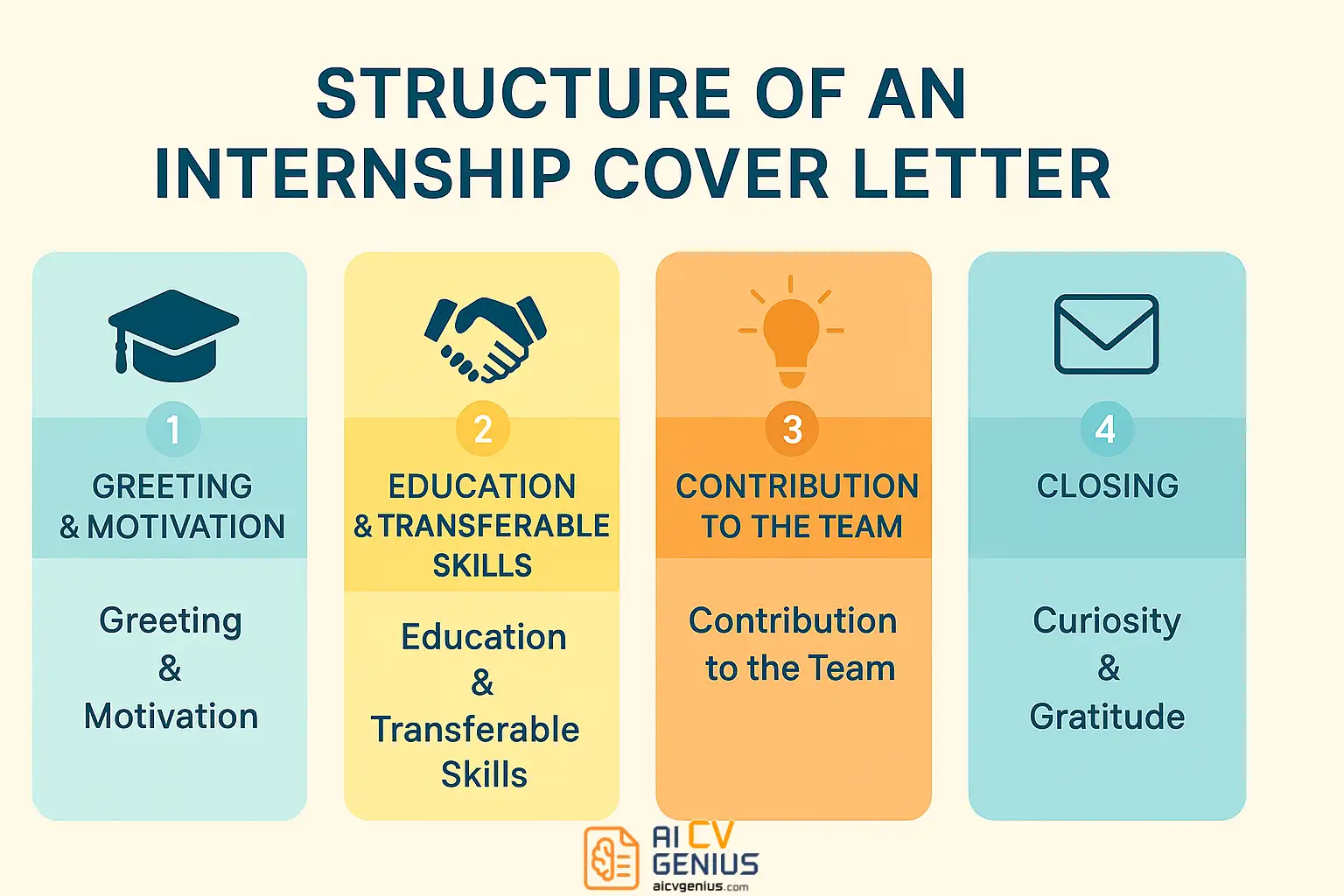
How to Structure Your Internship Cover Letter: A Blueprint for Clarity
A well-structured cover letter guides the reader logically, making your key points easy to follow and remember. Stick to a standard professional format.
1. Header: Your Contact Information
Include your full name, professional email address (e.g., firstname.lastname@email.com), phone number, city and state (optional, full address not needed), and potentially a link to your LinkedIn profile if it’s updated and professional. Add the date below your contact information. Ensure this header visually matches the header on your resume for consistency.
2. Recipient Information and Greeting
Whenever possible, address the letter to a specific person – the hiring manager, internship coordinator, or department head. Research the company website or LinkedIn to find the appropriate name. If a specific contact isn’t available after diligent searching, use a professional title like “Dear Internship Coordinator,” or “Dear Hiring Manager,”. Avoid the outdated and impersonal “To Whom It May Concern.”
3. Opening Paragraph: State Your Purpose and Enthusiasm (“Your Why”)
Start directly. Clearly state the specific internship position you are applying for and where you saw the advertisement (e.g., LinkedIn, university career portal). Immediately express your genuine enthusiasm for the role and the company. Briefly connect the opportunity to your academic focus or burgeoning career aspirations.
Example:
“As a third-year Computer Science student deeply interested in user experience design, I am writing to enthusiastically apply for the UX Design Internship at Innovate Solutions, advertised on the university career portal. I am eager to apply my classroom knowledge of human-computer interaction and my passion for creating intuitive digital experiences in a real-world setting.”
4. Body Paragraph(s): Connect Learning to Action and Demonstrate Potential
This is the core of your letter, where you bridge the gap between your academic background and the internship’s requirements. Since you likely lack extensive professional experience, focus on highlighting relevant coursework, academic projects, volunteer activities, part-time jobs, or extracurricular involvement that demonstrate transferable skills. Use specific examples:
- Instead of saying “Good teamwork skills,” describe leading a group project: “Led a four-person team project analyzing consumer behavior data for a marketing class, where I coordinated research efforts and presented our findings, earning an A grade.”
- Instead of “Strong communication skills,” mention a specific instance: “Developed and presented a social media engagement plan for the university debate club, resulting in a 25% increase in meeting attendance.”
- Highlight relevant technical skills or software proficiency learned in class or through self-study: “Gained proficiency in Python and SQL through coursework, applying these skills to analyze datasets for my statistics final project.”
- Showcase soft skills through action: “Managed logistics and volunteer coordination under tight deadlines for the annual campus charity drive, demonstrating composure and problem-solving skills.”
Focus on 1-2 concise examples that directly relate to the internship description. Action-oriented language proves you’ve actively applied what you’ve learned, showcasing initiative and practical readiness.
5. Company Alignment Paragraph (Optional but Recommended): Show You’ve Done Your Research
Briefly mention something specific about the company that genuinely interests you – their mission, a recent project, their company culture, or a specific technology they use. This demonstrates that you’re not just sending out generic applications and that you envision yourself contributing to their specific environment.
Example:
“I am particularly drawn to [Company Name]’s commitment to sustainable design, as highlighted in your recent [Project Name] initiative. My coursework in environmental engineering aligns with this focus, and I am eager to learn from a team dedicated to innovative, responsible solutions.”
6. Closing Paragraph: Express Gratitude, Curiosity, and Call to Action
Reiterate your enthusiasm for the specific internship and the opportunity to learn. Express appreciation for the reader’s time and consideration. Politely indicate your interest in discussing your application further.
Example:
“Thank you for considering my application. I am very excited about the possibility of learning from experienced professionals at [Company Name] and contributing my skills and enthusiasm to your team. I have attached my resume for your review and welcome the opportunity to discuss my qualifications further.”
7. Professional Closing
Use a standard professional closing like “Sincerely,” or “Respectfully,” followed by your typed full name.
Full Example: Internship Cover Letter Sample (Marketing Focus)
Here’s a complete example demonstrating the structure and tone:
[Your Name]
[Your Phone Number] | [Your Email Address] | [Your LinkedIn Profile URL (Optional)]
[Date]Ms. Sarah Nguyen
Marketing Manager
BrightIdeas Agency
[Agency Address]Dear Ms. Nguyen,
I am writing to express my enthusiastic interest in the Marketing Internship at BrightIdeas Agency, which I discovered through Greenfield University’s career portal. As a third-year Communication major with a minor in Digital Marketing, I have spent the past two years studying the fascinating intersection of storytelling and consumer behavior. I am now eager to apply these academic insights and develop practical skills within a dynamic agency environment like yours.
During my Digital Campaigns course last semester, I led a small team project tasked with developing a comprehensive social media strategy for a local independent café. By analyzing their existing audience data and focusing on creating authentic, engaging content (including short video clips and user polls), we successfully grew their Instagram engagement rate by 30% over one month. This hands-on experience ignited my passion for blending creative content development with data-driven strategy to achieve measurable results – an approach I admire in BrightIdeas Agency’s recent work for [mention a specific client or campaign if known].
Beyond coursework, I serve as the Communications Lead for the campus event planning committee, where I coordinate promotional efforts and manage communication between various student organizations and external vendors. This role requires me to manage tight deadlines, adapt quickly to changing plans, and communicate clearly and professionally under pressure – skills I believe are essential for supporting client projects in a fast-paced agency setting.
I am particularly drawn to BrightIdeas’ reputation for fostering a strong mentorship culture, where interns are actively encouraged to contribute ideas and learn directly from seasoned professionals. I would be thrilled by the opportunity to grow under your team’s guidance while contributing my strong work ethic and fresh perspective to help deliver impactful campaigns. Thank you for considering my application. My resume is attached for your review, and I look forward to the possibility of discussing my qualifications further.
Sincerely,
Maria Lopez
This letter effectively balances humility (acknowledging student status) with confidence (showcasing specific actions and results). It clearly articulates learning goals but frames them within the context of contributing value. It avoids apologizing for lack of experience and instead celebrates the initiative shown during academic and extracurricular activities.
Writing a Letter That Mentors Want to Read: Beyond Qualifications
Potential mentors and internship supervisors aren’t looking for fully formed experts; they are looking for individuals who demonstrate teachability. The most compelling internship cover letters subtly convey three core qualities that signal strong potential for growth and positive team contribution:
- Demonstrate Genuine Curiosity: Show that you’ve done more than just read the job description. Mention specific aspects of the company’s work, mission, or recent projects that genuinely intrigue you. Frame questions thoughtfully if you get an interview. Curiosity signals intellectual engagement and a proactive desire to understand, not just perform tasks.
- Provide Evidence of Reliability: Even without formal job experience, you can demonstrate reliability through examples. Mention consistent participation in a club, successful completion of long-term projects (academic or personal), managing responsibilities in a part-time job (even if unrelated), or adhering to strict deadlines. Reliability is the bedrock of trust in any professional setting.
- Express Authentic Gratitude: Acknowledge explicitly that mentorship and learning opportunities are valuable. Express appreciation for the chance to learn from experienced professionals. This shows humility and respect, positioning you as someone who values guidance rather than taking it for granted. Avoid entitlement; frame the internship as a privilege.
Recruiters and managers are adept at reading between the lines. When a student writes with maturity, demonstrating an understanding of professional norms and expressing these core qualities authentically, it signals strong emotional intelligence – a rare and highly valued attribute that often outweighs purely technical skills at the internship level.
Quick Tips for Students Writing Their First Cover Letter
Writing your first professional cover letter can feel daunting. Keep these practical tips in mind:
- ✅ Focus on Effort and Enthusiasm, Not Lack of Experience: Frame your narrative around what you have done (projects, coursework, volunteering) and your eagerness to learn, rather than apologizing for what you haven’t.
- ✅ Write Conversationally, Not Academically: Avoid overly formal, stiff language or complex jargon from your field of study. Aim for a clear, professional, yet natural tone – as if you were speaking confidently to the hiring manager.
- ✅ Show Respect for Their Time – Keep it Concise: Stick to under one page (around 300-400 words). Get straight to the point in each paragraph. Recruiters appreciate brevity.
- ✅ Personalize Every Single Letter: Tailor the introduction, the examples you use, and the company alignment section for each specific application. Generic letters rarely impress. Mention the company name and the specific internship title.
- ✅ Read Your Letter Out Loud Before Sending: This simple trick helps catch awkward phrasing, grammatical errors, and ensures the tone sounds natural and confident, not robotic or memorized.
- ✅ Proofread Meticulously: Typos or grammatical errors undermine your claim of being detail-oriented. Use spell-check, grammar tools (like Grammarly), and consider asking a friend, professor, or career services advisor to review it.
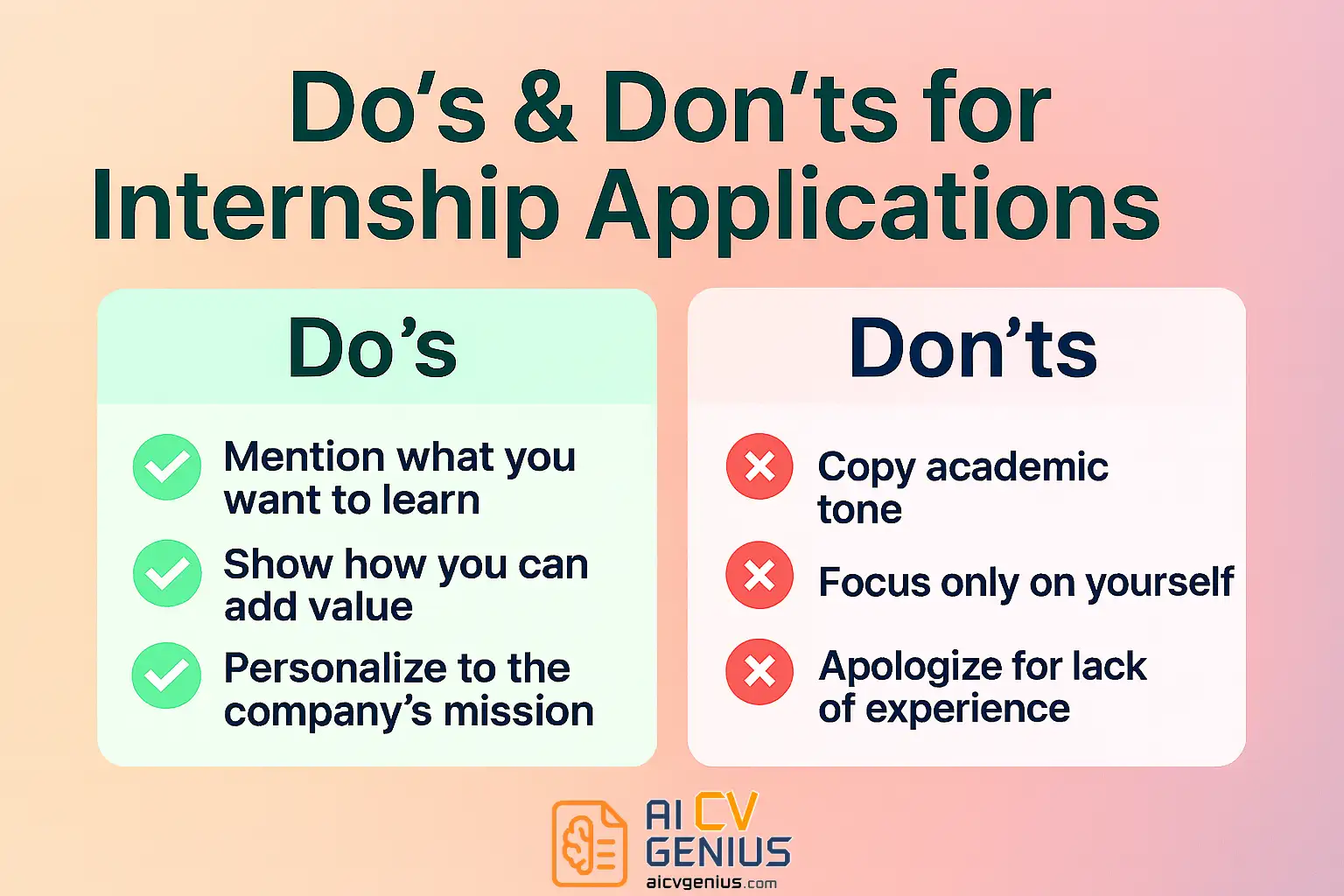
Common Mistakes to Avoid in Internship Cover Letters
Steer clear of these frequent pitfalls:
- ❌ Simply Repeating Your Resume: The cover letter should add context, personality, and specific connections to the role – not just list the same facts in paragraph form.
- ❌ Using Overly Academic or Theoretical Language: Writing like you’re submitting a college essay can sound detached or impractical. Focus on action and potential application.
- ❌ Focusing Only on What You Want to Learn: While expressing eagerness to learn is good, balance it by emphasizing the skills (even basic ones) and enthusiasm you bring to them. Frame it as a mutually beneficial relationship.
- ❌ Sending a Generic, Un-Personalized Letter: Failing to mention the specific company name or tailor content makes your application seem lazy and uninterested.
- ❌ Neglecting to Proofread: Errors in names, titles, company details, spelling, or grammar create an immediate negative impression about your attention to detail.
- ❌ Sounding Entitled or Overconfident: While confidence is good, arrogance is not. Maintain a respectful, humble tone appropriate for an intern seeking guidance.
Pros & Cons of Writing an Internship Cover Letter
While highly recommended, it’s useful to understand the trade-offs:
| Pros ✅ | Cons ❌ |
|---|---|
| Demonstrates strong initiative and maturity early in your career journey. | Requires significant time and effort to research and tailor each letter effectively. |
| Provides a platform to showcase communication skills and self-awareness beyond resume facts. | Easy to sound generic or make mistakes if rushed, potentially harming your application. |
| Helps build a personal connection and rapport with potential mentors or hiring managers. | Difficult to strike the right balance between humility (as a learner) and confidence (as a capable contributor). |
| Creates a human dimension to your application, differentiating you beyond grades or coursework. | Minor errors (typos, incorrect names) can disproportionately hurt credibility at this career stage. |
Despite the time investment, the potential benefits of a well-crafted cover letter – especially in a competitive internship market – far outweigh the cons.
How to End an Internship Cover Letter Powerfully
Your closing lines should leave a final positive impression, reinforcing your readiness to learn and your eagerness to contribute. Aim for a tone that is proactive, respectful, and genuinely enthusiastic. Here are a few examples that strike the right balance:
- “I am excited by the prospect of developing my skills under your team’s mentorship while contributing my proactive approach and fresh ideas to your ongoing projects. Thank you for your time and consideration.”
- “I am eager to bring my dedication and enthusiasm for [Field/Industry] to your team and learn from industry leaders at [Company Name]. I appreciate you considering my application and welcome the chance to discuss this opportunity further.”
- “This internship represents not just a valuable learning opportunity for me, but also a chance to actively support your team’s goals. I am ready to contribute my best effort from day one. Thank you for your consideration.”
End with a standard professional closing like “Sincerely,” followed by your typed name.
FAQs: Internship Cover Letter Queries
Final Thoughts: Potential Over Perfection
Writing an internship cover letter sample isn’t about pretending to be a seasoned expert – it’s about authentically showcasing your readiness to learn from one. The best interns don’t arrive knowing everything; they arrive with enthusiasm, humility, and a powerful curiosity that they bring into every task, regardless of how small it might seem. When you communicate your potential with honesty, clarity, and genuine interest in the opportunity, recruiters and mentors see more than just a student – they see a future professional in the making.
Pair your compelling cover letter with a clean, polished resume. You can find suitable layouts using our Resume Templates Finder, or review more real-world examples in our Cover Letters section. For continued guidance on navigating the early stages of your career with confidence, including networking and interview preparation, our Career Resources hub offers valuable insights.
Remember: internships are designed as training grounds, not final exams. Embrace the learning process, contribute your best effort consistently, and build relationships. The mentors you connect with today through a thoughtful application might very well become your most valuable references and advocates tomorrow.