
- Apple mindset: Secretive and perfection driven, they care about craft, quality, and user experience more than shipping fast.
- Process length: Expect a slow multi stage loop, Recruiter screen, Phone or case screen, 1 to 2 team rounds, Sometimes an exec round.
- Behavioral themes: Creativity, Detail obsession, And discretion, your stories should show “fewer but better” standards and trustworthiness.
- Questions that matter: “Why Apple” must be specific to your work style, plus failure and disagreement answers should show high standards and learning.
- Do not blow it: Never speculate on unreleased products, do not trash Apple, do not overshare confidential info, and note retail interviews are customer empathy focused.
Apple Interviews Are Secretive and Obsessed With Perfection
Apple’s interview process reflects its product philosophy: secretive, meticulous, and focused on excellence in every detail.
Candidates are often asked to sign NDAs before interviews. Questions probe not just what you know, but how you think about quality, design, and user experience. The bar for “good enough” is exceptionally high.
Apple doesn’t want people who ship quickly and iterate – they want people who get it right the first time. Every detail matters. This cultural difference from other tech companies means preparing for Apple requires a different mindset.
Here’s how to navigate Apple’s interview process and demonstrate the perfectionism and discretion they value.
The Process (Often Lengthy)
Apple’s hiring process is notoriously long and rigorous, sometimes taking 2-3 months from application to offer.
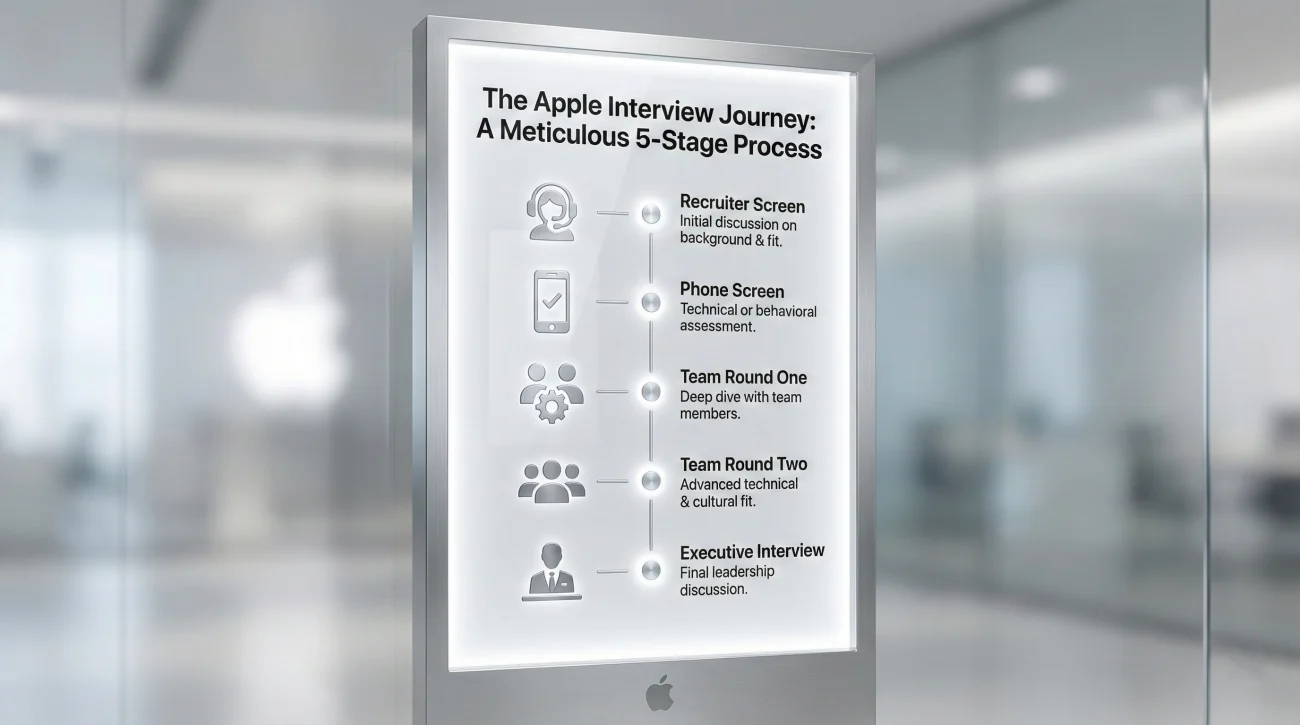
Typical Interview Stages
Stage 1: Recruiter Screen
- 30-45 minutes discussing background and fit
- Why Apple specifically (generic tech interest isn’t enough)
- May require NDA signing before proceeding
Stage 2: Phone Screen
- Technical assessment or case study depending on role
- 1-2 hours with team member
- Tests core competencies and technical depth
Stage 3: Team Interview (First Round)
- 4-6 interviews with potential teammates
- Mix of technical and behavioral questions
- Each interviewer assesses different competencies
- Full day on-site or virtual equivalent
Stage 4: Team Interview (Second Round)
- Sometimes Apple brings candidates back for additional rounds
- Meets with adjacent teams or stakeholders
- Deeper technical dives or cultural assessment
Stage 5: Executive Interview
- Final round with senior leadership
- Strategic thinking and long-term fit
- Only happens if previous rounds went very well
Why So Long?
Apple hires slowly and deliberately. They’d rather leave a position open than hire the wrong person. Perfectionism extends to hiring.
For comprehensive interview preparation strategies, see our complete interview guide.
Behavioral Questions: 3 Core Themes

1. Creativity and Innovation
Apple values original thinking and elegant solutions to complex problems.
Sample questions:
“Tell me about your most creative solution to a difficult problem.”
“Describe a time you challenged conventional thinking.”
“How do you approach problems that don’t have obvious solutions?”
How to answer: Focus on innovative thinking, not just hard work. Show how you found non-obvious solutions. Emphasize elegance and simplicity in your approach.
Apple doesn’t want 10 mediocre features – they want 3 perfect ones. Reflect this in your stories.
2. Attention to Detail and Perfection
Apple obsesses over details others ignore. They want people with similar standards.
Sample questions:
“Tell me about a time you caught a mistake others missed.”
“Describe a project where attention to detail made the difference.”
“How do you ensure quality in your work?”
How to answer: Share examples of going beyond minimum requirements, catching subtle issues, or insisting on higher standards when others were satisfied.
Example structure:
“Before launching our mobile app, I noticed the loading animation felt slightly off – the timing was 50ms too slow. Most people wouldn’t notice, but it bothered me. I spent an extra day refining the animation curve until it felt perfectly responsive. User reviews specifically mentioned how polished the app felt.”
This shows Apple-level attention to detail.
3. Teamwork and Discretion
Apple values collaboration but also requires absolute discretion about confidential work.
Sample questions:
“Tell me about a time you worked on a confidential project.”
“Describe how you collaborate while maintaining necessary boundaries.”
“How do you handle working with information you can’t share?”
How to answer: Demonstrate you can be trusted with sensitive information. Show collaborative skills without oversharing details about past projects.
Never:
- Share confidential details from previous employers
- Try to impress by hinting at secret knowledge
- Speculate about unreleased Apple products
Apple tests discretion by seeing if you violate previous employers’ confidentiality. Don’t.
For more behavioral-style practice prompts (so your stories feel tighter under pressure), see these behavioral interview questions.
Common Apple Interview Questions
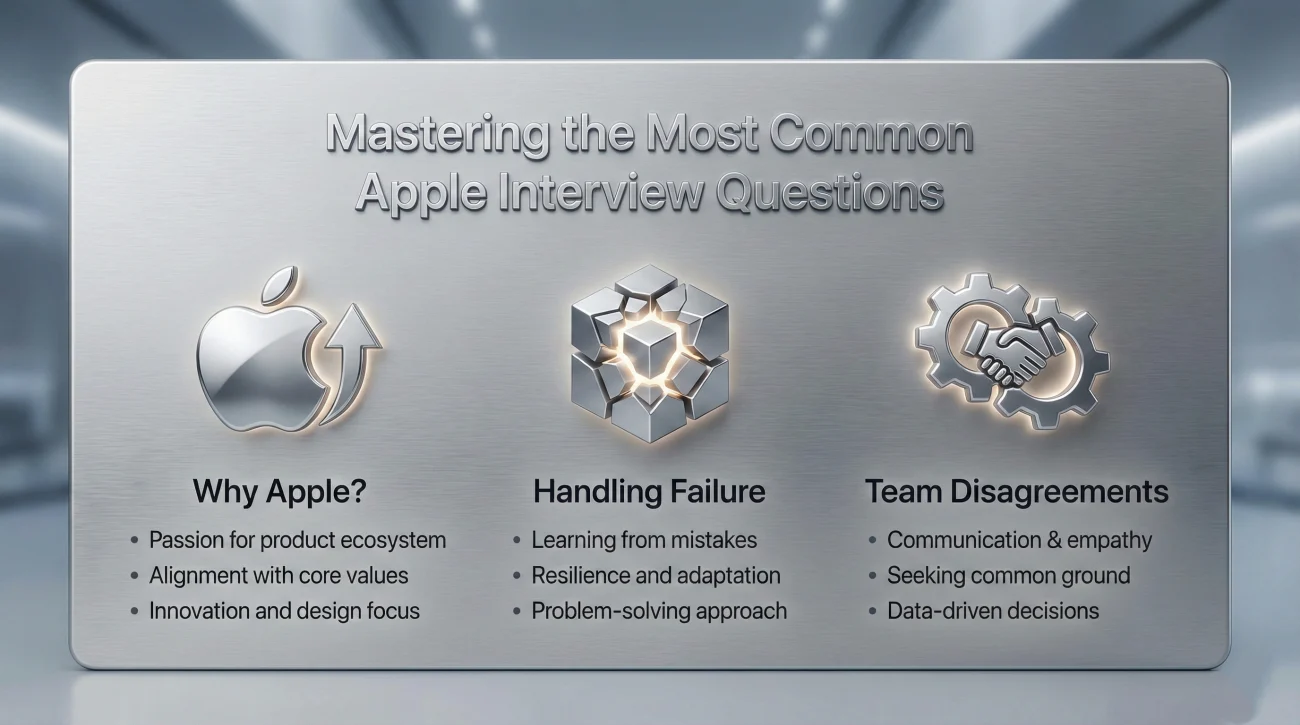
Why Apple?
This question is mandatory and deeply evaluated. Generic answers fail.
Bad answer:
“Apple is a great company with innovative products and good benefits.”
Good answer:
“I’m drawn to Apple’s design philosophy – the idea that technology should be intuitive and beautiful, not just functional. When I redesigned our company’s internal tool, I applied similar principles: removing unnecessary complexity and focusing on the essential experience. The adoption rate jumped 60% because people actually enjoyed using it. I want to work somewhere that values this level of craft.”
Connect Apple’s values to your actual work and philosophy.
Tell Me About a Time You Failed
Apple wants to see how you handle setbacks and what standards you hold yourself to.
“I launched a feature that technically worked but didn’t meet my quality standards. Users found it confusing despite passing usability testing. I took ownership, analyzed the confusion points, and pushed for a redesign that launched 6 weeks later. The second version achieved the metrics we wanted. I learned not to ship something just because it technically works – it needs to be genuinely great.”
Show high standards and learning from mistakes.
Describe a Disagreement With Your Team
“My team wanted to add 5 features to our MVP. I argued we should perfect 2 features instead. I presented data showing users prefer depth over breadth in this category. We compromised on 3 features but spent extra time polishing each one. The focused approach led to stronger reviews than our previous releases.”
This shows Apple’s “fewer things, better” philosophy.
Technical Questions (Role-Dependent)
For engineers, expect:
- Algorithm and data structure problems
- System design discussions
- Code optimization challenges
- Platform-specific knowledge (iOS, macOS if relevant)
For designers:
- Portfolio deep dives
- Design thinking processes
- User research methodologies
- Critique of Apple products (constructive, not complaining)
For product roles:
- Product sense questions
- Prioritization frameworks
- User experience philosophy
- Understanding of Apple’s ecosystem
For more behavioral interview strategies, explore our interview preparation guide.
The Apple Retail Interview (Completely Different)
Retail positions follow a different process focused entirely on customer service and cultural fit.
Retail Interview Process
- Group interview with other candidates
- One-on-one behavioral interview
- Hiring manager interview
What Retail Interviews Assess
- Customer empathy: Genuine desire to help people
- Product passion: Real enthusiasm for Apple products
- Communication skills: Explaining technical concepts simply
- Energy and positivity: Maintaining enthusiasm throughout busy days
- Problem-solving: Handling difficult customer situations
Retail-Specific Questions
“Describe a time you turned a frustrated customer into a happy one.”
“How would you explain iCloud to someone who’s never used it?”
“Tell me about your favorite Apple product and why.”
“How do you stay energized when dealing with repetitive questions?”
Retail Interview Tips
- Actually use and love Apple products (enthusiasm must be genuine)
- Focus on helping people, not just selling
- Demonstrate patience and empathy
- Show you can handle stress gracefully
- Be yourself – Apple retail values personality and authenticity
Critical Mistakes to Avoid
Don’t Speculate About Unreleased Products
Never:
- Ask about products not yet announced
- Try to impress by guessing what Apple is working on
- Share rumors you’ve heard
- Fish for information about upcoming releases
This shows poor judgment about confidentiality.
Don’t Criticize Apple Products Harshly
Constructive feedback is fine:
“I think Siri could be more contextually aware. There’s an opportunity to improve natural language understanding.”
But don’t say:
“Apple products are overpriced and behind competitors.”
Don’t Focus Only on Output
Apple cares deeply about process and craft, not just results.
Bad framing:
“I shipped 20 features last quarter.”
Better framing:
“I spent 3 months perfecting one feature, iterating on the interaction design until it felt completely intuitive. User testing showed 95% task success with zero training.”
Don’t Share Confidential Information
If you worked at competitors or other companies, don’t share:
- Proprietary technology details
- Unreleased product plans
- Internal metrics or data
- Confidential strategies
Apple tests your discretion by seeing if you’ll violate others’ trust.
FAQ
Focus on Your Craft, Not Product Speculation
Apple’s interview process reflects its obsession with excellence, secrecy, and attention to detail. The lengthy process – often 6-12 weeks with multiple rounds – ensures they find people who share these values.
Demonstrate three core attributes: creativity through innovative problem-solving and elegant solutions, perfectionism through attention to details others miss, and discretion through respect for confidentiality and appropriate boundaries.
Answer “Why Apple?” with genuine connection to their design philosophy and craft, not generic praise. Show high standards in your work examples – Apple wants people who won’t ship something just because it works, but insist it’s genuinely great.
For retail positions, focus entirely on customer service excellence, product passion, and genuine desire to help people. The assessment is completely different from corporate roles.
Avoid critical mistakes: never speculate about unreleased products, don’t criticize Apple harshly, focus on craft not just output, and never share confidential information from previous employers.
Remember: Apple isn’t looking for people who ship fast and iterate. They want people who get it right the first time through meticulous attention to detail and unwavering quality standards.
For additional Apple interview resources, check out our comprehensive career guide.