
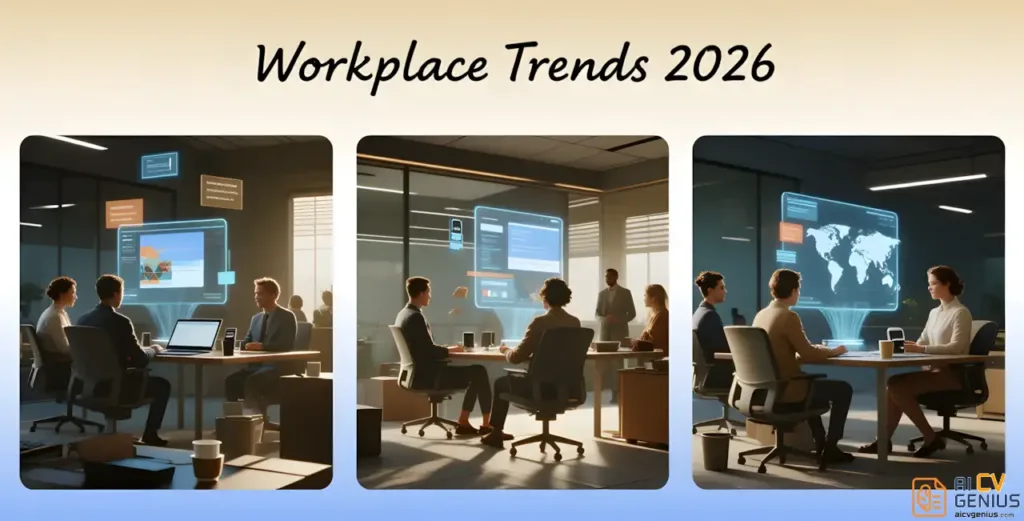
- Big shift: Work in 2026 is less about location and more about adaptability, communication, and problem solving.
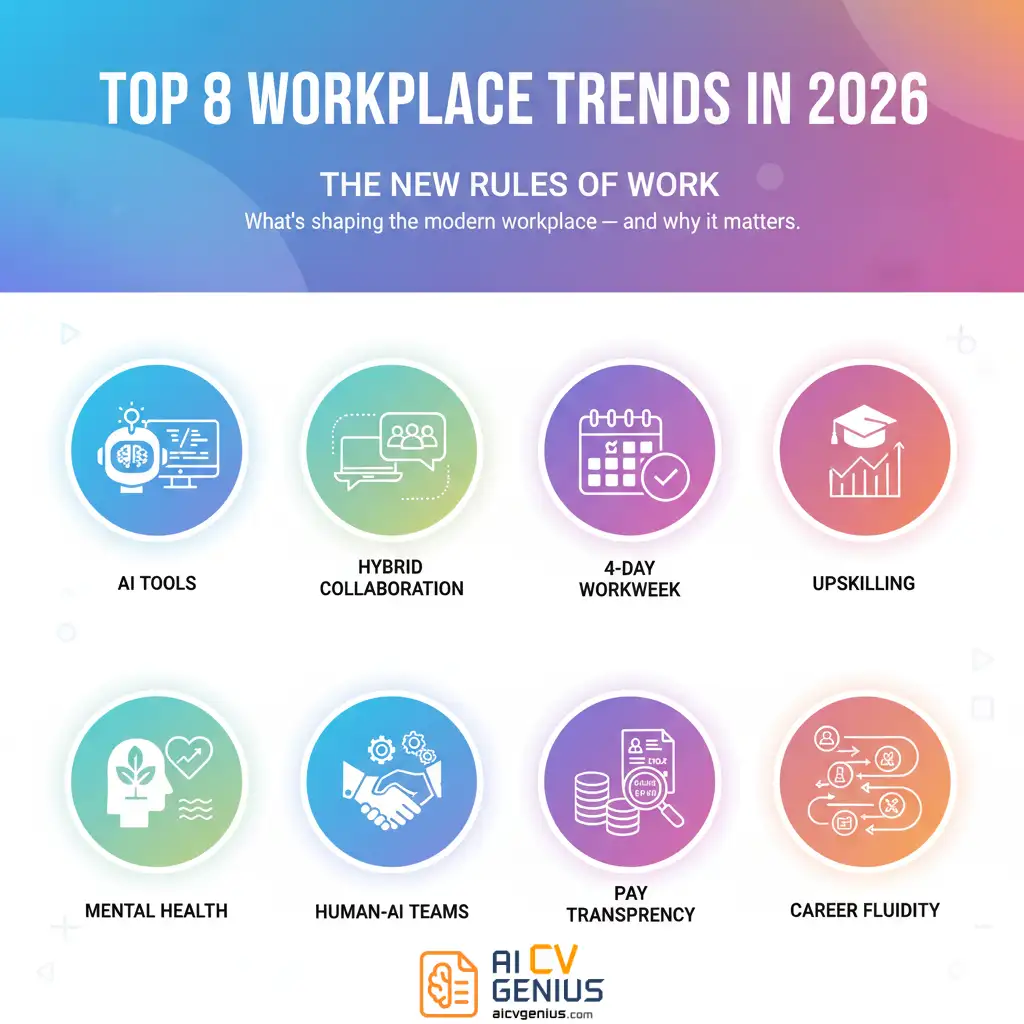
- 8 workplace trends: AI as a helper, mature hybrid models, 4 day workweek pilots, lifelong upskilling, human AI collaboration, career fluidity, mental health as a KPI, and pay transparency with skills based hiring.
- Culture change: Asynchronous work and clear writing become core workplace language, meetings get tighter, decisions get more documented.
- What stays timeless: Communication, adaptability, problem solving, empathy, and collaboration remain the highest value skills.
- How to stay ahead: Learn weekly, build a visible personal brand, measure results not hours, and design a sustainable rhythm that keeps you consistent.
The 2026 Workplace Revolution
The Quiet Revolution of Work
Work in 2026 doesn’t look like the dramatic “future of work” we once imagined. There are no flying desks or robot bosses. The transformation is quieter – invisible in daily habits, meeting culture, and the way people blend their personal and professional lives.
The biggest shift? Work has become less about where you are and more about *how you adapt.* Companies now hire for flexibility, communication, and problem-solving as much as technical expertise. Soft skills have become hard currency.
“The future of work isn’t built by technology – it’s built by the people who learn how to use it gracefully.”
The 8 Trends Redefining the 2026 Workplace
We analyzed reports from LinkedIn, Deloitte, and Gartner to identify eight trends shaping modern careers. Together, they tell a story of balance, innovation, and rediscovering what “meaningful work” actually means.
Trend 1: AI as a Colleague, Not a Competitor
AI is no longer the headline – it’s the helper. Professionals now work *with* AI to draft, analyze, and decide faster. The best employees aren’t threatened by automation; they’re empowered by it. Knowing how to use AI tools efficiently is as important as knowing Excel was 15 years ago.
Employees fluent in AI-assisted workflows – prompt writing, data interpretation, content generation – stand out in every field. For job seekers, that means adapting your résumé to show comfort with digital tools and automation systems. If you’re updating your résumé, check out our Computer Skills Resume Guide for real examples.
Trend 2: The Hybrid Workplace Matures
The “remote or not” debate is over. 2026 workplaces are hybrid by design – intentional flexibility, not chaos. Offices now serve as collaboration hubs, not daily attendance points. Employees might work remotely four days, then gather for focused sprints.
This shift has changed what managers look for: self-management, written communication, and asynchronous collaboration. Those who can lead without constant supervision thrive fastest.
Trend 3: The 4-Day Workweek Goes Mainstream
What started as an experiment in Iceland and New Zealand is now a global pilot program in multiple industries. Results? Productivity up, burnout down, retention stronger than ever.
In 2026, the 4-day model is becoming a negotiation point – not a radical idea. Smart companies are learning that efficiency matters more than face time.
Trend 4: Upskilling Becomes a Lifelong Habit
The pace of change makes static skillsets risky. Continuous learning has become an expectation, not a bonus. Workers spend 2–4 hours weekly learning new tools or frameworks. Microlearning, online certifications, and company-funded AI training programs are the new norm.
Employers reward curiosity. Résumés that show steady skill growth – like adding new certificates or mentioning “self-learning projects” – signal resilience.
Trend 5: Human-AI Teams Redefine Collaboration
Every professional now works in a blended environment where humans bring judgment, empathy, and creativity – while AI handles repetition. This synergy changes job descriptions across every department, from HR analytics to marketing automation.
To thrive, professionals need hybrid intelligence: knowing when to trust machines and when to lead with intuition.
Trend 6: The Rise of Career Fluidity
Careers are no longer ladders; they’re lattices. People move sideways to learn, explore, and rebrand themselves. A graphic designer may become a UX researcher. A journalist might evolve into a content strategist. Transferable skills have become the real currency of growth.
If you’re considering a change, our Transferable Skills Guide shows how to describe your evolution without sounding like you’re starting over.
Trend 7: Mental Health Is Finally Measured
Wellbeing has turned from HR slogan into KPI. Companies track burnout indicators, run “energy audits,” and invest in quiet weeks instead of constant productivity challenges. A healthy culture is now viewed as a performance metric – not a perk.
“The smartest companies realized: a calm mind solves problems faster than a burnt-out one.”
Trend 8: Pay Transparency and Skills-Based Hiring
Salary ranges are now public in 60% of job listings, and hiring is shifting from degrees to demonstrable skills. Portfolios, project examples, and certifications often outweigh traditional credentials. Meritocracy is being redefined in real time.
The New Culture: Tech, Skills, and Values
How Technology Quietly Shapes Culture
AI tools aren’t just changing workflows – they’re changing tone. Meetings are shorter, written documentation more thoughtful, and decisions more data-driven. Employees who write clearly and use AI responsibly stand out as future leaders.
Meanwhile, asynchronous collaboration – through platforms like Notion, ClickUp, or Slack – has become a language of its own. The best professionals now communicate with structure: clean updates, tagged action items, readable summaries. Writing is the new management skill.
The Soft Skills That Remain Timeless
Despite all the automation, the top soft skills for 2026 are deeply human:
- ✅ Communication – clarity across time zones.
- ✅ Adaptability – staying grounded in uncertainty.
- ✅ Problem Solving – turning chaos into structure.
- ✅ Empathy – leading with understanding, not ego.
- ✅ Collaboration – building trust without proximity.
These aren’t trends – they’re constants. The tools will change; the core remains the same.
The New Workplace Values
| Old Workplace | New Workplace (2026) |
|---|---|
| Presence = Productivity | Results = Productivity |
| Rigid Roles | Flexible Skill Portfolios |
| Manager-led Communication | Peer-to-peer Collaboration |
| Degree Requirements | Skill Demonstrations |
| Work-Life Balance | Work-Life Integration |
The difference might seem small, but it changes everything – how companies hire, how people lead, and how careers evolve.
What Employees Expect Now
Today’s professionals aren’t just chasing salaries. They’re chasing meaning, flexibility, and fairness. A clear mission, inclusive culture, and flexible schedule now rank higher than money for younger generations. And companies that adapt are winning the talent war.
Surveys show that 72% of employees prefer hybrid work with autonomy over a pay raise. Freedom has become the new currency of motivation.
Conclusion and FAQ
Final Thoughts
Workplace trends in 2026 aren’t about disruption – they’re about evolution. The best professionals adapt quietly, build cross-functional strength, and stay curious about what comes next. If you can balance technology with empathy, and ambition with rest – you’re already ahead of the curve.
The future of work doesn’t belong to those who know the most – it belongs to those who keep learning gracefully.